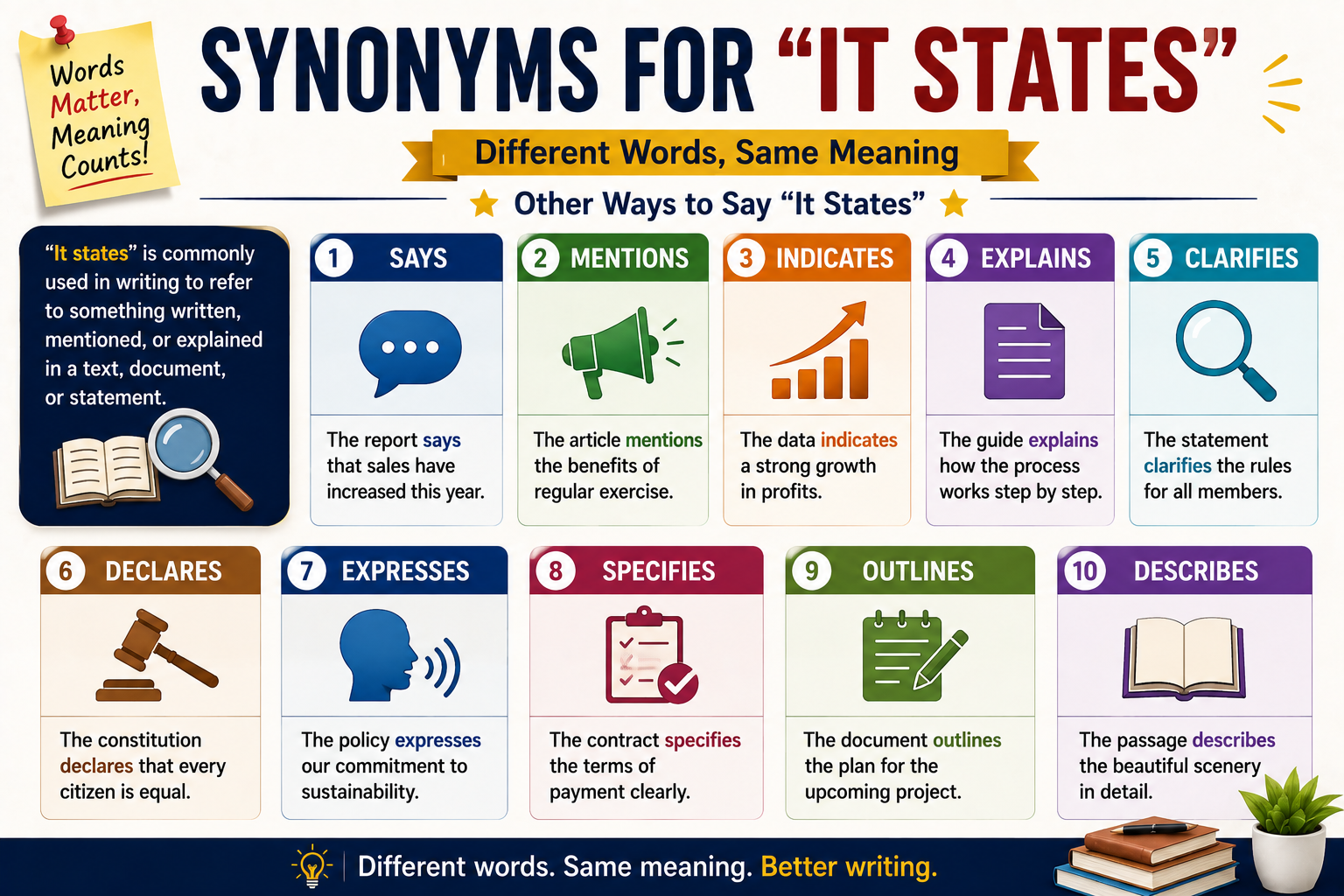
“It states” means that a source, document, person, or text says or clearly expresses information. Depending on context, alternatives include it says, it indicates, it notes, it reports, it explains, and it specifies.
Imagine you are writing a report and use the phrase “it states” five times in one page. The grammar may be correct, but the writing can start to sound flat and repetitive. I have often seen this problem in student essays, research papers, reports, and professional writing.
The phrase “it states” is common because it gives a simple way to introduce information from a source. However, English offers many other choices. The best alternative depends on what the source is doing. A report may indicate a fact, a study may reveal a result, and a document may specify a rule.
Learning these alternatives can make your writing clearer and more natural. This guide explains the meaning, grammar, history, pronunciation, and use of “it states.” You will also find 28 useful alternatives with simple examples.
Meaning of it states
Definition
It states (Verb Phrase):
“It states” means that a person, document, text, report, or other source says or clearly presents information.
Here, it is the subject and states is the third-person singular form of the verb state.
Examples
- The report states that the project was successful.
- The website states that tickets are non-refundable.
Connotative Meaning
Connotation means the feeling or idea that a word suggests beyond its basic meaning.
- Positive tone: It can sound clear, formal, and authoritative.
- Negative tone: Repeated use can make writing sound stiff or repetitive.
- Neutral tone: It simply introduces information from a source.
Etymology
The phrase “it states” comes from the verb state, which has a long history in English.
- Old English (450–1100): The modern verb state did not develop directly from a common Old English verb. Its history is linked to the Latin status, meaning condition, position, or state.
- Middle English (1100–1500): State entered English through Old French and Latin. It first referred to a condition, position, or rank.
- Modern English (1500–Present): The verb state developed the meaning to express something clearly in words. Today, it states is common in formal writing, reports, laws, studies, and academic texts.
Pronunciation (IPA)
- IPA: /ɪt steɪts/
- Syllables: it states
The word states rhymes with dates, gates, and waits.
Affixation Pattern of it states
- Root: stat- / state
- Prefix: None
- Suffix: -s in states, marking third-person singular present tense
Word formations
- state — verb/noun
- states — verb/noun plural
- stated — verb, past tense
- stating — verb, present participle
- statement — noun
- statedly — adverb, uncommon
- understate — verb
- overstate — verb
- restatement — noun
28 Synonyms of it states With Meaning & Examples
1. It says (Verb Phrase)
Meaning: It gives information or expresses something in words.
Examples:
- The notice says that the office will close early.
- The article says that prices have increased.
2. It indicates (Verb Phrase)
Meaning: It shows or points to a particular fact or idea.
Examples:
- The report indicates that sales are rising.
- The data indicates a change in customer behavior.
3. It notes (Verb Phrase)
Meaning: It mentions or points out something important.
Examples:
- The study notes that sleep affects memory.
- The report notes several safety concerns.
4. It reports (Verb Phrase)
Meaning: It gives information about an event, fact, or result.
Examples:
- The newspaper reports that the bridge has reopened.
- The study reports a rise in demand.
5. It explains (Verb Phrase)
Meaning: It makes an idea or fact easier to understand.
Examples:
- The guide explains how the system works.
- The report explains the reason for the delay.
6. It mentions (Verb Phrase)
Meaning: It refers to something briefly.
Examples:
- The article mentions the new policy.
- The document mentions several possible risks.
7. It declares (Verb Phrase)
Meaning: It says something clearly and formally.
Examples:
- The notice declares the area unsafe.
- The statement declares the company’s position.
8. It asserts (Verb Phrase)
Meaning: It says something firmly or confidently.
Examples:
- The report asserts that the method is reliable.
- The author asserts that the plan will succeed.
9. It claims (Verb Phrase)
Meaning: It says that something is true, especially when the claim may need proof.
Examples:
- The article claims that the product saves energy.
- The company claims that its service is faster.
10. It specifies (Verb Phrase)
Meaning: It gives exact details or requirements.
Examples:
- The contract specifies the payment date.
- The instructions specify the required size.
11. It describes (Verb Phrase)
Meaning: It gives details about something.
Examples:
- The report describes the new process.
- The article describes the effects of pollution.
12. It observes (Verb Phrase)
Meaning: It points out something based on careful thought or study.
Examples:
- The study observes a clear change in behavior.
- The author observes that the results are unusual.
13. It points out (Verb Phrase)
Meaning: It draws attention to a particular fact or detail.
Examples:
- The report points out several major problems.
- The writer points out that costs are increasing.
14. It suggests (Verb Phrase)
Meaning: It gives an idea or indicates something without saying it directly.
Examples:
- The evidence suggests that the plan may work.
- The study suggests a link between the two factors.
15. It reveals (Verb Phrase)
Meaning: It makes previously unknown information known.
Examples:
- The survey reveals a change in public opinion.
- The report reveals several serious errors.
16. It shows (Verb Phrase)
Meaning: It makes a fact or result clear.
Examples:
- The graph shows a steady increase.
- The research shows that practice improves performance.
17. It confirms (Verb Phrase)
Meaning: It proves or supports that something is true.
Examples:
- The report confirms the earlier findings.
- The test confirms that the system works.
18. It establishes (Verb Phrase)
Meaning: It proves or clearly sets out a fact, rule, or idea.
Examples:
- The study establishes a clear connection.
- The law establishes new safety standards.
19. It expresses (Verb Phrase)
Meaning: It communicates an idea, feeling, or opinion.
Examples:
- The statement expresses concern about the decision.
- The article expresses strong support for the proposal.
20. It conveys (Verb Phrase)
Meaning: It communicates or carries an idea or message.
Examples:
- The message conveys a sense of urgency.
- The report conveys the main concerns of the group.
21. It communicates (Verb Phrase)
Meaning: It gives or shares information with the reader or listener.
Examples:
- The notice communicates the new rules.
- The report communicates important safety information.
22. It records (Verb Phrase)
Meaning: It writes down or preserves information.
Examples:
- The document records the date of the meeting.
- The report records all reported incidents.
23. It documents (Verb Phrase)
Meaning: It provides written evidence or detailed information.
Examples:
- The report documents the changes.
- The study documents the effects of the treatment.
24. It outlines (Verb Phrase)
Meaning: It gives the main points without many details.
Examples:
- The report outlines the project’s main goals.
- The document outlines the steps for applying.
25. It emphasizes (Verb Phrase)
Meaning: It gives special importance to an idea or fact.
Examples:
- The study emphasizes the need for better training.
- The report emphasizes customer safety.
26. It maintains (Verb Phrase)
Meaning: It continues to say that something is true, often despite disagreement.
Examples:
- The company maintains that the product is safe.
- The author maintains that the policy is effective.
27. It argues (Verb Phrase)
Meaning: It gives reasons to support a particular idea or position.
Examples:
- The article argues that education needs reform.
- The paper argues for stronger environmental rules.
28. It contends (Verb Phrase)
Meaning: It strongly argues or claims that something is true.
Examples:
- The writer contends that the decision was unfair.
- The paper contends that the method is outdated.
Prototype Meaning
The most typical meaning of “it states” is “it says” or “it clearly gives information.” When readers see this phrase, they usually expect a document, report, article, law, study, or other source to provide a fact or idea. For example, “The report states that the project was completed” simply means that the report says the project was completed.
Prototype Categorization
The 28 alternatives can be grouped by meaning. This helps you choose a word that matches your exact purpose.
- Basic communication: it says, it mentions, it communicates — useful when a source simply gives information.
- Evidence and findings: it indicates, it shows, it reveals, it confirms — best for studies, data, charts, and research.
- Formal statements: it declares, it asserts, it specifies, it establishes — useful for laws, contracts, official documents, and formal writing.
- Explanation: it explains, it describes, it outlines — best when a source gives details or makes something clear.
- Suggestions and ideas: it suggests, it observes, it points out — useful when the source draws attention to an idea.
- Claims and arguments: it claims, it maintains, it argues, it contends — best when a writer or source presents a position.
- Records and evidence: it records, it documents — useful for reports, files, research, and historical records.
- Emphasis and message: it emphasizes, it expresses, it conveys — useful when the source gives importance to an idea, feeling, or message.
This grouping prevents you from choosing a synonym that changes the original meaning.
Antonyms of it states
There is no single perfect antonym for “it states.” The opposite depends on the intended meaning.
It withholds information
Meaning: It chooses not to give information.
It conceals
Meaning: It keeps information hidden.
It omits
Meaning: It leaves information out.
It denies
Meaning: It says that something is not true.
It remains silent
Meaning: It gives no information or opinion.
Short Questions and Answers
What does it states mean?
“It states” means that a source, document, or text says or clearly presents information. It is common in formal and academic writing.
When should it states be used?
Use “it states” when referring to information given by a document, report, study, article, rule, or other source. For example, “The report states that the policy was successful.”
Is it states positive or negative?
“It states” is neutral. It does not normally express a positive or negative feeling. The tone comes from the information that follows it.
How is it different from similar words?
The alternatives have slightly different meanings. “It says” is general, while “it specifies” gives exact details, “it suggests” gives an indirect idea, and “it confirms” supports something as true.
Conclusion
Learning alternatives to “it states” can make your English more flexible and natural. The phrase itself is correct, but repeating it can make your writing sound dull. You can choose a stronger verb when the context allows it.
Use “it says” for simple statements. Choose “it indicates” or “it shows” for evidence. Use “it specifies” for exact rules or details. Words such as “it argues,” “it claims,” and “it maintains” work well when discussing a writer’s position.
The key is to choose the word that matches the source’s purpose. Do not replace “it states” with a synonym just for variety if the new word changes the meaning.
Practice these alternatives in your essays, reports, and everyday writing. The more you use them, the easier it becomes to write with confidence and precision.

Sarah Linguist is a passionate language enthusiast who loves exploring words, meanings, and synonyms.
She creates clear, easy-to-understand content to help readers improve their vocabulary and English skills.
Through SynonymsGuide.com, Sarah makes finding the right words simple, useful, and enjoyable.