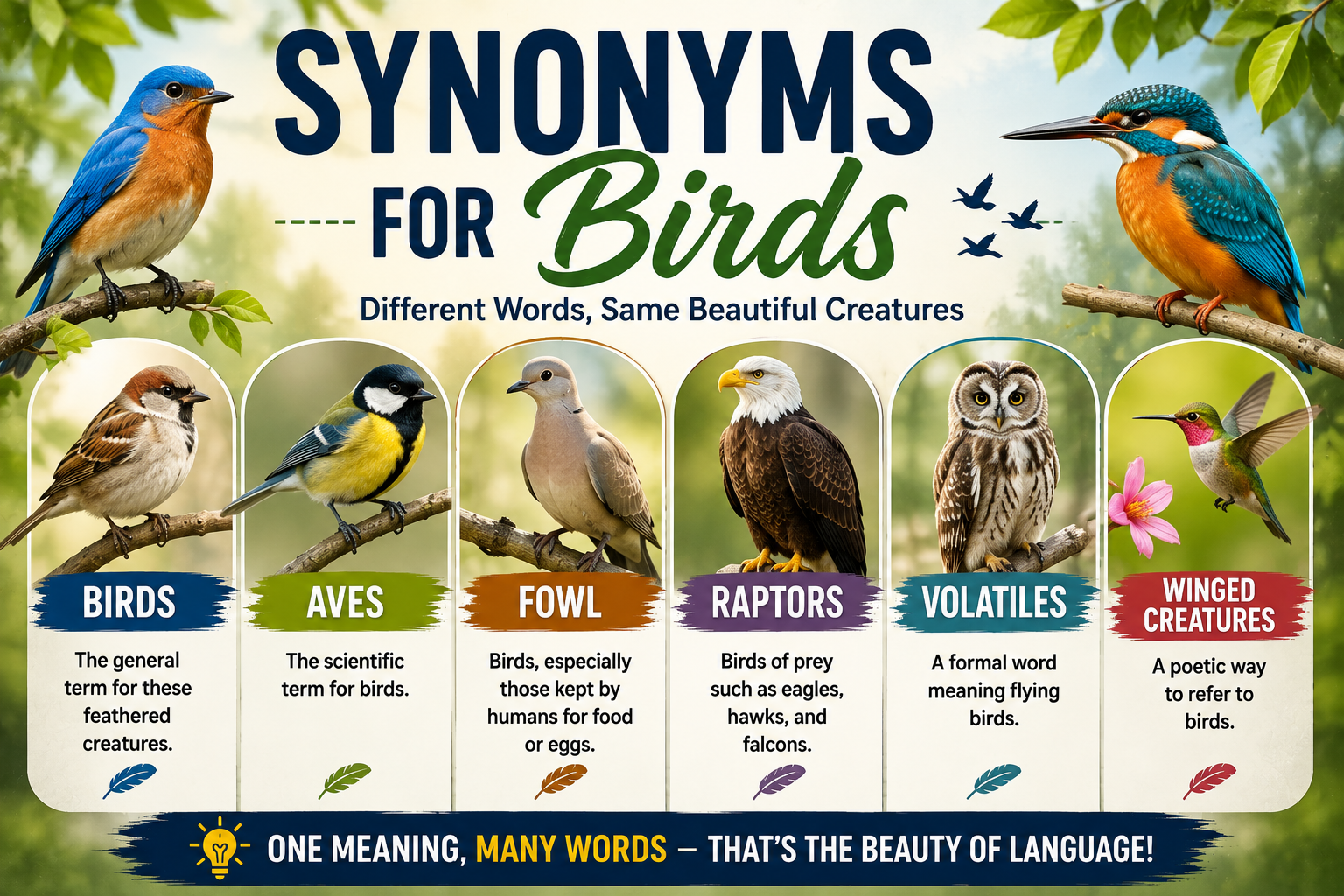
Synonyms for birds include fowl, avians, flying creatures, feathered creatures, winged creatures, songbirds, waterfowl, and poultry. The best word depends on the type of bird and the context.
Have you ever tried to describe a bird without using the word bird? You may quickly run out of ideas. A sparrow, eagle, duck, parrot, and chicken are all birds, but they are not the same. Each word carries a different image and meaning.
As an English teacher and writer, I often see learners search for synonyms for birds when they want to avoid repetition or make their writing more vivid. A student may want a better word for a school essay. A writer may need a more poetic phrase. A nature writer may need a scientific term such as avian.
The good news is that English gives you many choices. Some alternatives are broad. Others describe a specific group, such as waterfowl or songbirds. Some are formal, while others are poetic or informal.
This guide explains the best synonyms for birds, their meanings, examples, differences, origins, and common uses. By the end, you will know which word fits your sentence best.
Synonyms for birds – Quick Answer
The most useful alternatives to birds are:
- Avians — formal or scientific term for birds.
- Fowl — birds, especially domestic or wild birds used as food.
- Feathered creatures — descriptive and slightly poetic.
- Winged creatures — broad and literary.
- Songbirds — birds known for their songs.
- Waterfowl — birds that live around water.
- Poultry — domestic birds raised for eggs or meat.
- Birdlife — birds considered as a group in an area.
For example:
The garden was full of birds.
You could write:
The garden was full of songbirds.
That version gives the reader a more specific picture.
The Origin / Background of Birds
The word bird has a long history in English. It comes from an Old English word brid, which was originally used for a young bird or young creature. Over time, its meaning expanded to refer to birds in general.
The modern word developed through Middle English forms such as bird and brid.
Today, bird is the normal everyday word. More specialized terms developed as people needed to describe different groups, behaviors, and uses.
The word avian, for example, comes from Latin avis, meaning “bird.” It is now common in scientific and formal contexts.
This explains why bird and avian are close in meaning but do not always sound natural in the same sentence.
The bird landed on the fence.
sounds natural in everyday English.
The avian landed on the fence.
is grammatically possible but sounds more scientific or specialized.
Words such as fowl, poultry, waterfowl, and songbird developed more specific meanings. They are therefore not perfect replacements for bird in every sentence.
Synonyms for Birds Explained — Key Differences
The most important thing to remember is that synonyms are not always exact substitutes.
For example, poultry normally refers to domestic birds kept by people. A wild eagle is a bird, but it is not normally called poultry.
Likewise, waterfowl refers to birds associated with water. A sparrow is a bird but not normally waterfowl.
| Term | Meaning | When to Use | Region/Context |
|---|---|---|---|
| Birds | General name for the animal group | Everyday writing | Universal |
| Avians | Birds as a class or group | Scientific/formal writing | Formal |
| Fowl | Birds, often domestic or game birds | General/specialized | Traditional/general |
| Feathered creatures | Birds described by their feathers | Creative writing | Literary |
| Winged creatures | Creatures with wings | Descriptive writing | Literary |
| Songbirds | Birds known for their songs | Nature writing | General |
| Waterfowl | Birds associated with water | Wildlife writing | Scientific/general |
| Poultry | Domestic birds raised for food | Farming/food | General |
| Birdlife | Birds living in an area | Nature writing | Formal/general |
| Wildfowl | Wild birds, especially game birds | Wildlife contexts | British/general |
| Fledglings | Young birds learning to fly | Bird development | Nature |
| Chicks | Young birds | Specific young birds | General |
| Raptors | Birds of prey | Wildlife/science | Scientific |
| Birds of prey | Hunting birds | Nature writing | General |
| Seabirds | Birds that live around seas | Marine wildlife | General |
| Shorebirds | Birds found near shores | Wildlife | General |
| Game birds | Birds hunted for sport or food | Hunting/wildlife | Specialized |
Birds vs. avians
Birds is the everyday word.
Avians is more formal and often used in science, biology, and academic writing.
Scientists studied several avian species.
Birds vs. fowl
Fowl can refer broadly to birds, but it often has a narrower meaning.
It may refer to domestic birds or birds hunted as game.
The farmer keeps fowl on the property.
You should not automatically replace every use of bird with fowl.
Birds vs. poultry
Poultry refers to domestic birds raised by humans, especially for meat or eggs.
Common examples include:
- Chickens
- Turkeys
- Ducks
- Geese
A wild eagle is a bird, but it is not poultry.
Birds vs. songbirds
Songbirds are birds known for their vocal songs.
Examples include many:
- Sparrows
- Robins
- Thrushes
- Finches
The term is more specific than birds.
Which Version / Approach Should You Use?
The right synonym depends on your audience.
For beginners and students
Use birds most of the time.
It is simple, clear, and widely understood.
If you need variety, use:
- feathered creatures
- songbirds
- wild birds
- flying creatures
Choose a word that still keeps the meaning clear.
For academic writing
Use avian when discussing birds from a scientific or biological point of view.
For example:
Researchers studied avian migration patterns.
This sounds more suitable than:
Researchers studied bird migration patterns.
Both are correct, but avian gives the sentence a more technical tone.
For nature writing
Use more specific terms such as:
- songbirds
- waterfowl
- seabirds
- shorebirds
- raptors
- birds of prey
Specific words help readers create a clearer picture.
For creative writing
Try:
- feathered creatures
- winged creatures
- winged visitors
- feathered friends
- sky-dwellers
These can add color and emotion to your writing.
For global and neutral English
The safest choices are birds, avian species, and wild birds.
Use bird when there is no need for a more specific term.
Common Mistakes with Synonyms for Birds
1. Treating “poultry” as a synonym for every bird
Mistake:
The zoo has many kinds of poultry.
Better:
The zoo has many kinds of birds.
Why?
Poultry normally means domestic birds raised by people.
2. Calling every bird a songbird
Mistake:
Eagles are beautiful songbirds.
Better:
Eagles are impressive birds of prey.
Why?
Songbirds are associated with their singing ability. Eagles are raptors.
3. Using “fowl” in every sentence
Mistake:
I saw a fowl sitting on a tree.
Better:
I saw a bird sitting on a tree.
Why?
Bird is much more natural in everyday English.
4. Using “avian” in casual speech
Awkward:
Look at that beautiful avian!
Natural:
Look at that beautiful bird!
Why?
Avian is normally an adjective in phrases such as avian species or avian disease.
5. Using “winged creature” as an exact scientific term
Mistake:
The scientist identified three winged creatures.
Better:
The scientist identified three bird species.
Why?
Not every winged creature is a bird. Insects also have wings.
Synonyms for Birds in Real-World Examples
Professional email
We observed several avian species near the project site.
This works well in a scientific or environmental workplace.
News headline
Rare birds spotted near coastal wetlands
A news headline usually favors simple, familiar language.
Social media post
Spent the morning watching beautiful songbirds in the garden. 🐦
The specific term adds more detail and personality.
Formal document or report
The survey recorded several species of waterfowl in the wetland area.
Here, waterfowl is more precise than the general word birds.
Creative writing
A group of winged visitors crossed the evening sky.
This sounds more poetic than simply saying birds.
Synonyms for Birds — Data, Trends & Usage
The search intent behind synonyms for birds is mainly informational. Readers may be students, writers, teachers, ESL learners, or people looking for vocabulary alternatives.
The topic also connects with several related searches, such as:
- Types of birds
- Another word for bird
- Scientific word for bird
- Words for birds
- Synonyms for flying creatures
- Different names for birds
- Bird vocabulary
- Collective nouns for birds
One useful insight is that specific vocabulary is often better than a general synonym.
Instead of changing:
I saw many birds.
to:
I saw many avians.
you may get a stronger sentence by writing:
I saw several sparrows and finches.
The second version gives the reader real information.
In nature and science writing, terms such as avian, waterfowl, raptors, and seabirds help classify birds more accurately. In everyday writing, bird remains the clearest choice.
Standalone Comparison Table
| Term/Variant | Meaning | Region/Context | Best Used When |
|---|---|---|---|
| Bird | General term | All English | Everyday use |
| Avian | Relating to birds | Scientific/formal | Biology and research |
| Fowl | Bird, often domestic/game | General/specialized | Traditional or specific use |
| Poultry | Domestic birds raised for food | Farming | Meat and eggs |
| Songbird | Bird known for singing | Nature | Bird watching |
| Waterfowl | Water-associated bird | Wildlife | Lakes, rivers, wetlands |
| Wildfowl | Wild birds | Wildlife | Wild bird contexts |
| Raptor | Bird of prey | Scientific/general | Eagles, hawks, falcons |
| Bird of prey | Hunting bird | General | Nature writing |
| Seabird | Bird associated with the sea | Marine wildlife | Coastal areas |
| Shorebird | Bird found near shores | Wildlife | Beaches and wetlands |
| Fledgling | Young bird learning to fly | Nature | Young birds |
| Chick | Young bird | General | Baby birds |
| Birdlife | Birds in a particular place | Nature writing | Habitats |
| Feathered creature | Bird described creatively | Literary | Creative writing |
| Winged creature | Creature with wings | Literary | Descriptive writing |
Frequently Asked Questions
Q: What does “synonyms for birds” mean?
A: It means words or phrases that can describe birds or particular groups of birds. Examples include avians, fowl, songbirds, waterfowl, poultry, and feathered creatures.
Q: What is the best synonym for birds?
A: Avians is the closest formal alternative. However, bird is usually the best everyday word because it is simple and natural.
Q: How do you use “avian” correctly?
A: Avian is most often used as an adjective. For example, you can write “avian species,” “avian behavior,” or “avian migration.” The noun bird is usually better in everyday speech.
Q: What is the difference between birds and poultry?
A: Birds is the broad term. Poultry normally means domestic birds raised for food, such as chickens and turkeys.
Q: Is “fowl” a synonym for bird?
A: Sometimes. Fowl can refer to birds, especially domestic birds or game birds. It is not always a natural replacement for bird.
Q: Where does the word “bird” come from?
A: Bird comes from Old English brid, which originally referred to a young bird or young creature. Its meaning later expanded to the general word used today.
Q: Can “avian” be used in everyday conversation?
A: It can, but it may sound formal or scientific. In most casual conversations, bird is more natural.
Q: What is a group of birds called?
A: The collective noun depends on the species. Common terms include flock, colony, brood, and covey. For example, you can say a flock of birds.
Conclusion
Learning synonyms for birds can make your vocabulary richer, but the goal is not to replace bird every time. The best word is the one that gives your reader the right meaning.
Use bird for simple and general writing. Choose avian for scientific or formal contexts. Use songbird when singing is important. Choose waterfowl for birds linked to water. Use poultry for domestic birds raised for food. Words such as raptor, seabird, and shorebird are useful when you want to be more specific.
Creative writing gives you even more freedom. Phrases such as feathered creatures and winged visitors can create a vivid image.
The most useful habit is to think about meaning before choosing a synonym. A good synonym should improve your sentence, not simply make it different.
Now you know the best alternatives to “birds.” Try using one specific term in your next essay, story, report, or conversation.
Emma Collins is an English language expert and vocabulary writer with a passion for making English easier to understand. She specializes in synonyms, word meanings, word choice, and clear writing tips.