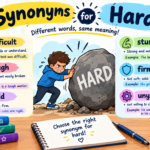
Quick Answer: Synonyms for hard include difficult, tough, challenging, demanding, complicated, solid, firm, rigid, severe, harsh, and demanding. The best synonym depends on the meaning of hard in your sentence.
Hard is a common English word with many meanings. If you are studying for a difficult exam, you might say, “This test is hard.” If you cannot break a piece of metal, you may call it hard because it is solid and strong. The word can also describe a tough situation, a strict person, or something that requires a lot of effort. Because hard has so many uses, learning its synonyms can make your English more precise. English learners can use alternatives to express difficulty, strength, effort, or severity more clearly. Content writers can also avoid repeating the same word in articles and descriptions. This guide explains the meaning, history, pronunciation, word formation, and different uses of hard. It also provides 31 synonyms with simple meanings, examples, and semantic categories.
Meaning of Hard
Definition
Hard (Adjective/Adverb):
Hard means difficult to do, understand, or deal with. It can also mean solid, firm, severe, or requiring a lot of effort.
Examples
- This mathematics problem is very hard.
- She worked hard to finish the project on time.
Connotative Meaning
Connotation means the feelings or ideas that a word suggests beyond its basic meaning.
- Positive tone: Hard can suggest strength, effort, determination, and dedication.
- Negative tone: It can suggest difficulty, suffering, strictness, or unpleasant conditions.
- Neutral tone: It can simply describe something that is physically solid or difficult without expressing emotion.
Etymology
The word hard has very old Germanic roots and has been part of English for many centuries.
- Old English (450–1100): Hard came from Old English heard, meaning “hard,” “solid,” “firm,” “severe,” or “difficult.”
- Middle English (1100–1500): The word developed into forms such as hard and continued to describe things that were physically firm as well as difficult or severe.
- Modern English (1500–Present): Hard expanded into many uses, including difficult tasks, strong materials, severe conditions, intense effort, and determined action.
Pronunciation (IPA)
- IPA: /hɑːrd/ (British English), /hɑːrd/ (American English)
- Syllables: hard
Affixation Pattern of Hard
- Root: hard- — expressing firmness, difficulty, or severity.
- Prefix: None.
- Suffix: None in the basic word.
- Word formations:
- Hard — adjective/adverb: difficult, firm, severe, or with great effort.
- Hardness — noun: the quality of being hard.
- Harden — verb: to become or make hard.
- Hardening — noun/verb form: the process of becoming or making hard.
- Hardened — adjective/past participle: made hard or tough.
- Hardy — adjective: strong enough to survive difficult conditions.
- Hardship — noun: a difficult or unpleasant condition.
- Hard-working — adjective: working with great effort.
- Hard-earned — adjective: gained through a lot of work or effort.
31 Synonyms of Hard With Meaning & Examples
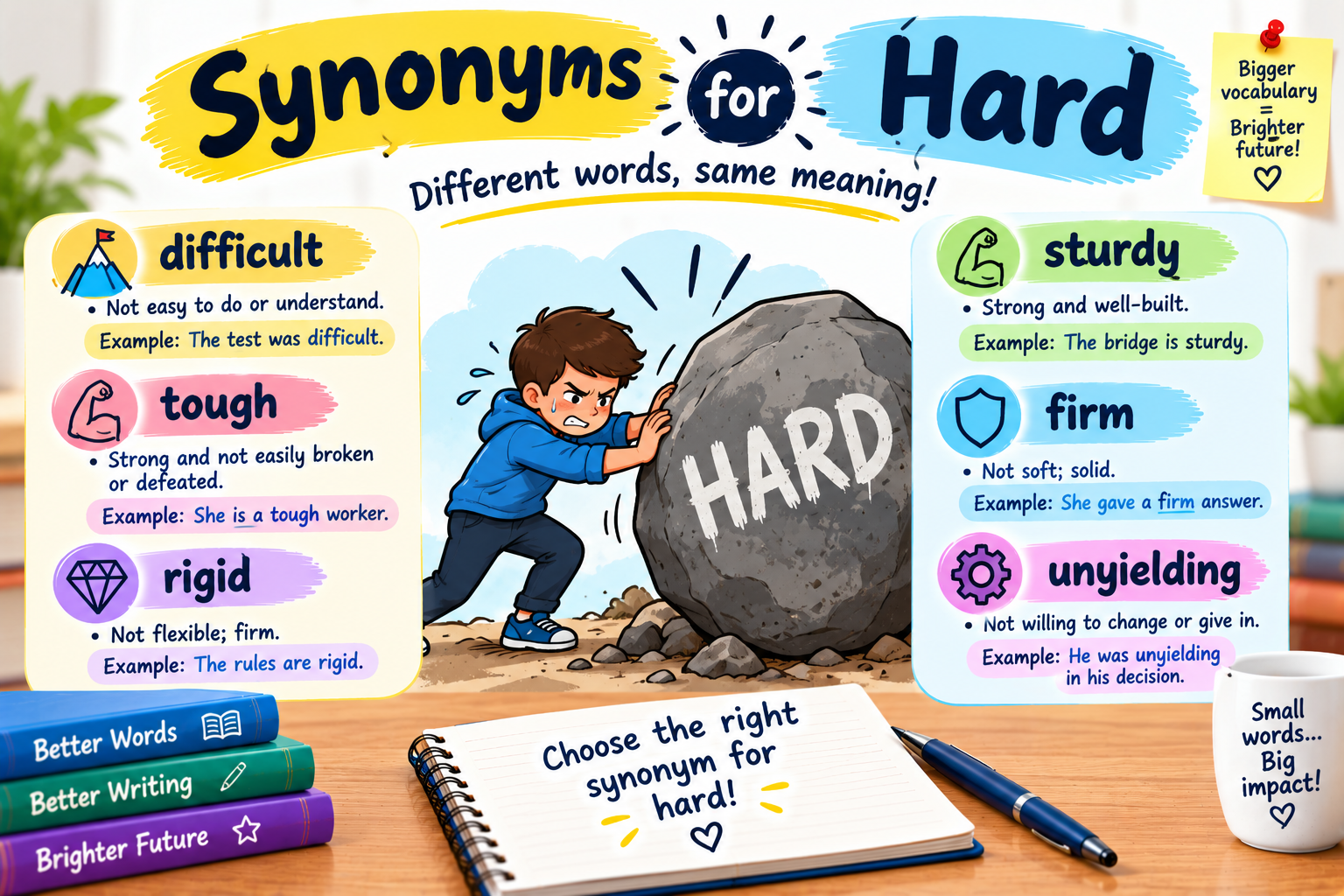
1. Difficult (Adjective)
Meaning: Not easy to do, understand, or deal with.
Examples:
- The exam was very difficult.
- She faced a difficult decision.
2. Tough (Adjective)
Meaning: Difficult to complete, handle, or overcome.
Examples:
- It was a tough job.
- We had a tough week at work.
3. Challenging (Adjective)
Meaning: Difficult in a way that tests your skills or abilities.
Examples:
- The course is challenging but useful.
- She accepted the challenging task.
4. Demanding (Adjective)
Meaning: Requiring a lot of time, energy, or effort.
Examples:
- Nursing can be a demanding career.
- The project was physically demanding.
5. Arduous (Adjective)
Meaning: Requiring a great deal of effort and energy.
Examples:
- They completed an arduous journey.
- Building the road was an arduous task.
6. Complicated (Adjective)
Meaning: Difficult because it has many parts or details.
Examples:
- The instructions were complicated.
- Solving the case was complicated.
7. Tricky (Adjective)
Meaning: Difficult because something requires care, skill, or careful thought.
Examples:
- This is a tricky question.
- The repair was more tricky than expected.
8. Formidable (Adjective)
Meaning: Very difficult or powerful and therefore hard to deal with.
Examples:
- They faced a formidable opponent.
- The mountain is a formidable challenge.
9. Daunting (Adjective)
Meaning: So difficult or frightening that it makes you feel worried.
Examples:
- Starting a new business can be daunting.
- The large project seemed daunting at first.
10. Laborious (Adjective)
Meaning: Requiring a lot of time and effort.
Examples:
- The process was slow and laborious.
- Copying all the records was a laborious task.
11. Grueling (Adjective)
Meaning: Extremely tiring and demanding.
Examples:
- The athletes completed a grueling workout.
- They went through a grueling training program.
12. Strenuous (Adjective)
Meaning: Requiring a lot of physical or mental effort.
Examples:
- Climbing the hill was strenuous.
- He avoided strenuous exercise after the long trip.
13. Rigorous (Adjective)
Meaning: Very thorough, strict, or demanding.
Examples:
- The students followed a rigorous training program.
- The research went through rigorous testing.
14. Severe (Adjective)
Meaning: Very serious, strong, or harsh.
Examples:
- The region experienced severe weather.
- He suffered severe pain after the accident.
15. Harsh (Adjective)
Meaning: Very unpleasant, strict, or severe.
Examples:
- The workers faced harsh conditions.
- The judge gave a harsh punishment.
16. Stern (Adjective)
Meaning: Very strict and serious.
Examples:
- The teacher gave him a stern warning.
- His father was stern but fair.
17. Strict (Adjective)
Meaning: Requiring rules to be followed closely.
Examples:
- The school has strict rules.
- My manager is strict about deadlines.
18. Firm (Adjective)
Meaning: Solid and not soft, weak, or easily changed.
Examples:
- The mattress is firm but comfortable.
- She gave the table a firm push.
19. Solid (Adjective)
Meaning: Hard and stable rather than soft or liquid.
Examples:
- The frozen ground was solid.
- The box is made from solid wood.
20. Rigid (Adjective)
Meaning: Very stiff and not easily bent or changed.
Examples:
- The frame is made from rigid plastic.
- The company has a rigid system.
21. Stiff (Adjective)
Meaning: Firm and difficult to bend, move, or change.
Examples:
- The new shoes felt stiff.
- The material is strong and stiff.
22. Unyielding (Adjective)
Meaning: Not willing to bend, change, or give way.
Examples:
- The rock was unyielding.
- He remained unyielding during the negotiations.
23. Inflexible (Adjective)
Meaning: Not willing or able to change.
Examples:
- The schedule is too inflexible.
- His inflexible attitude caused problems.
24. Solidly (Adverb)
Meaning: In a strong, firm, or stable way.
Examples:
- The shelf was solidly attached to the wall.
- The team played solidly throughout the match.
25. Forcefully (Adverb)
Meaning: With strong physical or emotional power.
Examples:
- He closed the door forcefully.
- She argued her point forcefully.
26. Vigorously (Adverb)
Meaning: With great energy, strength, or effort.
Examples:
- She worked vigorously to complete the task.
- The team defended its position vigorously.
27. Intensely (Adverb)
Meaning: With a very high level of strength, feeling, or concentration.
Examples:
- He studied intensely before the exam.
- The two teams competed intensely.
28. Laboriously (Adverb)
Meaning: In a way that requires a lot of time and effort.
Examples:
- She worked laboriously on the report.
- The machine was repaired laboriously by hand.
29. Tireless (Adjective)
Meaning: Continuing to work with great effort without becoming tired.
Examples:
- Her tireless work helped the team succeed.
- He made a tireless effort to improve the community.
30. Unrelenting (Adjective)
Meaning: Continuing strongly without stopping or becoming weaker.
Examples:
- The workers faced unrelenting pressure.
- The unrelenting heat made the journey difficult.
31. Struggle (Noun)
Meaning: A difficult effort to achieve something or deal with a problem.
Examples:
- Learning a new language can be a struggle.
- He described his struggle to complete the course.
Usage note: Hard has several meanings, so no single synonym works in every sentence. Difficult works for tasks, solid works for materials, severe works for conditions, and firm works for physical or personal firmness.
Prototype Meaning
The most typical meaning of hard is difficult or requiring a lot of effort. When people hear “hard,” they often think about a task that is not easy, such as a difficult exam, a demanding job, or a challenging problem. However, the word can also describe physical firmness, severe conditions, strict behavior, or intense effort. Context tells you which meaning is intended.
Prototype Categorization
The 31 alternatives can be grouped into meaningful semantic categories:
- Difficulty and challenge: difficult, tough, challenging, complicated, tricky, formidable, daunting — best for tasks, problems, decisions, and situations that are not easy.
- Effort and physical demand: demanding, arduous, laborious, grueling, strenuous, rigorous — useful when something requires major physical or mental effort.
- Severity and strictness: severe, harsh, stern, strict, unrelenting — useful for rules, treatment, weather, conditions, or strong pressure.
- Physical firmness: firm, solid, rigid, stiff, unyielding — best when hard describes an object or material.
- Strength and intensity: forcefully, vigorously, intensely, solidly — useful when hard works as an adverb and describes the way an action happens.
- Persistence and effort: tireless, laboriously, struggle — useful when describing continued effort or difficulty over time.
This categorization helps writers choose a more exact synonym. Instead of using hard repeatedly, you can show whether something is difficult, physically solid, severe, demanding, or intense.
Antonyms of Hard
1. Easy (Adjective)
Meaning: Not difficult to do, understand, or deal with.
2. Soft (Adjective)
Meaning: Easy to press, bend, or touch because it is not firm.
3. Gentle (Adjective)
Meaning: Kind, mild, or not harsh.
4. Flexible (Adjective)
Meaning: Able to bend, change, or adapt easily.
5. Mild (Adjective)
Meaning: Not severe, strong, or harsh.
6. Effortless (Adjective)
Meaning: Requiring little or no effort.
Short Questions and Answers
What does hard mean?
Hard can mean difficult, physically firm, severe, strict, or requiring a lot of effort.
When should hard be used?
Use hard when you need a common word for difficulty, firmness, severity, or strong effort. Choose a more specific synonym when you want greater detail.
Is hard positive or negative?
Hard can be either positive or negative. A hard worker has a positive meaning, while a hard situation may suggest difficulty or stress.
How is it different from similar words?
Hard is a broad word. Difficult focuses on lack of ease, tough often suggests difficulty or strength, solid describes physical firmness, and severe describes strong or harsh conditions.
Conclusion
Learning synonyms for hard can greatly improve your English vocabulary. The word hard has many meanings, so choosing the right alternative can make your writing clearer and more precise. Use difficult for challenging tasks, demanding for work that needs much effort, solid for firm materials, harsh for unpleasant conditions, and rigid for things that cannot bend or change easily.
These words are useful for students, English learners, speakers, bloggers, and content writers. They can help you avoid repetition and express your ideas with greater detail. Try learning two or three synonyms each day and use them in your own sentences. Regular practice will strengthen your vocabulary, improve your speaking and writing, and build your confidence in English.

Olivia Wordsmith is a passionate vocabulary writer who loves exploring words, meanings, and their everyday use.
She creates clear, engaging content to help readers expand their vocabulary and communicate with confidence.