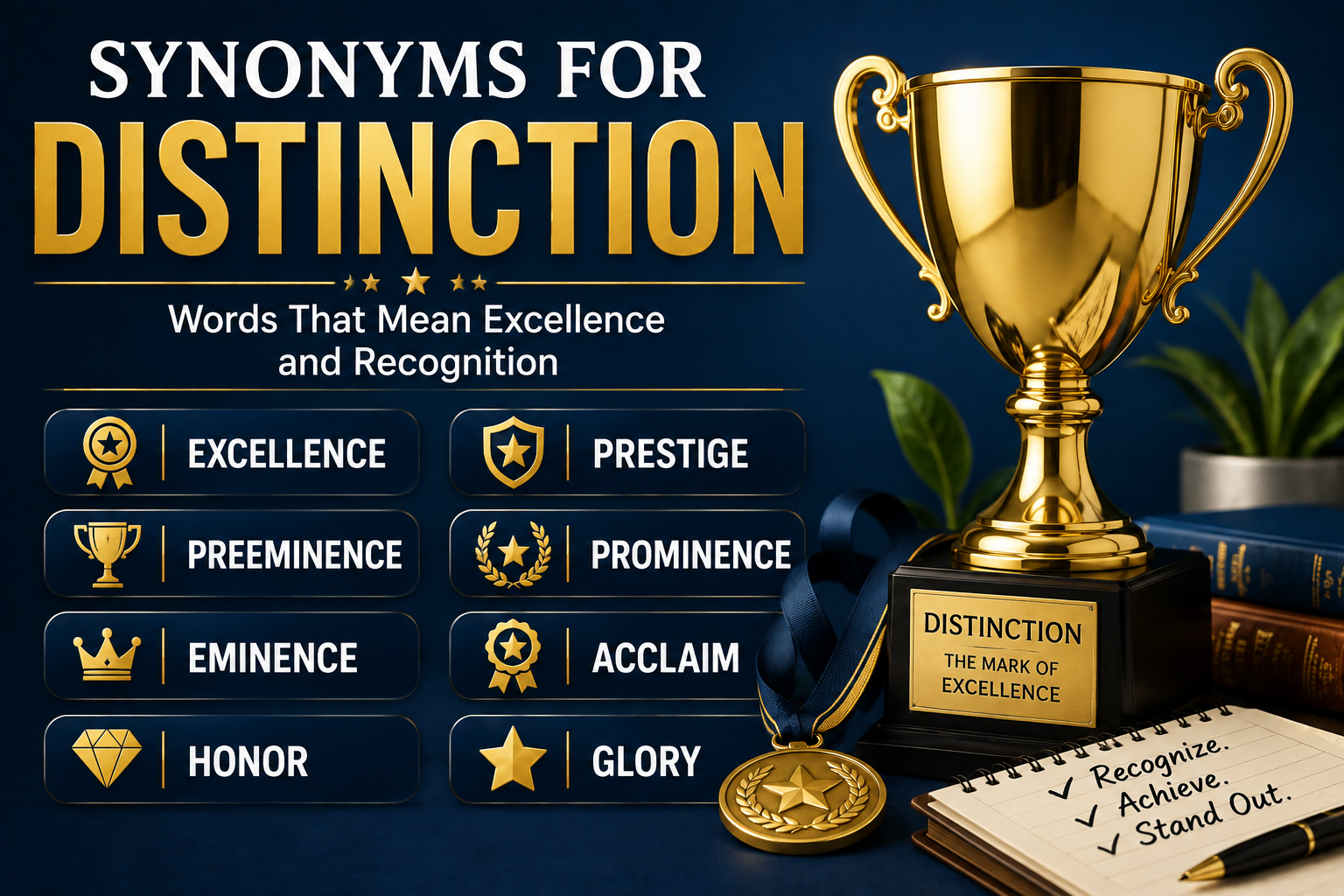
Synonyms for distinction can help you express ideas about difference, excellence, recognition, and separation with greater accuracy. The best synonym depends on the meaning you want.
Distinction means a clear difference between two things, but it can also mean excellence, honor, or special recognition. For example, you might say, “There is a clear distinction between the two ideas.” You might also say, “She graduated with distinction.” The word is common in academic, professional, and everyday English.
For English learners and content writers, knowing synonyms for distinction is useful because one word may not fit every situation. Using the right alternative can make your writing clearer and more natural. Words such as difference, contrast, separation, excellence, honor, recognition, and merit each carry a slightly different meaning.
This guide explains the meaning, history, pronunciation, grammar, and semantic uses of distinction. You will also find 30 useful synonyms with simple examples, plus antonyms and tips to help you choose the right word.
Meaning of Distinction
Definition
Distinction (noun): a clear difference between people or things; it can also mean special excellence, honor, or recognition.
The word has two main meanings:
- A difference or separation:
“There is an important distinction between facts and opinions.” - Excellence or special recognition:
“She graduated with distinction.”
Examples
- There is a clear distinction between the two colors.
- He earned a degree with distinction.
- The teacher made a distinction between formal and informal English.
Connotative Meaning
Connotation (the feeling or idea that a word suggests beyond its basic meaning) can change with context.
- Positive tone: When distinction means excellence, honor, or achievement.
- Negative tone: It can suggest division or separation when the difference creates distance between groups.
- Neutral tone: When it simply describes a clear difference between two things.
Etymology
The word distinction comes from Latin distinctio, meaning “a separation” or “difference.” It is related to the Latin verb distinguere, meaning “to separate” or “to mark off.”
Old English (450–1100)
The modern word distinction did not come directly from Old English. English speakers used other native words to express ideas such as difference, separation, and marking something apart.
Middle English (1100–1500)
After the Norman Conquest, English gained many words from French and Latin. Forms related to distinction entered English through this influence.
Modern English (1500–Present)
Distinction developed its modern meanings. It can describe a difference, but it can also refer to high achievement or honor.
Today, the word appears often in education, business, law, writing, and everyday speech.
Pronunciation (IPA)
- IPA: /dɪˈstɪŋkʃən/
- Syllables: dis-tinc-tion
The main stress falls on the second syllable:
dis-TINC-tion
The final part sounds like “shun.”
Affixation Pattern of Distinction
- Root: stinct / sting — related to the idea of marking or distinguishing
- Prefix: dis- — often suggests separation or apartness
- Suffix: -ion — forms a noun related to an action, process, or result
Word formations
- Distinction — noun
- Distinct — adjective
- Distinctly — adverb
- Distinguish — verb
- Distinguishable — adjective
- Distinguished — adjective
- Distinguishing — adjective/participle
- Distinguishably — adverb
30 Synonyms of Distinction With Meaning & Examples
The best synonym depends on which meaning of distinction you intend. Some synonyms describe difference, while others describe excellence or recognition.
1. Difference (Noun)
Meaning: A way in which two or more things are not the same.
Examples:
- There is a clear difference between the two plans.
- Can you explain the difference between these words?
2. Contrast (Noun)
Meaning: A strong difference between two things.
Examples:
- The contrast between the two colors is striking.
- There is a sharp contrast between city and country life.
3. Variation (Noun)
Meaning: A change or difference in form, quality, or condition.
Examples:
- There is some variation in the results.
- Regional variation affects pronunciation.
4. Divergence (Noun)
Meaning: A movement or development away from something else.
Examples:
- We noticed a divergence in their opinions.
- The report shows a divergence between the two trends.
5. Disparity (Noun)
Meaning: A large or unfair difference between two things.
Examples:
- There is a major disparity in income.
- The study found a disparity between the two groups.
6. Separation (Noun)
Meaning: The act or state of keeping things apart.
Examples:
- The wall creates a separation between the rooms.
- The law requires the separation of these duties.
7. Difference (Noun)
Meaning: The quality that makes one thing unlike another.
Examples:
- The main difference is the price.
- I noticed a small difference in the wording.
8. Discrimination (Noun)
Meaning: The ability to recognize or identify differences between things.
Examples:
- Good discrimination between sounds helps language learners.
- The test measures visual discrimination.
9. Distinctiveness (Noun)
Meaning: The quality of being clearly different or unique.
Examples:
- The brand is known for its distinctiveness.
- Her voice has a special distinctiveness.
10. Uniqueness (Noun)
Meaning: The quality of being unlike anything else.
Examples:
- The design is valued for its uniqueness.
- The artist celebrates the uniqueness of each piece.
11. Discrepancy (Noun)
Meaning: A difference between things that should be the same.
Examples:
- We found a discrepancy in the records.
- The accountant noticed a small discrepancy.
12. Inequality (Noun)
Meaning: A lack of equality between people or things.
Examples:
- The report discusses economic inequality.
- Education can help reduce inequality.
13. Gap (Noun)
Meaning: A space or difference between two things.
Examples:
- There is a large gap between the two scores.
- The course helps close the skills gap.
14. Division (Noun)
Meaning: A separation into different groups or parts.
Examples:
- The division between the teams was clear.
- The issue caused a division among voters.
15. Distinction (Noun)
Meaning: A clear difference that separates one thing from another.
Examples:
- We must make a distinction between fact and opinion.
- The teacher explained the distinction clearly.
16. Excellence (Noun)
Meaning: Very high quality or achievement.
Examples:
- The award recognizes excellence in teaching.
- Her work shows excellence and care.
17. Merit (Noun)
Meaning: The quality of being good or deserving praise.
Examples:
- The idea has great merit.
- Her work deserves merit for its originality.
18. Honor (Noun)
Meaning: High respect or recognition given to someone.
Examples:
- Receiving the award was a great honor.
- He received an honor for his service.
19. Recognition (Noun)
Meaning: Public or official praise for an achievement.
Examples:
- She received recognition for her research.
- The award gave him international recognition.
20. Prestige (Noun)
Meaning: Respect and admiration gained through success or importance.
Examples:
- The university has great prestige.
- The award brought prestige to the organization.
21. Eminence (Noun)
Meaning: A position of high importance, fame, or respect.
Examples:
- The scientist achieved great eminence in her field.
- His eminence made him a respected speaker.
22. Prominence (Noun)
Meaning: A state of being important, famous, or noticeable.
Examples:
- The issue gained prominence in the media.
- She rose to prominence after the discovery.
23. Superiority (Noun)
Meaning: The state of being better than another person or thing.
Examples:
- The test showed the superiority of the new method.
- He claimed superiority over his competitors.
24. Achievement (Noun)
Meaning: Something successfully completed through effort or skill.
Examples:
- Winning the prize was a major achievement.
- Her academic achievement impressed the teachers.
25. Distinction (Noun)
Meaning: Special recognition for excellent performance.
Examples:
- He graduated with distinction.
- She completed the course with distinction.
26. Rank (Noun)
Meaning: A position in a system of importance or achievement.
Examples:
- The university holds a high rank.
- Her work earned her a respected rank in the field.
27. Status (Noun)
Meaning: The level of respect, importance, or position someone has.
Examples:
- The award increased his professional status.
- The institution has a strong academic status.
28. Specialty (Noun)
Meaning: A particular skill, subject, or area of expertise.
Examples:
- Grammar is her specialty.
- His specialty is historical research.
29. Notability (Noun)
Meaning: The quality of being important or worthy of attention.
Examples:
- The discovery gained notability among researchers.
- Her work has earned notability in the field.
30. Esteem (Noun)
Meaning: Great respect or admiration.
Examples:
- The professor is held in high esteem.
- She earned the esteem of her colleagues.
Prototype Meaning
The most typical meaning of distinction is a clear difference between two things.
When people hear the word in this sense, they often imagine two ideas, objects, groups, or qualities that can be separated or compared.
For example, there is a distinction between formal and informal English. However, the word also has another common meaning: special achievement or honor, as in “graduated with distinction.”
The context tells you which meaning is intended.
Prototype Categorization
The 30 synonyms above can be grouped into useful semantic categories. This helps you choose a word that matches your exact meaning.
1. Difference and Contrast
These words focus on how things are not the same:
- Difference
- Contrast
- Variation
- Divergence
- Disparity
- Discrepancy
Use these when comparing ideas, objects, results, or groups.
2. Separation and Division
These words focus on keeping things apart:
- Separation
- Division
- Gap
- Inequality
They work well when discussing groups, systems, spaces, or social conditions.
3. Uniqueness and Special Qualities
These words focus on what makes something different:
- Distinctiveness
- Uniqueness
- Discrimination
- Specialty
Use them when you want to highlight a special feature or quality.
4. Excellence and Achievement
These words describe high performance:
- Excellence
- Merit
- Achievement
- Superiority
- Distinction
They are useful in academic, professional, and award-related writing.
5. Honor and Recognition
These words focus on respect or public praise:
- Honor
- Recognition
- Prestige
- Eminence
- Prominence
- Esteem
- Notability
Use these when talking about awards, careers, reputation, or public respect.
6. Position and Importance
These words describe someone’s place or level:
- Rank
- Status
- Prominence
- Prestige
These are useful in professional and social contexts.
Why categorization helps
A synonym is not always a perfect replacement.
For example, difference works well when you mean “not the same.” But honor works better when distinction means an award or special recognition.
Choosing words by meaning makes your writing more precise and natural.
Antonyms of Distinction
The opposite of distinction depends on its meaning.
1. Similarity (Noun)
Meaning: The quality of being alike.
- There is a strong similarity between the two designs.
2. Sameness (Noun)
Meaning: The state of being the same.
- The sameness of the designs made them hard to compare.
3. Equality (Noun)
Meaning: The state of being equal.
- The policy promotes equality for all workers.
4. Uniformity (Noun)
Meaning: The state of being the same throughout.
- The rules created uniformity across the system.
5. Inferiority (Noun)
Meaning: The state of being lower in quality or ability.
- The test did not prove the inferiority of either method.
Short Questions and Answers
What does distinction mean?
Distinction usually means a clear difference between two things. It can also mean excellence, honor, or special recognition.
When should distinction be used?
Use distinction when you want to describe a meaningful difference or special achievement. For example, “There is a distinction between the two methods” or “She graduated with distinction.”
Is distinction positive or negative?
It depends on context. Distinction can have a positive meaning when it refers to excellence or honor. It can be neutral when it simply means a difference.
How is distinction different from similar words?
Difference is the broadest synonym. Contrast suggests a strong difference, while disparity often suggests an unequal difference. When distinction means honor, words such as recognition, excellence, and prestige are better choices.
Can distinction mean excellence?
Yes. In education, with distinction means achieving a high level of performance. For example, “She graduated with distinction.”
What is the opposite of distinction?
Common antonyms include similarity, sameness, uniformity, equality, and inferiority, depending on the intended meaning.
Why should I learn synonyms for distinction?
Learning synonyms helps you avoid repetition and choose more exact words. It also improves your writing, speaking, reading, and overall English vocabulary.
Conclusion
Learning distinction and its synonyms gives you more control over your English. The word can mean a difference, but it can also describe excellence, honor, or recognition. That is why context matters when choosing a synonym.
Words such as difference, contrast, variation, separation, and disparity work well when you mean a difference. Words such as excellence, merit, recognition, prestige, and honor are better when you mean achievement or respect.
You do not need to memorize all 30 words at once. Start with five or six. Use them in your own sentences. Then add more as your vocabulary grows.
Regular practice will help you write with less repetition and speak with more confidence. Learn one new synonym each day, use it in a sentence, and make it part of your active vocabulary.

Sarah Linguist is a passionate language enthusiast who loves exploring words, meanings, and synonyms.
She creates clear, easy-to-understand content to help readers improve their vocabulary and English skills.
Through SynonymsGuide.com, Sarah makes finding the right words simple, useful, and enjoyable.