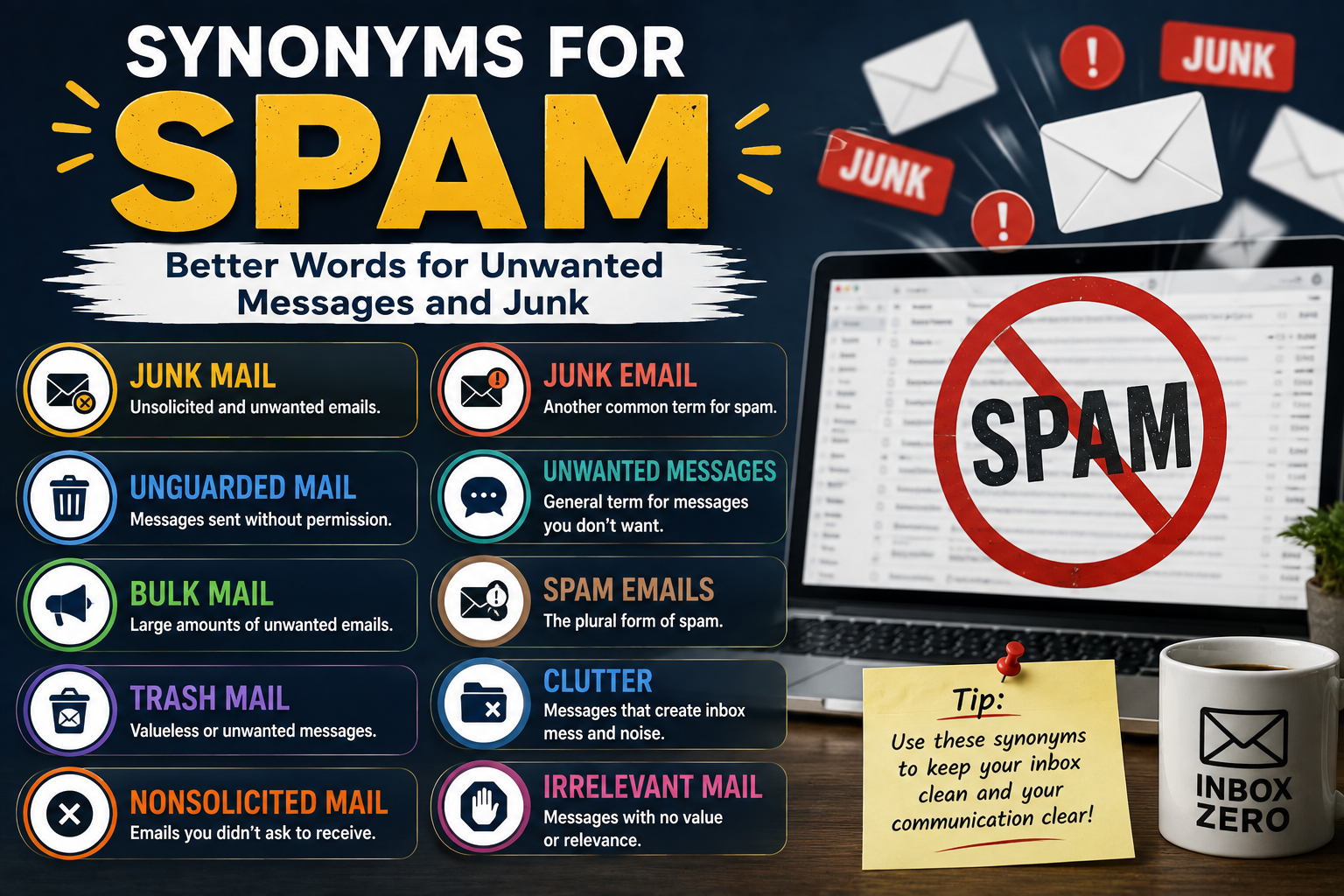
Spam means unwanted or irrelevant messages, emails, comments, or content sent to people. Imagine opening your inbox and finding ten messages you never asked for. That is spam. You may also see spam comments on a website or unwanted promotional posts on social media.
The word is common in emails, online marketing, social media, cybersecurity, and everyday digital communication. However, using the same word again and again can make your writing feel dull. Learning synonyms for spam helps English learners, bloggers, marketers, and content writers choose words that fit each situation better.
For example, junk mail works well for unwanted emails, while unsolicited messages sounds more formal. Scam is stronger when the message tries to deceive someone.
This guide explains the meaning, history, pronunciation, word forms, and 30 useful synonyms for spam. You will also learn how these words differ and when to use each one.
Meaning of Spam
Definition
Spam (noun/verb): Unwanted messages or content that are sent to many people, often for advertising, promotion, or harmful purposes.
As a verb, spam means to send large amounts of unwanted messages or content.
Examples
- I received several spam emails this morning.
- Please do not spam the group with repeated messages.
Connotative Meaning
Connotation means the feeling or idea that a word suggests beyond its basic meaning.
- Positive tone: Spam rarely has a positive meaning.
- Negative tone: Usually suggests unwanted, annoying, excessive, or harmful content.
- Neutral tone: In technical writing, spam can simply describe unwanted digital communication.
Etymology
The modern digital meaning of spam has an unusual history.
- Old English (450–1100): The modern word spam was not used for unwanted digital messages.
- Middle English (1100–1500): There was no modern internet-related meaning of spam.
- Modern English (1500–Present): The word originally became known as a brand name for canned meat. Later, a famous comedy sketch by Monty Python repeatedly used the word Spam. The repeated use helped inspire the later idea of unwanted, repeated messages.
The internet meaning became popular in the late 20th century as unwanted electronic messages became a growing problem.
Pronunciation (IPA)
- IPA: /spæm/
- Syllables: spam
It is a one-syllable word. The vowel sound is similar to the sound in ham.
Affixation Pattern of Spam
- Root: spam
- Prefix: none
- Suffix: none
Word formations
- spam — noun/verb
- spammed — verb, past tense
- spamming — verb, present participle
- spammer — noun, a person or system that sends spam
- spammy — adjective, informal; full of spam or resembling spam
30 Synonyms of Spam With Meaning & Examples
1. Junk Mail (Noun)
Meaning: Unwanted mail or email, often containing advertising.
Examples:
- My inbox is full of junk mail.
- I moved the message to the junk mail folder.
2. Unsolicited Messages (Noun)
Meaning: Messages that someone receives without asking for them.
Examples:
- The company blocks unsolicited messages.
- I often receive unsolicited messages from unknown accounts.
3. Unwanted Messages (Noun)
Meaning: Messages that the receiver does not want.
Examples:
- The app helps users block unwanted messages.
- I deleted several unwanted messages today.
4. Junk (Noun)
Meaning: Unwanted or useless digital content.
Examples:
- Most of these emails are junk.
- Check your junk folder before deleting messages.
5. Bulk Mail (Noun)
Meaning: Mail sent to many people at the same time.
Examples:
- The company sent bulk mail to its customers.
- Some bulk mail may be useful, while other messages are unwanted.
6. Mass Email (Noun)
Meaning: An email sent to a large group of people.
Examples:
- The business sent a mass email to its subscribers.
- A poorly targeted mass email can annoy readers.
7. Promotional Email (Noun)
Meaning: An email designed to promote a product, service, or offer.
Examples:
- I received a promotional email about the sale.
- Too many promotional emails can fill your inbox.
8. Unwanted Email (Noun)
Meaning: An email that the receiver does not want.
Examples:
- I deleted the unwanted email.
- The filter automatically detects unwanted emails.
9. Solicitation (Noun)
Meaning: A request for money, business, support, or action.
Examples:
- The website blocks unwanted solicitations.
- I received a sales solicitation by email.
10. Advertisement (Noun)
Meaning: A message designed to promote a product, service, or idea.
Examples:
- The email contained an unwanted advertisement.
- I saw an advertisement in my inbox.
11. Marketing Message (Noun)
Meaning: A message used to promote a product or service.
Examples:
- The company sent a marketing message to customers.
- Some users considered the repeated marketing messages annoying.
12. Sales Pitch (Noun)
Meaning: A message or speech designed to persuade someone to buy something.
Examples:
- The email looked like a long sales pitch.
- I ignored the unwanted sales pitch.
13. Scam Message (Noun)
Meaning: A message designed to trick someone into giving money or information.
Examples:
- The email was a scam message.
- Never click links in a suspicious scam message.
14. Fraudulent Message (Noun)
Meaning: A dishonest message intended to deceive someone.
Examples:
- The bank warned customers about fraudulent messages.
- She reported the fraudulent message immediately.
15. Phishing Message (Noun)
Meaning: A deceptive message that tries to steal personal information.
Examples:
- The email was a phishing message.
- Never share your password after receiving a suspicious phishing message.
16. Nuisance Message (Noun)
Meaning: An annoying message that causes inconvenience.
Examples:
- The repeated texts became a nuisance message problem.
- The filter removes many nuisance messages.
17. Digital Clutter (Noun)
Meaning: Unwanted digital information that fills a device or account.
Examples:
- Too many promotional emails create digital clutter.
- Cleaning your inbox can reduce digital clutter.
18. Noise (Noun)
Meaning: Unwanted information that distracts from useful content.
Examples:
- The repeated posts created too much digital noise.
- Good filters help reduce online noise.
19. Flood (Noun)
Meaning: A very large amount of messages or content sent at once.
Examples:
- Users faced a flood of unwanted emails.
- A flood of comments made the page difficult to manage.
20. Deluge (Noun)
Meaning: A very large and overwhelming amount of something.
Examples:
- We received a deluge of promotional emails.
- The website faced a deluge of unwanted comments.
21. Bombardment (Noun)
Meaning: A large number of messages or advertisements sent repeatedly.
Examples:
- Customers complained about the bombardment of emails.
- I felt a bombardment of advertisements after visiting the website.
22. Pestering (Noun)
Meaning: Repeatedly annoying someone with requests or messages.
Examples:
- The constant messages felt like pestering.
- Users complained about repeated pestering from advertisers.
23. Harassment (Noun)
Meaning: Repeated unwanted behavior that causes distress or fear.
Examples:
- The repeated messages became online harassment.
- She reported the messages as harassment.
24. Intrusion (Noun)
Meaning: An unwanted entry into someone’s private space or attention.
Examples:
- The message felt like an intrusion.
- Users viewed the repeated advertisements as an intrusion.
25. Interruption (Noun)
Meaning: Something that stops or distracts someone from what they are doing.
Examples:
- The constant alerts were an interruption.
- Unwanted messages can be a major interruption during work.
26. Clutter (Noun)
Meaning: A collection of unwanted or unnecessary things.
Examples:
- My inbox is full of digital clutter.
- Removing old emails reduced the clutter.
27. Unwanted Content (Noun)
Meaning: Content that users did not request or want to see.
Examples:
- The platform removed unwanted content.
- Users can report unwanted content.
28. Irrelevant Content (Noun)
Meaning: Content that does not relate to what the user wants or needs.
Examples:
- The search page contained irrelevant content.
- Moderators removed irrelevant content from the discussion.
29. Unwanted Promotion (Noun)
Meaning: Promotional material that a person did not ask to receive.
Examples:
- The website was filled with unwanted promotion.
- Users can report repeated unwanted promotion.
30. Overposting (Noun)
Meaning: Posting too much content, especially when it becomes annoying or excessive.
Examples:
- The account was criticized for overposting.
- Constant overposting can drive followers away.
Prototype Meaning
The most typical meaning of spam is unwanted digital communication sent repeatedly or to many people. When people hear the word, they often think of a crowded email inbox filled with advertisements, suspicious offers, fake alerts, or repeated messages.
The key ideas are unwanted, repeated, and mass communication. However, spam can also appear in comments, social media posts, text messages, forums, and online forms.
Prototype Categorization
The 30 synonyms above can be grouped by meaning. This helps you choose the right word instead of treating every synonym as an exact replacement.
- General unwanted communication:
junk mail, unwanted messages, unwanted email, junk, unsolicited messages - Marketing and advertising:
promotional email, advertisement, marketing message, sales pitch, solicitation, unwanted promotion - Fraud and online threats:
scam message, fraudulent message, phishing message - Large amounts of content:
bulk mail, mass email, flood, deluge, bombardment - Annoying or disruptive communication:
nuisance message, pestering, interruption, intrusion, harassment - Unwanted digital material:
digital clutter, clutter, noise, unwanted content, irrelevant content - Excessive posting:
overposting
This grouping matters because spam is a broad word. A phishing message is not simply any spam message. It has a specific goal: trying to steal information. Likewise, a promotional email may be legitimate marketing, while spam is usually unwanted.
Antonyms of Spam
1. Requested Message (Noun)
Meaning: A message that someone asked or agreed to receive.
2. Relevant Content (Noun)
Meaning: Content that directly matches a person’s needs or interests.
3. Wanted Email (Noun)
Meaning: An email that the receiver wants to receive.
4. Personal Message (Noun)
Meaning: A message intended for a specific person rather than a large audience.
5. Useful Information (Noun)
Meaning: Information that provides value or helps someone.
6. Legitimate Communication (Noun)
Meaning: Genuine communication that is not deceptive or unwanted.
Short Questions and Answers
What does spam mean?
Spam means unwanted messages or content sent to people, often in large numbers. It commonly refers to unwanted emails, texts, comments, or online posts.
When should spam be used?
Use spam when talking about unwanted or excessive digital communication. It works well in casual, technical, and professional writing.
Is spam positive or negative?
Spam usually has a negative meaning. It suggests that content is unwanted, annoying, excessive, or sometimes harmful.
How is spam different from similar words?
The word spam is broad. For example, junk mail usually means unwanted email, while phishing refers to deceptive messages that try to steal information.
Is spam a noun or a verb?
It can be both. As a noun, you can say, “I received spam.” As a verb, you can say, “Do not spam the group.”
Conclusion
Learning spam and its synonyms can make your English more precise and useful. The word itself is broad, but its alternatives often give you more detail. Junk mail fits unwanted email. Promotional email focuses on marketing. Phishing message points to an attempt to steal information. Scam message highlights deception.
Using the right synonym also helps you avoid repetition. This is useful for students, bloggers, marketers, journalists, and business writers. It can make your writing clearer and easier to understand.
Remember that synonyms are not always perfect replacements. Check the meaning and context before changing one word for another.
Try to learn a few new words each day. Use them in your own sentences. With regular practice, your vocabulary will grow, your writing will sound more natural, and your confidence will improve.
Keep practicing, and choose the word that says exactly what you mean.

Sarah Linguist is a passionate language enthusiast who loves exploring words, meanings, and synonyms.
She creates clear, easy-to-understand content to help readers improve their vocabulary and English skills.
Through SynonymsGuide.com, Sarah makes finding the right words simple, useful, and enjoyable.