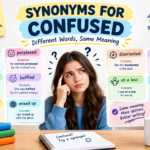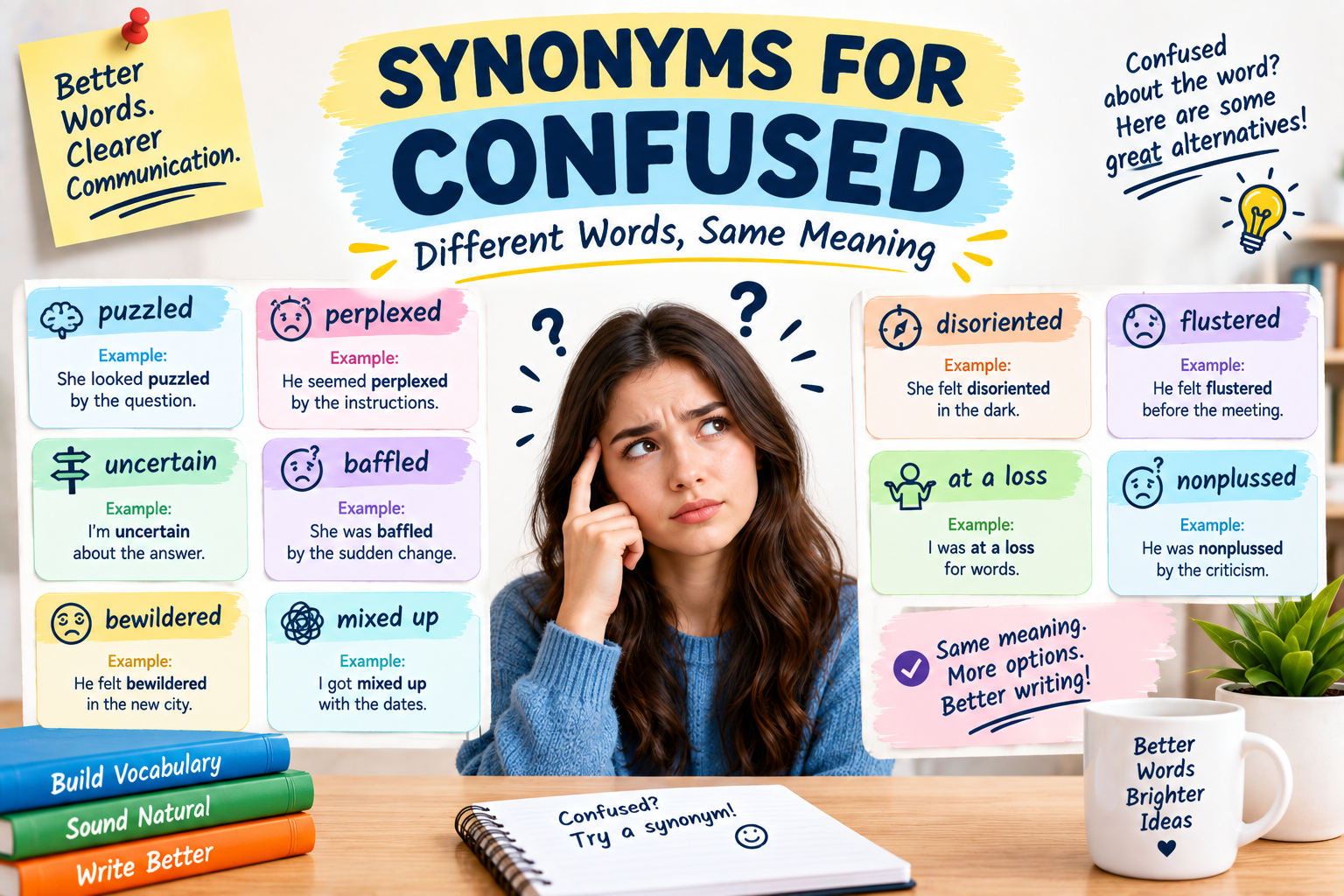
Synonyms for confused include puzzled, bewildered, perplexed, uncertain, unclear, unsure, baffled, disoriented, muddled, mixed-up, lost, bewildered, and perplexed. The best choice depends on the type and level of confusion.
Confused means unable to understand something clearly or unsure about what to think or do. Imagine reading a set of instructions for the first time and not knowing which step to follow. You might say, “I’m confused.” The word is very common because people often need to describe unclear thoughts, difficult situations, or uncertain feelings. However, repeating confused can make your writing less varied. Learning synonyms gives you more precise ways to describe different kinds of confusion. This is useful for English learners, students, teachers, and content writers. In this guide, you will learn the meaning of confused, its grammar, history, pronunciation, and word formation. You will also discover 25 useful synonyms with simple meanings and examples, plus semantic categories, antonyms, and practical usage tips.
Meaning of Confused
Definition
Confused (Adjective): Confused means unable to think clearly, understand something, or decide what to do.
It can also describe something that is difficult to understand because it lacks order or clarity.
Examples
- I felt confused after reading the complicated instructions.
- She looked confused when the teacher changed the rules.
Connotative Meaning
- Positive tone: Confused can sometimes sound mild and temporary, especially when someone is learning something new.
- Negative tone: It can suggest frustration, uncertainty, mental difficulty, or a lack of understanding.
- Neutral tone: It can simply describe a person who does not understand something clearly.
(Connotation: the feeling or association that a word carries in addition to its basic meaning.)
Etymology
- Old English (450–1100): The modern word confused was not used in its present English form in Old English. Older Germanic English used other words to express disorder, uncertainty, or lack of understanding.
- Middle English (1100–1500): Confuse entered English through Anglo-French and Latin influence. It came from Latin confundere, meaning “to mix together” or “to mingle.”
- Modern English (1500–Present): Confused developed both a physical sense of things being mixed together and a mental sense of being unable to understand or think clearly.
The Latin roots are con-, meaning “together,” and fundere, meaning “to pour.” The original idea was therefore something being poured or mixed together.
Pronunciation (IPA)
- IPA: /kənˈfjuːzd/
- Syllables: con-fused
Affixation Pattern of Confused
- Root: fuse
- Prefix: con-
- Suffix: -ed
- Word formations:
- confuse — verb
- confuses — verb
- confused — adjective/past participle
- confusing — adjective/present participle
- confusion — noun
- confusions — plural noun
- confusingly — adverb
- confusedly — adverb
- confuser — noun
- unconfused — adjective
The historical Latin root relates to the idea of mixing things together. In modern English, confused often describes a person’s mental state.
25 Synonyms of Confused With Meaning & Examples
1. Puzzled (Adjective)
Meaning: Puzzled means unsure because something is difficult to understand.
Examples:
- I was puzzled by his strange answer.
- She looked puzzled when she saw the results.
2. Bewildered (Adjective)
Meaning: Bewildered means very confused and unsure about what is happening.
Examples:
- The sudden change left him bewildered.
- She looked bewildered by the complicated instructions.
3. Perplexed (Adjective)
Meaning: Perplexed means confused because something is difficult to understand or explain.
Examples:
- The strange behavior left me perplexed.
- He seemed perplexed by the question.
4. Baffled (Adjective)
Meaning: Baffled means completely unable to understand something.
Examples:
- The difficult puzzle left everyone baffled.
- I was baffled by the sudden decision.
5. Uncertain (Adjective)
Meaning: Uncertain means not sure about something.
Examples:
- I am uncertain about the correct answer.
- She felt uncertain about her next step.
6. Unsure (Adjective)
Meaning: Unsure means lacking confidence about what is true or what to do.
Examples:
- I am unsure which road to take.
- He was unsure about joining the team.
7. Disoriented (Adjective)
Meaning: Disoriented means confused about where you are, what is happening, or what to do.
Examples:
- He felt disoriented after waking up suddenly.
- The traveler became disoriented in the unfamiliar city.
8. Muddled (Adjective)
Meaning: Muddled means confused, mixed up, or poorly organized.
Examples:
- Her explanation was muddled and difficult to follow.
- I had a muddled understanding of the topic.
9. Mixed-Up (Adjective)
Meaning: Mixed-up means confused or arranged in the wrong order.
Examples:
- I was mixed-up about the meeting time.
- The instructions became mixed-up in my notes.
10. Unclear (Adjective)
Meaning: Unclear means difficult to understand or not expressed clearly.
Examples:
- The teacher’s explanation was unclear.
- The instructions are still unclear to me.
11. Perplexed (Adjective)
Meaning: Perplexed describes someone who cannot understand something puzzling.
Examples:
- The unusual result left the researchers perplexed.
- She was perplexed by his reaction.
12. At a Loss (Phrase)
Meaning: At a loss means unsure about what to say, think, or do.
Examples:
- I was at a loss for words.
- She was at a loss about how to solve the problem.
13. Stumped (Adjective)
Meaning: Stumped means unable to find an answer or solution.
Examples:
- The difficult question stumped me.
- We were stumped by the final problem.
14. Confounded (Adjective)
Meaning: Confounded means extremely confused or unable to understand something.
Examples:
- The unexpected result confounded the scientists.
- I was confounded by his strange explanation.
15. Dazed (Adjective)
Meaning: Dazed means unable to think clearly for a short time.
Examples:
- He looked dazed after the sudden noise.
- She was still dazed by the unexpected news.
16. Distracted (Adjective)
Meaning: Distracted means unable to concentrate because your attention is elsewhere.
Examples:
- I was too distracted to understand the lesson.
- He seemed distracted during the meeting.
17. Unsettled (Adjective)
Meaning: Unsettled means unsure, disturbed, or unable to feel mentally calm.
Examples:
- The unexpected news left her unsettled.
- I felt unsettled about the sudden change.
18. Uncertain-Minded (Adjective)
Meaning: Uncertain-minded describes someone who has difficulty making a clear decision or forming a firm view.
Examples:
- He seemed uncertain-minded about the proposal.
- Her uncertain-minded response showed that she needed more information.
19. Hesitant (Adjective)
Meaning: Hesitant means unsure about whether to act or make a decision.
Examples:
- She was hesitant about accepting the offer.
- He gave a hesitant answer.
20. Indecisive (Adjective)
Meaning: Indecisive means unable to choose between different options.
Examples:
- I was indecisive about which course to take.
- His indecisive nature slowed the project.
21. Disconcerted (Adjective)
Meaning: Disconcerted means confused or uncomfortable because something unexpected has happened.
Examples:
- She was disconcerted by the sudden question.
- The unusual situation left him disconcerted.
22. Flustered (Adjective)
Meaning: Flustered means confused or nervous because you are under pressure.
Examples:
- I became flustered during the interview.
- She looked flustered when everyone asked questions at once.
23. Befuddled (Adjective)
Meaning: Befuddled means very confused and unable to think clearly.
Examples:
- The complicated instructions left me befuddled.
- He looked befuddled by the new software.
24. Nonplussed (Adjective)
Meaning: Nonplussed traditionally means so surprised or confused that you do not know how to react.
Examples:
- I was nonplussed by his unexpected response.
- She seemed completely nonplussed by the strange situation.
25. Discombobulated (Adjective)
Meaning: Discombobulated means confused, disorganized, or unable to think clearly.
Examples:
- I felt discombobulated after the long journey.
- The sudden change left the team discombobulated.
Usage note: These words are not exact replacements in every sentence. Puzzled suggests a difficult question, bewildered suggests strong confusion, uncertain focuses on doubt, disoriented often relates to location or awareness, and indecisive focuses on difficulty making a choice.
Prototype Meaning
The most typical meaning of confused is being unable to understand something clearly. When people hear this word, they often imagine someone looking at complicated instructions, hearing conflicting information, or trying to make a difficult decision. The person may not know what something means, what is true, or what action to take.
Prototype Categorization
Grouping synonyms by their exact meaning helps writers choose the right word instead of using confused for every situation.
- General confusion: puzzled, confused, bewildered, perplexed, baffled — useful when someone cannot understand something.
- Doubt and uncertainty: uncertain, unsure, hesitant — useful when someone does not know what to believe or choose.
- Mental disorganization: muddled, mixed-up, befuddled, discombobulated — useful when thoughts or information lack order.
- Difficulty finding an answer: stumped, confounded, at a loss — useful when someone cannot solve a problem or respond.
- Physical or situational confusion: disoriented, dazed — useful when someone has difficulty understanding their surroundings or situation.
- Pressure-related confusion: flustered, distracted, unsettled, disconcerted — useful when emotions or unexpected events affect clear thinking.
- Decision-related confusion: indecisive — best when someone cannot choose between options.
This categorization helps writers match the synonym to the exact type of confusion they want to describe.
Antonyms of Confused
- Clear (Adjective): Easy to understand or think about.
- Certain (Adjective): Sure about something.
- Sure (Adjective): Having confidence that something is true or correct.
- Certain-minded (Adjective): Firm and clear in one’s thinking or decision.
- Focused (Adjective): Giving full attention to one thing.
- Aware (Adjective): Knowing or understanding what is happening.
- Decisive (Adjective): Able to make choices quickly and confidently.
- Organized (Adjective): Arranged clearly and logically.
Short Questions and Answers
What does confused mean?
Confused means unable to understand something clearly or unsure about what to think, believe, or do.
When should confused be used?
Use confused when someone does not understand something or cannot decide what to do. It is a broad and common word.
Is confused positive or negative?
Confused is usually neutral or negative. It can describe a normal learning moment, but it may also suggest frustration or difficulty.
How is it different from similar words?
Confused is a broad term. Puzzled often means confused by a question, bewildered suggests stronger confusion, uncertain means not sure, and indecisive means unable to choose.
What is a strong synonym for confused?
Bewildered, perplexed, and baffled are strong synonyms when the confusion is serious or difficult to resolve.
What is a simple synonym for confused?
Unsure, puzzled, and unclear are simple alternatives that work well in everyday English.
Can confused describe information?
Yes. For example, you can say, “The instructions are confused,” although unclear, muddled, or confusing may sound more natural depending on the sentence.
What is the difference between confused and confusing?
Confused describes the person who does not understand. Confusing describes something that causes that lack of understanding. For example, “I am confused because the instructions are confusing.”
Conclusion
Learning synonyms for confused gives you more accurate ways to describe uncertainty and lack of understanding. Words such as puzzled, perplexed, and baffled work well for difficult questions. Unsure and uncertain focus on doubt, while indecisive describes difficulty making a choice. Other words, such as disoriented, flustered, and muddled, describe more specific types of confusion. Using these words can strengthen your writing and speaking while helping you avoid repetition. They are useful in essays, emails, conversations, reports, and everyday English. Try learning two or three new synonyms each day and use them in your own sentences. With regular practice, you can build a stronger vocabulary and speak and write with greater confidence.

Sarah Linguist is a passionate language enthusiast who loves exploring words, meanings, and synonyms.
She creates clear, easy-to-understand content to help readers improve their vocabulary and English skills.
Through SynonymsGuide.com, Sarah makes finding the right words simple, useful, and enjoyable.