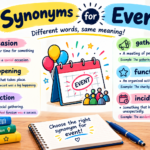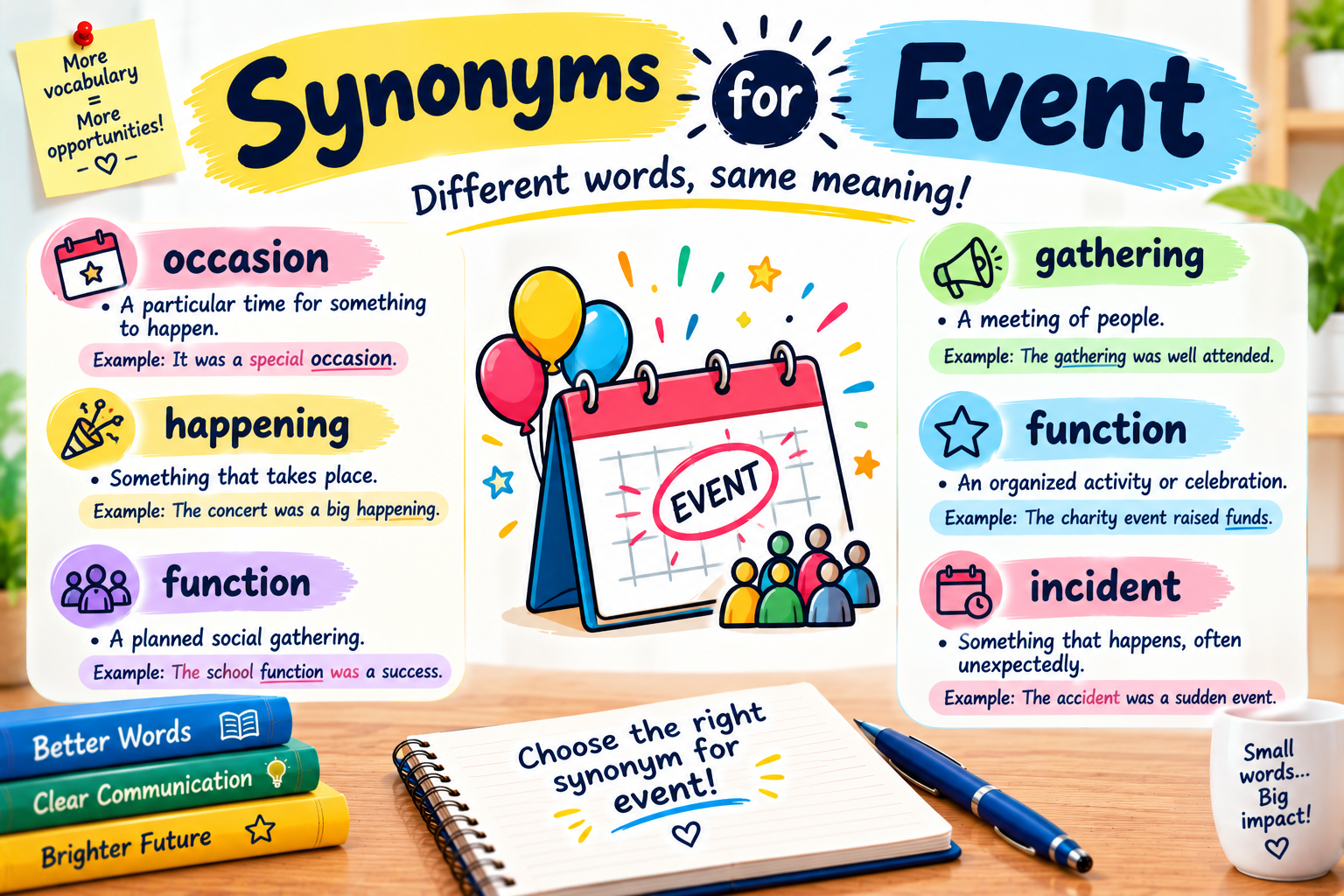
Synonyms for event include occasion, happening, incident, occurrence, function, activity, ceremony, gathering, affair, and experience. The best synonym depends on the type of event you mean.
An event is something that happens, especially something important, planned, or noticeable. For example, imagine your school is holding a sports day. Students gather, teachers organize activities, and everyone takes part. You could call this a school event. The word is very common because it can describe many things, from a birthday party to a major historical occurrence. Learning synonyms for event helps English learners describe situations with greater accuracy. It also helps content writers avoid using the same word again and again. A ceremony is different from an incident, while a conference is different from a casual gathering. This guide explains the meaning, grammar, history, pronunciation, and word formation of event, then gives 29 useful synonyms with examples and semantic categories to help you choose the right word.
Meaning of Event
Definition
Event (Noun):
An event is something that happens, especially something planned, important, or noticeable.
It can also mean a planned public or social activity, such as a concert, wedding, meeting, or festival.
Examples
- The school organized a sports event for its students.
- The accident was an unexpected event that changed their plans.
Connotative Meaning
Connotation means the feelings or ideas that a word suggests beyond its basic meaning.
- Positive tone: Event can suggest celebration, excitement, achievement, or an enjoyable gathering.
- Negative tone: It can refer to something unpleasant, such as an accident, disaster, or conflict.
- Neutral tone: It can simply describe something that happened without showing any emotion.
Etymology
The word event comes from Latin through French and entered English with the sense of something that happens or comes about.
- Old English (450–1100): The modern word event was not part of Old English. Ideas about something happening were expressed through other Germanic words.
- Middle English (1100–1500): Event entered English through Old French and Anglo-French from Latin eventus, meaning “occurrence,” “result,” or “outcome.”
- Modern English (1500–Present): Event developed into its current broad meanings, referring to occurrences, important happenings, and organized social or public activities.
Pronunciation (IPA)
- IPA: /ɪˈvent/
- Syllables: e-vent
Affixation Pattern of Event
- Root: ven/vent — related to the Latin root meaning “come.”
- Prefix: None in the English word event.
- Suffix: None in the modern English form.
- Word formations:
- Event — noun: something that happens or a planned occasion.
- Events — plural noun: more than one event.
- Eventful — adjective: full of important or interesting happenings.
- Eventfully — adverb: in an eventful manner.
- Eventfulness — noun: the quality of being eventful.
- Event-based — adjective: organized around events or triggered by an event.
29 Synonyms of Event With Meaning & Examples
1. Occasion (Noun)
Meaning: A particular time or situation, often marked by a special activity.
Examples:
- Her wedding was a joyful occasion.
- We dressed formally for the special occasion.
2. Happening (Noun)
Meaning: Something that takes place or occurs.
Examples:
- The strange happening surprised everyone.
- We talked about the day’s important happenings.
3. Occurrence (Noun)
Meaning: Something that happens or takes place.
Examples:
- The unusual occurrence was reported to the police.
- Such an occurrence is rare in this area.
4. Incident (Noun)
Meaning: An event, usually an unusual or unpleasant one.
Examples:
- The police investigated the incident.
- Nobody was injured during the incident.
5. Affair (Noun)
Meaning: An event or activity, often of a formal or public nature.
Examples:
- The award ceremony was a grand affair.
- The evening was a private family affair.
6. Function (Noun)
Meaning: A formal or social event.
Examples:
- The company held a formal function.
- She attended a charity function last night.
7. Gathering (Noun)
Meaning: A group of people meeting together for a purpose or social activity.
Examples:
- We had a family gathering on Sunday.
- The community held a small gathering.
8. Ceremony (Noun)
Meaning: A formal event that follows a special set of actions or traditions.
Examples:
- The graduation ceremony began at noon.
- They attended the opening ceremony.
9. Celebration (Noun)
Meaning: An event held to honor or enjoy something special.
Examples:
- The birthday celebration lasted all evening.
- The team held a celebration after winning.
10. Activity (Noun)
Meaning: Something people do, often as part of an organized program.
Examples:
- The festival offers many outdoor activities.
- The children joined a fun classroom activity.
11. Meeting (Noun)
Meaning: A planned gathering where people discuss or work on something.
Examples:
- We have a team meeting tomorrow.
- The board held an important meeting.
12. Conference (Noun)
Meaning: A formal meeting where people discuss a particular subject.
Examples:
- She spoke at an international conference.
- The technology conference attracted hundreds of visitors.
13. Convention (Noun)
Meaning: A large formal meeting of people with a shared interest or profession.
Examples:
- The company attended a business convention.
- Thousands of fans visited the annual convention.
14. Festival (Noun)
Meaning: A special event that celebrates art, culture, religion, or another important theme.
Examples:
- The city holds a music festival every year.
- We enjoyed traditional food at the festival.
15. Ceremony (Noun)
Meaning: A formal occasion used to mark an important moment.
Examples:
- The award ceremony was televised.
- Everyone stood during the opening ceremony.
16. Celebration (Noun)
Meaning: A social event held to mark a happy or important occasion.
Examples:
- The wedding celebration continued into the night.
- They planned a small celebration for her success.
17. Appointment (Noun)
Meaning: An arranged time to meet someone or attend a place.
Examples:
- I have a doctor’s appointment tomorrow.
- She made an appointment with the manager.
18. Engagement (Noun)
Meaning: A planned activity, meeting, or involvement with someone or something.
Examples:
- The speaker has several public engagements this month.
- The meeting was an important professional engagement.
19. Performance (Noun)
Meaning: A public presentation of music, acting, dance, or another form of entertainment.
Examples:
- The band’s performance was excellent.
- We bought tickets for the evening performance.
20. Show (Noun)
Meaning: A public performance or display designed for an audience.
Examples:
- We watched a comedy show last night.
- The fashion show attracted many visitors.
21. Tournament (Noun)
Meaning: A competition involving several players or teams.
Examples:
- Our school hosted a football tournament.
- She won the tennis tournament.
22. Competition (Noun)
Meaning: An organized activity in which people or teams try to win.
Examples:
- He entered a writing competition.
- The swimming competition begins tomorrow.
23. Session (Noun)
Meaning: A period set aside for a particular activity or purpose.
Examples:
- The training session lasted two hours.
- We attended a question-and-answer session.
24. Experience (Noun)
Meaning: Something that happens to a person and becomes part of their life.
Examples:
- The trip was an unforgettable experience.
- Meeting the author was a special experience.
25. Episode (Noun)
Meaning: A particular event or period that forms part of a larger series.
Examples:
- The disagreement was an unfortunate episode.
- That episode changed the course of his career.
26. Development (Noun)
Meaning: A new change or situation that happens over time.
Examples:
- The announcement was an important development.
- Recent developments changed the project plan.
27. Circumstance (Noun)
Meaning: A condition or situation connected with something that happens.
Examples:
- Under these circumstances, we had to cancel the trip.
- The unusual circumstances made the case difficult.
28. Milestone (Noun)
Meaning: An important event or achievement that marks progress.
Examples:
- Graduation was a major milestone in her life.
- Reaching one million users was an important milestone for the company.
29. Phenomenon (Noun)
Meaning: An unusual or notable event, fact, or situation that can be observed.
Examples:
- The northern lights are a natural phenomenon.
- The sudden trend became a global phenomenon.
Usage note: These words are related to event, but they are not interchangeable in every sentence. For example, ceremony means a formal event, incident often suggests something unusual or negative, and milestone describes an important point of progress.
Prototype Meaning
The most typical meaning of event is something that happens or takes place. People may imagine a planned gathering such as a wedding, concert, conference, or sports match. However, event can also describe an unexpected occurrence, such as an accident or unusual incident. The meaning depends on the context.
Prototype Categorization
The 29 synonyms can be grouped into meaningful categories:
- General occurrences: happening, occurrence, incident, episode, development — useful when talking about something that happens.
- Social and formal occasions: occasion, affair, function, gathering, ceremony, celebration — best for social, public, or formal activities.
- Professional events: meeting, conference, convention, appointment, engagement, session — useful in business, education, and professional settings.
- Entertainment and public activities: festival, performance, show, tournament, competition — useful for organized public events and entertainment.
- Personal experiences: experience, episode, circumstance — useful when an event affects or involves an individual.
- Important events: milestone, development, phenomenon — useful when an event is especially significant, noticeable, or unusual.
This categorization helps writers choose the most precise word. Instead of using event for everything, you can select a synonym that shows exactly what happened.
Antonyms of Event
Because event can mean either an occurrence or an organized occasion, it does not have one perfect antonym.
1. Nonoccurrence (Noun)
Meaning: Something that does not happen.
2. Inaction (Noun)
Meaning: A lack of action or activity.
3. Stillness (Noun)
Meaning: A state with little or no movement or activity.
4. Inactivity (Noun)
Meaning: A state in which little or nothing is happening.
5. Continuation (Noun)
Meaning: The state of something continuing without a separate or new event.
Short Questions and Answers
What does event mean?
An event is something that happens, especially something planned, important, or noticeable.
When should event be used?
Use event when talking about something that happens or a planned activity, such as a meeting, concert, wedding, festival, or competition.
Is event positive or negative?
Event is neutral. It can describe positive events, such as celebrations, or negative events, such as accidents.
How is it different from similar words?
Event is a broad word. Occasion often suggests a special time, incident usually describes an unusual event, ceremony is formal, and milestone marks important progress.
Conclusion
Learning synonyms for event can make your English more accurate and interesting. Instead of using event in every sentence, you can choose occasion, gathering, ceremony, incident, conference, festival, or milestone based on the meaning you need.
These alternatives are useful for students, English learners, bloggers, journalists, and content writers. They can help you describe social activities, professional meetings, unexpected happenings, personal experiences, and major achievements with greater detail. The key is to learn the small differences between related words. Try using two or three new synonyms each day in your own sentences. With regular practice, you can strengthen your vocabulary, improve your speaking and writing, avoid repetition, and feel more confident when using English.

Olivia Wordsmith is a passionate vocabulary writer who loves exploring words, meanings, and their everyday use.
She creates clear, engaging content to help readers expand their vocabulary and communicate with confidence.