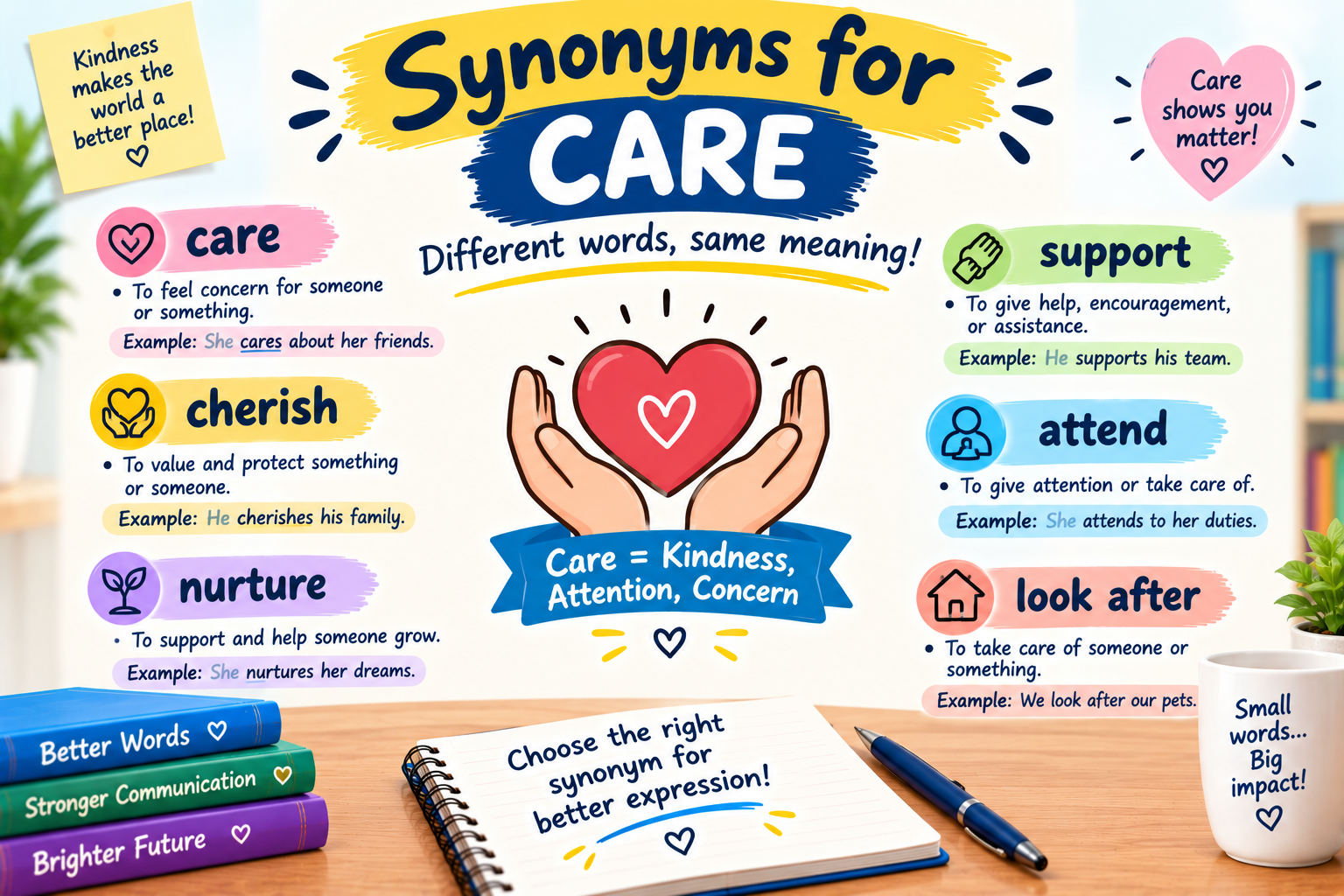
Synonyms for care include concern, attention, concern, caution, affection, support, protection, supervision, responsibility, kindness, compassion, and consideration. The best synonym depends on how care is used.
Care means giving attention, concern, or help to someone or something. For example, you may care for a sick family member, take care of a pet, or care about a friend’s feelings. The word is very common because it describes many forms of attention and concern in daily life. However, care has several meanings, so choosing the right synonym can make your writing more precise. English learners and content writers can use synonyms to avoid repetition and express emotions or actions more clearly. In this guide, you will learn the meaning of care, its grammar, history, pronunciation, and word formation. You will also explore 27 useful synonyms with simple meanings and examples. Semantic categories, antonyms, and common questions will help you understand which alternative works best in different situations.
Meaning of Care
Definition
Care (Noun/Verb): Care means concern, attention, or responsibility for someone or something. As a verb, it can also mean to feel concern or to look after someone or something.
Examples
- She takes great care of her elderly mother.
- I care about my friends and their feelings.
Connotative Meaning
- Positive tone: Care can suggest love, kindness, support, attention, and responsibility.
- Negative tone: It can suggest worry, anxiety, or excessive concern in some contexts.
- Neutral tone: Care can simply mean attention or responsibility toward something.
(Connotation: the emotional feeling or association that a word suggests beyond its basic meaning.)
Etymology
- Old English (450–1100): Care comes from Old English caru or cearu, meaning “sorrow,” “anxiety,” or “concern.”
- Middle English (1100–1500): The word appeared as forms such as care and developed meanings related to worry, concern, attention, and responsibility.
- Modern English (1500–Present): Care developed a wider range of meanings. It can now describe worry, attention, protection, affection, responsibility, and medical or personal support.
The older meaning focused strongly on worry or sorrow. Modern English expanded the word to include both emotional concern and practical attention.
Pronunciation (IPA)
- IPA: /ker/
- Syllables: care
Affixation Pattern of Care
- Root: care
- Prefix: None
- Suffix: None in the basic word
Word formations:
- care — noun/verb
- cares — noun/verb
- cared — verb
- caring — adjective/verb form
- careful — adjective
- carefully — adverb
- carefulness — noun
- careless — adjective
- carelessly — adverb
- carelessness — noun
- caregiver — noun
- caretaker — noun
- caregiving — noun/adjective
- uncaring — adjective
- cared-for — adjective
27 Synonyms of Care With Meaning & Examples
1. Concern (Noun)
Meaning: Concern is a feeling of worry, interest, or responsibility about someone or something.
Examples:
- Her health is a major concern for her family.
- He showed great concern for the injured animal.
2. Attention (Noun)
Meaning: Attention means carefully noticing or focusing on someone or something.
Examples:
- This problem needs immediate attention.
- Pay close attention to the instructions.
3. Caution (Noun)
Meaning: Caution means carefulness used to avoid danger or mistakes.
Examples:
- Drive with caution on wet roads.
- She handled the glass with caution.
4. Affection (Noun)
Meaning: Affection is a feeling of love, warmth, or fondness for someone.
Examples:
- She has great affection for her grandmother.
- The child showed affection toward the puppy.
5. Support (Noun)
Meaning: Support means help or encouragement given to someone who needs it.
Examples:
- Her family gave her strong support.
- Emotional support can help people during difficult times.
6. Protection (Noun)
Meaning: Protection means keeping someone or something safe from harm.
Examples:
- The helmet provides protection for cyclists.
- Children need love and protection.
7. Supervision (Noun)
Meaning: Supervision means watching and guiding someone to make sure things are done properly.
Examples:
- Young children need adult supervision.
- The workers completed the task under close supervision.
8. Responsibility (Noun)
Meaning: Responsibility means having a duty to look after someone or something.
Examples:
- Taking responsibility for a pet requires time.
- She has responsibility for the project.
9. Kindness (Noun)
Meaning: Kindness means being friendly, helpful, and considerate toward others.
Examples:
- Her kindness made the visitor feel welcome.
- A little kindness can make someone’s day better.
10. Compassion (Noun)
Meaning: Compassion is sympathy and concern for someone who is suffering.
Examples:
- The nurse treated every patient with compassion.
- He showed compassion toward the homeless man.
11. Consideration (Noun)
Meaning: Consideration means thoughtful concern for another person or situation.
Examples:
- Thank you for your consideration.
- She showed great consideration for her neighbors.
12. Regard (Noun)
Meaning: Regard means respect, concern, or a feeling of importance toward someone or something.
Examples:
- He has great regard for his teacher.
- She treats everyone with regard and respect.
13. Thoughtfulness (Noun)
Meaning: Thoughtfulness means showing careful concern for the needs and feelings of others.
Examples:
- Her thoughtfulness made everyone feel valued.
- I appreciated his thoughtfulness.
14. Vigilance (Noun)
Meaning: Vigilance means careful and constant attention to possible danger or problems.
Examples:
- Security staff must maintain vigilance.
- Vigilance is important when driving at night.
15. Watchfulness (Noun)
Meaning: Watchfulness means staying alert and carefully observing something.
Examples:
- The guard maintained watchfulness throughout the night.
- Her watchfulness helped prevent an accident.
16. Custody (Noun)
Meaning: Custody means responsibility for looking after or protecting someone or something.
Examples:
- The documents remained in his custody.
- The child was placed in her mother’s custody.
17. Guardianship (Noun)
Meaning: Guardianship means legal or personal responsibility for protecting and caring for someone.
Examples:
- The court gave her guardianship of the child.
- Guardianship carries serious responsibilities.
18. Nurture (Noun/Verb)
Meaning: Nurture means to care for and help someone or something grow.
Examples:
- Parents nurture their children’s talents.
- Plants need water and nurture to grow well.
19. Maintenance (Noun)
Meaning: Maintenance means keeping something in good condition through regular care.
Examples:
- The car needs regular maintenance.
- Proper maintenance keeps the machine working.
20. Assistance (Noun)
Meaning: Assistance means help given to someone who needs it.
Examples:
- The patient needed medical assistance.
- Thank you for your assistance.
21. Aid (Noun/Verb)
Meaning: Aid means help or support given to someone in need.
Examples:
- The organization provides aid to families.
- Volunteers came to aid the injured people.
22. Help (Noun/Verb)
Meaning: Help means doing something that makes a situation easier for someone.
Examples:
- Thank you for your help.
- Can you help me carry these boxes?
23. Tenderness (Noun)
Meaning: Tenderness means gentle kindness, affection, or concern.
Examples:
- She treated the child with tenderness.
- His voice showed great tenderness.
24. Empathy (Noun)
Meaning: Empathy is the ability to understand and share another person’s feelings.
Examples:
- Good nurses need empathy.
- She showed empathy when her friend described the problem.
25. Diligence (Noun)
Meaning: Diligence means careful and steady effort in doing something properly.
Examples:
- She completed the work with great diligence.
- His diligence helped the project succeed.
26. Cherish (Verb)
Meaning: Cherish means to care about someone or something deeply and lovingly.
Examples:
- I cherish the memories of my childhood.
- She cherishes her family.
27. Look After (Phrasal Verb)
Meaning: Look after means to take care of or protect someone or something.
Examples:
- Can you look after my dog while I am away?
- She looks after her younger brother.
Usage note: These synonyms are not interchangeable in every sentence. Concern focuses on worry or interest, attention focuses on focus, affection focuses on love, caution focuses on avoiding danger, and look after specifically means to take responsibility for someone or something.
Prototype Meaning
The most typical meaning of care is showing concern and attention toward someone or something. When people hear the word, they often imagine a person helping a family member, looking after a child, protecting an animal, or showing kindness to a friend. Care can be emotional, such as loving someone, or practical, such as providing food, medicine, or protection.
Prototype Categorization
Grouping synonyms by meaning helps writers choose the most accurate alternative for each situation.
- Concern and feelings: concern, affection, compassion, empathy, tenderness — useful for emotional care and relationships.
- Attention and caution: attention, caution, vigilance, watchfulness — useful when careful observation is needed.
- Help and support: support, assistance, aid, help — useful when someone needs practical or emotional help.
- Protection and responsibility: protection, supervision, custody, guardianship, responsibility — useful when someone has a duty to keep another person safe.
- Kindness and consideration: kindness, consideration, thoughtfulness, regard — useful when describing respectful treatment.
- Growth and development: nurture, cherish — useful when describing loving support and development.
- Practical care: maintenance, diligence — useful for objects, tasks, work, and responsibilities.
- Direct caregiving: look after — useful when someone actively takes care of another person or thing.
This categorization helps writers avoid choosing a synonym that changes the intended meaning.
Antonyms of Care
Because care has several meanings, its antonyms depend on the context.
- Neglect (Noun/Verb): Failure to give proper attention or care.
- Indifference (Noun): Lack of interest or concern.
- Disregard (Noun/Verb): Lack of attention or respect.
- Inattention (Noun): Failure to pay attention.
- Carelessness (Noun): Lack of proper attention or caution.
- Negligence (Noun): Failure to give the required level of care or attention.
- Apathy (Noun): Lack of interest, feeling, or concern.
- Abandonment (Noun): Leaving someone or something without proper care or support.
Short Questions and Answers
What does care mean?
Care means concern, attention, responsibility, or help. As a verb, it can also mean feeling concern or looking after someone.
When should care be used?
Use care when talking about concern, attention, protection, responsibility, or affection. The surrounding sentence shows which meaning is intended.
Is care positive or negative?
Care is usually positive because it suggests kindness, attention, and concern. However, care can also refer to worry or anxiety.
How is it different from similar words?
Care is a broad word. Concern focuses on interest or worry, affection focuses on love, attention focuses on focus, and protection focuses on keeping someone or something safe.
What is the best synonym for care?
There is no single best synonym. Concern, attention, affection, support, and protection are useful depending on the meaning.
What is a synonym for care in a relationship?
Affection, love, concern, compassion, tenderness, and consideration can describe care in a relationship.
What is the difference between care and concern?
Care can mean concern, but it has wider meanings. Concern usually focuses on interest, worry, or responsibility about someone or something.
What is the difference between care and attention?
Care often includes concern or responsibility, while attention mainly means focusing on or noticing someone or something.
Conclusion
Learning synonyms for care can make your English more precise and expressive. Words such as concern, attention, and caution describe different forms of careful thought. Affection, compassion, and tenderness are useful when talking about emotions and relationships. Support, aid, and assistance focus on helping others, while protection, supervision, and guardianship describe responsibility and safety. Choosing the right synonym helps you avoid repetition and communicate your exact meaning. These words can improve your essays, emails, conversations, reports, and professional writing. Try learning a few alternatives each day and use them in your own sentences. With regular practice, you will build a stronger vocabulary and gain more confidence when speaking and writing English.

Emma Collins is an English language expert and vocabulary writer with a passion for making English easier to understand. She specializes in synonyms, word meanings, word choice, and clear writing tips.