Harmless means not likely to hurt, damage, or cause trouble. Imagine a small insect sitting on your desk. You may not like it, but you know it cannot hurt you. You might call it harmless.
The word is common in daily speech and writing. We use it to describe people, animals, actions, jokes, substances, and situations that do not cause harm. However, using the same word again and again can make your writing less interesting.
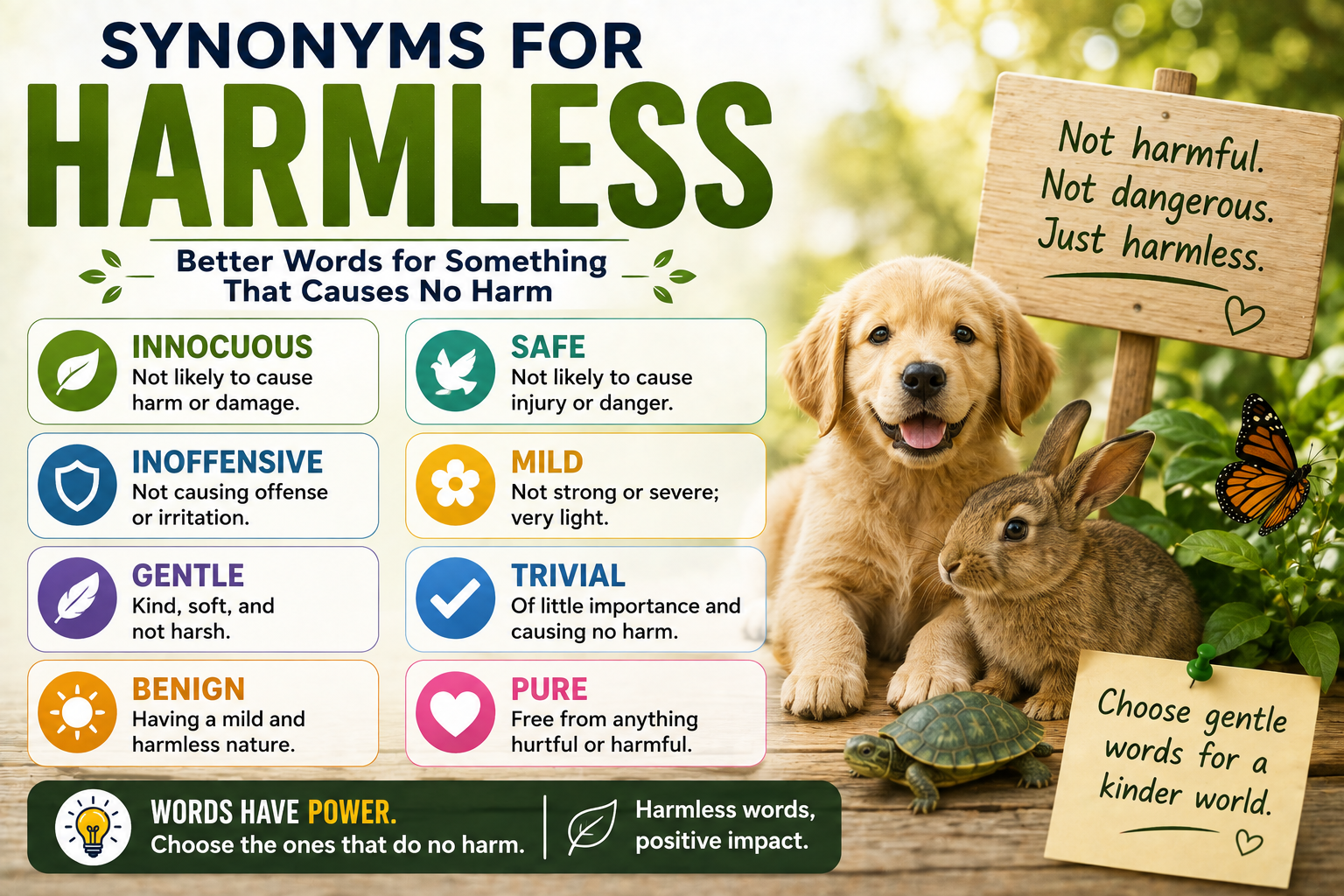
Learning synonyms for harmless gives you more ways to express the same idea. For example, safe is useful when there is no danger, while innocent often describes a person, action, or intention with no bad purpose. Benign is more formal and is common in medical and technical writing.
This guide explains the meaning, history, pronunciation, grammar, and 30 useful synonyms for harmless, with simple examples to help you choose the right word.
Meaning of Harmless
Definition
Harmless (Adjective): Not causing, or not likely to cause, injury, damage, or trouble.
Examples
- The little puppy looked harmless.
- His joke was completely harmless.
Connotative Meaning
Connotation means the feeling or idea connected with a word beyond its basic meaning.
- Positive tone: Safe, gentle, peaceful, and non-threatening.
- Negative tone: It can sometimes suggest that something is weak or unimportant.
- Neutral tone: Simply describes something that does not cause harm.
Etymology
The word harmless comes from the older word harm, combined with the suffix -less, meaning “without.”
- Old English (450–1100): Harm came from Old English hearm, meaning injury, pain, or evil.
- Middle English (1100–1500): The forms harm and harme were used for injury, suffering, or damage.
- Modern English (1500–Present): Harmless developed as a clear compound meaning “without harm” or “not causing harm.”
The structure is simple:
harm + less = harmless
The suffix -less is also found in words such as careless, fearless, and endless.
Pronunciation (IPA)
- IPA: /ˈhɑːrmləs/ (British English), /ˈhɑːrmləs/ (American English)
- Syllables: harm-less
The stress falls on the first syllable: HARM-less.
Affixation Pattern of Harmless
- Root: harm
- Prefix: none
- Suffix: -less
Word formations
- harm — noun/verb
- harmful — adjective
- harmless — adjective
- harmlessly — adverb
- harmlessness — noun
- harmed — verb
- harming — verb
- harmer — noun, less common
30 Synonyms of Harmless With Meaning & Examples
1. Safe (Adjective)
Meaning: Not likely to cause injury, danger, or damage.
Examples:
- This area is safe for children.
- The medicine is considered safe when used correctly.
2. Innocuous (Adjective)
Meaning: Not harmful, offensive, or dangerous.
Examples:
- It was an innocuous question.
- The comment seemed innocuous at first.
3. Innocent (Adjective)
Meaning: Not intending to cause harm or do something wrong.
Examples:
- It was an innocent mistake.
- She asked an innocent question.
4. Benign (Adjective)
Meaning: Gentle and not harmful or dangerous.
Examples:
- The doctor said the growth was benign.
- It was a benign condition.
5. Nonthreatening (Adjective)
Meaning: Not appearing dangerous or likely to cause harm.
Examples:
- The animal looked nonthreatening.
- His calm voice was nonthreatening.
6. Nonviolent (Adjective)
Meaning: Not involving physical force or violence.
Examples:
- The group supports nonviolent protests.
- They chose a nonviolent solution.
7. Gentle (Adjective)
Meaning: Kind, mild, or unlikely to cause pain or harm.
Examples:
- Use a gentle soap on your skin.
- The dog has a very gentle nature.
8. Mild (Adjective)
Meaning: Not strong, severe, or harmful.
Examples:
- He had a mild reaction.
- The treatment caused only mild discomfort.
9. Innocent-Looking (Adjective)
Meaning: Appearing safe, harmless, or without bad intentions.
Examples:
- It was an innocent-looking device.
- The man had an innocent-looking smile.
10. Peaceful (Adjective)
Meaning: Calm and free from violence or conflict.
Examples:
- The demonstration was peaceful.
- We spent a peaceful afternoon at home.
11. Inoffensive (Adjective)
Meaning: Not likely to upset, hurt, or offend anyone.
Examples:
- His comment was inoffensive.
- She made an inoffensive joke.
12. Unthreatening (Adjective)
Meaning: Not presenting a danger or threat.
Examples:
- The stranger seemed unthreatening.
- The animal appeared unthreatening from a distance.
13. Non-dangerous (Adjective)
Meaning: Not dangerous or likely to cause harm.
Examples:
- The substance is non-dangerous in small amounts.
- The machine was tested and found non-dangerous.
14. Tame (Adjective)
Meaning: Not wild, aggressive, or dangerous.
Examples:
- The bird was completely tame.
- The horse is calm and tame.
15. Docile (Adjective)
Meaning: Calm and easy to control.
Examples:
- The animal was quiet and docile.
- The normally wild horse became docile around people.
16. Passive (Adjective)
Meaning: Not aggressive or likely to fight back.
Examples:
- The animal remained passive.
- He took a passive approach to the dispute.
17. Amicable (Adjective)
Meaning: Friendly and peaceful rather than hostile.
Examples:
- They reached an amicable agreement.
- The meeting ended on an amicable note.
18. Peaceable (Adjective)
Meaning: Calm and free from violence or conflict.
Examples:
- They found a peaceable solution.
- The community remained peaceable throughout the event.
19. Unobjectionable (Adjective)
Meaning: Not likely to cause disagreement, offense, or concern.
Examples:
- The suggestion was unobjectionable.
- His proposal seemed unobjectionable to everyone.
20. Unproblematic (Adjective)
Meaning: Not causing problems or difficulty.
Examples:
- The repair was unproblematic.
- The process was simple and unproblematic.
21. Noninjurious (Adjective)
Meaning: Not causing physical injury or harm.
Examples:
- The exercise is noninjurious when done correctly.
- The treatment was considered noninjurious.
22. Neutral (Adjective)
Meaning: Not supporting or attacking either side.
Examples:
- The country remained neutral during the dispute.
- He gave a neutral response.
23. Friendly (Adjective)
Meaning: Kind, pleasant, and not hostile.
Examples:
- The dog was very friendly.
- She gave us a friendly smile.
24. Kind (Adjective)
Meaning: Caring and not intending to hurt others.
Examples:
- He is a kind person.
- She gave me some kind advice.
25. Considerate (Adjective)
Meaning: Careful about other people’s feelings and needs.
Examples:
- It was considerate of him to call first.
- She is always considerate toward others.
26. Gentlehearted (Adjective)
Meaning: Kind, caring, and unlikely to hurt others.
Examples:
- He is a gentlehearted person.
- Her gentlehearted nature made people trust her.
27. Nonmalignant (Adjective)
Meaning: Not cancerous or harmful in a medical context.
Examples:
- The test showed a nonmalignant tumor.
- The doctor confirmed that the growth was nonmalignant.
28. Benignant (Adjective)
Meaning: Kind, gentle, and favorable.
Examples:
- The leader had a benignant manner.
- His benignant attitude made the staff feel comfortable.
29. Innocent-Minded (Adjective)
Meaning: Having simple, pure, or non-harmful thoughts.
Examples:
- The child was innocent-minded and curious.
- Her innocent-minded nature made her trust others easily.
30. Unharmful (Adjective)
Meaning: Not causing harm or injury.
Examples:
- The substance is generally unharmful.
- The activity is unharmful when proper care is taken.
Prototype Meaning
The most typical meaning of harmless is safe and not likely to cause harm. When people hear this word, they often imagine something that looks safe, gentle, or non-threatening.
A harmless joke does not hurt someone’s feelings. A harmless animal does not pose a danger. A harmless mistake causes little or no damage.
The core idea is simple: nothing bad or dangerous is expected to happen.
Prototype Categorization
The 30 synonyms can be placed into useful semantic groups. This helps you select a word that matches the exact meaning you want.
- Safety and lack of danger:
safe, innocuous, benign, nonthreatening, unthreatening, non-dangerous - Kindness and gentle behavior:
gentle, kind, friendly, considerate, gentlehearted, benignant - Peace and lack of violence:
peaceful, nonviolent, peaceable, passive, amicable - Medical and technical contexts:
benign, noninjurious, nonmalignant, unharmful - Lack of offense or problems:
inoffensive, unobjectionable, unproblematic, innocent - Animals and behavior:
tame, docile, nonthreatening, gentle
This categorization helps writers avoid using a synonym that sounds unnatural. For example, benign works well in medical writing, while friendly is better for describing a person or animal.
Antonyms of Harmless
1. Harmful (Adjective)
Causing or likely to cause damage or injury.
2. Dangerous (Adjective)
Likely to cause harm or injury.
3. Harmful (Adjective)
Having a damaging or bad effect.
4. Threatening (Adjective)
Showing a risk of danger or harm.
5. Dangerous (Adjective)
Not safe and likely to cause injury or trouble.
6. Malicious (Adjective)
Intending to cause harm or trouble.
7. Harmful (Adjective)
Producing an unwanted or damaging result.
8. Violent (Adjective)
Using or involving physical force intended to hurt someone.
Short Questions and Answers
What does harmless mean?
Harmless means not causing harm, injury, damage, or trouble. It describes something that is safe or not dangerous.
When should harmless be used?
Use harmless when you want to say that something does not cause harm. You can use it for people, animals, actions, jokes, substances, mistakes, and situations.
Is harmless positive or negative?
Harmless usually has a positive or neutral tone because it suggests safety. However, the meaning can change slightly with context.
How is harmless different from similar words?
Harmless is a broad word. Safe focuses on the absence of danger, innocent often focuses on intention, and benign is common in medical or formal contexts.
Conclusion
Learning harmless and its synonyms can make your English clearer and more flexible. The word is simple, but its alternatives can express more exact ideas. You can use safe for a lack of danger, innocent for a lack of bad intent, gentle for soft behavior, and benign for medical or formal contexts.
These distinctions help you avoid repetition in essays, emails, stories, reports, and everyday conversations. They also make your writing sound more natural.
For English learners, learning synonyms is a useful way to build vocabulary. Try choosing one synonym each day and writing two sentences with it. Then use the word in a real conversation or piece of writing.
Keep practicing, and you will soon have more words to express simple ideas with confidence.

Sarah Linguist is a passionate language enthusiast who loves exploring words, meanings, and synonyms.
She creates clear, easy-to-understand content to help readers improve their vocabulary and English skills.
Through SynonymsGuide.com, Sarah makes finding the right words simple, useful, and enjoyable.