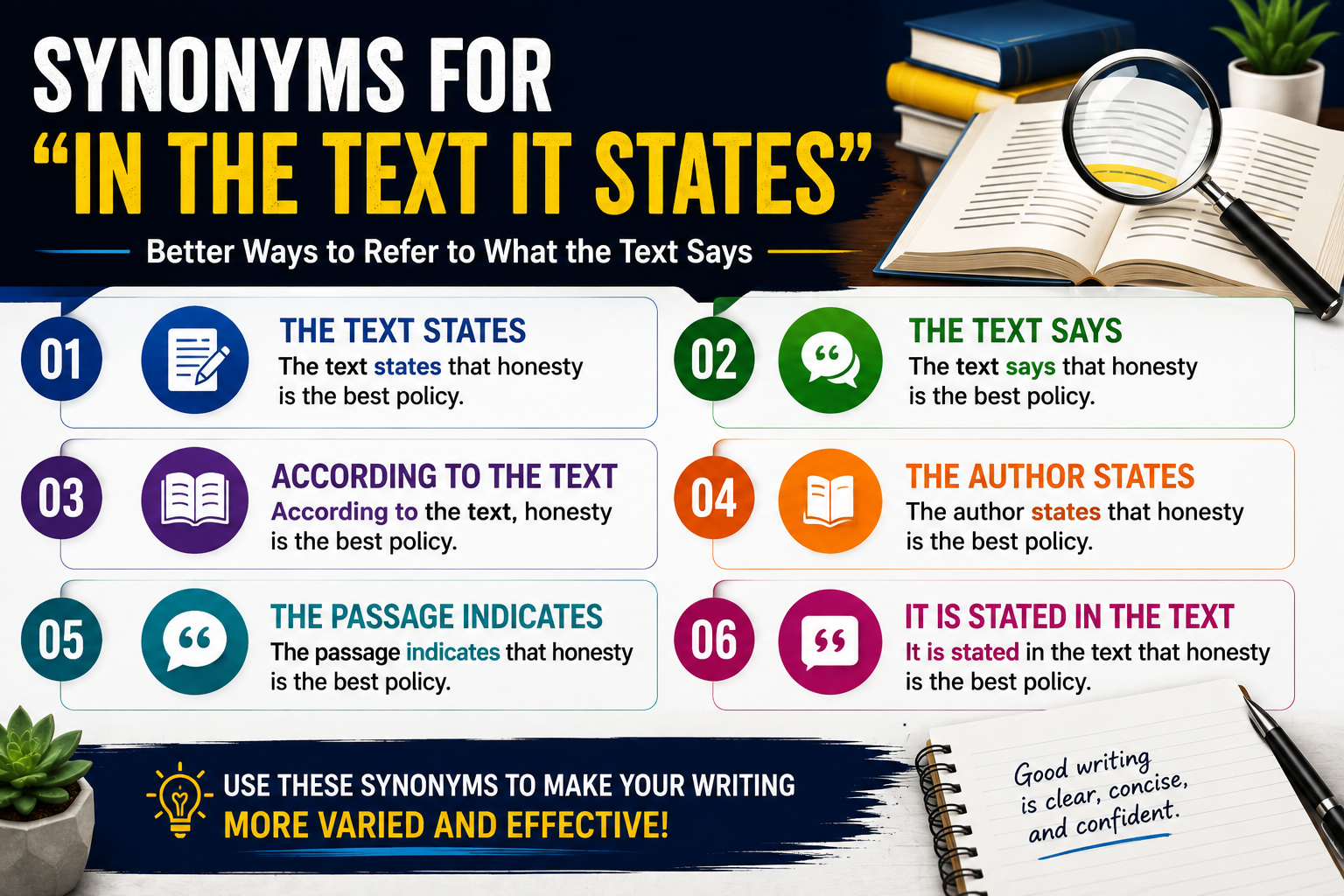
“In the text, it states” can often be replaced with “the text says,” “the text notes,” “the text explains,” “the text indicates,” or “the text mentions.” The best choice depends on how formal and precise you want your writing to be.
Have you ever written, “In the text, it states that…” and then wondered if there is a better way to say it? This is a common question for students, essay writers, and English learners. The phrase is understandable, but it can sometimes sound wordy because “in the text” already tells the reader where the information comes from.
In my experience helping learners improve their English writing, small changes like this can make a sentence sound much more natural. For example, instead of saying, “In the text, it states that the man was unhappy,” you can simply write, “The text states that the man was unhappy.” You can also choose says, explains, notes, reveals, shows, or indicates, depending on the meaning.
This guide explains useful synonyms and sentence patterns for “in the text it states.” You will learn the differences between them, when to use each one, common mistakes, and practical examples for essays, reports, and everyday writing.
“In the text it states” – Quick Answer
The phrase “in the text it states” means that the written material gives or expresses certain information.
However, the phrase is often more natural as:
- The text states that…
- The text says that…
- The text notes that…
- The text explains that…
- The text indicates that…
- The text mentions that…
Simple examples
Less natural:
In the text, it states that the character is afraid.
Better:
The text states that the character is afraid.
Also natural:
The text shows that the character is afraid.
The best version depends on whether the text directly says, explains, suggests, or shows something.
The Origin / Background of “In the Text It States”
The phrase contains several common English words.
Text comes from Latin textus, meaning “that which is woven.” The idea later developed into something written or composed from connected words.
State comes from Latin status, meaning “condition,” “position,” or “standing.” In English, the verb state developed the meaning “to express something clearly.”
The structure “it states” is the third-person singular form of the verb state.
For example:
The article states that exercise can improve health.
The phrase “in the text” acts as a prepositional phrase. It tells the reader where the information appears.
This is why “in the text it states” can feel slightly awkward. English often prefers putting the source first:
The text states…
rather than:
In the text, it states…
The second version is not always grammatically wrong, but it can be unnecessarily indirect.
“In the Text It States” Explained — Key Differences
Different alternatives carry different meanings. You should not replace states with any word at random.
| Term | Meaning | When to Use | Region/Context |
|---|---|---|---|
| The text states | Gives information directly | Formal writing | Academic/general |
| The text says | Gives information | Simple writing | Everyday/general |
| The text notes | Points out information | Reports and essays | Formal/general |
| The text explains | Makes an idea clear | When giving reasons/details | Academic/general |
| The text indicates | Shows or suggests | Evidence and data | Formal/academic |
| The text mentions | Refers to something briefly | Small details | General |
| The text describes | Gives details about something | People, places, events | General |
| The text reveals | Makes something known | New information | General/formal |
| The text shows | Gives evidence of something | Analysis | Academic/general |
| The text argues | Presents a reasoned position | Persuasive writing | Academic |
| The text claims | Says something is true | Claims needing support | Academic/general |
| The text emphasizes | Gives special importance | Main ideas | Academic |
| The text highlights | Draws attention to something | Key points | General/formal |
| The text suggests | Gives an indirect idea | Implied meaning | Academic/general |
| The text confirms | Shows something is true | Supporting evidence | Formal/general |
“States” vs. “Says”
States sounds more formal.
The report states that the policy will change.
Says is simpler and more conversational.
The report says that the policy will change.
For an academic essay, states is often a good choice. For simple English, says is perfectly natural.
“States” vs. “Indicates”
These words are not always interchangeable.
States means the source directly expresses information.
The report states that sales increased.
Indicates means the evidence points toward a conclusion.
The data indicates that sales increased.
Use indicates when the information is evidence or a sign.
“States” vs. “Suggests”
Suggests is weaker than states.
The article states that the plan failed.
This means the article directly says it.
The article suggests that the plan failed.
This means the article gives clues or ideas that lead you to that conclusion.
Which Version / Approach Should You Use?
Your best choice depends on your audience.
For students
Use:
- The text says…
- The text explains…
- The text shows…
- The text describes…
These are clear and easy to understand.
For academic writing
Use:
- The text states…
- The author argues…
- The text indicates…
- The author suggests…
- The study demonstrates…
These options can make analytical writing more precise.
For formal reports
Use:
- The report states…
- The report indicates…
- The report notes…
- The report confirms…
- The report identifies…
These phrases work well when discussing evidence or findings.
For global and neutral English
The safest choices are:
The text states that…
and
The text says that…
Both are easy to understand.
Best general recommendation
If you are writing an essay, avoid repeating “in the text, it states.”
Instead, write:
The text states that…
This is shorter, cleaner, and more direct.
Common Mistakes with “In the Text It States”
1. Repeating “text” and “it”
Weak:
In the text, it states that the character is brave.
Better:
The text states that the character is brave.
The source itself can be the subject of states.
2. Using “states” when the idea is only implied
Incorrect meaning:
The text states that the character is lonely.
If the text never directly says this, suggests or shows may be better.
Better:
The text suggests that the character is lonely.
3. Using “mentions” for a major argument
Weak:
The article mentions that climate change is a major concern.
If this is the article’s main point, argues, states, or emphasizes may be stronger.
4. Using “claims” without considering tone
Example:
The article claims that the treatment works.
Claims can suggest that the statement may need proof.
If the evidence is well established, states, reports, or confirms may be more suitable.
5. Starting every sentence with “The text states”
This creates repetition.
Instead, vary your verbs:
- The text explains…
- The author argues…
- The passage suggests…
- The article highlights…
- The report indicates…
“In the Text It States” in Real-World Examples
Professional email
The report states that the project deadline has been moved to Friday.
This is clear and professional.
A shorter version is:
The report notes that the project deadline has been moved to Friday.
News article
The report indicates that prices may continue to rise next year.
Here, indicates works because the report provides evidence rather than simply making a direct statement.
Social media post
The article says that the new rule will start next month.
Says is natural in a casual post.
Formal document or report
The policy states that employees must complete the training before starting work.
This is a strong choice because states fits rules, policies, and official documents.
Literary analysis
The passage suggests that the character feels isolated.
Here, suggests is better than states if the feeling is implied rather than directly expressed.
“In the Text It States” — Data, Trends & Usage
The search intent behind “synonyms for in the text it states” is mainly informational. People searching this phrase are usually looking for a better way to discuss evidence from a passage, article, essay, report, or source.
This type of wording is especially common among students and English learners. They often need alternatives for repetitive phrases such as:
- “The text states…”
- “The author states…”
- “The article states…”
- “The passage states…”
The key writing lesson is that the best alternative depends on the relationship between the source and the information.
If the source directly gives the information, use states or says.
If the source gives clues, use suggests or indicates.
If the source gives reasons, use explains or argues.
If the source draws attention to something, use highlights or emphasizes.
That approach gives your writing more variety without changing the meaning.
Standalone Comparison Table
| Term/Variant | Meaning | Region/Context | Best Used When |
|---|---|---|---|
| The text states | Directly gives information | Academic/formal | Reporting a clear statement |
| The text says | Gives information | General | Simple writing |
| The text notes | Points out information | Academic/formal | Mentioning a fact |
| The text explains | Makes something clear | Academic/general | Explaining an idea |
| The text indicates | Shows or points toward something | Academic/formal | Discussing evidence |
| The text mentions | Refers to something | General | Brief references |
| The text describes | Gives details | General | Describing content |
| The text reveals | Makes something known | General | New information |
| The text shows | Provides evidence | Academic/general | Text analysis |
| The text argues | Supports an idea with reasons | Academic | Arguments |
| The text claims | Presents something as true | General/academic | Claims |
| The text emphasizes | Gives special importance | Academic | Main ideas |
| The text highlights | Draws attention | General/formal | Important points |
| The text suggests | Gives an indirect idea | Academic/general | Implied meanings |
| The text confirms | Supports something as true | Formal | Evidence |
Frequently Asked Questions
Q: What does “synonyms for in the text it states” mean?
A: It usually means alternative ways to say “in the text, it states.” Common options include “the text says,” “the text notes,” “the text explains,” and “the text indicates.”
Q: How do you use “the text states” correctly?
A: Use “the text states” when the written source directly gives information. For example: “The text states that the character left home.”
Q: Is “in the text, it states” grammatically correct?
A: It can be understood, but it is often less direct than “the text states.” The cleaner version is usually “The text states that…”
Q: What is the difference between “the text states” and “the text says”?
A: Both can mean that the text gives information. States is more formal, while says is simpler and more conversational.
Q: Is “the text states” acceptable in formal writing?
A: Yes. It is common in academic, professional, and formal writing. However, a more specific verb such as indicates, explains, argues, or confirms may be better when it describes the source more precisely.
Q: What can I use instead of “the text states”?
A: You can use the text says, notes, explains, indicates, mentions, describes, reveals, shows, suggests, argues, claims, emphasizes, or highlights.
Q: Should I use “states” or “suggests” in literary analysis?
A: Use states when the text directly gives the information. Use suggests when the reader must infer the meaning from clues or details.
Conclusion
Finding good synonyms for in the text it states is really about choosing the right level of meaning. The simplest option is often “the text says.” For formal writing, “the text states” is clear and useful. When you need more precision, choose indicates, explains, suggests, argues, confirms, highlights, or reveals.
There is also an important grammar point to remember. “In the text, it states” is often more wordy than necessary. In most cases, “The text states that…” is cleaner and more natural.
Your goal should not be to replace states every time. Instead, choose a verb that tells the reader exactly what the source is doing. Does it give a fact? States. Does it offer evidence? Indicates. Does it give an idea indirectly? Suggests. Does it support an opinion? Argues.
Use these choices in your next essay or report, and your writing will sound clearer, stronger, and less repetitive.
SEO Meta Description
Synonyms for in the text it states explained with clear alternatives, examples, grammar tips, and formal phrases for essays, reports, and analysis.

Emily Watson is an English language writer and vocabulary specialist dedicated to helping readers improve their communication skills. She writes clear, easy-to-understand guides on synonyms, word meanings, grammar, and word usage.