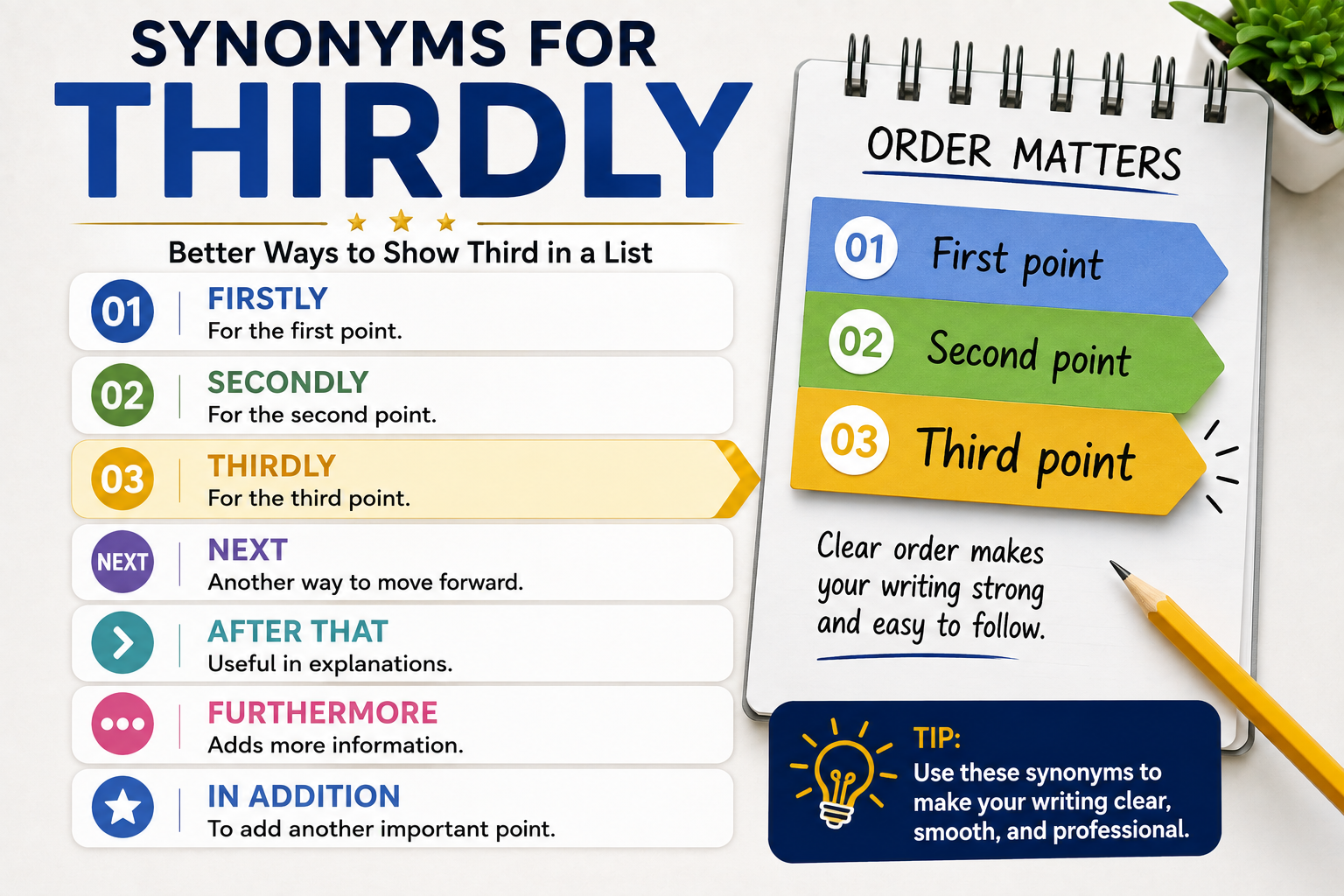
THIRDLY is used to introduce the third point, reason, or item in a list or series. It helps readers follow ideas in a clear order, especially in formal writing and speeches.
Thirdly is a simple word, but it can make your writing much easier to follow. Imagine you are explaining three reasons why students should read every day. You might say, “Firstly, reading builds vocabulary. Secondly, it improves focus. Thirdly, it helps you write better.” The word clearly tells your reader that the third point is coming.
Thirdly is common in formal essays, reports, presentations, and speeches. However, using the same transition again and again can make your writing sound stiff. That is why learning alternatives is useful for English learners, students, and content writers.
Some alternatives are close synonyms. Others are natural transition words and phrases that perform the same job. In this guide, you will learn the meaning, history, pronunciation, grammar, and 30 alternatives to thirdly, with simple examples.
Meaning of THIRDLY
Definition
THIRDLY (Adverb):
Thirdly means in the third place or as the third point in a series.
It is a sequencing adverb. It shows the order of an idea, reason, event, or argument.
Examples
- Thirdly, we need to consider the cost.
- Thirdly, regular exercise can improve your energy levels.
Connotative Meaning
Connotation means the feeling or idea that a word suggests beyond its basic meaning.
- Positive tone: Thirdly can make writing feel organized and logical.
- Negative tone: It can sometimes sound formal or old-fashioned when overused.
- Neutral tone: It simply shows that something is the third point.
Etymology
The word thirdly comes from third + -ly.
Old English (450–1100)
The word third developed from Old English þridda, meaning “third.” It was related to older Germanic words for the third position.
Middle English (1100–1500)
During Middle English, forms such as thridde and thirde were used. English spelling gradually changed as pronunciation and writing practices developed.
Modern English (1500–Present)
Thirdly developed as the adverbial form of third. The suffix -ly turns an adjective or ordinal form into an adverb that can show manner or position.
Today, thirdly is mainly used to introduce the third item in an ordered list.
Pronunciation (IPA)
- IPA: /ˈθɜːrd.li/ in British English; /ˈθɝːd.li/ in American English
- Syllables: third-ly
- Stress: The first syllable is stressed.
Affixation Pattern of THIRDLY
- Root: third
- Prefix: None
- Suffix: -ly
- Word formation: third + ly → thirdly
Related word formations
- third — adjective/noun/ordinal
- thirds — noun
- thirdly — adverb
- third-place — compound noun/adjective
- third-rate — adjective
- third-class — adjective/noun
The most direct formation is third + -ly = thirdly.
30 Synonyms of THIRDLY With Meaning & Examples
Note: Not every word below is a dictionary synonym of thirdly. Some are natural alternatives for introducing a third point. This distinction matters because English has only a small number of exact synonyms for thirdly.
1. Third (Adverb)
Meaning: In the third position or as the third point.
Examples:
- Third, we should review the results.
- Third, the plan needs more testing.
2. In the Third Place (Phrase)
Meaning: Used to introduce the third point in a list.
Examples:
- In the third place, we need better training.
- In the third place, consider the long-term cost.
3. As a Third Point (Phrase)
Meaning: Used to introduce another point that comes third.
Examples:
- As a third point, we should discuss safety.
- As a third point, the report mentions staffing.
4. Thirdly Speaking (Phrase)
Meaning: A formal phrase used to introduce a third idea.
Examples:
- Thirdly speaking, the policy needs review.
- Thirdly speaking, we must consider the risks.
5. Next (Adverb)
Meaning: Used to introduce the following point or step.
Examples:
- Next, we need to discuss the budget.
- Next, check the final paragraph.
6. Then (Adverb)
Meaning: Used to show what comes after something else.
Examples:
- First, collect the data. Then, study it.
- We discussed the plan and then reviewed the costs.
7. After That (Phrase)
Meaning: Following the point or event just mentioned.
Examples:
- We checked the figures. After that, we reviewed the report.
- First, finish the task. After that, contact your manager.
8. Following This (Phrase)
Meaning: Used to introduce something that comes next.
Examples:
- Following this, we examined the results.
- Following this, the team changed its plan.
9. Subsequently (Adverb)
Meaning: After something else has happened.
Examples:
- The team tested the system and subsequently improved it.
- The company subsequently changed its policy.
10. Thereafter (Adverb)
Meaning: After that time or event.
Examples:
- The contract was signed, and thereafter the work began.
- The rules changed, and thereafter all staff followed them.
11. In Addition (Phrase)
Meaning: Used to add another point.
Examples:
- In addition, the plan saves money.
- In addition, it reduces waste.
12. Furthermore (Adverb)
Meaning: Used to add another important point.
Examples:
- Furthermore, the method is easy to use.
- Furthermore, it requires little training.
13. Moreover (Adverb)
Meaning: Used to add another strong or important point.
Examples:
- Moreover, the plan is affordable.
- Moreover, it can save time.
14. Also (Adverb)
Meaning: Used to add another fact or idea.
Examples:
- Also, the new system is faster.
- Also, it is easier to maintain.
15. Besides (Adverb)
Meaning: Used to add another reason or point.
Examples:
- Besides, the journey is too long.
- Besides, we already have enough supplies.
16. Additionally (Adverb)
Meaning: Used to introduce extra information.
Examples:
- Additionally, the service is available online.
- Additionally, users can save their work.
17. Another Point Is (Phrase)
Meaning: Used to introduce another idea.
Examples:
- Another point is that the process takes time.
- Another point is the lack of staff.
18. Another Consideration Is (Phrase)
Meaning: Used to introduce another factor to think about.
Examples:
- Another consideration is the total cost.
- Another consideration is customer safety.
19. A Third Consideration (Noun Phrase)
Meaning: A third factor that should be considered.
Examples:
- A third consideration is the available space.
- A third consideration is the delivery time.
20. A Third Point (Noun Phrase)
Meaning: The third idea in a discussion.
Examples:
- A third point is the need for better planning.
- A third point concerns employee training.
21. Third on the List (Phrase)
Meaning: Something that appears in the third position.
Examples:
- Third on the list is customer service.
- Third on the list is the cost of materials.
22. In Third Position (Phrase)
Meaning: Being third in an order or ranking.
Examples:
- Our team finished in third position.
- The product ranked in third position.
23. At Number Three (Phrase)
Meaning: Used to identify something as number three.
Examples:
- At number three is the most popular choice.
- At number three on our list is email marketing.
24. Number Three (Noun Phrase)
Meaning: The item that comes third.
Examples:
- Number three is the easiest option.
- Let’s move to number three on the agenda.
25. The Third Item (Noun Phrase)
Meaning: The item that appears after the first two.
Examples:
- The third item needs more attention.
- We will discuss the third item next.
26. The Third Step (Noun Phrase)
Meaning: The action that comes after the first two steps.
Examples:
- The third step is to check your work.
- Complete the third step before moving on.
27. Third in Order (Phrase)
Meaning: Coming after two earlier items.
Examples:
- This factor is third in order.
- The final issue is third in order on the agenda.
28. To Begin With… Then… Finally… (Transition Pattern)
Meaning: A sequence pattern used to organize several ideas.
Examples:
- To begin with, check the data. Then, review the results.
- To begin with, plan the work. Then, complete each step.
29. For a Third Reason (Phrase)
Meaning: Used to introduce a third reason.
Examples:
- For a third reason, the plan is easier to manage.
- We rejected the idea for a third reason: it was too expensive.
30. As a Final Point in the Sequence (Phrase)
Meaning: Used to identify a point that comes after two earlier points.
Examples:
- As a final point in the sequence, we should review the results.
- As a final point in the sequence, check the figures again.
Prototype Meaning
The most typical meaning of thirdly is “as the third point in a series.” When people hear thirdly, they usually expect that two earlier points have already been given. For example, a speaker may say, “Firstly, the plan is cheap. Secondly, it is simple. Thirdly, it saves time.” The word acts like a signpost. It tells the reader or listener where they are in the sequence.
Prototype Categorization
The 30 alternatives can be grouped by meaning and use. This helps you pick a phrase that fits your sentence instead of replacing thirdly with a word that does not have the same function.
- Direct third-point markers:third, in the third place, as a third point, thirdly speaking
- These are closest to thirdly.
- Use them when you clearly need to mark the third idea.
- Sequence markers:next, then, after that, following this, subsequently, thereafter
- These show order.
- They do not always mean “third,” so use them when the exact position is not important.
- Addition markers:in addition, furthermore, moreover, also, besides, additionally
- These add information.
- They are useful when you want smoother writing without strict numbering.
- Third-point phrases:a third point, a third consideration, the third item, the third step
- These clearly identify the third idea.
- They work well in reports, essays, and instructions.
- Ranking and position phrases:third on the list, in third position, at number three, number three
- These are best for lists, rankings, and ordered information.
Choosing the right category makes your writing more natural. You do not always need firstly, secondly, thirdly. Sometimes a simple transition sounds much better.
Antonyms of THIRDLY
Because thirdly is a sequencing word, it has no perfect opposite. However, these words express different positions in a sequence:
Firstly (Adverb)
Meaning: As the first point or item.
Secondly (Adverb)
Meaning: As the second point or item.
Initially (Adverb)
Meaning: At the beginning.
Finally (Adverb)
Meaning: At the end of a sequence.
Last (Adverb)
Meaning: After all other points or items.
Short Questions and Answers
What does thirdly mean?
Thirdly means in the third place or as the third point in a series. It is commonly used to organize ideas in formal writing and speech.
When should thirdly be used?
Use thirdly when you have already given two points and want to introduce the third. For example: “Firstly, it is cheap. Secondly, it is simple. Thirdly, it saves time.”
Is thirdly positive or negative?
Thirdly is neutral. It does not express a positive or negative feeling by itself. Its tone depends on the sentence and the ideas around it.
How is thirdly different from similar words?
Thirdly specifically marks the third point. Words such as next and then show sequence but do not always mean that something is third.
Is thirdly formal?
Yes. Thirdly is common in formal essays, reports, presentations, and speeches. In casual conversation, third or another point may sound more natural.
Can I use “third” instead of “thirdly”?
Yes. Third can work as a transition in many sentences. For example, “Third, we need to check the figures” is natural and often sounds more direct than “Thirdly, we need to check the figures.”
Should I always use firstly, secondly, and thirdly together?
No. You can use them together, but you do not have to. Mixing transitions such as first, next, another point, and finally can make your writing smoother.
Conclusion
Learning thirdly and its alternatives can make your English clearer and more flexible. Thirdly is useful when you need to introduce the third point in an ordered list. However, you have many other choices, such as third, in the third place, a third point, another consideration, and additionally.
The best choice depends on your sentence and the level of formality you want. Use thirdly when a clear numbered structure is helpful. Use other transitions when you want your writing to feel more natural and varied.
For English learners and content writers, learning these alternatives can improve vocabulary, strengthen writing and speaking, and reduce repetition. It also helps you express ideas with greater confidence.
Practice one or two new alternatives each day, and soon your writing will sound clearer, richer, and more natural.

Sarah Linguist is a passionate language enthusiast who loves exploring words, meanings, and synonyms.
She creates clear, easy-to-understand content to help readers improve their vocabulary and English skills.
Through SynonymsGuide.com, Sarah makes finding the right words simple, useful, and enjoyable.