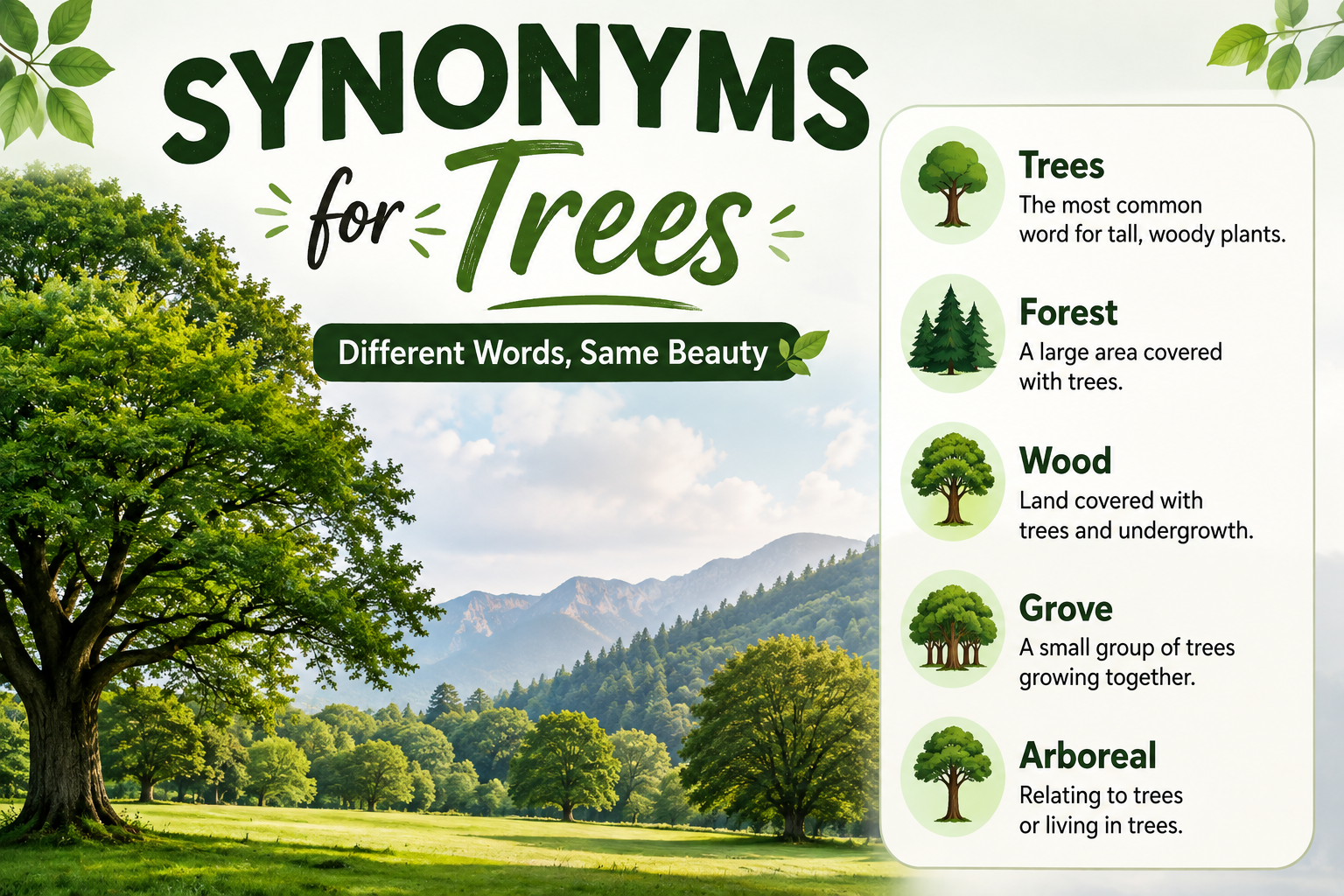
Trees are tall plants with woody stems, branches, leaves, and roots. You see them in forests, parks, gardens, streets, and fields. A tree can provide shade, fruit, wood, shelter, and beauty.
The word trees is common in everyday English, but using the same word again and again can make your writing feel dull. Learning synonyms helps English learners and content writers add variety and choose words that fit the exact meaning they want. Some alternatives describe trees by their size, age, type, or setting. Others refer to groups of trees or specific kinds of woody plants. In this guide, you will learn 30 synonyms and related alternatives for trees, with simple meanings and examples. You will also learn their history, pronunciation, grammar, and semantic categories.
Meaning of Trees
Definition
Trees (Noun, plural): Woody plants that usually have a main stem or trunk, branches, leaves, and roots.
The singular form is tree.
Examples
- Tall trees lined both sides of the road.
- The children played beneath the trees in the park.
Connotative Meaning
Connotation: The feelings or ideas that a word suggests beyond its basic meaning.
- Positive tone: Trees can suggest life, nature, peace, growth, and beauty.
- Negative tone: In some contexts, trees may suggest darkness, danger, or an obstacle.
- Neutral tone: Trees can simply refer to woody plants without an emotional meaning.
Etymology
The word tree has a very old history in English.
- Old English (450–1100): Trēow or trēo meant tree and could also refer to wood.
- Middle English (1100–1500): The word developed into forms such as tre and tree.
- Modern English (1500–Present): Tree became the standard modern form. Its plural is trees.
The word is also related to older Germanic words found in other Germanic languages.
Pronunciation (IPA)
- IPA: /triːz/
- Syllables: trees — 1 syllable
The singular tree is pronounced /triː/.
The final s in trees sounds like /z/.
Affixation Pattern of Trees
- Root: tree
- Prefix: None
- Suffix: -s — plural marker
- Word formations:
- tree — noun
- trees — plural noun
- treeless — adjective
- tree-like — adjective
- treeing — verb/noun in specific contexts
- tree-lined — adjective
- treehouse — noun
- tree cover — noun phrase
- treetop — noun
- tree trunk — noun phrase
30 Synonyms of Trees With Meaning & Examples
1. Woods (Noun)
Meaning: A group or area covered mainly by trees.
Examples:
- We walked through the woods after lunch.
- The deer disappeared into the woods.
2. Timber (Noun)
Meaning: Trees or wood considered as a useful natural resource.
Examples:
- The region has large timber resources.
- The company manages timber forests carefully.
3. Saplings (Noun)
Meaning: Young trees that are still growing.
Examples:
- Volunteers planted hundreds of saplings.
- The young saplings need regular water.
4. Seedlings (Noun)
Meaning: Very young plants that have grown from seeds.
Examples:
- The gardener planted several tree seedlings.
- The seedlings were protected from strong winds.
5. Trees (Noun)
Meaning: The standard plural word for more than one tree.
Examples:
- The trees provide shade.
- Many trees grow near the river.
6. Forests (Noun)
Meaning: Large areas covered mainly by trees and other plants.
Examples:
- Tropical forests support many animals.
- We traveled through dense forests.
7. Groves (Noun)
Meaning: Small groups of trees growing together.
Examples:
- An olive grove stood behind the house.
- We rested in a shady grove.
8. Orchards (Noun)
Meaning: Areas where fruit trees are grown.
Examples:
- The apple orchards were full of blossoms.
- Farmers manage large citrus orchards.
9. Plantings (Noun)
Meaning: Groups of plants or trees that have been planted in an area.
Examples:
- New tree plantings improved the park.
- The city increased its roadside plantings.
10. Vegetation (Noun)
Meaning: Plants growing in a particular area.
Examples:
- Thick vegetation covered the hillside.
- The area has dense natural vegetation.
11. Flora (Noun)
Meaning: The plant life found in a particular place.
Examples:
- The island has unusual flora.
- Researchers studied the local flora.
12. Canopy (Noun)
Meaning: A layer or covering formed by the tops and branches of trees.
Examples:
- Birds moved through the forest canopy.
- The thick canopy blocked much of the sunlight.
13. Stand (Noun)
Meaning: A group of trees growing in a particular area.
Examples:
- A stand of pine trees covered the hill.
- The forest contains a large stand of oak.
14. Plantation (Noun)
Meaning: A large area where trees are deliberately grown, often for commercial use.
Examples:
- The region has a large tea and tree plantation.
- The company manages a commercial tree plantation.
15. Timberland (Noun)
Meaning: Land covered with trees that can be used for timber.
Examples:
- The family owns several acres of timberland.
- Much of the region is protected timberland.
16. Woodland (Noun)
Meaning: Land covered with trees, usually smaller or less dense than a forest.
Examples:
- A quiet woodland surrounded the village.
- We followed a path through the woodland.
17. Copse (Noun)
Meaning: A small group of trees growing close together.
Examples:
- A small copse stood beside the field.
- The fox hid in a nearby copse.
18. Thicket (Noun)
Meaning: A dense group of bushes, shrubs, or small trees.
Examples:
- The rabbit ran into the thicket.
- We could not see through the dense thicket.
19. Bushes (Noun)
Meaning: Woody plants that are usually shorter and more spread out than trees.
Examples:
- Birds nested in the bushes.
- The garden has trees and bushes.
20. Shrubs (Noun)
Meaning: Small woody plants that usually have several stems.
Examples:
- The garden contains flowering shrubs.
- Small shrubs grew beneath the larger trees.
21. Evergreen Plants (Noun Phrase)
Meaning: Plants that keep their leaves throughout most or all of the year.
Examples:
- The garden has several evergreen plants.
- Evergreen plants add color during winter.
22. Conifers (Noun)
Meaning: Cone-bearing trees and shrubs, often with needle-like leaves.
Examples:
- Pine trees are conifers.
- The mountain slopes are covered with conifers.
23. Hardwood Trees (Noun Phrase)
Meaning: Trees generally classified as hardwood species, often with dense wood.
Examples:
- Oak and maple are common hardwood trees.
- The forest contains many native hardwood trees.
24. Softwood Trees (Noun Phrase)
Meaning: Trees that belong mainly to conifer groups and produce softwood.
Examples:
- Pine and spruce are common softwood trees.
- The area is known for its softwood trees.
25. Fruit Trees (Noun Phrase)
Meaning: Trees that produce edible fruit.
Examples:
- The garden has several fruit trees.
- Farmers planted new fruit trees this year.
26. Native Trees (Noun Phrase)
Meaning: Trees that naturally occur in a particular region.
Examples:
- The park protects many native trees.
- Native trees support local wildlife.
27. Specimens (Noun)
Meaning: Individual plants or trees considered as examples for study or display.
Examples:
- The garden contains rare tree specimens.
- Several old specimens grow near the entrance.
28. Giants (Noun)
Meaning: Very large or impressive trees, used figuratively.
Examples:
- Ancient giants towered over the forest.
- The redwoods are true natural giants.
29. Sentinels (Noun)
Meaning: Trees described figuratively as guards standing watch.
Examples:
- Tall trees stood like sentinels along the road.
- The ancient trees looked like silent sentinels.
30. Greenery (Noun)
Meaning: Green plants and leaves, especially when viewed as a group.
Examples:
- The garden was surrounded by lush greenery.
- New greenery made the street look more attractive.
Prototype Meaning
The most typical meaning of trees is large, woody plants with trunks, branches, leaves, and roots. When most people hear the word, they picture a tall plant standing outdoors, often in a forest, garden, park, or field. A typical tree has a strong trunk and a crown of branches and leaves. The word can refer to many species, from small fruit trees to huge forest trees.
Prototype Categorization
The 30 alternatives above do not all have exactly the same meaning. Some are close synonyms, while others describe groups, types, parts, or figurative ideas connected with trees. This distinction helps you choose the most accurate word.
- General tree-related terms:trees, vegetation, flora, greenery
- Use these when you want a broad reference to plant life.
- Large natural areas:forests, woods, woodland
- These work when talking about areas dominated by trees.
- Small groups of trees:groves, copse, stand, thicket
- Choose these when the trees grow together in a smaller area.
- Young trees:saplings, seedlings
- Use these when age or growth stage matters.
- Commercial or managed trees:timber, timberland, plantation, plantings
- These fit forestry, farming, business, and land-use writing.
- Specific tree groups:orchards, conifers, hardwood trees, softwood trees, fruit trees
- These give readers more exact information about the trees.
- Smaller woody plants:bushes, shrubs
- These are related to trees but are not exact synonyms.
- Descriptive or figurative terms:giants, sentinels, specimens
- These are useful for creative, scientific, or descriptive writing.
Choosing the right category makes your writing more precise. For example, use orchard for fruit trees, but use forest for a large natural area filled with trees.
Antonyms of Trees
There is no single perfect antonym for trees, because the word describes a type of plant. However, these words can express an opposite or contrasting idea in specific contexts.
H3: Treeless (Adjective)
Meaning: Having no trees.
- The landscape was completely treeless.
- The mountain slope is mostly treeless.
H3: Barren (Adjective)
Meaning: Having little or no plant life.
- The land looked barren after the drought.
- The rocky area was almost barren.
H3: Open Land (Noun Phrase)
Meaning: Land without trees or dense vegetation.
- The forest ended at a wide area of open land.
- The animals moved across the open land.
H3: Desert (Noun)
Meaning: A very dry region with little vegetation.
- Few trees grow naturally in the desert.
- The desert landscape was dry and open.
Short Questions and Answers
What does trees mean?
Trees is the plural form of tree. It refers to more than one woody plant with a trunk, branches, leaves, and roots.
When should trees be used?
Use trees when you are talking about two or more individual trees or referring to trees in general.
Is trees positive or negative?
Trees is normally neutral. It can have a positive feeling when connected with nature, shade, beauty, life, or environmental protection.
How is it different from similar words?
Words such as forest, woodland, grove, and orchard describe groups or areas of trees rather than individual trees. Words such as sapling describe young trees, while conifer describes a specific type.
Conclusion
Learning synonyms for trees gives you more ways to describe nature, forests, gardens, farming, and the environment. The basic word trees is clear and useful, but related terms can make your writing more exact and interesting.
For example, forest describes a large tree-covered area, while grove suggests a smaller group. Saplings are young trees, orchards contain fruit trees, and conifers describe a particular group of trees. Words such as giants and sentinels can add a creative touch.
Knowing these differences helps you avoid repetition and choose the word that matches your meaning. It also improves both writing and speaking skills.
Try learning three new tree-related words each day. Use each one in a sentence. With regular practice, your vocabulary will become richer, more natural, and more precise.

Emily Watson is an English language writer and vocabulary specialist dedicated to helping readers improve their communication skills. She writes clear, easy-to-understand guides on synonyms, word meanings, grammar, and word usage.