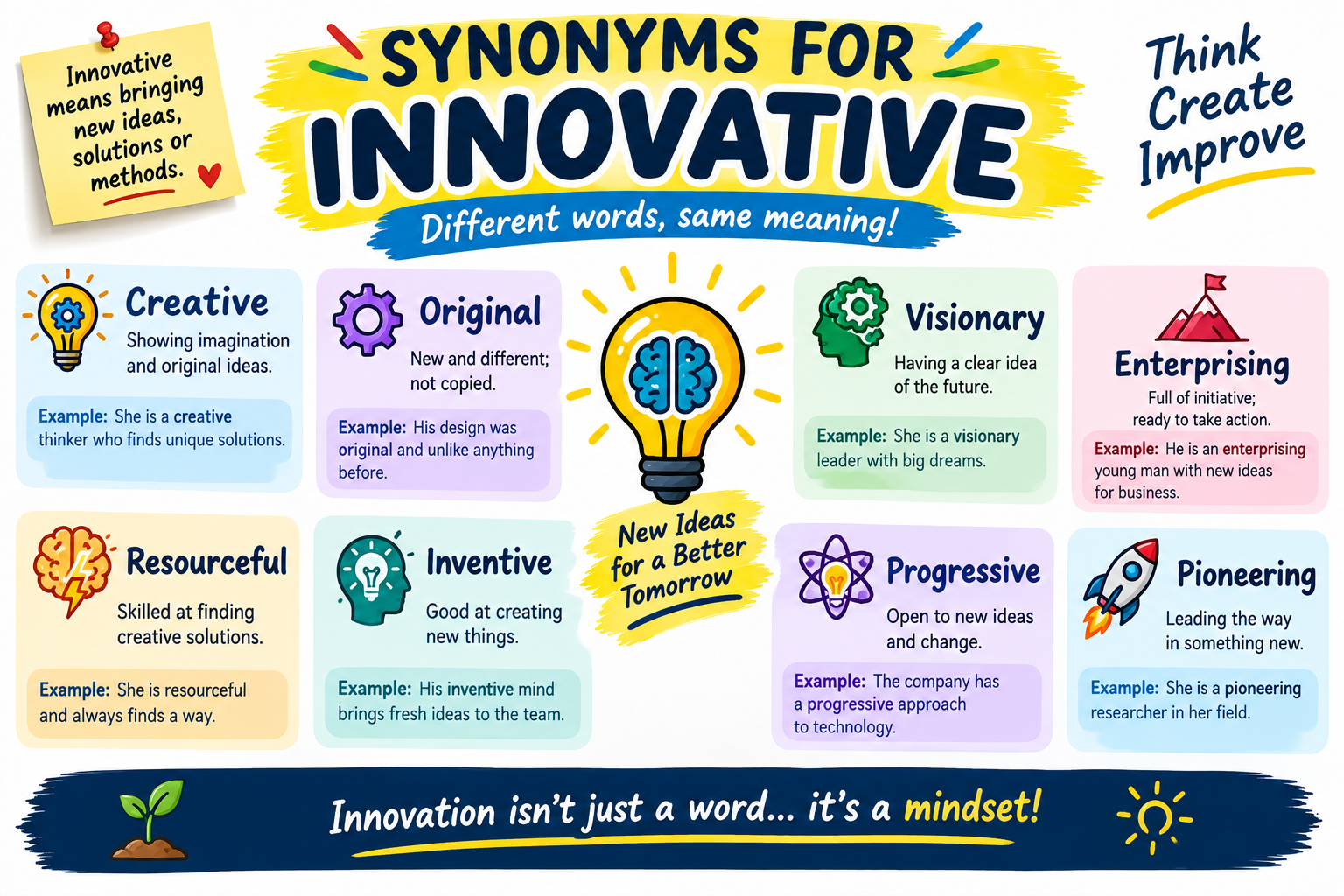
Innovative means using new ideas, methods, or technology to create something better or different. Imagine a company that replaces a slow paper system with a smart app that saves time. That new approach is innovative.
The word is common in business, technology, education, science, design, and everyday writing. However, using the same word again and again can make your writing sound dull. Learning synonyms for innovative gives you more ways to describe fresh ideas and creative solutions. It also helps English learners choose the right word for different situations. In this guide, you will learn the meaning of innovative, its examples, grammar, history, pronunciation, word forms, and 22 useful synonyms. You will also see how these words fit into different semantic categories, so you can choose the best word for your sentence.
Meaning of Innovative
Definition
Innovative (Adjective):
Innovative means using new ideas, methods, or technology in a creative and useful way.
Examples
- The company created an innovative way to reduce plastic waste.
- Her innovative teaching method helped students learn faster.
Connotative Meaning
Connotation means the feeling or idea that a word suggests beyond its basic meaning.
- Positive tone: Innovative usually suggests creativity, progress, improvement, and originality.
- Negative tone: It can sometimes suggest unnecessary change or risky experimentation when a new idea does not work well.
- Neutral tone: In some contexts, it simply describes something new or different without judging whether it is good or bad.
Etymology
The word innovative comes from innovate, which is linked to Latin innovare, meaning “to renew” or “to make new.”
- Old English (450–1100): The modern word innovative was not used in Old English. English speakers used other native words to express ideas such as new, fresh, or change.
- Middle English (1100–1500): Latin-based vocabulary entered English in greater numbers through French and scholarly writing. The word family connected to innovation developed from Latin roots.
- Modern English (1500–Present): Innovate, innovation, and later innovative became established in English. Today, innovative is widely used for new ideas, products, methods, technology, and solutions.
The deeper Latin root is novus, meaning “new.” This root also appears in words such as novel and novelty.
Pronunciation (IPA)
- IPA: /ˈɪnəveɪtɪv/
- Syllables: in-no-va-tive
The main stress falls on the first syllable.
Affixation Pattern of Innovative
- Root: nov — related to the Latin idea of new
- Prefix: in- — part of the historical formation of innovate
- Suffix: -ative — forms an adjective connected with an action, process, or quality
Word Formations
- Innovate — verb
- Innovates — verb
- Innovated — verb
- Innovating — verb
- Innovative — adjective
- Innovatively — adverb
- Innovativeness — noun
- Innovation — noun
- Innovations — noun
- Innovator — noun
- Innovators — noun
- Innovational — adjective
- Innovatory — adjective
The word family is useful because it lets you change the grammatical form without changing the basic idea.
22 Synonyms of Innovative With Meaning & Examples
1. Novel (Adjective)
Meaning: Something novel is new, unusual, or different from what people normally see.
Examples:
- The scientist developed a novel treatment method.
- They found a novel way to solve the problem.
2. Original (Adjective)
Meaning: Original describes an idea that is new and comes from creative thinking.
Examples:
- She presented an original idea at the meeting.
- His original design attracted many customers.
3. Inventive (Adjective)
Meaning: Inventive means good at creating new ideas, tools, or solutions.
Examples:
- The engineer is highly inventive.
- Her inventive solution saved the company money.
4. Creative (Adjective)
Meaning: Creative means using imagination to produce new or interesting ideas.
Examples:
- The teacher used a creative way to explain the lesson.
- We need a creative solution to this challenge.
5. Groundbreaking (Adjective)
Meaning: Groundbreaking describes something completely new that can change a field.
Examples:
- The researchers made a groundbreaking discovery.
- The company launched a groundbreaking technology.
6. Pioneering (Adjective)
Meaning: Pioneering describes work that introduces a new method or leads the way for others.
Examples:
- She conducted pioneering research in robotics.
- The hospital introduced a pioneering treatment.
7. Cutting-edge (Adjective)
Meaning: Cutting-edge means using the newest and most advanced ideas or technology.
Examples:
- The lab uses cutting-edge equipment.
- They developed a cutting-edge software system.
8. Visionary (Adjective)
Meaning: Visionary describes ideas or people that show a clear and advanced view of the future.
Examples:
- The CEO has a visionary approach to business.
- Her visionary plan changed the industry.
9. Modern (Adjective)
Meaning: Modern describes something based on current ideas, methods, or technology.
Examples:
- The school uses modern teaching methods.
- We need a modern approach to customer service.
10. Forward-thinking (Adjective)
Meaning: Forward-thinking means considering future needs and new possibilities.
Examples:
- The company has a forward-thinking strategy.
- His forward-thinking ideas helped the team prepare for future changes.
11. Progressive (Adjective)
Meaning: Progressive describes ideas or methods that support improvement and change.
Examples:
- The school follows a progressive teaching model.
- The company introduced progressive workplace policies.
12. Fresh (Adjective)
Meaning: Fresh describes an idea that feels new, interesting, and different.
Examples:
- She brought a fresh perspective to the project.
- We need a fresh idea for our marketing campaign.
13. Unconventional (Adjective)
Meaning: Unconventional means different from the usual or accepted way of doing something.
Examples:
- He used an unconventional method to solve the puzzle.
- Her unconventional design received attention.
14. Imaginative (Adjective)
Meaning: Imaginative means showing strong creativity and the ability to think of new possibilities.
Examples:
- The children created an imaginative story.
- His imaginative design impressed the judges.
15. Transformative (Adjective)
Meaning: Transformative describes something that causes a major and positive change.
Examples:
- The new technology had a transformative effect on education.
- Digital tools can be transformative for small businesses.
16. Revolutionary (Adjective)
Meaning: Revolutionary describes something that creates a major change in an established system or field.
Examples:
- The invention was revolutionary for the medical industry.
- The company introduced a revolutionary product.
17. Resourceful (Adjective)
Meaning: Resourceful means good at finding clever ways to solve problems.
Examples:
- She is resourceful when facing difficult tasks.
- The team found a resourceful way to use limited materials.
18. Ingenious (Adjective)
Meaning: Ingenious describes an idea that is clever, practical, and inventive.
Examples:
- They created an ingenious device for saving water.
- His ingenious solution solved the technical problem.
19. Experimental (Adjective)
Meaning: Experimental describes something based on testing a new method or idea.
Examples:
- The scientists used an experimental technique.
- The company tested an experimental product.
20. State-of-the-art (Adjective)
Meaning: State-of-the-art means using the most advanced technology or methods available.
Examples:
- The hospital has state-of-the-art equipment.
- The factory uses state-of-the-art machines.
21. Futuristic (Adjective)
Meaning: Futuristic describes something that seems designed for the future.
Examples:
- The building has a futuristic design.
- The company showed a futuristic transport system.
22. Trailblazing (Adjective)
Meaning: Trailblazing describes something that is the first of its kind and opens a new path for others.
Examples:
- She made trailblazing contributions to science.
- The startup developed a trailblazing business model.
Usage note: These synonyms are not always exact replacements. For example, creative focuses on imagination, cutting-edge focuses on advanced technology, groundbreaking suggests major impact, and unconventional focuses on being different from the usual approach.
Prototype Meaning
The most typical meaning of innovative is new, creative, and useful. When people hear the word, they often imagine a new product, smart technology, fresh business idea, or better way of solving a problem. The word usually suggests progress rather than simple change. Something innovative does not just have to be different. It often needs to offer a useful improvement or a fresh approach.
Prototype Categorization
The 22 synonyms can be grouped by their main meaning. This helps writers choose a word that matches the exact situation.
- Newness: novel, original, fresh
These words highlight that something is new or different. - Creativity and imagination: creative, inventive, imaginative, ingenious
These words focus on the ability to create clever or unusual ideas. - Major change: groundbreaking, revolutionary, transformative, trailblazing
These are strong choices when an idea has a large effect on a field or society. - Advanced technology: cutting-edge, state-of-the-art, futuristic
These words work well for technology, science, engineering, and modern products. - Future-focused thinking: visionary, forward-thinking, progressive
These describe ideas that look ahead and support future development. - Different approaches: unconventional, experimental
These words work when someone tests a new method or moves away from normal practice. - Practical problem-solving: resourceful
This word focuses on finding clever solutions, especially when resources are limited.
This categorization helps writers avoid repetition. Instead of using innovative in every sentence, you can select a more precise word based on the meaning you want to express.
Antonyms of Innovative
- Traditional (Adjective): Based on long-established customs or methods.
- Conventional (Adjective): Following the usual or accepted way.
- Old-fashioned (Adjective): No longer considered modern or current.
- Outdated (Adjective): No longer useful or suitable because newer methods exist.
- Conservative (Adjective): Preferring established ideas and avoiding major change.
- Routine (Adjective): Done regularly in the same familiar way.
- Imitative (Adjective): Copying an existing idea instead of creating something new.
- Standard (Adjective): Following a commonly accepted method or level.
Short Questions and Answers
What does innovative mean?
Innovative means using a new, creative, or improved idea, method, product, or technology.
When should innovative be used?
Use innovative when you want to describe something that introduces a fresh idea or improves the way something is normally done.
Is innovative positive or negative?
Innovative is usually positive because it suggests creativity, progress, and improvement. However, it can sound negative if a new idea is risky, impractical, or unnecessary.
How is it different from similar words?
The exact meaning depends on the synonym. Creative highlights imagination, novel highlights newness, groundbreaking highlights major impact, and cutting-edge highlights advanced technology.
Is innovative the same as creative?
Not exactly. Creative means producing new ideas, while innovative often suggests using new ideas in a practical or useful way.
Can innovative describe a person?
Yes. You can call someone innovative when they regularly create or use new and useful ideas.
Conclusion
Learning innovative and its synonyms can make your English more flexible and powerful. You can use creative when you want to highlight imagination, ingenious for a clever solution, and groundbreaking for a major discovery. Words such as cutting-edge and state-of-the-art work well when talking about advanced technology. Understanding these small differences helps you choose the right word instead of simply replacing one word with another. This improves your writing, speaking, and vocabulary. It also helps you avoid repetition in essays, blogs, reports, and everyday conversations. Try learning two or three new synonyms each day. Then use them in your own sentences. With regular practice, you will become more confident and precise when describing new ideas and creative solutions.

Sarah Linguist is a passionate language enthusiast who loves exploring words, meanings, and synonyms.
She creates clear, easy-to-understand content to help readers improve their vocabulary and English skills.
Through SynonymsGuide.com, Sarah makes finding the right words simple, useful, and enjoyable.