Explore alternatives like library specialist, information specialist, archivist, bibliographer, and information professional to describe library-related roles.
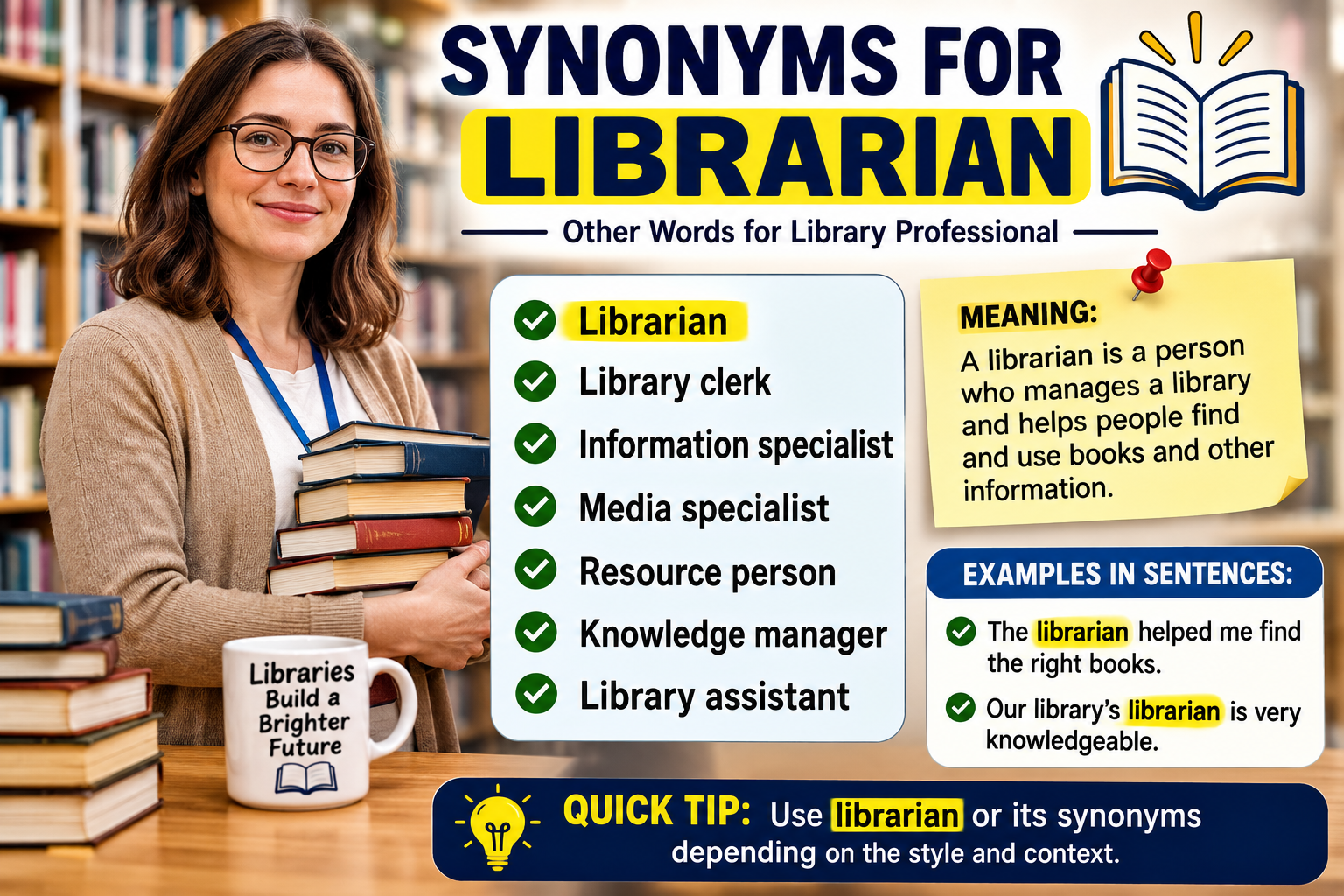
A librarian is a person who manages, organizes, and helps people use books, information, and other library resources. Imagine visiting a library to find a book for a school project. You cannot find it, so a friendly librarian helps you locate the right shelf, find useful sources, and answer your questions. Librarians are commonly found in public, school, university, and special libraries.
Learning synonyms for librarian can help English learners and content writers avoid repetition and choose words that fit different situations. Some alternatives focus on information, research, books, or library management rather than being exact synonyms. This article explains the meaning of librarian, its history, pronunciation, grammar, and 30 related words and phrases. It also groups these alternatives by meaning so you can select the best term for your writing.
Meaning of Librarian
Definition
Librarian (Noun):
A person who works in a library and helps manage, organize, provide, or find books, information, and other resources.
Examples
- The librarian helped me find a book about history.
- Our school librarian showed us how to find reliable sources.
Connotative Meaning
Connotation: The feeling or idea that a word suggests beyond its basic meaning.
- Positive tone: Helpful, knowledgeable, organized, educated, and trustworthy.
- Negative tone: The word itself is not normally negative, although a particular context may create a negative impression.
- Neutral tone: A professional who works with library resources and users.
Etymology
The word librarian is connected to the Latin word liber, meaning “book” or “book bark.” The word developed through European languages before becoming part of English.
- Old English (450–1100): There was no direct modern English word librarian. People who cared for books or manuscripts could be described using other terms.
- Middle English (1100–1500): Latin and French influenced English vocabulary related to books, learning, and written records. Words connected with liber developed in European languages.
- Modern English (1500–Present): Librarian developed as the term for a person responsible for a library and its collections. Its meaning later expanded to include research assistance, information services, technology, education, and resource management.
Pronunciation (IPA)
- IPA: /laɪˈbrɛəriən/
- Syllables: li-brar-i-an (4 syllables)
In American English, it is commonly pronounced /laɪˈbrɛriən/.
Affixation Pattern of Librarian
- Root: library / Latin liber
- Prefix: None
- Suffix: -ian
- Word formations:
- library — noun: a place or collection containing books and information
- librarian — noun: a person who works in or manages a library
- librarianship — noun: the profession or practice of working as a librarian
- librarian-like — adjective: similar to a librarian in manner or qualities
The suffix -ian can indicate a person connected with a particular profession, activity, or field.
30 Synonyms of Librarian With Meaning & Examples
1. Library Professional (Noun)
Meaning: A trained person who works in the library profession.
Examples:
- The library professional helped students find research sources.
- She has worked as a library professional for many years.
2. Library Worker (Noun)
Meaning: A person employed to perform duties in a library.
Examples:
- A library worker helped me locate the book.
- The library worker organized the new materials.
3. Library Staff Member (Noun)
Meaning: A person who works as part of a library team.
Examples:
- A library staff member answered my question.
- Ask a library staff member for help with the catalog.
4. Information Specialist (Noun)
Meaning: A professional who helps people find, evaluate, and use information.
Examples:
- The information specialist helped with the research project.
- An information specialist can help you find reliable sources.
5. Information Professional (Noun)
Meaning: A professional who manages or provides access to information.
Examples:
- The information professional guided the research team.
- She works as an information professional at a university.
6. Information Officer (Noun)
Meaning: A person responsible for managing or providing information in an organization.
Examples:
- The information officer helped researchers access the records.
- Contact the information officer for further details.
7. Research Specialist (Noun)
Meaning: A person with professional knowledge of research and information resources.
Examples:
- The research specialist helped me find academic sources.
- Students can ask the research specialist for guidance.
8. Research Librarian (Noun)
Meaning: A librarian who specializes in helping users conduct research.
Examples:
- The research librarian showed us how to use academic databases.
- Ask the research librarian for help with your thesis.
9. Reference Librarian (Noun)
Meaning: A librarian who helps people find information and answer research questions.
Examples:
- The reference librarian helped me find an old newspaper.
- A reference librarian can suggest useful research sources.
10. School Librarian (Noun)
Meaning: A librarian who works in a school library.
Examples:
- The school librarian recommended a book for my project.
- Our school librarian teaches students how to research.
11. Academic Librarian (Noun)
Meaning: A librarian who works in a college or university.
Examples:
- The academic librarian helped students use the research database.
- I contacted an academic librarian about my dissertation.
12. Public Librarian (Noun)
Meaning: A librarian who works in a public library.
Examples:
- The public librarian organized a reading program.
- The public librarian helped children choose books.
13. Archivist (Noun)
Meaning: A professional who preserves and manages historical records and documents.
Examples:
- The archivist carefully preserved the old letters.
- We asked the archivist about the historical collection.
14. Cataloger (Noun)
Meaning: A person who creates and manages records for books and other library materials.
Examples:
- The cataloger added the new books to the database.
- A cataloger makes resources easier to find.
15. Curator (Noun)
Meaning: A person who selects, organizes, and cares for a collection.
Examples:
- The curator organized the special collection.
- The museum curator explained the historical items.
16. Bibliographer (Noun)
Meaning: A person who specializes in books, bibliographies, or the study of published works.
Examples:
- The bibliographer prepared a detailed list of sources.
- A bibliographer can help researchers trace published works.
17. Bibliothecary (Noun)
Meaning: An old or literary term for a librarian.
Examples:
- The novel describes a bibliothecary who protects rare books.
- The historical collection was managed by a bibliothecary.
18. Bookkeeper (Noun)
Meaning: A person who keeps records or maintains books; in older contexts, the term can refer to someone responsible for books.
Examples:
- The old institution employed a bookkeeper to manage its collection.
- The historical text uses bookkeeper for a person who cared for books.
Note: In modern English, bookkeeper usually means someone who maintains financial records, so it is not a direct synonym for librarian.
19. Bookseller (Noun)
Meaning: A person who sells books.
Examples:
- The bookseller recommended a new novel.
- I asked the bookseller where to find the history section.
Note: A bookseller is not a librarian. This word is related to books but describes a different profession.
20. Book Specialist (Noun)
Meaning: A person with specialized knowledge about books and written works.
Examples:
- The book specialist helped identify the rare edition.
- We consulted a book specialist about the collection.
21. Literary Specialist (Noun)
Meaning: A person with expert knowledge of literature and written works.
Examples:
- The literary specialist recommended several classic novels.
- A literary specialist helped students understand the texts.
22. Literary Professional (Noun)
Meaning: A professional who works with literature, books, or literary resources.
Examples:
- The literary professional discussed the author’s work.
- She has experience as a literary professional.
23. Collection Manager (Noun)
Meaning: A person who manages and organizes a collection of materials.
Examples:
- The collection manager organized the rare books.
- The collection manager reviewed the library’s materials.
24. Resource Manager (Noun)
Meaning: A person who organizes and manages useful resources.
Examples:
- The resource manager helped students access digital materials.
- The resource manager reviewed the available resources.
25. Knowledge Manager (Noun)
Meaning: A professional who organizes and shares knowledge within an organization.
Examples:
- The knowledge manager improved access to internal information.
- A knowledge manager helps teams share useful knowledge.
26. Information Manager (Noun)
Meaning: A person who organizes, controls, and manages information.
Examples:
- The information manager improved the organization’s database.
- The information manager helped staff find important records.
27. Records Manager (Noun)
Meaning: A professional who manages and preserves organizational records.
Examples:
- The records manager organized the historical files.
- The records manager created a system for storing documents.
28. Library Administrator (Noun)
Meaning: A person who manages the operations and administration of a library.
Examples:
- The library administrator planned the annual budget.
- The library administrator supervised the library team.
29. Library Director (Noun)
Meaning: The senior person responsible for managing a library or library system.
Examples:
- The library director announced the new community program.
- The library director approved the library’s development plan.
30. Library Assistant (Noun)
Meaning: A person who supports librarians and helps with everyday library tasks.
Examples:
- The library assistant helped visitors find books.
- A library assistant organized materials on the shelves.
Note: A library assistant is a related library job, but it is not always equivalent to a professional librarian.
Prototype Meaning
The most typical meaning of librarian is a trained library professional who helps people find and use books, information, and other resources. People often imagine someone working at a library desk, organizing books, answering questions, helping with research, and guiding visitors toward useful information. Modern librarians may also work with digital databases, computers, archives, educational programs, and online resources.
Prototype Categorization
The 30 alternatives can be grouped into useful semantic categories:
- Direct library-related terms: library professional, library worker, library staff member, library assistant, library administrator, library director. These are best when discussing people who work directly in library services.
- Research and information terms: information specialist, information professional, research specialist, research librarian, reference librarian, information manager, knowledge manager. These emphasize finding, evaluating, organizing, and sharing information.
- Specialized library roles: school librarian, academic librarian, public librarian, cataloger, collection manager. These identify librarians by workplace or specific duties.
- Historical and book-related terms: archivist, bibliographer, bibliothecary, book specialist, literary specialist. These work well when discussing books, historical records, literature, or specialized collections.
- Related but not exact synonyms: bookseller, bookkeeper, curator, records manager, resource manager, library assistant. These terms describe related professions or roles but should not automatically replace librarian.
This categorization helps writers choose accurate vocabulary. A research librarian is more specific than librarian, while an archivist focuses on historical records. Choosing the right term makes writing clearer and more precise.
Antonyms of Librarian
There is no exact antonym for librarian because it is a job title rather than a quality or action. However, some contrasting role descriptions can be used depending on context.
1. Library User (Noun)
Meaning: A person who uses library services rather than providing them.
2. Library Visitor (Noun)
Meaning: A person who visits a library.
3. Non-reader (Noun)
Meaning: A person who does not read books or written material.
4. Information Seeker (Noun)
Meaning: A person who looks for information rather than manages or provides it.
Short Questions and Answers
What does synonyms for librarian mean?
It refers to alternative words and related professional terms that can describe a librarian or a person who performs similar information, research, or library duties.
When should librarian be used?
Use librarian when referring to a professional or staff member whose work involves managing library resources and helping library users.
Is librarian positive or negative?
Librarian is generally neutral and often has positive associations with knowledge, learning, organization, and helpfulness.
How is librarian different from similar words?
A librarian works with library resources and users. An archivist mainly preserves historical records, a bookseller sells books, and a curator manages a collection or exhibition. These roles may overlap but are not identical.
Conclusion
Learning synonyms for librarian gives English learners and writers more ways to describe library and information professionals accurately. Words such as library professional, research librarian, information specialist, and reference librarian can add useful detail, while terms such as archivist, cataloger, and collection manager describe related but more specific roles.
It is important to remember that not every alternative is a perfect synonym. The best word depends on the person’s job, workplace, and responsibilities. Using precise vocabulary makes writing clearer, reduces repetition, and shows stronger knowledge of English.
Practice these words in short sentences each day. Try using one new term in conversation or writing and compare its meaning with librarian. Regular vocabulary practice can improve your speaking and writing skills, expand your word choice, and build confidence in English.

Sarah Linguist is a passionate language enthusiast who loves exploring words, meanings, and synonyms.
She creates clear, easy-to-understand content to help readers improve their vocabulary and English skills.
Through SynonymsGuide.com, Sarah makes finding the right words simple, useful, and enjoyable.