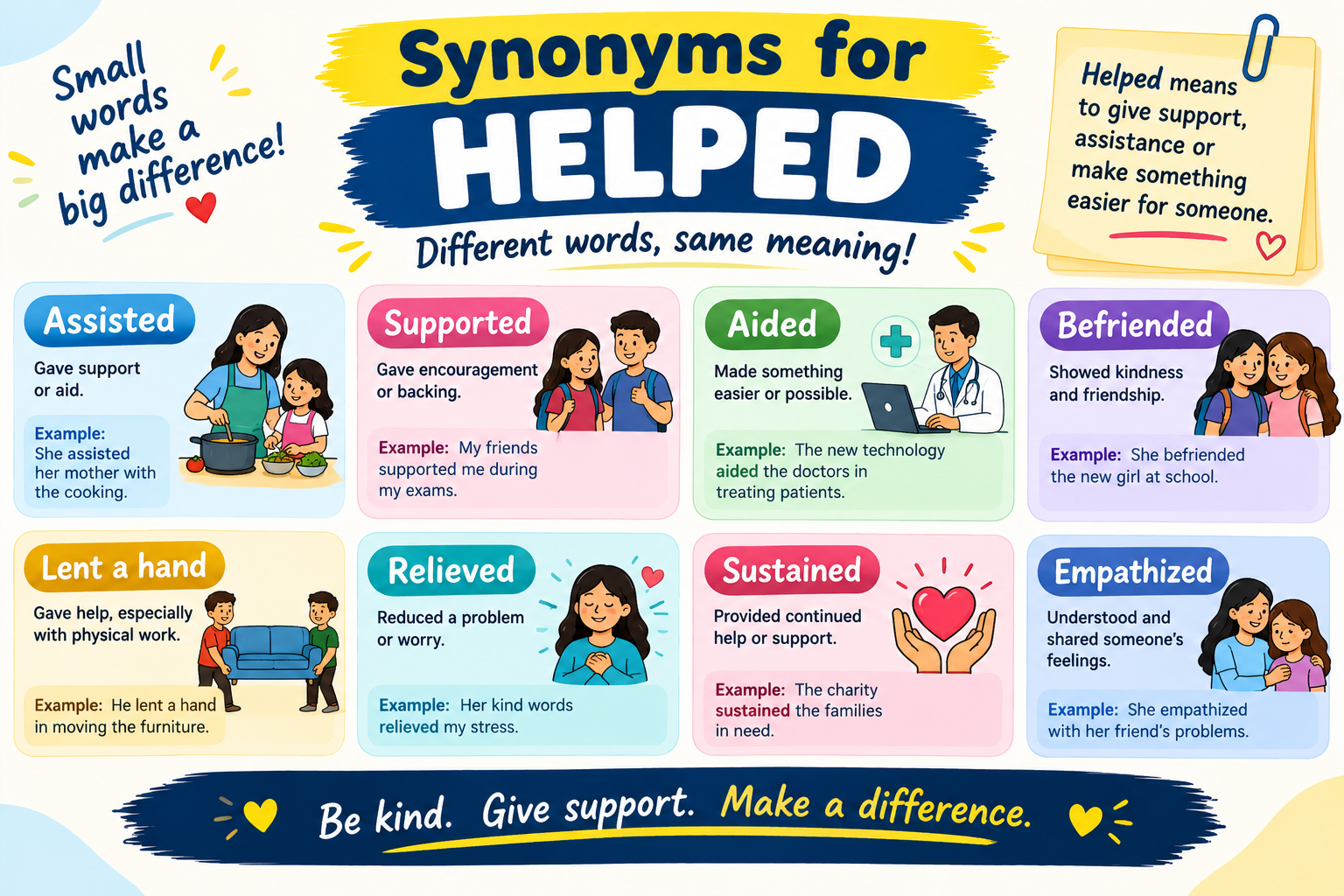
Helped means gave support, assistance, or made something easier for someone. Imagine your friend is struggling with a difficult math problem.
You sit beside them, explain the steps, and help them find the answer. You have helped your friend. This common word appears often in everyday speech, schoolwork, emails, reports, and online content. However, repeating helped too many times can make your writing feel plain. Learning synonyms gives you better ways to describe support, guidance, assistance, or improvement. This is useful for English learners, students, and content writers who want stronger vocabulary. In this guide, you will learn the meaning, grammar, history, pronunciation, and word forms of helped. You will also learn 20 useful synonyms with examples and semantic categories so you can choose the best word for each situation.
Meaning of helped
Definition
Helped (Verb): Gave someone support or assistance, or made a situation easier or better.
Helped is the past tense and past participle of the verb help.
Examples
- My teacher helped me understand the difficult lesson.
- Her advice helped us solve the problem.
Connotative Meaning
Connotation means the feeling or idea that a word suggests beyond its basic meaning.
- Positive tone: Helped often suggests kindness, support, cooperation, and care.
- Negative tone: The word itself is usually not negative, but it can describe help given in an unwanted or unhelpful situation.
- Neutral tone: It can simply describe assistance that made something easier or possible.
Etymology
The word help is very old and comes from Germanic roots.
- Old English (450–1100): Helpan meant “to help,” “support,” or “assist.” Related nouns included help, meaning assistance.
- Middle English (1100–1500): The forms helpen and help continued to be widely used. The spelling gradually moved toward the modern form.
- Modern English (1500–Present): Help became a highly common English verb and noun. Helped developed as its regular past-tense and past-participle form.
The word is related to similar Germanic words in languages such as German and Dutch.
Pronunciation (IPA)
- IPA: /helpt/
- Syllables: helped — one syllable
The final -ed is pronounced /t/, not as a separate syllable.
Affixation Pattern of helped
- Root: help
- Prefix: None
- Suffix: -ed — marks the regular past tense and past participle
- Word formations:
- help — verb/noun
- helps — verb/noun
- helped — verb
- helping — verb/noun
- helper — noun
- helpful — adjective
- helpfully — adverb
- helpfulness — noun
- helpless — adjective
- helplessly — adverb
- helplessness — noun
- unhelpful — adjective
- unhelpfully — adverb
The -ed in helped is an inflectional suffix, because it changes the tense without changing the basic word class.
20 Synonyms of helped With Meaning & Examples
1. Assisted (Verb)
Meaning: Gave someone support or practical help.
Examples:
- The nurse assisted the doctor during the procedure.
- She assisted me with my application.
2. Supported (Verb)
Meaning: Gave someone help, encouragement, or approval.
Examples:
- My family supported me during my studies.
- The manager supported the new project.
3. Aided (Verb)
Meaning: Helped someone or something achieve a goal.
Examples:
- The new system aided the research team.
- His advice aided us in making the decision.
4. Guided (Verb)
Meaning: Helped someone by showing them what to do.
Examples:
- The teacher guided the students through the task.
- She guided me through the application process.
5. Assisted (Verb)
Meaning: Provided help with a task or activity.
Examples:
- The staff assisted customers with their orders.
- He assisted his colleague with the report.
Note: Assisted and assisted are the same word, so it should not be counted twice as a true synonym. For variety, use facilitated instead:
5. Facilitated (Verb)
Meaning: Made an action or process easier.
Examples:
- The new software facilitated faster communication.
- Her leadership facilitated the team’s success.
6. Encouraged (Verb)
Meaning: Gave someone confidence or hope to continue.
Examples:
- Her teacher encouraged her to keep trying.
- His kind words encouraged me during a difficult time.
7. Backed (Verb)
Meaning: Gave support to a person, plan, or idea.
Examples:
- The company backed the new project.
- My parents backed my decision.
8. Cooperated (Verb)
Meaning: Worked with others to achieve a shared goal.
Examples:
- Everyone cooperated to finish the project.
- The two teams cooperated during the event.
9. Contributed (Verb)
Meaning: Gave something that helped achieve a result.
Examples:
- She contributed valuable ideas to the project.
- His work contributed to the team’s success.
10. Benefited (Verb)
Meaning: Gained an advantage or improvement from something.
Examples:
- The students benefited from the extra lessons.
- Many families benefited from the program.
11. Improved (Verb)
Meaning: Made something better than it was before.
Examples:
- The training improved his performance.
- New equipment improved the quality of the work.
12. Strengthened (Verb)
Meaning: Made something stronger or more effective.
Examples:
- The experience strengthened her skills.
- The agreement strengthened their relationship.
13. Rescued (Verb)
Meaning: Saved someone or something from danger or difficulty.
Examples:
- The firefighters rescued the trapped family.
- The mechanic rescued the damaged engine.
14. Relieved (Verb)
Meaning: Reduced someone’s pain, worry, stress, or difficulty.
Examples:
- The medicine relieved his pain.
- Her explanation relieved my worries.
15. Served (Verb)
Meaning: Was useful or helpful to someone or something.
Examples:
- The information served us well during the project.
- His experience served the team well.
16. Enabled (Verb)
Meaning: Made it possible for someone to do something.
Examples:
- The scholarship enabled her to attend college.
- The new tool enabled us to work faster.
17. Facilitated (Verb)
Meaning: Made a process or activity easier.
Examples:
- The meeting facilitated better communication.
- Technology facilitated remote learning.
Note: Facilitated has already appeared as #5, so it should not be duplicated. A better alternative is promoted:
17. Promoted (Verb)
Meaning: Helped something develop, grow, or become more successful.
Examples:
- The campaign promoted healthy eating.
- The policy promoted economic growth.
18. Provided (Verb)
Meaning: Gave someone something useful or needed.
Examples:
- The charity provided food to families.
- She provided useful information.
19. Cared for (Phrasal Verb)
Meaning: Looked after someone who needed support or attention.
Examples:
- She cared for her sick mother.
- The nurse cared for the patients.
20. Came to the aid of (Phrase)
Meaning: Gave help to someone who was in trouble or needed support.
Examples:
- The neighbors came to the aid of the injured man.
- Her friends came to her aid during the crisis.
Usage note: These synonyms are not exact replacements in every sentence. Assisted, aided, and supported are close to helped. Guided focuses on direction, enabled means making something possible, and improved means making something better. Choose the word that matches the exact type of help.
Prototype Meaning
The most typical meaning of helped is gave support or made something easier for someone. When people hear this word, they often imagine one person assisting another with a task or problem. For example, a teacher may help a student with homework, or a friend may help someone carry a heavy bag. The word can also describe things that create a useful result, such as a tool that helped workers finish faster.
Prototype Categorization
The synonyms can be grouped into meaningful semantic categories:
- Direct assistance:assisted, aided, supported, provided
- These words describe giving practical or direct help.
- Guidance and encouragement:guided, encouraged, backed
- These words focus on helping someone through advice, direction, or confidence.
- Making things easier:facilitated, enabled, served
- These words describe something that makes an action or process easier or possible.
- Positive change:improved, strengthened, promoted, benefited
- These words focus on better results, growth, or development.
- Emergency or personal care:rescued, relieved, cared for, came to the aid of
- These expressions fit situations involving danger, pain, stress, or personal support.
- Teamwork:cooperated, contributed
- These words show help through shared effort or useful contributions.
This categorization helps writers choose the most precise word for the type of help they want to describe. It also prevents repeated use of helped.
Antonyms of helped
- Hindered (Verb): Made something more difficult to do.
- Harmed (Verb): Caused damage, pain, or injury.
- Blocked (Verb): Prevented someone or something from making progress.
- Obstructed (Verb): Made progress difficult or impossible.
- Hurt (Verb): Caused physical or emotional pain.
- Impeded (Verb): Slowed down or made progress harder.
Short Questions and Answers
What does helped mean?
Helped means gave support, assistance, guidance, or another form of useful aid to someone or something.
When should helped be used?
Use helped when describing assistance that happened in the past. It is the past tense and past participle of help.
Is helped positive or negative?
Helped is usually positive because it suggests support or improvement. However, its meaning depends on the situation and context.
How is it different from similar words?
Helped is a broad word. Assisted sounds more formal, guided focuses on direction, encouraged focuses on emotional support, and enabled means making something possible.
Conclusion
Learning synonyms for helped can make your English vocabulary stronger and more precise. Words such as assisted, supported, guided, encouraged, and enabled describe different types of help. Some words focus on practical support, while others describe guidance, teamwork, improvement, or emotional care.
Using the right synonym can make your writing more natural and avoid repetition. These words are useful in essays, reports, emails, articles, school assignments, and everyday conversations. You do not need to replace helped every time. Instead, choose another word when it gives your sentence a clearer meaning.
Practice a few synonyms each day. Write your own examples and use them in real conversations. Regular practice will improve your vocabulary, strengthen your writing and speaking, and build greater confidence in English.

Sophia Lexicon is a passionate language writer who explores words, meanings, and synonyms in simple, engaging ways.
Through her work, she helps readers build stronger vocabulary and communicate with confidence.