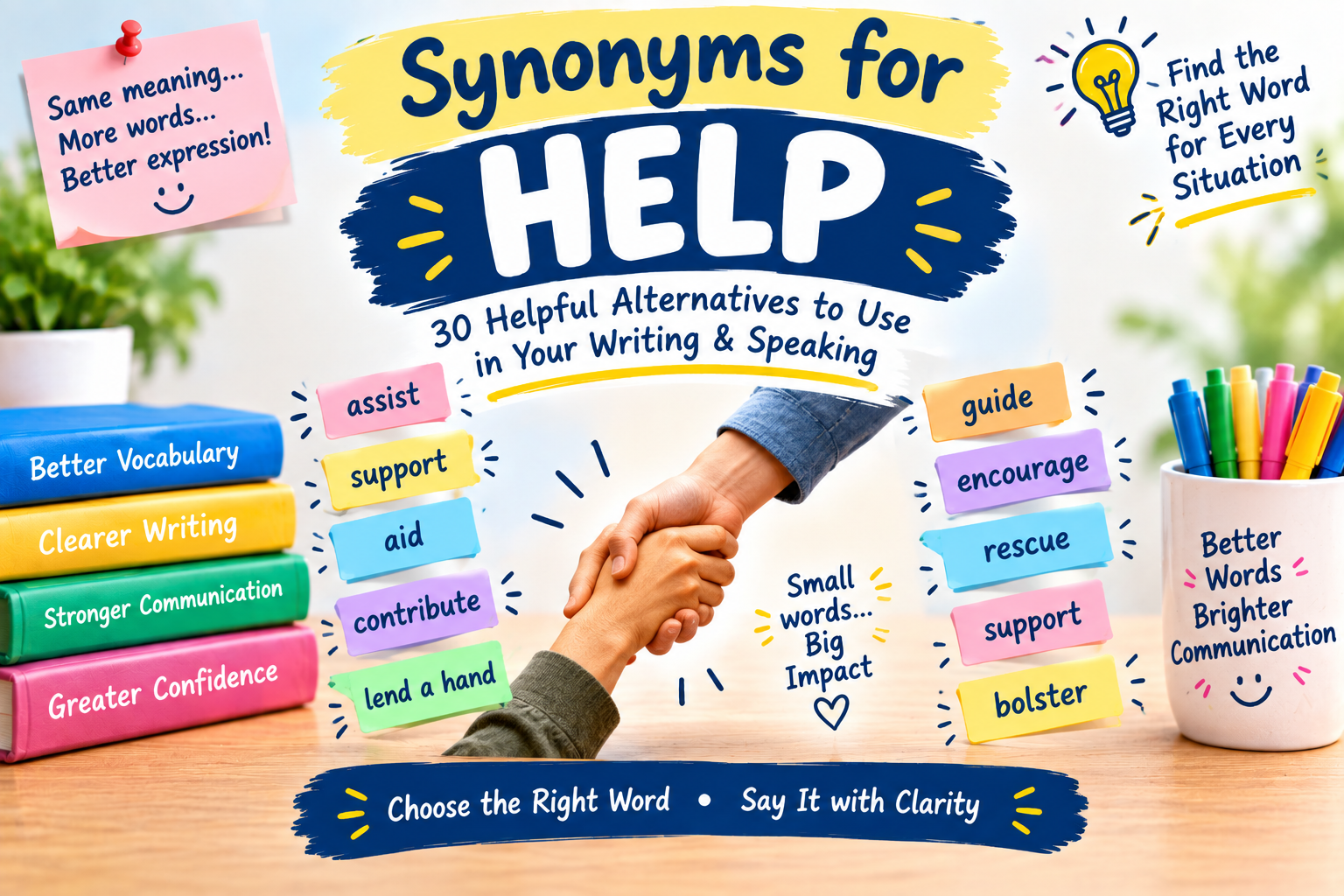
Help means to make something easier for someone or to give support when it is needed. For example, a student may ask a teacher to help with a difficult question, or a friend may help carry a heavy bag.
The word is very common in everyday English because people often need or offer support. However, using the same word many times can make writing sound repetitive. Learning synonyms for help gives English learners more ways to express support, assistance, guidance, and care.
It also helps content writers choose words that fit different situations and tones. In this article, we will explore the meaning of help, its examples, connotation, etymology, pronunciation, word formations, and 30 useful synonyms. Each synonym includes a simple meaning and natural examples to make vocabulary learning easier.
Meaning of help
Definition
Help (Verb/Noun):
To make something easier, give support, or provide what someone needs to deal with a problem or task.
Examples
- Can you help me with my homework?
- Her advice helped me solve the problem.
- Thank you for your help.
Connotative Meaning
The word help usually has a positive and supportive feeling. It suggests kindness, cooperation, usefulness, or assistance.
- Positive tone: Supportive, caring, useful, and generous.
- Negative tone: It can sometimes suggest dependence or a lack of ability when someone always needs help.
- Neutral tone: Simply means providing assistance or making something easier.
(Connotation means the feeling or idea associated with a word beyond its basic meaning.)
Etymology
The word help has a long history in English and has kept a meaning close to its original sense of providing assistance.
- Old English (450–1100): Help comes from Old English helpan, meaning “to aid, support, or assist.”
- Middle English (1100–1500): The word developed into forms such as helpen and continued to mean aiding or assisting someone.
- Modern English (1500–Present): Help became one of the most common English words for giving assistance, support, or relief.
Pronunciation (IPA)
- IPA: /help/
- Syllables: help
Affixation Pattern of help
- Root: help
- Prefix: None
- Suffix: None in the basic word
- Word formations:
- help — verb/noun
- helps — verb/noun
- helped — verb
- helping — verb/noun
- helper — noun
- helpful — adjective
- helpfully — adverb
- helpfulness — noun
- helpless — adjective
- helplessness — noun
30 Synonyms of help With Meaning & Examples
1. Aid (Verb/Noun)
Meaning: To give assistance or support to someone or something.
Examples:
- The nurse aided the patient.
- The charity provided aid to families.
2. Assist (Verb)
Meaning: To help someone do something, especially in a specific task.
Examples:
- The teacher assisted the students.
- Can you assist me with this form?
3. Support (Verb/Noun)
Meaning: To give someone help, encouragement, or resources.
Examples:
- Her family supported her during the project.
- We appreciate your support.
4. Serve (Verb)
Meaning: To be useful to someone or provide what they need.
Examples:
- This guide will serve as a useful resource.
- The program serves local students.
5. Facilitate (Verb)
Meaning: To make an action or process easier.
Examples:
- The new system facilitates communication.
- Good planning can facilitate learning.
6. Guide (Verb/Noun)
Meaning: To show someone the right way or help them make a decision.
Examples:
- The teacher guided the students through the lesson.
- She gave me useful guidance.
7. Advise (Verb)
Meaning: To give someone suggestions about what they should do.
Examples:
- My teacher advised me to practice daily.
- The doctor advised him to rest.
8. Encourage (Verb)
Meaning: To give someone confidence or hope to do something.
Examples:
- Her parents encouraged her to keep trying.
- Good teachers encourage students to learn.
9. Back (Verb)
Meaning: To support a person, idea, or plan.
Examples:
- Her friends backed her decision.
- The organization backed the new project.
10. Rescue (Verb/Noun)
Meaning: To save someone from danger or a difficult situation.
Examples:
- The team rescued the stranded hikers.
- The rescue team arrived quickly.
11. Save (Verb)
Meaning: To protect someone or something from harm, loss, or difficulty.
Examples:
- The quick action saved the child from danger.
- This shortcut can save you time.
12. Relieve (Verb)
Meaning: To reduce pain, stress, difficulty, or worry.
Examples:
- The medicine relieved her pain.
- Talking to a friend can relieve stress.
13. Benefit (Verb/Noun)
Meaning: To provide an advantage or positive result.
Examples:
- Regular reading can benefit students.
- The program offers many benefits.
14. Contribute (Verb)
Meaning: To give something that helps achieve a shared result.
Examples:
- Everyone contributed to the project.
- She contributed useful ideas to the discussion.
15. Lend a Hand (Verb Phrase)
Meaning: To help someone with a task or problem.
Examples:
- Can you lend a hand with these boxes?
- My brother lent a hand during the event.
16. Assist (Verb)
Meaning: To provide practical help or support.
Examples:
- Volunteers assisted the visitors.
- The manager assisted the new employee.
17. Bolster (Verb)
Meaning: To strengthen or support something.
Examples:
- The new evidence bolstered the argument.
- Training can bolster students’ confidence.
18. Enable (Verb)
Meaning: To make it possible for someone to do something.
Examples:
- Technology enables students to learn online.
- The scholarship enabled her to continue her studies.
19. Promote (Verb)
Meaning: To encourage or support the growth or development of something.
Examples:
- Schools should promote healthy reading habits.
- The program promotes teamwork.
20. Cooperate (Verb)
Meaning: To work together to achieve a shared goal.
Examples:
- The students cooperated on the project.
- Everyone needs to cooperate to solve the problem.
21. Nurture (Verb)
Meaning: To care for and encourage the growth or development of someone or something.
Examples:
- Parents nurture their children’s talents.
- Good teachers nurture creativity.
22. Sustain (Verb)
Meaning: To support something so that it can continue.
Examples:
- The funds helped sustain the program.
- Healthy habits can sustain your energy.
23. Encourage (Verb)
Meaning: To give someone confidence or motivation.
Examples:
- Her coach encouraged her to practice.
- Friends can encourage each other during difficult tasks.
24. Care For (Verb Phrase)
Meaning: To look after someone or something.
Examples:
- She cares for her younger brother.
- Volunteers care for the animals.
25. Attend To (Verb Phrase)
Meaning: To deal with or take care of a person, need, or problem.
Examples:
- The nurse quickly attended to the patient.
- Please attend to this problem today.
26. Ease (Verb)
Meaning: To make something less difficult, painful, or stressful.
Examples:
- Her kind words eased my worries.
- The new tool eased the workload.
27. Remedy (Verb/Noun)
Meaning: To correct or improve a problem.
Examples:
- The new plan may remedy the problem.
- The treatment provided a remedy for the issue.
28. Advocate (Verb/Noun)
Meaning: To publicly support a person, idea, or cause.
Examples:
- She advocates better access to education.
- He is an advocate for young learners.
29. Champion (Verb/Noun)
Meaning: To strongly support or promote a person, idea, or cause.
Examples:
- The organization champions equal access to education.
- She became a champion of the new program.
30. Provide Assistance (Verb Phrase)
Meaning: To give someone the practical help they need.
Examples:
- Staff members provided assistance to visitors.
- The center provides assistance to students.
Prototype Meaning
The most typical meaning of help is to give assistance or make something easier for another person. When people hear the word, they often imagine someone offering support with a task, problem, or need. Help can be practical, emotional, financial, or informational. It can also describe something that makes a situation easier, such as a useful tool or helpful advice.
Prototype Categorization
The 30 synonyms can be grouped into useful semantic categories:
- Direct assistance: aid, assist, support, lend a hand, and provide assistance. These are useful when someone receives practical help.
- Guidance and advice: guide, advise, encourage, and advocate. These words focus on direction, motivation, or support.
- Making things easier: facilitate, enable, ease, and serve. These describe actions or tools that make a task or process easier.
- Protection and relief: rescue, save, and relieve. These words are suitable when help involves danger, difficulty, pain, or stress.
- Growth and development: nurture, promote, bolster, and sustain. These suggest strengthening, developing, or maintaining something.
- Cooperation and contribution: cooperate, contribute, and back. These focus on working together or supporting a shared goal.
- Care and problem-solving: care for, attend to, and remedy. These are useful for looking after people or dealing with problems.
- Strong support: champion and advocate. These often describe active or public support for an idea, person, or cause.
This categorization helps writers choose a synonym based on the exact type of help they want to describe.
Antonyms of help
1. Hinder (Verb)
Meaning: To make something more difficult to do.
2. Harm (Verb/Noun)
Meaning: To cause damage, injury, or a negative effect.
3. Obstruct (Verb)
Meaning: To block or prevent progress.
4. Impede (Verb)
Meaning: To slow down or interfere with progress.
5. Prevent (Verb)
Meaning: To stop something from happening or being done.
6. Discourage (Verb)
Meaning: To reduce someone’s confidence or desire to continue.
Short Questions and Answers
What does help mean?
Help means to give assistance, support, or useful action that makes a task or situation easier.
When should help be used?
Use help when you want to describe giving assistance, solving a problem, supporting someone, or making something easier.
Is help positive or negative?
Help is usually positive because it suggests support or assistance. However, its meaning can depend on the situation and context.
How is it different from similar words?
Help is a broad word. Assist often sounds more formal, aid can suggest practical or organized support, guide focuses on direction, and encourage focuses on confidence or motivation.
Conclusion
Learning help and its synonyms gives English learners more ways to express support and assistance. Words such as aid, assist, support, guide, encourage, facilitate, enable, and relieve can make writing more precise and interesting. However, each synonym has its own meaning and is best suited to certain situations. For example, guide is useful for direction, while ease describes making something less difficult.
Using different words can also reduce repetition in essays, articles, conversations, and professional writing. A stronger vocabulary helps you communicate your ideas with greater clarity and confidence. Try learning a few synonyms each day and use them in your own sentences. With regular practice, you can improve your vocabulary, strengthen your writing and speaking skills, and become a more confident English user.

Olivia Wordsmith is a passionate vocabulary writer who loves exploring words, meanings, and their everyday use.
She creates clear, engaging content to help readers expand their vocabulary and communicate with confidence.