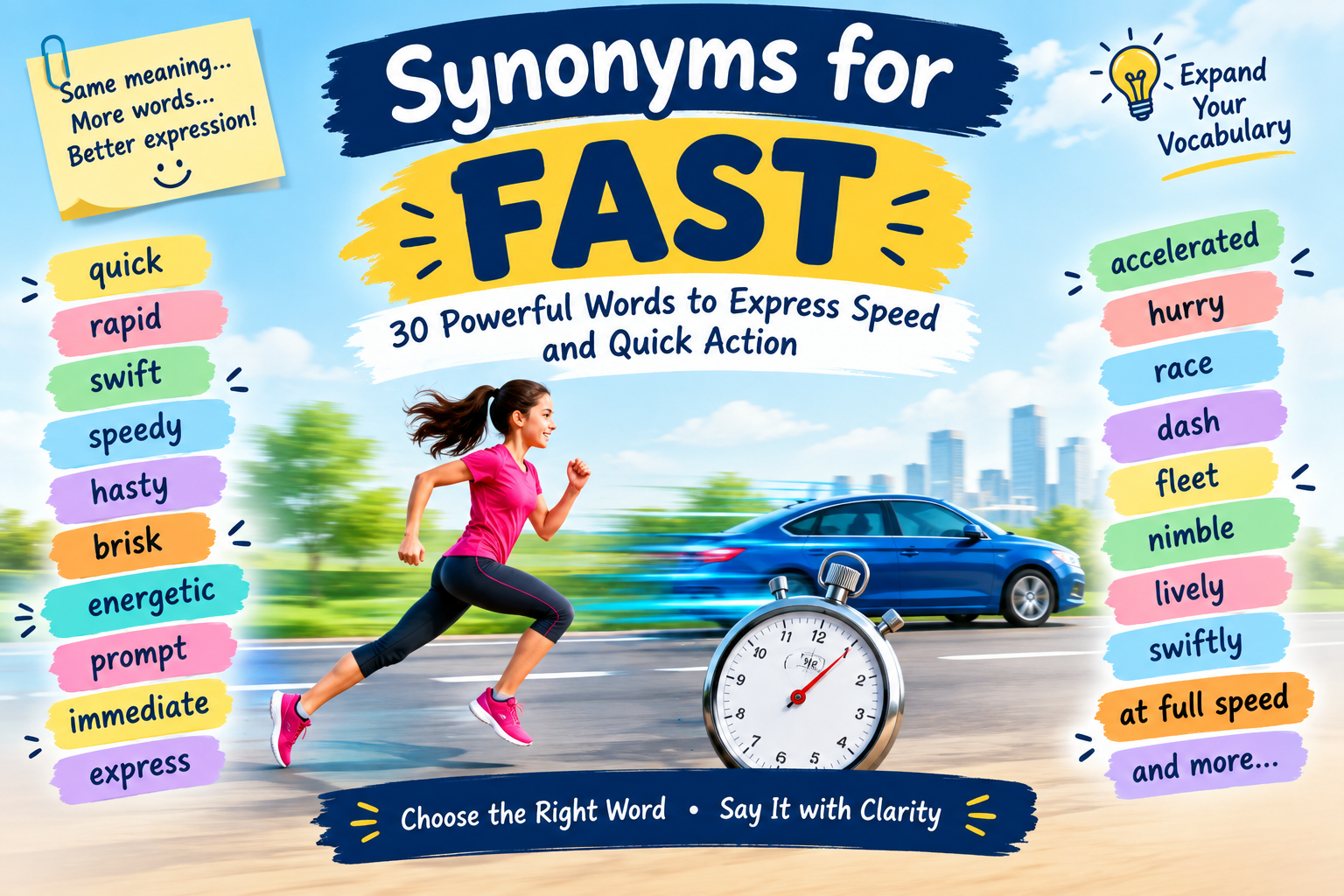
Fast means moving, happening, or working at a high speed.
Imagine a student rushing to school because the bell is about to ring. She walks fast, takes a fast bus, and quickly reaches the classroom. The word fast is very common because it can describe people, animals, vehicles, machines, actions, and even changes. It can also mean something that happens in a short time, such as a fast response or fast growth. Learning synonyms for fast helps English learners choose more precise words for different situations. It also helps content writers avoid repetition and make their writing more lively. In this article, we will explore the meaning, examples, connotation, history, pronunciation, word formation, and 30 useful synonyms of fast. We will also group these words by meaning to make them easier to understand and use.
Meaning of Fast
Definition
Fast (Adjective, Adverb): Moving, happening, or working at high speed or in a short amount of time.
Fast (Noun): A period when someone does not eat or drink, usually for a particular reason.
Examples
- The car is very fast.
- She runs fast when she is training for a race.
Connotative Meaning
- Positive tone: Fast can suggest energy, efficiency, skill, or quick results.
- Negative tone: In some contexts, being fast can suggest rushing or acting without enough care.
- Neutral tone: Fast can simply describe high speed or a short period of time.
(Connotation: the feeling or idea that a word suggests beyond its basic meaning.)
Etymology
The word fast is very old and has Germanic roots. Its meaning has changed over time, and it has several related historical senses.
- Old English (450–1100): Fast appeared as fæst, meaning firmly fixed, secure, or strong. The idea of speed developed from the sense of being firm or closely held in a particular state.
- Middle English (1100–1500): Forms such as fast were used for meanings including firmly, strongly, and securely. The modern sense of moving quickly became more established during this period.
- Modern English (1500–Present): Fast developed its familiar meanings related to high speed, quick action, and rapid movement. It also retained older meanings connected with firmness and fasting.
Pronunciation (IPA)
- IPA: /fæst/
- Syllables: fast
Affixation Pattern of Fast
- Root: fast
- Prefix: None
- Suffix: None
- Word formations:
- fast — adjective/adverb/noun/verb
- faster — adjective/adverb
- fastest — adjective/adverb
- fastness — noun
- fasting — noun/verb
- fasted — verb
- fast-paced — adjective
- fast-moving — adjective
- fast-growing — adjective
- breakfast — noun/verb
30 Synonyms of Fast With Meaning & Examples
1. Quick (Adjective)
Meaning: Happening or done in a short time.
Examples:
- She gave me a quick answer.
- We need a quick solution to the problem.
2. Rapid (Adjective)
Meaning: Happening or moving very quickly.
Examples:
- The company experienced rapid growth.
- Rapid changes took place in the city.
3. Swift (Adjective)
Meaning: Moving or happening with great speed.
Examples:
- The bird made a swift movement.
- The government took swift action.
4. Speedy (Adjective)
Meaning: Happening or completed quickly.
Examples:
- We received a speedy reply.
- The service was fast and speedy.
5. Hasty (Adjective)
Meaning: Done very quickly, often without enough thought.
Examples:
- He made a hasty decision.
- Do not make a hasty judgment.
6. Rapidly (Adverb)
Meaning: At a fast speed or rate.
Examples:
- Technology is changing rapidly.
- The river rose rapidly after the storm.
7. Quickly (Adverb)
Meaning: At a high speed or within a short time.
Examples:
- Please finish the work quickly.
- She quickly opened the door.
8. Swiftly (Adverb)
Meaning: In a fast and efficient way.
Examples:
- The police responded swiftly.
- The team moved swiftly toward its goal.
9. Brisk (Adjective)
Meaning: Quick and energetic in movement or action.
Examples:
- We went for a brisk walk.
- She took a brisk step toward the office.
10. Expeditious (Adjective)
Meaning: Done quickly and efficiently.
Examples:
- The office promised an expeditious response.
- We need an expeditious solution.
11. Accelerated (Adjective)
Meaning: Happening at a faster rate than usual.
Examples:
- The project followed an accelerated schedule.
- The program provides accelerated learning.
12. Hurrying (Adjective/Verb)
Meaning: Moving or acting quickly because of limited time.
Examples:
- The hurrying passengers ran toward the train.
- She was hurrying to finish her work.
13. Hurried (Adjective)
Meaning: Done or completed very quickly because of pressure or lack of time.
Examples:
- He gave a hurried answer.
- We had a hurried breakfast before school.
14. Fleet (Adjective)
Meaning: Moving very quickly and lightly.
Examples:
- The deer was fleet and difficult to catch.
- The athlete has fleet feet.
15. Nimble (Adjective)
Meaning: Able to move quickly and easily.
Examples:
- The cat is nimble and alert.
- She has nimble fingers.
16. Lively (Adjective)
Meaning: Full of energy and active movement.
Examples:
- The children had a lively game.
- The lively horse ran around the field.
17. Energetic (Adjective)
Meaning: Having a lot of energy and activity.
Examples:
- The energetic runner finished the race.
- She is energetic during morning workouts.
18. Hurtle (Verb)
Meaning: To move very quickly and often with great force.
Examples:
- The car hurtled down the road.
- The ball hurtled toward the wall.
19. Dash (Verb)
Meaning: To move somewhere very quickly.
Examples:
- He dashed across the street.
- She dashed home after school.
20. Race (Verb)
Meaning: To move or travel very quickly.
Examples:
- They raced to catch the bus.
- The children raced across the playground.
21. Hurry (Verb)
Meaning: To move or act faster because there is limited time.
Examples:
- Hurry or you will miss the train.
- We hurried to complete the assignment.
22. Speed (Verb)
Meaning: To move or travel quickly.
Examples:
- The driver sped along the highway.
- The train sped toward the station.
23. Breakneck (Adjective)
Meaning: Extremely fast and potentially dangerous.
Examples:
- The car was traveling at breakneck speed.
- The project moved at a breakneck pace.
24. High-speed (Adjective)
Meaning: Operating or moving at a very high speed.
Examples:
- They use a high-speed train.
- The company provides high-speed internet.
25. Express (Adjective)
Meaning: Designed to provide a service or journey quickly.
Examples:
- We took the express train.
- The store offers express delivery.
26. Instant (Adjective)
Meaning: Happening immediately or with almost no delay.
Examples:
- The app provides instant results.
- She received an instant response.
27. Prompt (Adjective)
Meaning: Done or given without unnecessary delay.
Examples:
- Thank you for your prompt reply.
- The doctor provided prompt assistance.
28. Immediate (Adjective)
Meaning: Happening at once or without waiting.
Examples:
- The problem needs immediate attention.
- We received an immediate response.
29. Briskly (Adverb)
Meaning: In a quick and energetic way.
Examples:
- She walked briskly to the station.
- The workers moved briskly around the room.
30. At Full Speed (Adverbial Phrase)
Meaning: Moving as quickly as possible.
Examples:
- The cyclist traveled at full speed.
- The boat moved at full speed toward the shore.
Prototype Meaning
The most typical meaning of fast is moving or happening at high speed. When people hear the word, they often imagine a person running quickly, a car traveling rapidly, or an action completed in a short time. The word is broad and can describe physical movement, services, processes, changes, and responses. Its exact meaning depends on the context.
Prototype Categorization
The 30 synonyms can be grouped into useful semantic categories:
- General speed: quick, rapid, swift, speedy, rapidly, quickly, swiftly. These words describe something that happens or moves at a high speed.
- Quick and energetic movement: brisk, fleet, nimble, lively, energetic, briskly. These words often suggest active or energetic movement.
- Urgent or rushed action: hasty, hurrying, hurried, hurry, dash, race. These words often suggest that someone is moving quickly because of limited time.
- Very high speed: accelerated, hurtle, breakneck, high-speed, at full speed. These expressions emphasize unusually high or extreme speed.
- Fast service or response: expeditious, express, prompt, immediate, instant. These words are useful when talking about services, answers, results, or actions that happen with little delay.
- Fast travel: speed, race, dash, express, high-speed. These words commonly describe quick movement from one place to another.
This categorization helps writers select a synonym that matches the exact type of speed they want to describe. For example, prompt works well for a response, while swift can describe movement or action.
Antonyms of Fast
1. Slow (Adjective/Adverb)
Moving or happening at a low speed.
2. Sluggish (Adjective)
Moving or working slowly and with little energy.
3. Gradual (Adjective)
Happening slowly over a period of time.
4. Leisurely (Adjective/Adverb)
Done in a relaxed way without rushing.
5. Unhurried (Adjective)
Done calmly without feeling pressure to move quickly.
6. Delayed (Adjective)
Happening later than expected or planned.
7. Slow-moving (Adjective)
Moving at a low speed.
8. Tardy (Adjective)
Arriving or happening later than expected.
Short Questions and Answers
What does fast mean?
Fast means moving, happening, or working at a high speed or within a short time.
When should fast be used?
Use fast when describing high speed, quick movement, rapid action, or something that happens in a short time.
Is fast positive or negative?
Fast is usually neutral. It can suggest efficiency or energy in some contexts, while in others it can suggest rushing or a lack of care.
How is fast different from similar words?
Fast is a broad word. Quick often means taking little time, rapid emphasizes a high rate of change or movement, swift suggests fast and smooth action, and hasty often suggests excessive speed or insufficient thought.
Conclusion
Learning synonyms for fast gives English learners more ways to describe speed, movement, timing, and quick action. Words such as quick, rapid, swift, speedy, brisk, prompt, immediate, and accelerated may have similar meanings, but they do not always fit the same sentence. Understanding these small differences makes writing clearer and more natural. A strong vocabulary also helps speakers express ideas with greater accuracy and avoid using the same word again and again. Content writers can use these alternatives to make articles more varied and engaging. English learners can practice by choosing one synonym each day and creating two original sentences with it. With regular practice, your vocabulary will grow, your writing will become stronger, and your confidence in English will improve.

Sophia Lexicon is a passionate language writer who explores words, meanings, and synonyms in simple, engaging ways.
Through her work, she helps readers build stronger vocabulary and communicate with confidence.