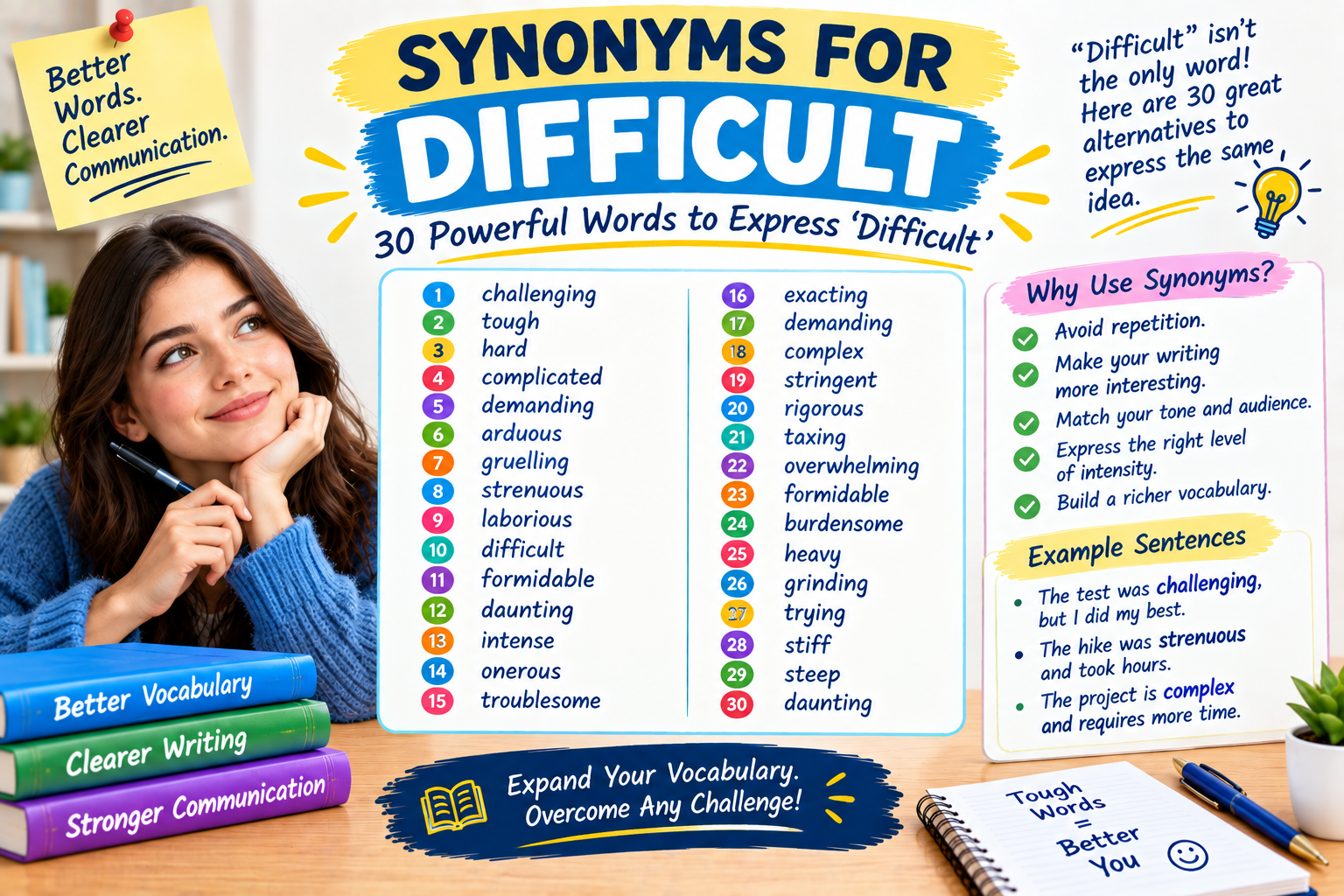
Synonyms for difficult include hard, challenging, tough, demanding, complicated, tricky, arduous, strenuous, demanding, daunting, and formidable.
Difficult describes something that is not easy to do, understand, solve, or deal with. Imagine preparing for a difficult exam. You study for hours, but some questions still make you stop and think. You may call the exam challenging, tough, or demanding. These words are close to difficult, but each can give a slightly different feeling.
The word difficult is very common in everyday English. It can describe tasks, problems, decisions, situations, people, and subjects. Learning its synonyms helps English learners express ideas more clearly and avoid repeating the same word. It also helps content writers choose stronger and more accurate vocabulary. This guide explains the meaning, history, pronunciation, word formation, synonyms, antonyms, and semantic categories of difficult with simple examples.
Meaning of Difficult
Definition
Difficult (Adjective):
Difficult means not easy to do, understand, solve, or deal with.
Examples
- This math problem is very difficult.
- She faced a difficult decision.
Connotative Meaning
Connotation means the feeling or idea connected with a word beyond its basic meaning.
- Positive tone: Difficult can suggest a challenge that helps someone learn or improve.
- Negative tone: It can suggest frustration, stress, or hardship.
- Neutral tone: It can simply describe something that requires more effort or skill.
Etymology
- Old English (450–1100): The modern word difficult did not exist in Old English. English used other words, such as earfoþ and related forms, for hardship or something hard to accomplish.
- Middle English (1100–1500): Difficult entered English through Old French, from Latin difficilis, meaning “hard” or “not easy.”
- Modern English (1500–Present): Difficult became a common adjective for things that require effort, skill, patience, or careful thought.
Pronunciation (IPA)
- IPA: /ˈdɪfɪkəlt/
- Syllables: dif-fi-cult
Affixation Pattern of Difficult
- Root: facil / fic — related to doing or making
- Prefix: dif- — a form related to dis-, expressing separation or opposition
- Suffix: -ult as part of the historical formation
- Word formations:
- difficult — adjective
- difficulty — noun
- difficultly — adverb, rare
- difficulties — plural noun
25 Synonyms of Difficult With Meaning & Examples
1. Hard (Adjective)
Meaning: Not easy to do, understand, or deal with.
Examples:
- This test is very hard.
- It was hard to make a decision.
2. Challenging (Adjective)
Meaning: Requiring skill, effort, or determination.
Examples:
- The new project is challenging.
- She enjoys challenging tasks.
3. Tough (Adjective)
Meaning: Difficult to deal with or complete.
Examples:
- We had a tough exam today.
- It was a tough decision.
4. Demanding (Adjective)
Meaning: Requiring a lot of time, effort, or attention.
Examples:
- Nursing can be a demanding job.
- The course is very demanding.
5. Arduous (Adjective)
Meaning: Requiring a lot of effort and energy over a long period.
Examples:
- They completed an arduous journey.
- The work was physically arduous.
6. Complicated (Adjective)
Meaning: Difficult because something has many connected parts.
Examples:
- The instructions are complicated.
- It is a complicated problem.
7. Tricky (Adjective)
Meaning: Difficult because it requires careful thought or skill.
Examples:
- This question is tricky.
- That was a tricky situation.
8. Daunting (Adjective)
Meaning: Seeming very difficult and making you feel worried.
Examples:
- The large project seemed daunting.
- Starting a new career can be daunting.
9. Formidable (Adjective)
Meaning: Very difficult to deal with or overcome.
Examples:
- She faced a formidable challenge.
- The team has a formidable opponent.
10. Grueling (Adjective)
Meaning: Extremely tiring and demanding.
Examples:
- They completed a grueling training program.
- The race was grueling.
11. Strenuous (Adjective)
Meaning: Requiring a lot of physical or mental effort.
Examples:
- The hike was strenuous.
- Avoid strenuous activity after the injury.
12. Taxing (Adjective)
Meaning: Requiring a lot of mental or physical effort.
Examples:
- The long meeting was taxing.
- Solving the problem was mentally taxing.
13. Onerous (Adjective)
Meaning: Involving an unpleasant or heavy amount of work or responsibility.
Examples:
- The contract placed onerous demands on the company.
- The task became onerous over time.
14. Intricate (Adjective)
Meaning: Having many small parts or details that make something hard to understand.
Examples:
- The artist created an intricate design.
- The machine has an intricate system.
15. Complex (Adjective)
Meaning: Having many parts or ideas that make something difficult to understand.
Examples:
- The problem is highly complex.
- Climate systems are complex.
16. Problematic (Adjective)
Meaning: Causing difficulty or creating problems.
Examples:
- The old system is problematic.
- We found several problematic areas.
17. Perplexing (Adjective)
Meaning: Very confusing or difficult to understand.
Examples:
- The mystery was perplexing.
- His answer was perplexing.
18. Confusing (Adjective)
Meaning: Difficult to understand clearly.
Examples:
- The directions were confusing.
- The explanation was confusing.
19. Laborious (Adjective)
Meaning: Requiring a lot of time and effort.
Examples:
- Data entry can be laborious.
- The process was slow and laborious.
20. Exacting (Adjective)
Meaning: Requiring a very high level of effort, skill, or care.
Examples:
- The job has exacting standards.
- The training is exacting.
21. Severe (Adjective)
Meaning: Very serious, intense, or difficult to deal with.
Examples:
- The region faced severe weather.
- He experienced severe financial problems.
22. Trying (Adjective)
Meaning: Difficult or annoying and requiring patience.
Examples:
- It was a very trying period.
- The situation became trying for everyone.
23. Challenging (Adjective)
Meaning: Requiring considerable effort or ability.
Examples:
- Learning a new language is challenging.
- The assignment was challenging but useful.
24. Uphill (Adjective)
Meaning: Very difficult and requiring continuous effort.
Examples:
- They faced an uphill battle.
- Building the business was an uphill task.
25. Unmanageable (Adjective)
Meaning: Too difficult to control or deal with successfully.
Examples:
- The workload became unmanageable.
- The situation was almost unmanageable.
Prototype Meaning
The most typical meaning of difficult is not easy to do, understand, or solve. People often imagine a difficult task as something that requires extra time, effort, knowledge, or skill. A difficult exam, difficult decision, or difficult problem are common examples. The exact meaning can change with context, but the central idea is that something requires more effort than usual.
Prototype Categorization
- General difficulty: hard, challenging, tough — useful in everyday speech and writing.
- High effort: demanding, arduous, strenuous, grueling, taxing — emphasize effort or tiredness.
- Complexity: complicated, complex, intricate, perplexing, confusing — useful when understanding is the main problem.
- Serious difficulty: formidable, daunting, severe, unmanageable — suggest a major or intimidating problem.
- Work-related difficulty: laborious, onerous, exacting — useful for tasks, duties, rules, and responsibilities.
- Situational difficulty: tricky, problematic, trying, uphill — useful when circumstances create problems.
This grouping helps writers select a word that matches the exact type of difficulty they want to describe.
Antonyms of Difficult
- Easy (Adjective): Not requiring much effort or skill.
- Simple (Adjective): Easy to understand or do.
- Effortless (Adjective): Requiring little or no effort.
- Straightforward (Adjective): Easy to understand or deal with.
- Manageable (Adjective): Possible to control or complete successfully.
- Simple-minded (Adjective): Easy to understand, although this can describe a person negatively.
Short Questions and Answers
What does difficult mean?
Difficult means something is not easy to do, understand, solve, or deal with.
When should difficult be used?
Use difficult when something requires more effort, knowledge, skill, or patience than usual.
Is difficult positive or negative?
It is usually neutral. It can have a negative feeling when describing hardship, but a difficult challenge can also be useful for learning and growth.
How is it different from similar words?
Hard is common and informal, challenging often suggests useful effort, complicated focuses on complexity, and arduous emphasizes long or tiring effort.
Conclusion
Learning synonyms for difficult gives you more ways to describe challenges clearly. Instead of using difficult in every sentence, you can choose challenging for a task that tests your skills, complicated for something with many parts, or arduous for work that takes a lot of effort.
Words such as daunting, formidable, strenuous, and taxing can also show different levels or types of difficulty. This makes your writing more precise and your speech more natural.
For English learners, studying these words improves vocabulary and confidence. For writers, they help avoid repetition and create stronger sentences. Practice a few synonyms each day and use them in your own examples. Over time, choosing the right word will become easier.

Emily Watson is an English language writer and vocabulary specialist dedicated to helping readers improve their communication skills. She writes clear, easy-to-understand guides on synonyms, word meanings, grammar, and word usage.