People means human beings considered as individuals or as a group. For example, when you walk into a busy market, you may see many people shopping, talking, and moving from one place to another. The word is one of the most common nouns in English because we use it to talk about humans in almost every part of daily life.
However, repeating people too often can make writing sound plain. Learning suitable synonyms helps English learners and content writers make their sentences clearer and more varied. Words such as individuals, persons, citizens, residents, and community members can express different ideas depending on the context. This guide explains the meaning, grammar, history, pronunciation, word formation, synonyms, semantic groups, and antonyms of people, with simple examples to help you use each word correctly.
Meaning of PEOPLE
Definition
PEOPLE (Noun): Human beings considered as individuals or as a group.
People is the plural of person when referring to more than one human being. It can also refer to a particular group, community, or population.
Examples
- Many people visit the park on weekends.
- The people in our neighborhood are very friendly.
- Young people often use social media to communicate.
Connotative Meaning
Connotation means the feeling or idea that a word suggests beyond its basic meaning.
- Positive tone: People can suggest friendship, community, cooperation, or togetherness.
- Negative tone: In some contexts, it may refer to a crowd seen as noisy, difficult, or troublesome.
- Neutral tone: Most often, people is a neutral word simply referring to human beings.
Etymology
Old English (450–1100)
The modern word people does not come directly from a native Old English plural form. Old English commonly used menn or þēod for ideas such as people, nation, or a group of human beings.
Middle English (1100–1500)
People entered Middle English from Anglo-French and Old French people, which came from Latin populus, meaning “a people,” “nation,” or “population.” The word became increasingly common in English for a group of human beings.
Modern English (1500–Present)
In Modern English, people became the standard plural form of person in ordinary use. It can refer to humans generally, a particular population, or a group connected by a place, culture, occupation, or shared activity.
Pronunciation (IPA)
- IPA: /ˈpiːpəl/
- Syllables: peo-ple
Affixation Pattern of PEOPLE
- Root: people
- Prefix: None in the basic word.
- Suffix: None in the basic word.
- Word formations:
- people — plural noun
- person — singular noun
- personhood — noun
- personal — adjective
- personally — adverb
- personality — noun
- personalize — verb
- personalized — adjective
- personnel — noun
- people-centered — adjective
- people-oriented — adjective
- peopled — verb/adjective, meaning inhabited or populated
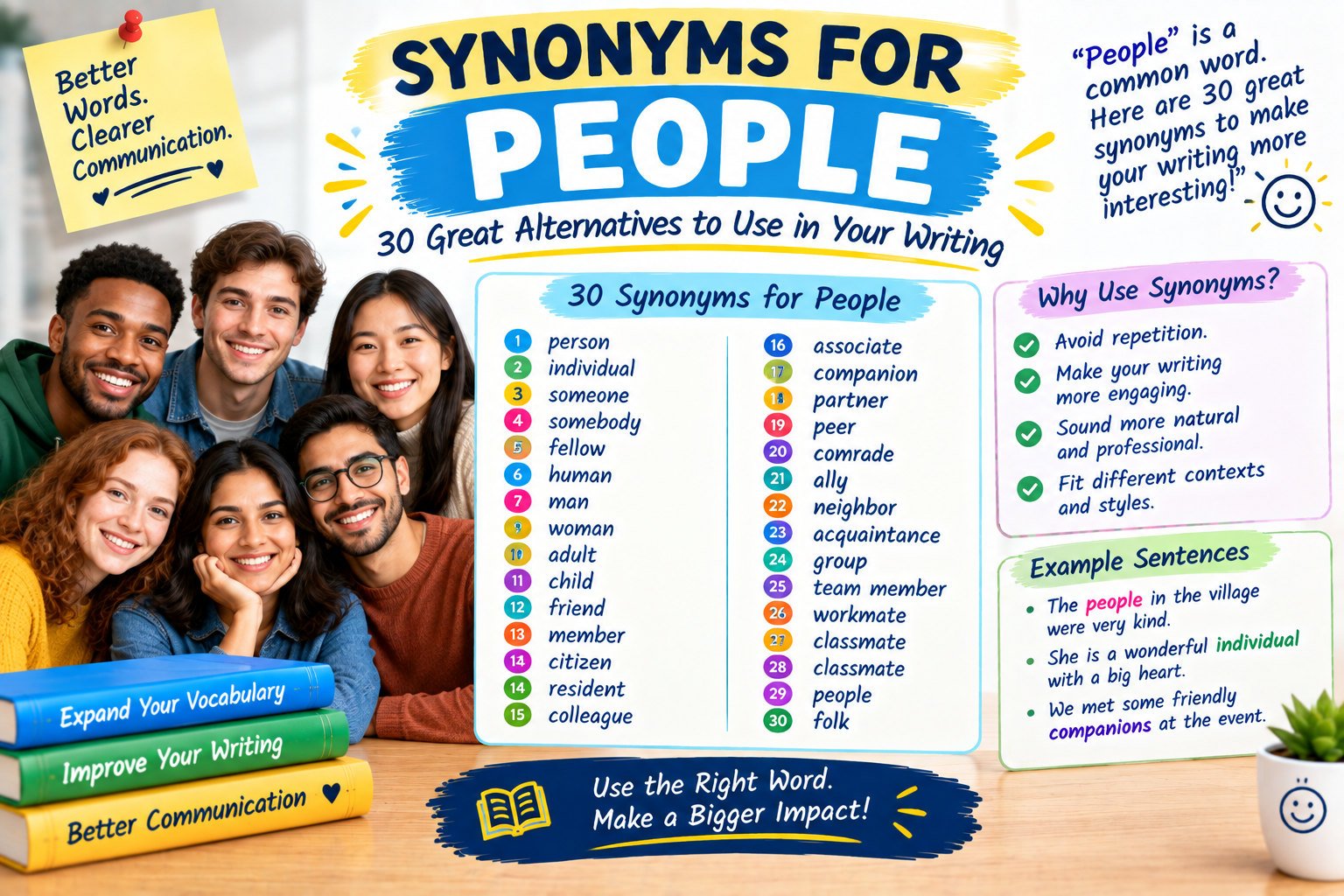
25 Synonyms of PEOPLE With Meaning & Examples
1. Individuals (Noun)
Meaning: Separate human beings considered one at a time.
Examples:
- The survey included 500 individuals.
- Each individual has different needs.
2. Persons (Noun)
Meaning: Human beings, especially in formal or legal language.
Examples:
- Only authorized persons may enter the room.
- Several persons were questioned about the incident.
3. Humans (Noun)
Meaning: Members of the human species.
Examples:
- Humans need food, water, and shelter.
- Humans have created many useful technologies.
4. Human Beings (Noun Phrase)
Meaning: People considered as members of the human species.
Examples:
- All human beings deserve basic respect.
- Human beings learn through experience.
5. Citizens (Noun)
Meaning: People who legally belong to a particular country or state.
Examples:
- Citizens voted in the local election.
- The government provides services for its citizens.
6. Residents (Noun)
Meaning: People who live in a particular place.
Examples:
- Local residents complained about the noise.
- The building has more than 200 residents.
7. Inhabitants (Noun)
Meaning: People or other living beings who live in a particular place.
Examples:
- The island has about 10,000 inhabitants.
- The inhabitants welcomed the visitors.
8. Population (Noun)
Meaning: All the people living in a particular area or country.
Examples:
- The city’s population is growing quickly.
- A large part of the population lives near the coast.
9. Community (Noun)
Meaning: A group of people who live in the same area or share something in common.
Examples:
- The community worked together to clean the park.
- Our community supports local businesses.
10. Public (Noun)
Meaning: Ordinary people considered as a group.
Examples:
- The public welcomed the new service.
- The museum is open to the public.
11. Crowd (Noun)
Meaning: A large group of people gathered in one place.
Examples:
- A crowd gathered outside the stadium.
- The crowd cheered when the team scored.
12. Group (Noun)
Meaning: Several people gathered or connected for a particular reason.
Examples:
- A group of students visited the library.
- The group discussed the new project.
13. Society (Noun)
Meaning: People living together within an organized community or system.
Examples:
- Education plays an important role in society.
- Technology has changed modern society.
14. Humanity (Noun)
Meaning: Human beings considered as a whole.
Examples:
- Humanity has made great scientific advances.
- Peace benefits all of humanity.
15. Mankind (Noun)
Meaning: Human beings considered as a whole.
Examples:
- The discovery changed the history of mankind.
- Mankind has explored only a small part of the universe.
16. Folk (Noun)
Meaning: People in general, often used in a friendly or informal way.
Examples:
- Local folk helped the visitors find the road.
- The folk of the village gathered for the festival.
17. Individuals (Noun)
Meaning: People viewed as separate members of a larger group.
Examples:
- Individuals can have very different opinions.
- The program helps individuals develop new skills.
18. Members (Noun)
Meaning: People who belong to a group, organization, or community.
Examples:
- Club members attended the meeting.
- All team members received an award.
19. Participants (Noun)
Meaning: People who take part in an activity or event.
Examples:
- All participants received a certificate.
- The participants answered several questions.
20. Attendees (Noun)
Meaning: People who attend an event, meeting, class, or gathering.
Examples:
- The conference had more than 500 attendees.
- Attendees received free information packs.
21. Residents (Noun)
Meaning: People who live in a particular area or building.
Examples:
- Local residents planted trees along the street.
- The residents organized a neighborhood meeting.
22. Consumers (Noun)
Meaning: People who buy or use goods and services.
Examples:
- Consumers often compare prices before buying.
- Online reviews can influence consumers.
23. Customers (Noun)
Meaning: People who buy goods or services from a business.
Examples:
- The store attracts many customers each day.
- Customers can contact the company for support.
24. Audiences (Noun)
Meaning: Groups of people watching, listening to, or reading something.
Examples:
- The film attracted large audiences.
- Online audiences responded positively to the video.
25. Peers (Noun)
Meaning: People who are similar to someone in age, status, education, or position.
Examples:
- Students often learn from their peers.
- She received support from her peers at work.
Prototype Meaning
The most typical meaning of people is human beings considered as a group. When most readers hear the word, they think of ordinary humans in everyday life. For example, “Many people live in this city” simply means that many human beings live there. The exact synonym depends on context. Citizens focuses on legal membership, residents focuses on where people live, customers focuses on buying, and participants focuses on taking part in an activity.
Prototype Categorization
The 25 synonyms can be grouped into useful semantic categories:
- General human references: individuals, persons, humans, human beings, folk — useful when referring to people in a broad sense.
- People connected to a place: citizens, residents, inhabitants, population, community — useful when location or shared community matters.
- People as a larger social unit: public, society, humanity, mankind — useful for broad social or human topics.
- People gathered together: crowd, group, members — useful when people are together or belong to an organization.
- People taking part in something: participants, attendees, audiences — useful for events, meetings, classes, and performances.
- People connected to business: consumers, customers — useful for shopping, markets, products, and services.
- People of a similar position: peers — useful for school, work, age groups, or professional settings.
This categorization helps writers select a word that gives more information than the general word people.
Antonyms of PEOPLE
People does not have one exact antonym because it refers broadly to human beings. However, these words can contrast with people in particular contexts:
- Animals (Noun): Living creatures that are not human beings.
- Objects (Noun): Physical things rather than living people.
- Things (Noun): Non-human items or concepts.
- Machines (Noun): Devices or systems that perform tasks instead of humans.
- Solitude (Noun): A state of being alone rather than being with other people.
Short Questions and Answers
What does people mean?
People means human beings, usually considered as a group or more than one person.
When should people be used?
Use people when you are talking about humans generally or about a group of humans. Choose a more specific synonym when the context gives you a reason to do so.
Is people positive or negative?
People is normally a neutral word. Its emotional meaning depends on the sentence and the context in which it is used.
How is it different from similar words?
People is a broad term. Citizens refers to legal members of a country, residents refers to people living in a place, customers refers to buyers, and participants refers to people taking part in an activity.
Conclusion
Learning synonyms for people can make your English clearer, richer, and more precise. The word people is useful in almost every type of communication, but repeating it too often can make writing less varied. Words such as individuals, citizens, residents, community members, participants, customers, and peers allow you to give readers more specific information.
For English learners, these alternatives can improve both speaking and writing. They also help content writers create natural sentences without unnecessary repetition. The best way to learn them is to practice each word in a real sentence and pay attention to its context. Read articles, listen to English conversations, and use a few new words each day. With regular practice, your vocabulary will grow and your confidence will become stronger.

Emma Collins is an English language expert and vocabulary writer with a passion for making English easier to understand. She specializes in synonyms, word meanings, word choice, and clear writing tips.