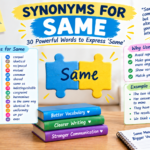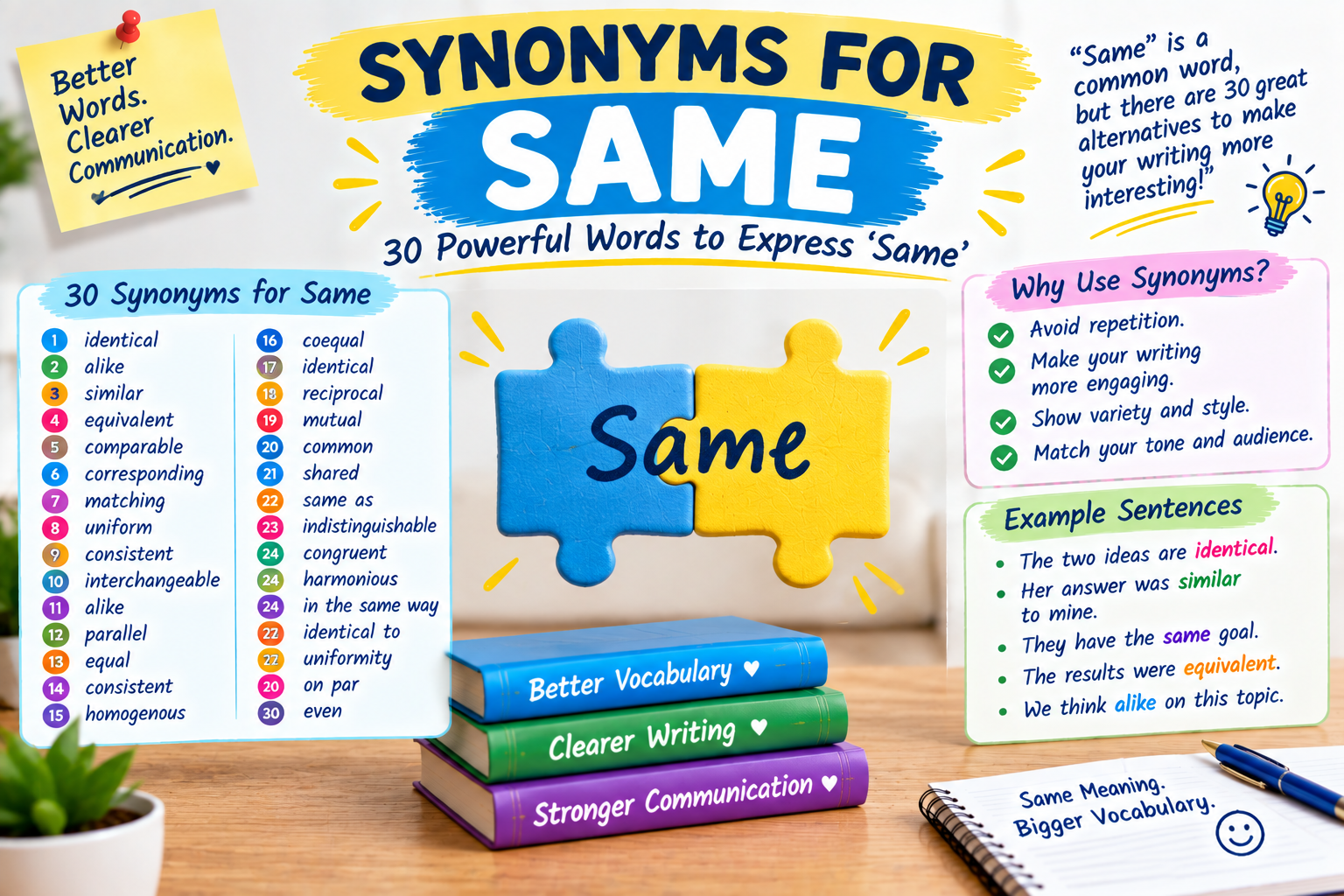
Same means identical or not different from another person, thing, idea, or situation. For example, if two students buy the same book, they have identical books.
We use this simple word every day when comparing people, objects, choices, places, and ideas. However, using same again and again can make your writing sound plain or repetitive. Learning synonyms gives you more ways to express exact meanings and small differences in context. This is especially useful for English learners, students, teachers, bloggers, and content writers. In this guide, you will learn the meaning, examples, connotations, history, pronunciation, word forms, and 25 synonyms for same. Each synonym includes simple examples so you can understand when to use it naturally.
Meaning of Same
Definition
Same (Adjective, Pronoun, Adverb):
Same means identical to another person or thing, or not different in a particular way.
Examples
- We wore the same color shirt to the party.
- These two answers are the same.
Connotative Meaning
Positive tone: The word can suggest agreement, consistency, or shared qualities.
Negative tone: In some contexts, same can suggest a lack of change, variety, or freshness.
Neutral tone: It simply shows that two or more things are identical or alike in a specific way.
(Connotation: the feeling or idea that a word suggests beyond its basic meaning.)
Etymology
- Old English (450–1100): The word developed from an old Germanic form related to words meaning “same” or “one and the same.” Old English had forms such as same and sama.
- Middle English (1100–1500): Middle English continued forms such as same and sam, which were used to describe identical or corresponding things.
- Modern English (1500–Present): Same became the standard modern form and developed many common uses, including comparison, identity, agreement, and continuity.
Pronunciation (IPA)
- IPA: /seɪm/
- Syllables: same (1 syllable)
Affixation Pattern of Same
- Root: same — from an old Germanic root associated with identity or likeness.
- Prefix: None.
- Suffix: None.
- Word formations:
- same — adjective, pronoun, adverb
- sameness — noun
- samey — adjective, meaning repetitive or lacking variety
- sames — plural noun, informal or specialized use
- the same — adjective phrase
- same-minded — adjective, describing people with similar views
25 Synonyms of Same With Meaning & Examples
1. Identical (Adjective)
Meaning: Exactly the same in every important detail.
Examples:
- The two copies are identical.
- The twins wore identical jackets.
2. Alike (Adjective)
Meaning: Similar or almost the same in appearance, qualities, or behavior.
Examples:
- The two houses look alike.
- The sisters are very alike in personality.
3. Equal (Adjective)
Meaning: The same in amount, value, size, or status.
Examples:
- Both teams have an equal number of players.
- The two pieces are equal in size.
4. Equivalent (Adjective)
Meaning: Equal in value, meaning, function, or effect.
Examples:
- One dollar is roughly equivalent to another unit of currency.
- These two expressions have equivalent meanings.
5. Matching (Adjective)
Meaning: Having the same or compatible appearance, pattern, or quality.
Examples:
- She wore matching shoes and a handbag.
- We bought matching curtains for the room.
6. Corresponding (Adjective)
Meaning: Similar or connected because two things have the same position, purpose, or relationship.
Examples:
- Write your answers in the corresponding boxes.
- The two reports contain corresponding sections.
7. Congruent (Adjective)
Meaning: Exactly matching in shape, size, or another defined feature.
Examples:
- The two triangles are congruent.
- Their actions were congruent with their stated goals.
8. Indistinguishable (Adjective)
Meaning: So similar that it is difficult or impossible to tell things apart.
Examples:
- The two designs are almost indistinguishable.
- The copies were indistinguishable from the originals.
9. Uniform (Adjective)
Meaning: The same or consistent throughout a group or area.
Examples:
- The company uses a uniform design across its websites.
- The temperature remained uniform throughout the room.
10. Consistent (Adjective)
Meaning: Remaining the same or following the same pattern.
Examples:
- Her results have been consistent all year.
- Use consistent formatting throughout the report.
11. Unchanged (Adjective)
Meaning: Remaining exactly as it was without alteration.
Examples:
- The original schedule remains unchanged.
- His opinion has stayed unchanged.
12. Unvarying (Adjective)
Meaning: Remaining the same without changes or variation.
Examples:
- The machine operates at an unvarying speed.
- His daily routine is almost unvarying.
13. Similar (Adjective)
Meaning: Almost the same, although not necessarily identical.
Examples:
- We have similar interests.
- The two products have similar features.
14. Comparable (Adjective)
Meaning: Similar enough to be compared in a useful way.
Examples:
- The two cars offer comparable performance.
- Her results are comparable to those of her classmates.
15. Common (Adjective)
Meaning: Shared by two or more people or things.
Examples:
- They have a common goal.
- English is their common language.
16. Shared (Adjective)
Meaning: Used, owned, experienced, or held by more than one person or group.
Examples:
- They have a shared interest in music.
- The students worked toward a shared goal.
17. Synonymous (Adjective)
Meaning: Having the same or nearly the same meaning.
Examples:
- The two words are synonymous in this context.
- Success is often considered synonymous with achievement.
18. Coequal (Adjective)
Meaning: Equal in rank, importance, or status.
Examples:
- The partners have coequal authority.
- Both departments have coequal status within the organization.
19. Coextensive (Adjective)
Meaning: Having the same extent, range, or boundaries.
Examples:
- The two areas are coextensive.
- The company’s service region is coextensive with the local district.
20. Duplicate (Adjective/Noun)
Meaning: An exact copy of something.
Examples:
- Please send me a duplicate copy of the document.
- The office kept a duplicate of the original file.
21. Repeated (Adjective)
Meaning: Happening or appearing again in the same or similar form.
Examples:
- The report contains repeated information.
- Repeated patterns appear throughout the design.
22. Recurrent (Adjective)
Meaning: Happening again, especially in a similar pattern.
Examples:
- The study found a recurrent pattern.
- The same problem became recurrent after several months.
23. Homogeneous (Adjective)
Meaning: Consisting of similar or uniform parts.
Examples:
- The group was relatively homogeneous in age.
- The mixture should become homogeneous before use.
24. Interchangeable (Adjective)
Meaning: Able to be used in place of each other without a meaningful difference in function.
Examples:
- These two batteries are interchangeable.
- The terms are sometimes treated as interchangeable.
25. Uniformly Identical (Adjective Phrase)
Meaning: Completely the same throughout or across a group.
Examples:
- The samples were uniformly identical in size.
- The digital copies appeared uniformly identical on every screen.
Prototype Meaning
The most typical meaning of same is not different from another thing in a specific way. When people hear the word, they often imagine two objects, people, ideas, or situations that match or share an important feature. For example, two identical shirts can be called the same, while two cars with similar designs may only be alike. The exact meaning depends on what is being compared.
Prototype Categorization
The synonyms of same can be grouped by their specific meaning:
- Exact identity: identical, indistinguishable, duplicate — use these when two things are exactly alike.
- General similarity: alike, similar, comparable, matching — useful when things share important features but may not be exactly equal.
- Equality: equal, equivalent, coequal — best when discussing value, amount, rank, or effect.
- Consistency and lack of change: consistent, unchanged, unvarying, uniform — useful when something remains stable.
- Shared qualities: common, shared, synonymous — describe ideas, goals, meanings, or experiences held by more than one person or thing.
- Technical similarity: congruent, coextensive, homogeneous, interchangeable — useful in mathematics, science, business, and technical writing.
- Repetition: repeated, recurrent — describe something that appears or happens again.
This grouping helps writers choose a synonym based on the exact meaning they want instead of replacing same with a word that does not fully fit.
Antonyms of Same
- Different (Adjective): Not identical or not alike.
- Unlike (Adjective): Not similar in nature or appearance.
- Dissimilar (Adjective): Clearly different from something else.
- Unequal (Adjective): Not equal in amount, size, value, or status.
- Distinct (Adjective): Clearly separate or different.
- Varied (Adjective): Showing differences or many types.
- Changed (Adjective): No longer in the original state.
- Opposite (Adjective): Completely different in direction, meaning, or quality.
Short Questions and Answers
What does same mean?
Same means identical or not different from another person, thing, idea, or situation in a particular way.
When should same be used?
Use same when you want to show that two or more things match, share an identity, or have no meaningful difference in the feature being discussed.
Is same positive or negative?
Same is usually neutral. It can sound positive when it suggests consistency or agreement, but it can sound negative when it suggests boredom or a lack of change.
How is it different from similar words?
Same can mean identical, while similar usually means alike but not exactly identical. Identical is stronger because it stresses complete sameness. Equivalent focuses on equal value or function.
Conclusion
Learning same and its synonyms can make your English clearer and more flexible. Words such as identical, alike, equal, equivalent, and matching may seem close, but each one carries a slightly different meaning. Choosing the right word helps you describe comparisons with greater accuracy. These alternatives are useful in everyday conversations, schoolwork, professional writing, and online content. Regular practice can also help you avoid repeating the word same too often. Try learning a few synonyms each day and use them in your own sentences. Over time, your vocabulary will grow, your writing will sound more natural, and you will feel more confident when expressing ideas in English.
Emily Watson is an English language writer and vocabulary specialist dedicated to helping readers improve their communication skills. She writes clear, easy-to-understand guides on synonyms, word meanings, grammar, and word usage.