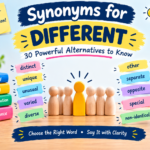
Different means not the same as another person, thing, or idea. Imagine two students wearing similar uniforms, but one has a bright red backpack while the other carries a blue one. You could say their backpacks are different. This simple word is common in everyday speech, school writing, business, and online content.
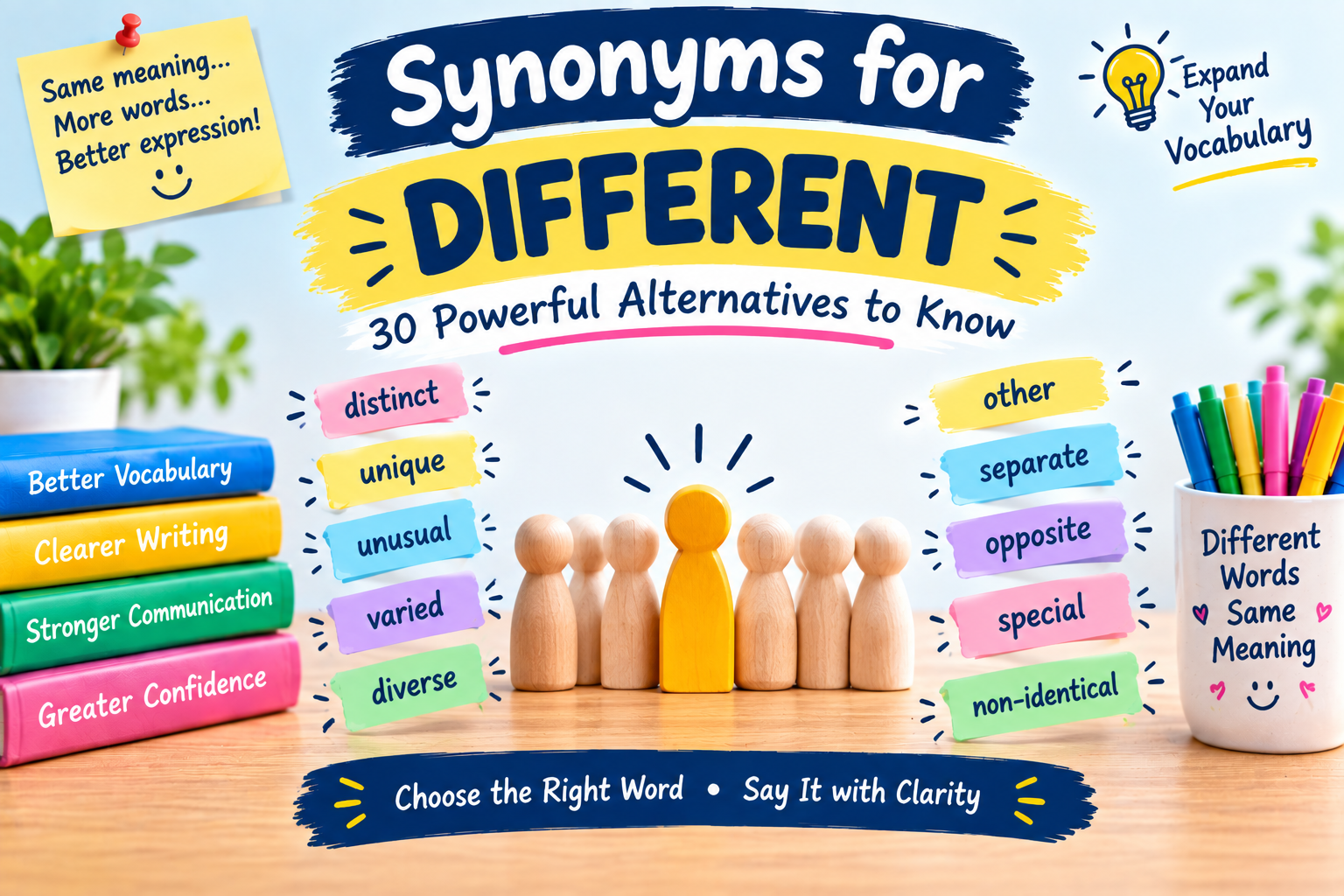
Learning synonyms for different helps you describe differences with greater accuracy. Instead of repeating the same word, English learners and content writers can use words such as distinct, unique, separate, unlike, varied, or diverse. Each word has a slightly different meaning and works best in certain situations. This guide explains the meaning, grammar, history, pronunciation, word formation, synonyms, semantic categories, and antonyms of different. Simple examples are included to help you understand each alternative and use it naturally.
Meaning of Different
Definition
Different (Adjective): Not the same as another person, thing, idea, or situation.
It can also mean unusual or separate from what is normal or expected.
Examples
- My answer is different from yours.
- She chose a different route to work.
- This restaurant offers something different from the usual menu.
Connotative Meaning
Connotation means the feeling or idea that a word suggests beyond its basic meaning.
- Positive tone: Different can suggest originality, creativity, or individuality.
- Negative tone: It can suggest something strange, unusual, or unfamiliar when the context is critical.
- Neutral tone: It often simply describes something that is not the same.
Etymology
Old English (450–1100)
Different is not a native Old English word. Old English used words such as sundor, meaning “apart” or “separately,” to express related ideas.
Middle English (1100–1500)
Different entered English through Old French different, from Latin differentem, the present participle of differre, meaning “to carry apart” or “to differ.”
Modern English (1500–Present)
In Modern English, different became a common adjective meaning “not alike” or “not the same.” It can describe differences in appearance, quality, opinion, behavior, style, size, or nature.
Pronunciation (IPA)
- IPA: /ˈdɪfərənt/
- Syllables: dif-fer-ent
Affixation Pattern of Different
- Root: Latin fer / ferre, meaning “carry or bear,” through differre
- Prefix: dif-, a form of Latin dis-, suggesting separation
- Suffix: -ent, used to form adjectives
- Word formations:
- different — adjective
- differ — verb
- difference — noun
- differently — adverb
- differing — adjective/participle
- indifferent — adjective
- indifference — noun
- indifferently — adverb
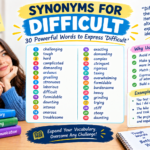
25 Synonyms of Different With Meaning & Examples
1. Distinct (Adjective)
Meaning: Clearly separate or noticeably unlike something else.
Examples:
- The two cultures have distinct traditions.
- Each product has a distinct design.
2. Unlike (Preposition/Adjective)
Meaning: Not similar to someone or something.
Examples:
- This method is unlike the one we used before.
- Unlike his brother, he enjoys quiet places.
3. Diverse (Adjective)
Meaning: Including many different types of people, things, or ideas.
Examples:
- The city has a diverse population.
- We discussed a diverse range of topics.
4. Varied (Adjective)
Meaning: Including many different types or forms.
Examples:
- The restaurant has a varied menu.
- She has varied interests.
5. Unique (Adjective)
Meaning: Very special or unlike anything else.
Examples:
- Each painting has a unique style.
- The building has a unique design.
6. Separate (Adjective)
Meaning: Existing apart from something else.
Examples:
- The children have separate bedrooms.
- Keep the two documents in separate folders.
7. Dissimilar (Adjective)
Meaning: Not alike in appearance, nature, or qualities.
Examples:
- The two materials are quite dissimilar.
- Their opinions are dissimilar in several ways.
8. Unalike (Adjective)
Meaning: Not similar to each other.
Examples:
- The twins look surprisingly unalike.
- Their personalities are completely unalike.
9. Disparate (Adjective)
Meaning: Very different from each other.
Examples:
- The report combines several disparate ideas.
- They came from disparate backgrounds.
10. Variegated (Adjective)
Meaning: Showing different types, colors, or patterns.
Examples:
- The garden contains variegated plants.
- She admired the variegated colors of the fabric.
11. Individual (Adjective)
Meaning: Separate and distinct from others.
Examples:
- Each student has an individual learning style.
- The artist developed an individual style.
12. Divergent (Adjective)
Meaning: Moving or developing in different directions.
Examples:
- The researchers reached divergent conclusions.
- They have divergent views on the issue.
13. Contrary (Adjective)
Meaning: Opposite or strongly different from something else.
Examples:
- His actions were contrary to his words.
- She reached a contrary conclusion.
14. Alternative (Adjective/Noun)
Meaning: Different from the usual choice or method.
Examples:
- We need an alternative solution.
- They chose an alternative route.
15. Uncommon (Adjective)
Meaning: Not usual or not often seen.
Examples:
- She has an uncommon talent for languages.
- This plant has an uncommon color.
16. Unusual (Adjective)
Meaning: Not normal, common, or expected.
Examples:
- He had an unusual idea.
- The weather was unusual for this season.
17. Novel (Adjective)
Meaning: New, original, or different from what is familiar.
Examples:
- The team developed a novel approach.
- She suggested a novel way to solve the problem.
18. Original (Adjective)
Meaning: New and created in an independent or inventive way.
Examples:
- He presented an original idea.
- The designer created an original pattern.
19. Contrary to (Prepositional Phrase)
Meaning: Opposite to what is expected, believed, or stated.
Examples:
- Contrary to expectations, the plan succeeded.
- Contrary to popular belief, the plant needs little water.
20. Other (Adjective/Pronoun)
Meaning: Referring to a person or thing that is not the one already mentioned.
Examples:
- Try the other option.
- Some students chose one topic, while others chose another.
21. Separate (Adjective)
Meaning: Different and kept apart from another person or thing.
Examples:
- The company has separate offices for each department.
- We discussed the issues in separate meetings.
22. Discrete (Adjective)
Meaning: Clearly separate or distinct from other things.
Examples:
- The study divided the data into discrete groups.
- These are discrete stages of the process.
23. Heterogeneous (Adjective)
Meaning: Made up of different kinds of people or things.
Examples:
- The sample was heterogeneous.
- The class has a heterogeneous mix of students.
24. Changing (Adjective)
Meaning: Becoming different over time.
Examples:
- The industry is changing rapidly.
- We live in a changing environment.
25. Divergent (Adjective)
Meaning: Different because of moving away from the same idea, path, or position.
Examples:
- The scientists developed divergent theories.
- Their opinions became increasingly divergent.
Prototype Meaning
The most typical meaning of different is not the same as another person or thing. When people hear this word, they usually think about a clear contrast between two or more things. For example, “My phone is different from yours” means the two phones are not the same. The exact synonym depends on the type of difference. Distinct highlights clear separation, diverse highlights variety, unique highlights special qualities, and unusual highlights something outside the normal pattern.
Prototype Categorization
The synonyms of different can be grouped into several useful semantic categories:
- General difference: distinct, unlike, dissimilar, unalike, separate — useful when simply showing that two things are not the same.
- Variety: diverse, varied, variegated, heterogeneous — useful when many different types exist together.
- Strong difference: disparate, divergent, contrary — useful when the differences are large or significant.
- Originality: unique, novel, original, individual — useful when something is new, special, or personally distinctive.
- Unusual qualities: uncommon, unusual — useful when something is outside the normal or expected pattern.
- Alternative choices: alternative, other — useful when comparing one choice with another.
- Clear separation: discrete, separate — useful when things exist as distinct units.
This categorization helps writers choose a more precise word instead of using different for every type of contrast.
Antonyms of Different
- Same (Adjective): Identical or not different.
- Similar (Adjective): Almost the same in important ways.
- Alike (Adjective): Similar in appearance or qualities.
- Identical (Adjective): Exactly the same in every relevant way.
- Equal (Adjective): The same in amount, value, size, or status.
- Common (Adjective): Frequently found, seen, or experienced.
- Usual (Adjective): Normal or regularly expected.
- Uniform (Adjective): Consistent and the same throughout.
Short Questions and Answers
What does different mean?
Different means not the same as another person, thing, idea, or situation.
When should different be used?
Use different when you want to show that two or more things are not the same. It is a broad word that works in many everyday and formal contexts.
Is different positive or negative?
Different is usually neutral. It can have a positive meaning when it suggests creativity or originality, or a negative meaning when it suggests something strange or unwanted.
How is it different from similar words?
Different is a broad term. Distinct emphasizes clear separation, diverse emphasizes variety, unique emphasizes special qualities, and unusual emphasizes something that is not common.
Conclusion
Learning synonyms for different gives you more ways to describe contrast and variety. Instead of repeating different, you can use distinct for clear separation, diverse for variety, unique for something special, or unusual for something outside the norm. Each synonym adds a slightly different meaning to your sentence.
These words are useful for English learners, students, professionals, and content writers. They can make your speaking more natural and your writing more precise. The best way to remember them is to practice each word in a real sentence. Read English regularly, notice how writers use these alternatives, and try using a few new words each day. With steady practice, you can build stronger vocabulary, avoid repetition, and communicate your ideas with greater confidence.

Sarah Linguist is a passionate language enthusiast who loves exploring words, meanings, and synonyms.
She creates clear, easy-to-understand content to help readers improve their vocabulary and English skills.
Through SynonymsGuide.com, Sarah makes finding the right words simple, useful, and enjoyable.