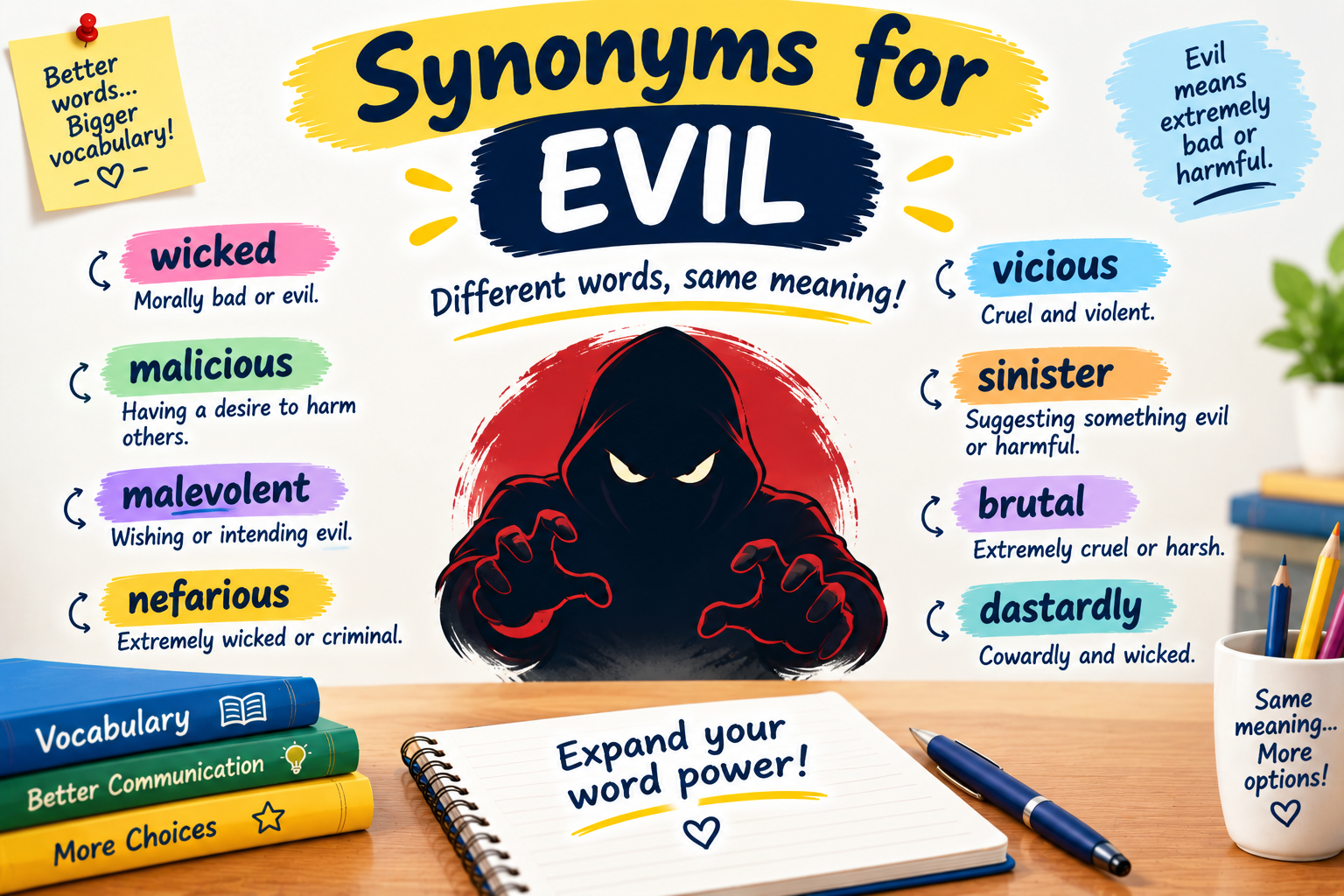
Synonyms for evil include wicked, immoral, sinful, corrupt, malicious, vile, vicious, cruel, harmful, malevolent, depraved, sinister, and nefarious. The best synonym depends on whether you mean bad behavior, harmful intentions, or extreme moral wrongdoing.
Evil describes something that is deeply wrong, harmful, cruel, or morally bad. Imagine a story where a character deliberately hurts innocent people for personal gain. You might describe that character as evil. The word is common in books, movies, religion, philosophy, news, and everyday speech. However, evil can describe actions, people, intentions, or ideas, so choosing a more exact synonym can make your writing stronger. Learning synonyms also helps English learners and content writers avoid repetition and express different levels of moral wrongdoing. In this guide, you will learn the meaning of evil, its grammar, history, pronunciation, and word formation. You will also explore 28 synonyms with simple meanings and examples, followed by semantic categories, antonyms, and useful questions and answers.
Meaning of Evil
Definition
Evil (Adjective/Noun): Evil means extremely bad, harmful, cruel, or morally wrong. As a noun, it can mean wickedness, suffering, or harmful wrongdoing.
Examples
- The villain in the story was evil and cruel.
- The novel explores the difference between good and evil.
Connotative Meaning
- Positive tone: Evil normally does not have a positive meaning, although it can be used positively when someone describes an act as “fighting evil.”
- Negative tone: Evil strongly suggests moral wrongdoing, cruelty, or harmful intentions.
- Neutral tone: In academic, philosophical, or fictional contexts, evil can be discussed as a concept without directly judging a particular person.
(Connotation: the emotional feeling or association that a word carries beyond its basic meaning.)
Etymology
- Old English (450–1100): Evil comes from Old English yfel, meaning “bad,” “wicked,” or “harmful.” It was used for both moral wrongdoing and unpleasant conditions.
- Middle English (1100–1500): The word appeared in forms such as evil and ivel. Its meanings continued to include moral wrongdoing, harm, misfortune, and something bad.
- Modern English (1500–Present): Evil developed its strong modern sense of serious moral wickedness. It is also used more broadly for harmful things, suffering, or negative forces.
The word is related to older Germanic forms found in several Germanic languages. Its exact deeper origin is uncertain.
Pronunciation (IPA)
- IPA: /ˈiːvəl/
- Syllables: e-vil
Affixation Pattern of Evil
- Root: evil
- Prefix: None
- Suffix: None in the basic word
Word formations:
- evil — noun/adjective
- evils — plural noun
- evilly — adverb
- evilness — noun
- evil-minded — adjective
- evil-doer — noun
- evil-doing — noun
- evildoer — noun
The basic word evil is an old English word rather than a modern prefixed or suffixed formation.
28 Synonyms of Evil With Meaning & Examples
1. Wicked (Adjective)
Meaning: Wicked means morally bad or deliberately harmful.
Examples:
- The story describes a wicked ruler.
- The villain made a wicked plan.
2. Immoral (Adjective)
Meaning: Immoral means going against accepted moral principles.
Examples:
- The judge criticized the company’s immoral behavior.
- Lying to innocent people can be considered immoral.
3. Sinful (Adjective)
Meaning: Sinful means involving actions considered wrong according to religious or moral beliefs.
Examples:
- The character believed his actions were sinful.
- The novel describes a life filled with sinful choices.
4. Wickedness (Noun)
Meaning: Wickedness means the quality or behavior of being morally evil.
Examples:
- The story shows the wickedness of the ruler.
- His wickedness harmed many people.
5. Malicious (Adjective)
Meaning: Malicious means deliberately intending to hurt someone or cause harm.
Examples:
- The company faced a malicious online attack.
- He made a malicious comment about his colleague.
6. Malevolent (Adjective)
Meaning: Malevolent means having a strong desire to harm others.
Examples:
- The story features a malevolent spirit.
- His malevolent intentions became clear.
7. Vile (Adjective)
Meaning: Vile means extremely unpleasant, disgusting, or morally bad.
Examples:
- The criminal committed a vile act.
- The character was known for his vile behavior.
8. Vicious (Adjective)
Meaning: Vicious means cruel, violent, or deliberately harmful.
Examples:
- The animal became vicious when threatened.
- He launched a vicious attack on his rival.
9. Cruel (Adjective)
Meaning: Cruel means causing pain or suffering without showing kindness.
Examples:
- It was cruel to treat the animal that way.
- The ruler was known for his cruel punishments.
10. Corrupt (Adjective)
Meaning: Corrupt means morally dishonest or willing to act wrongly for personal gain.
Examples:
- The official was accused of being corrupt.
- The novel features a corrupt leader.
11. Depraved (Adjective)
Meaning: Depraved means having extremely bad moral standards or behavior.
Examples:
- The film portrays a depraved criminal.
- His depraved actions shocked the community.
12. Sinister (Adjective)
Meaning: Sinister means suggesting that something harmful or evil may happen.
Examples:
- The house had a sinister appearance.
- He gave me a sinister smile.
13. Nefarious (Adjective)
Meaning: Nefarious means extremely wicked or involved in serious wrongdoing.
Examples:
- The detective uncovered a nefarious scheme.
- The group was involved in nefarious activities.
14. Heinous (Adjective)
Meaning: Heinous means shockingly wicked or morally horrible.
Examples:
- The court described the crime as heinous.
- The murderer committed a heinous act.
15. Atrocious (Adjective)
Meaning: Atrocious means extremely cruel, terrible, or morally unacceptable.
Examples:
- The prisoners suffered atrocious treatment.
- The report described the conditions as atrocious.
16. Monstrous (Adjective)
Meaning: Monstrous means extremely cruel, evil, or shocking.
Examples:
- The villain committed a monstrous act.
- The decision was described as monstrous and unfair.
17. Fiendish (Adjective)
Meaning: Fiendish means extremely cruel, evil, or wicked.
Examples:
- The villain created a fiendish plan.
- The prisoner faced a fiendish punishment.
18. Diabolical (Adjective)
Meaning: Diabolical means extremely evil or cruel.
Examples:
- The villain had a diabolical plan.
- It was a diabolical act of cruelty.
19. Malevolent (Adjective)
Meaning: Malevolent means showing a desire to cause harm or suffering.
Examples:
- The character had a malevolent personality.
- A malevolent force controlled the house.
20. Malignant (Adjective)
Meaning: Malignant can describe something harmful, destructive, or showing a desire to cause damage.
Examples:
- The story presents a malignant force.
- His malignant influence affected the entire group.
21. Sinister (Adjective)
Meaning: Sinister describes something that seems threatening, dangerous, or evil.
Examples:
- There was a sinister feeling in the empty building.
- The stranger’s sinister behavior worried everyone.
22. Pernicious (Adjective)
Meaning: Pernicious means causing serious harm, especially in a gradual or hidden way.
Examples:
- The habit had a pernicious effect on society.
- Misinformation can have a pernicious influence.
23. Harmful (Adjective)
Meaning: Harmful means causing damage, injury, or negative effects.
Examples:
- Smoking can be harmful to your health.
- The policy had harmful effects on poor families.
24. Destructive (Adjective)
Meaning: Destructive means causing serious damage or destruction.
Examples:
- The conflict had destructive consequences.
- His destructive behavior damaged the relationship.
25. Malevolence (Noun)
Meaning: Malevolence means a strong desire to cause harm or suffering.
Examples:
- The character acted with pure malevolence.
- His malevolence was clear to everyone.
26. Brutal (Adjective)
Meaning: Brutal means extremely cruel, violent, or harsh.
Examples:
- The attack was brutal and unexpected.
- The dictator used brutal methods.
27. Iniquitous (Adjective)
Meaning: Iniquitous means extremely unfair, wicked, or morally wrong.
Examples:
- The writer criticized the iniquitous system.
- They fought against an iniquitous law.
28. Villainous (Adjective)
Meaning: Villainous means behaving like a villain or showing evil and cruel behavior.
Examples:
- The story has a villainous character.
- His villainous actions caused great suffering.
Usage note: These words are not exact replacements in every sentence. Immoral focuses on moral rules, malicious focuses on harmful intentions, cruel focuses on causing suffering, corrupt focuses on dishonesty, and sinister often describes something that appears threatening or evil.
Prototype Meaning
The most typical meaning of evil is serious moral wrongdoing or extreme wickedness. When people hear the word, they may imagine a cruel villain who deliberately hurts others. In stories, religion, and philosophy, evil is often presented as the opposite of good. In everyday English, however, the word can also describe harmful actions, ideas, or forces.
Prototype Categorization
Grouping synonyms by meaning helps writers choose the right word for the exact type of evil they want to describe.
- General moral evil: wicked, immoral, sinful, wickedness — useful for broad discussions of right and wrong.
- Harmful intentions: malicious, malevolent, malevolence — useful when someone deliberately wants to cause harm.
- Extreme moral wrongdoing: depraved, heinous, atrocious, iniquitous — useful for very serious or shocking wrongdoing.
- Cruel or violent behavior: vicious, cruel, brutal, monstrous — useful when describing suffering, violence, or harsh actions.
- Threatening or mysterious evil: sinister, fiendish, diabolical — common in stories, fiction, and dramatic descriptions.
- Dishonest or morally damaged behavior: corrupt, nefarious — useful for crime, politics, business, or secret wrongdoing.
- Harmful effects: harmful, destructive, pernicious, malignant — useful when describing damaging people, actions, systems, or influences.
- Villain-like behavior: villainous — especially useful for fictional characters or people behaving like villains.
This categorization helps writers avoid using evil as a general label when a more precise word can explain the exact type of wrongdoing.
Antonyms of Evil
- Good (Adjective/Noun): Morally right, kind, or beneficial.
- Virtuous (Adjective): Showing high moral standards.
- Moral (Adjective): Following accepted principles of right and wrong.
- Kind (Adjective): Caring and considerate toward others.
- Benevolent (Adjective): Wanting to help others and do good.
- Righteous (Adjective): Morally right or just.
- Noble (Adjective): Showing admirable moral qualities.
- Innocent (Adjective): Not guilty of wrongdoing or harm.
- Compassionate (Adjective): Showing concern for people who are suffering.
Short Questions and Answers
What does evil mean?
Evil means extremely bad, harmful, cruel, or morally wrong. It can describe a person, action, intention, idea, or force.
When should evil be used?
Use evil when describing serious moral wrongdoing or something that is strongly harmful or wicked. It is a powerful word, so it should not be used for every small mistake.
Is evil positive or negative?
Evil is strongly negative because it suggests serious wrongdoing, cruelty, or harmful behavior.
How is it different from similar words?
Evil is a broad and powerful word. Cruel focuses on causing suffering, immoral focuses on breaking moral standards, malicious focuses on harmful intent, and corrupt focuses on dishonest or morally damaged behavior.
What is a strong synonym for evil?
Wicked, malevolent, depraved, heinous, and nefarious are strong synonyms, but each has a slightly different use.
What is the difference between evil and wicked?
Both can mean morally bad. Evil is often stronger and broader, while wicked is commonly used to describe a person’s actions, character, or behavior.
What is the difference between evil and cruel?
Evil focuses on serious moral wrongness. Cruel specifically focuses on causing pain, suffering, or distress.
Can evil be a noun?
Yes. Evil can be a noun, as in “the struggle between good and evil.” It can also be an adjective, as in “an evil character.”
Conclusion
Learning synonyms for evil helps you describe moral wrongdoing with greater accuracy. Wicked and immoral are useful for general moral judgment, while malicious and malevolent focus on harmful intentions. Cruel, vicious, and brutal describe actions that cause pain or suffering. Stronger words such as heinous, depraved, and atrocious are useful for extremely serious wrongdoing. In fiction, sinister, diabolical, and villainous can create a dramatic tone. Choosing the right synonym helps you avoid repetition and makes your writing more precise. Practice these words in your own sentences, and learn how their meanings change with context. A stronger vocabulary will help you communicate ideas clearly and build confidence in both spoken and written English.

Emily Watson is an English language writer and vocabulary specialist dedicated to helping readers improve their communication skills. She writes clear, easy-to-understand guides on synonyms, word meanings, grammar, and word usage.