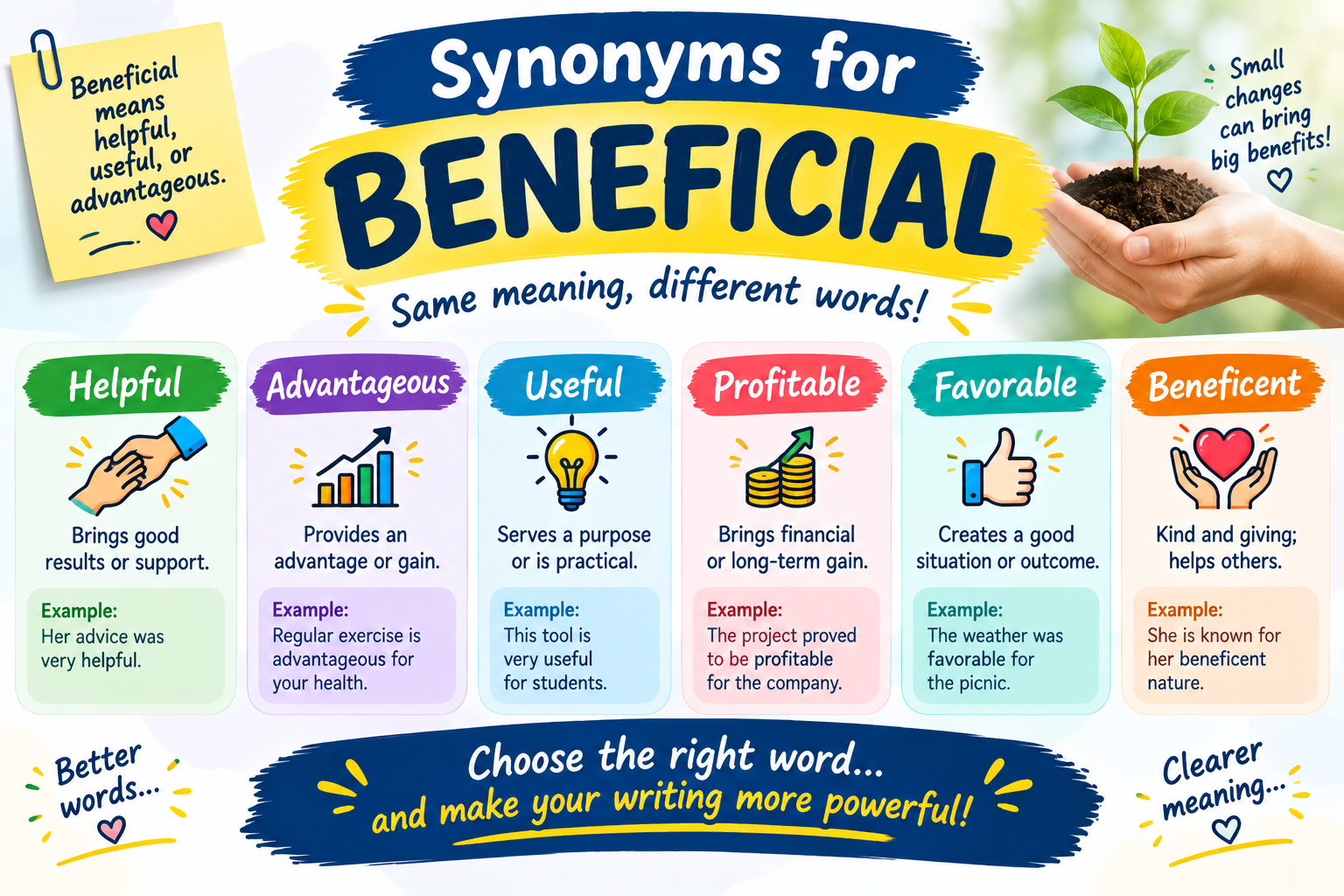
Common synonyms for beneficial include helpful, useful, advantageous, valuable, positive, favorable, worthwhile, productive, effective, and profitable. The best synonym depends on what kind of benefit you mean.
Beneficial means helpful or good for someone or something. For example, a daily walk can be beneficial because it can support your health and improve your mood. A new study method may also be beneficial if it helps you learn faster.
The word beneficial is common in health, education, business, science, and everyday writing. English learners and content writers often need synonyms for beneficial to avoid repeating the same word and to express ideas more clearly.
Knowing the right synonym can also help you match your tone to the situation. Some words sound simple, while others are better for formal writing. This guide explains the meaning, grammar, history, pronunciation, and word forms of beneficial. You will also learn 27 useful synonyms with examples and semantic categories.
Meaning of Beneficial
Definition
Beneficial (Adjective): Producing a good result or helping someone or something.
Examples
- Regular exercise is beneficial for your health.
- Reading every day can be beneficial for language learners.
Connotative Meaning
(Connotation: the feeling or idea that a word suggests beyond its basic meaning.)
- Positive tone: Beneficial strongly suggests help, value, improvement, or a good result.
- Negative tone: The word itself is not negative, but it can appear in a sentence about a harmful situation that is being compared with a helpful one.
- Neutral tone: In factual or scientific writing, beneficial can simply describe something that produces a useful effect.
Etymology
The word beneficial has Latin roots and entered English through French.
- Old English (450–1100): The modern word beneficial was not part of Old English. English used native words such as those related to “good,” “help,” and “benefit.”
- Middle English (1100–1500): Beneficial entered English through Anglo-French and Medieval Latin, connected with beneficium, meaning “benefit, favor, or kindness.”
- Modern English (1500–Present): Beneficial became established as an adjective meaning “producing benefit” or “helpful.”
The word is related to benefit, beneficial, beneficiary, and benefactor. These words share the Latin root bene, meaning “well” or “good.”
Pronunciation (IPA)
- IPA: /ˌbenɪˈfɪʃəl/
- Syllables: ben-e-fi-cial
Affixation Pattern of Beneficial
- Root: bene- / fic — from Latin roots connected with “well” and “do/make”
- Prefix: bene- in the historical Latin formation
- Suffix: -ial, forming an adjective
Word Formations
- benefit — noun/verb
- beneficial — adjective
- beneficially — adverb
- beneficialness — noun, uncommon
- beneficiary — noun
- benefactor — noun
- benefaction — noun
- beneficent — adjective
- beneficence — noun
27 Synonyms of Beneficial With Meaning & Examples
1. Helpful (Adjective)
Meaning: Giving help or making a situation better.
Examples:
- Your advice was very helpful.
- This guide is helpful for new students.
2. Useful (Adjective)
Meaning: Having a practical purpose or helping someone do something.
Examples:
- This tool is useful for cleaning small spaces.
- She gave me some useful information.
3. Advantageous (Adjective)
Meaning: Giving someone or something a benefit or advantage.
Examples:
- Learning another language can be advantageous at work.
- The new location is advantageous for the business.
4. Valuable (Adjective)
Meaning: Very useful, important, or worth having.
Examples:
- Her experience was valuable to the team.
- This book provides valuable information.
5. Positive (Adjective)
Meaning: Producing a good or useful result.
Examples:
- The treatment had a positive effect.
- We received positive results from the test.
6. Favorable (Adjective)
Meaning: Producing a good or desired result.
Examples:
- The company received favorable feedback.
- The weather was favorable for the outdoor event.
7. Productive (Adjective)
Meaning: Producing useful or successful results.
Examples:
- We had a productive meeting.
- The new system made the team more productive.
8. Effective (Adjective)
Meaning: Producing the result that is wanted.
Examples:
- Exercise can be an effective way to reduce stress.
- The teacher used an effective learning method.
9. Worthwhile (Adjective)
Meaning: Good enough to be worth the time, effort, or money spent.
Examples:
- Learning these skills is worthwhile.
- The training was difficult but worthwhile.
10. Profitable (Adjective)
Meaning: Producing financial gain or profit.
Examples:
- The business became profitable after two years.
- Online sales can be profitable for small companies.
11. Rewarding (Adjective)
Meaning: Giving satisfaction, value, or a feeling of achievement.
Examples:
- Teaching children can be very rewarding.
- Volunteering was a rewarding experience.
12. Constructive (Adjective)
Meaning: Helping to improve something rather than simply criticizing it.
Examples:
- She gave me constructive feedback.
- The discussion was calm and constructive.
13. Beneficent (Adjective)
Meaning: Doing good or giving help to others.
Examples:
- The beneficent organization supports poor families.
- His beneficent actions helped the local community.
14. Salutary (Adjective)
Meaning: Having a good effect, especially by improving behavior or health.
Examples:
- The experience had a salutary effect on him.
- The warning served as a salutary lesson.
Usage note: Salutary is formal and less common than helpful or beneficial.
15. Favoring (Adjective)
Meaning: Giving an advantage to a person, group, or result.
Examples:
- The conditions were favoring the home team.
- The market is favoring smaller companies this year.
16. Gainful (Adjective)
Meaning: Providing useful work or financial gain.
Examples:
- She found gainful employment after graduation.
- The program helps people find gainful work.
17. Wholesome (Adjective)
Meaning: Good for health, well-being, or moral development.
Examples:
- Fresh vegetables are part of a wholesome diet.
- The children enjoyed the wholesome activity.
18. Healthful (Adjective)
Meaning: Good for physical or mental health.
Examples:
- Fresh fruit is a healthful food.
- Regular sleep is healthful for the body.
19. Salubrious (Adjective)
Meaning: Good for health or well-being.
Examples:
- The area has a salubrious climate.
- They moved to a quieter and more salubrious place.
Usage note: Salubrious is formal and uncommon in everyday speech.
20. Promising (Adjective)
Meaning: Showing signs that something good may happen or develop.
Examples:
- The young student showed promising results.
- The new treatment looks promising.
21. Improving (Adjective)
Meaning: Making something better or becoming better.
Examples:
- The patient’s condition is improving.
- The new policy has had an improving effect on services.
22. Enriching (Adjective)
Meaning: Making life, knowledge, or experience better and more meaningful.
Examples:
- Travel can be an enriching experience.
- Reading is an enriching activity for children.
23. Supportive (Adjective)
Meaning: Giving help, encouragement, or support.
Examples:
- Her family was very supportive.
- A supportive environment helps students learn.
24. Positive-Impact (Adjective)
Meaning: Producing a useful or good effect.
Examples:
- The project had a positive-impact result for the community.
- We need a positive-impact approach to the problem.
Usage note: Positive impact is more natural than positive-impact in most English sentences.
25. Gainful (Adjective)
Meaning: Providing a useful benefit, especially through work or income.
Examples:
- The course helped him find gainful employment.
- She wanted to build a gainful career.
Usage note: Gainful is mainly used with work, employment, or income, so it is not a general synonym for beneficial.
26. Useful to (Phrase)
Meaning: Giving practical help or value to someone.
Examples:
- This information is useful to new learners.
- The advice was useful to the whole team.
27. Of Benefit (Phrase)
Meaning: Helpful or useful to someone or something.
Examples:
- Regular practice is of benefit to language learners.
- The new rule may be of benefit to employees.
Prototype Meaning
The most typical meaning of beneficial is helpful or producing a good result. When people hear this word, they often imagine something that improves health, learning, work, money, or daily life. The core idea is that something creates a useful advantage or positive effect.
Prototype Categorization
The synonyms of beneficial can be grouped by the kind of benefit they describe. This makes it easier for writers to choose the right word instead of using the same adjective repeatedly.
- General help: helpful, useful, advantageous, valuable — best for things that provide support or practical value.
- Positive results: positive, favorable, effective, promising — useful when focusing on good outcomes.
- Success and productivity: productive, profitable, rewarding, gainful — suitable for work, business, money, and achievement.
- Health and well-being: wholesome, healthful, salutary, salubrious — useful for health, lifestyle, and well-being.
- Personal or social improvement: constructive, supportive, enriching, improving — useful for learning, relationships, feedback, and personal development.
- Formal expressions: beneficent, salutary, salubrious, of benefit — better suited to formal or specialized writing.
This categorization helps writers select a synonym that matches both the meaning and the tone of their sentence.
Antonyms of Beneficial
- Harmful (Adjective): Causing damage or injury.
- Harmful (Adjective): Having a bad effect on someone or something.
- Detrimental (Adjective): Causing harm or damage.
- Disadvantageous (Adjective): Creating a disadvantage.
- Unhelpful (Adjective): Not giving useful support.
- Useless (Adjective): Not providing any useful purpose.
- Damaging (Adjective): Causing harm or loss.
- Negative (Adjective): Producing an unwanted or bad result.
Short Questions and Answers
What does beneficial mean?
Beneficial means helpful, useful, or likely to produce a good result.
When should beneficial be used?
Use beneficial when you want to say that something helps, improves a situation, or creates a positive result. It works well in both everyday and formal writing.
Is beneficial positive or negative?
Beneficial has a positive meaning because it describes something that provides a good effect or advantage.
How is it different from similar words?
Beneficial is a broad word for something that provides a good result. Helpful focuses on giving help, useful focuses on practical value, profitable focuses on financial gain, and healthful focuses on health.
Conclusion
Learning beneficial and its synonyms can make your English vocabulary stronger and more flexible. Words such as helpful, useful, advantageous, valuable, effective, productive, and rewarding let you express different kinds of benefits with greater accuracy.
These words are useful in essays, emails, reports, business content, health writing, and everyday conversations. They also help you avoid repeating beneficial in every sentence.
Try using one new synonym each day. Write a short sentence with it and connect it to a real situation. Regular practice will improve your vocabulary, strengthen your writing and speaking, and help you communicate with greater confidence.

Olivia Wordsmith is a passionate vocabulary writer who loves exploring words, meanings, and their everyday use.
She creates clear, engaging content to help readers expand their vocabulary and communicate with confidence.