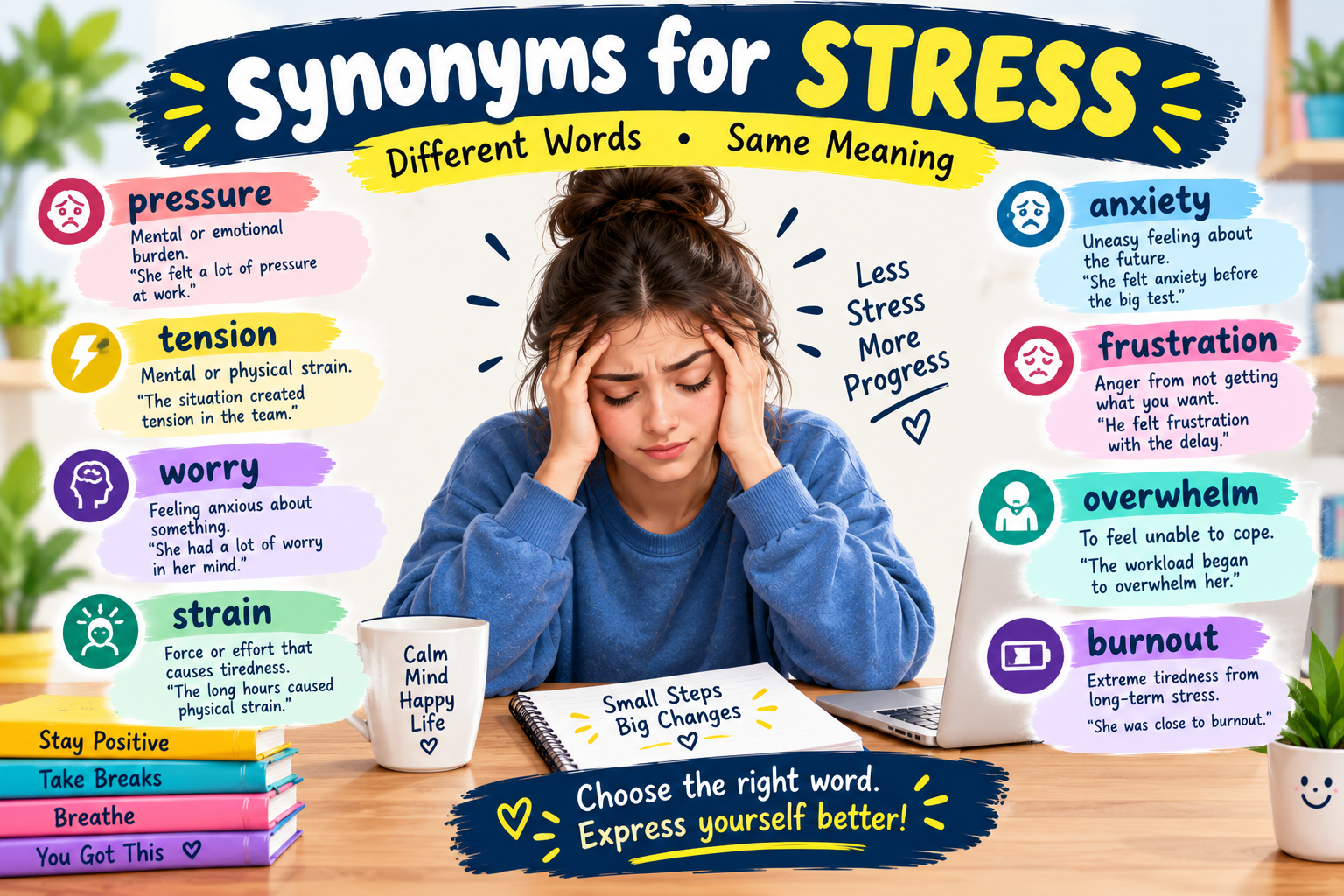
Common synonyms for stress include pressure, tension, strain, anxiety, worry, nervousness, distress, burden, concern, and unease. The best synonym depends on the type and level of stress you mean.
Stress is a feeling of pressure or worry that happens when life feels difficult, demanding, or overwhelming. Imagine having a big exam tomorrow, several tasks at work, and messages waiting on your phone. You may feel tense, worried, or under pressure. That feeling is stress.
The word stress is common in everyday English because people often talk about work, school, money, relationships, health, and other situations that create pressure. Learning synonyms for stress helps English learners express these feelings more clearly. It also helps writers avoid repeating the same word in articles, essays, emails, and stories.
In this guide, we will explore the meaning of stress, its synonyms, examples, grammar, history, pronunciation, word formation, and semantic categories. You will also learn which alternatives work best in different situations.
Meaning of Stress
Definition
Stress (Noun/Verb): A feeling of pressure, worry, or emotional tension caused by difficult or demanding situations; as a verb, it can also mean to give special importance to something.
Examples
- Too much stress can make it hard to sleep.
- She felt a lot of stress before her final exam.
Connotative Meaning
- Positive tone: In some contexts, stress can encourage someone to focus, prepare, or perform well.
- Negative tone: It often suggests worry, pressure, emotional strain, or difficulty.
- Neutral tone: It can simply describe pressure or emphasis without strong emotion.
(Connotation means the feeling or idea that a word suggests beyond its basic meaning.)
Etymology
The word stress has a long history connected with ideas of pressure and force.
- Old English (450–1100): The modern word is not directly from a common Old English form. Its deeper roots are linked to the Latin strictus, meaning “drawn tight” or “tightened.”
- Middle English (1100–1500): The word entered English through Anglo-French and Middle English forms related to pressure, force, hardship, and distress.
- Modern English (1500–Present): Stress developed broader meanings. It can now describe emotional pressure, physical strain, importance placed on something, and emphasis in speech.
Pronunciation (IPA)
- IPA: /strɛs/
- Syllables: stress (1 syllable)
Affixation Pattern of Stress
- Root: stress
- Prefix: None
- Suffix: None in the basic word
- Word formations:
- Stress — noun/verb
- Stressed — adjective/verb
- Stressing — verb
- Stressor — noun
- Stressful — adjective
- Stressfully — adverb
- Stresslessness — noun
- Stressless — adjective
30 Synonyms of Stress With Meaning & Examples
1. Pressure (Noun)
Meaning: A strong feeling that you must deal with a difficult demand or situation.
Examples:
- She works well under pressure.
- The pressure of the deadline made him nervous.
2. Tension (Noun)
Meaning: A feeling of mental or emotional strain.
Examples:
- There was a lot of tension before the meeting.
- Meditation helped reduce her tension.
3. Strain (Noun)
Meaning: Pressure or difficulty that makes someone tired or worried.
Examples:
- The long hours put a strain on him.
- Financial strain can affect family life.
4. Anxiety (Noun)
Meaning: A strong feeling of worry or fear about what may happen.
Examples:
- She felt anxiety before the interview.
- His anxiety increased as the test date came closer.
5. Worry (Noun)
Meaning: A feeling of concern about a problem or possible danger.
Examples:
- Money was his biggest worry.
- Try not to let small worries control your day.
6. Nervousness (Noun)
Meaning: A feeling of being worried, excited, or uneasy.
Examples:
- Her nervousness disappeared after she started speaking.
- He could not hide his nervousness before the presentation.
7. Distress (Noun)
Meaning: Strong emotional suffering or upset.
Examples:
- The news caused great distress.
- She called her friend when she was in distress.
8. Burden (Noun)
Meaning: A heavy responsibility or problem that is difficult to handle.
Examples:
- Paying the bills became a heavy burden.
- He did not want to place a burden on his family.
9. Concern (Noun)
Meaning: A feeling of worry about something important.
Examples:
- Her health was a major concern.
- The teacher expressed concern about his progress.
10. Unease (Noun)
Meaning: A feeling that something is wrong or uncertain.
Examples:
- He felt a sense of unease before entering the room.
- The sudden change caused unease among employees.
11. Agitation (Noun)
Meaning: A state of nervousness, restlessness, or emotional disturbance.
Examples:
- The long wait caused agitation.
- His agitation was easy to notice.
12. Frustration (Noun)
Meaning: A feeling of annoyance caused by problems or failure.
Examples:
- Repeated mistakes caused frustration.
- She expressed her frustration calmly.
13. Pressure (Noun)
Meaning: A demand that makes someone feel forced or worried.
Examples:
- Students often face pressure during exams.
- Social pressure can influence people’s choices.
14. Hardship (Noun)
Meaning: A difficult condition that causes suffering or trouble.
Examples:
- The family faced financial hardship.
- Many people showed strength during hardship.
15. Trouble (Noun)
Meaning: A problem or difficult situation that causes concern.
Examples:
- He was having trouble at work.
- She tried to stay calm during the trouble.
16. Worrying (Adjective)
Meaning: Causing concern, fear, or anxiety.
Examples:
- The situation became worrying.
- There was a worrying increase in costs.
17. Overload (Noun)
Meaning: A situation in which there is more work or demand than someone can manage.
Examples:
- An information overload can make learning difficult.
- She took a break because of workload overload.
18. Exhaustion (Noun)
Meaning: Extreme tiredness caused by physical or mental effort.
Examples:
- Stress eventually led to exhaustion.
- He rested after several days of exhaustion.
19. Fright (Noun)
Meaning: A sudden feeling of fear or alarm.
Examples:
- The accident gave everyone a fright.
- She experienced fright when the lights suddenly went out.
20. Fear (Noun)
Meaning: An unpleasant feeling caused by danger or uncertainty.
Examples:
- Fear of failure can create stress.
- He faced his fear and continued.
21. Apprehension (Noun)
Meaning: A feeling of worry or fear about something that may happen.
Examples:
- She approached the interview with apprehension.
- His apprehension disappeared after the teacher reassured him.
22. Restlessness (Noun)
Meaning: An inability to relax or remain still because of worry or discomfort.
Examples:
- Stress caused restlessness at night.
- His restlessness made it difficult to concentrate.
23. Aggravation (Noun)
Meaning: Annoyance or irritation caused by a problem.
Examples:
- The delay caused considerable aggravation.
- She avoided unnecessary aggravation by planning ahead.
24. Irritation (Noun)
Meaning: A feeling of annoyance or anger.
Examples:
- Constant noise caused irritation.
- He spoke with irritation after the repeated interruptions.
25. Disturbance (Noun)
Meaning: Something that interrupts peace, calm, or normal activity.
Examples:
- The argument caused a disturbance.
- Noise can create mental disturbance.
26. Pressurefulness (Noun)
Meaning: A state characterized by heavy pressure or demanding conditions.
Examples:
- The pressurefulness of the job affected his mood.
- She struggled with the pressurefulness of her responsibilities.
27. Overwhelm (Verb)
Meaning: To make someone feel unable to cope with too many problems or demands.
Examples:
- Too many tasks can overwhelm a new employee.
- The amount of work overwhelmed him.
28. Strain (Verb)
Meaning: To put someone or something under pressure or difficulty.
Examples:
- Long working hours can strain your energy.
- The disagreement strained their relationship.
29. Distress (Verb)
Meaning: To cause someone to feel very upset or worried.
Examples:
- The sudden news distressed her.
- His words distressed the young student.
30. Burden (Verb)
Meaning: To give someone a difficult responsibility or problem to carry.
Examples:
- Do not burden yourself with unnecessary worries.
- She did not want to burden her parents with the problem.
Prototype Meaning
The most typical meaning of stress is a feeling of mental or emotional pressure caused by demanding situations. When people hear the word, they often imagine a person who has too much work, an important deadline, financial problems, an exam, or another difficult responsibility. The word can describe both the pressure itself and the emotional response to it.
Prototype Categorization
The synonyms above can be grouped by the type of feeling or situation they describe:
- Pressure and demands: pressure, strain, burden, overload, hardship. These are useful when stress comes from responsibilities or difficult conditions.
- Fear and uncertainty: anxiety, worry, fear, apprehension, unease. These work best when stress is connected to fear about the future.
- Emotional suffering: distress, agitation, frustration, irritation, aggravation. These words describe stronger emotional reactions.
- Mental and physical effects: exhaustion, restlessness, tension, nervousness. These focus on how stress affects the body or mind.
- Problems and difficult situations: trouble, disturbance, hardship, concern. These are useful when the cause of stress matters more than the emotion itself.
- Verb forms: overwhelm, strain, distress, burden. These are useful when describing an action that creates stress.
This categorization helps writers select the right word instead of using stress repeatedly. A writer describing fear may choose anxiety, while a writer describing heavy responsibility may choose burden or pressure.
Antonyms of Stress
1. Calm (Adjective/Noun)
A peaceful state without worry or strong emotional pressure.
2. Relaxation (Noun)
A state of rest in which the body and mind become calm.
3. Peace (Noun)
A state of quiet, calm, and freedom from conflict or worry.
4. Comfort (Noun)
A state of physical or emotional ease.
5. Ease (Noun)
A relaxed condition without difficulty or pressure.
6. Tranquility (Noun)
A peaceful and calm state.
7. Serenity (Noun)
A deep feeling of peace and calmness.
8. Relief (Noun)
A feeling of comfort after worry, pain, or pressure becomes less intense.
Short Questions and Answers
What does stress mean?
Stress means mental, emotional, or physical pressure caused by difficult demands, problems, or situations. It can also mean giving special importance to something.
When should stress be used?
Use stress when talking about pressure, worry, tension, or demanding situations. It is common in everyday, academic, professional, and health-related writing.
Is stress positive or negative?
Stress is usually associated with a negative feeling, but it can sometimes describe useful pressure that motivates someone to prepare or perform better.
How is stress different from similar words?
Stress is a broad word for pressure or emotional strain. Anxiety usually focuses more on fear or worry. Tension suggests mental or emotional tightness. Pressure often comes from demands or expectations, while distress suggests stronger emotional suffering.
Conclusion
Learning synonyms for stress can make your English more accurate, natural, and interesting. Words such as pressure, tension, strain, anxiety, worry, distress, burden, and unease can describe different forms and levels of stress.
Using the right synonym helps you explain your ideas more clearly. It also prevents repetition in essays, blog posts, emails, stories, and everyday conversations. English learners can build stronger vocabulary by learning these words in context rather than simply memorizing lists.
Try using one or two new synonyms each day. Write a sentence with each word and notice how its meaning changes in different situations. With regular practice, you can speak and write with greater confidence and choose the perfect word for every situation.

Sarah Linguist is a passionate language enthusiast who loves exploring words, meanings, and synonyms.
She creates clear, easy-to-understand content to help readers improve their vocabulary and English skills.
Through SynonymsGuide.com, Sarah makes finding the right words simple, useful, and enjoyable.