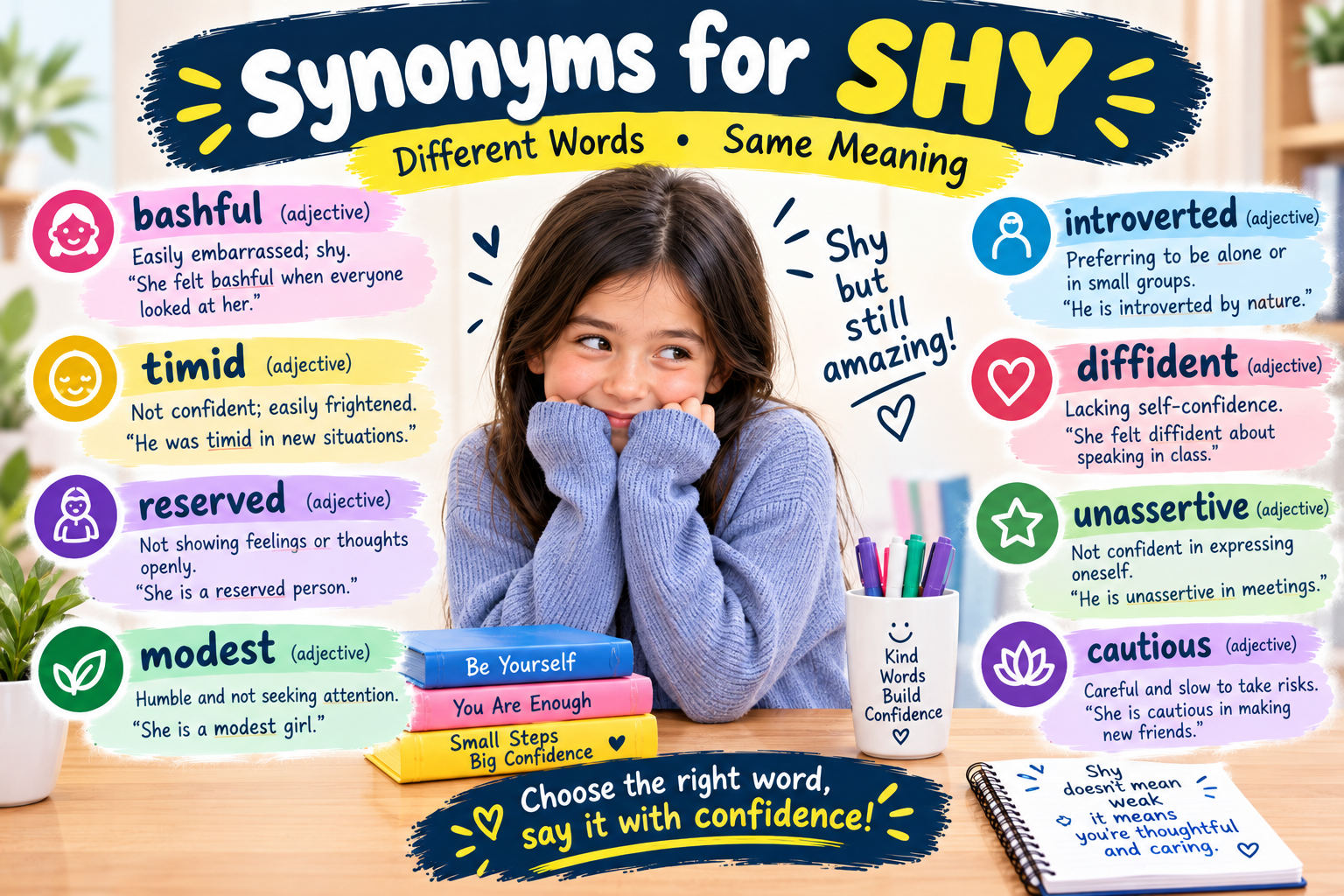
Synonyms for shy include timid, bashful, reserved, introverted, nervous, self-conscious, quiet, and hesitant. These words describe different forms of shyness, from feeling nervous around strangers to avoiding attention or speaking less in social situations.
Have you ever felt nervous when meeting new people or speaking in front of a group? Perhaps you wanted to join a conversation but felt uncomfortable. You might describe yourself as shy. This feeling is common, but the English language offers many other words to describe it.
Learning synonyms for shy helps you express your thoughts clearly and improve your vocabulary. For example, timid describes someone who lacks confidence or feels easily frightened, while reserved describes someone who does not share personal thoughts easily. Similarly, bashful often refers to someone who feels embarrassed when receiving attention.
These words are useful for students, English learners, teachers, bloggers, and content writers. They can make essays, emails, stories, and everyday conversations more interesting.
In this guide, you will discover 30 synonyms for shy, their meanings, and practical examples. You will also learn their differences, common antonyms, word forms, and tips for choosing the right alternative.
What Does Shy Mean?
Definition of Shy
Shy is an adjective that describes someone who feels nervous, uncomfortable, or uncertain around other people. A shy person may find it difficult to start conversations, meet strangers, or speak in public.
Examples:
- She felt shy at the school party.
- He is shy when meeting new people.
- The shy student hesitated to ask a question.
Being shy does not mean someone is unfriendly. A shy person may want to make friends but need extra time to feel comfortable.
Connotative Meaning of Shy
Connotation refers to the feelings or ideas connected to a word beyond its basic meaning.
The word shy can have positive, negative, or neutral associations.
- Positive: Gentle, modest, thoughtful, and quiet.
- Negative: Nervous, hesitant, withdrawn, or lacking confidence.
- Neutral: Reserved, quiet, or uncomfortable in certain social situations.
For example, modest often sounds positive because it suggests a lack of arrogance. However, timid can suggest that someone is afraid to speak or act confidently.
30 Synonyms for Shy With Meanings and Examples
Here are 30 alternatives to the word shy. Each has a slightly different meaning, so choose the word that best fits your sentence.
- Timid (adjective): Easily frightened or lacking confidence.
Example: The timid boy was afraid to speak in class. - Bashful (adjective): Easily embarrassed, especially when receiving attention.
Example: She gave a bashful smile when her teacher praised her. - Reserved (adjective): Not open about personal thoughts or feelings.
Example: He is reserved around people he does not know. - Introverted (adjective): More comfortable with quiet activities or smaller social groups.
Example: My introverted friend enjoys reading at home. - Nervous (adjective): Worried or uneasy about something.
Example: I felt nervous before my first interview. - Self-conscious (adjective): Worried about how other people see or judge you.
Example: She felt self-conscious while speaking on stage. - Apprehensive (adjective): Worried about something that may happen.
Example: He felt apprehensive about joining the new class. - Uneasy (adjective): Uncomfortable, worried, or uncertain.
Example: I felt uneasy in the crowded room. - Wary (adjective): Careful because you do not fully trust someone or something.
Example: The child was wary of strangers. - Quiet (adjective): Not speaking much or making little noise.
Example: The quiet student listened carefully to the lesson. - Withdrawn (adjective): Less willing to communicate or spend time with others.
Example: She became withdrawn after moving to a new school. - Reticent (adjective): Unwilling to speak freely or share information.
Example: He was reticent about his personal problems. - Modest (adjective): Not showing off or acting as if you are better than others.
Example: She remained modest despite her success. - Unassuming (adjective): Not trying to attract attention or impress others.
Example: The unassuming teacher treated everyone kindly. - Humble (adjective): Not proud or arrogant.
Example: He stayed humble after winning the award. - Coy (adjective): Shy or playfully reluctant to show feelings or intentions.
Example: She gave a coy smile and looked away. - Awkward (adjective): Feeling uncomfortable or unsure how to behave.
Example: I felt awkward when I entered the room late. - Diffident (adjective): Lacking confidence in yourself or your abilities.
Example: The diffident speaker needed encouragement. - Hesitant (adjective): Unsure about whether to act or speak.
Example: He was hesitant to share his opinion. - Fearful (adjective): Feeling fear or expecting danger.
Example: The fearful child held his mother’s hand. - Intimidated (adjective): Feeling less confident because someone or something seems powerful or frightening.
Example: She felt intimidated by the large audience. - Embarrassed (adjective): Feeling uncomfortable because of an awkward situation.
Example: He felt embarrassed after forgetting her name. - Insecure (adjective): Lacking confidence or feeling uncertain about yourself.
Example: He felt insecure about his speaking skills. - Aloof (adjective): Distant or not very friendly in the way you behave.
Example: He seemed aloof during the meeting. - Antisocial (adjective): Avoiding social interaction; the word can also have other meanings in psychology and everyday English.
Example: After a busy week, she felt antisocial and wanted to stay home. - Introvert (noun): A person who tends to prefer quieter settings or smaller social groups.
Example: As an introvert, he enjoys peaceful evenings. - Soft-spoken (adjective): Speaking in a quiet, gentle voice.
Example: The soft-spoken teacher explained the topic calmly. - Unassertive (adjective): Not expressing your needs or opinions confidently.
Example: He was unassertive during the discussion. - Self-effacing (adjective): Avoiding attention or not drawing attention to your achievements.
Example: Her self-effacing nature made her easy to work with. - Shy (adjective): Feeling nervous or uncomfortable around other people.
Example: The shy child took time to make new friends.
Note: Some words above describe related behaviors rather than exact synonyms. For example, soft-spoken describes someone’s voice, while introverted describes a personality preference.
Quick Comparison Table: Synonyms for Shy
| Synonym | Meaning | Best Used When |
|---|---|---|
| Timid | Easily frightened | Someone lacks courage |
| Bashful | Easily embarrassed | Someone feels awkward receiving attention |
| Reserved | Not openly sharing feelings | Someone keeps thoughts private |
| Introverted | Prefers quieter settings | Describing personality |
| Nervous | Worried or uneasy | Someone feels anxious |
| Self-conscious | Worried about judgment | Someone feels watched or judged |
| Hesitant | Unsure about acting | Someone pauses before speaking |
| Reticent | Unwilling to speak freely | Someone avoids sharing information |
| Diffident | Lacking confidence | Someone doubts their abilities |
| Soft-spoken | Speaks quietly | Describing someone’s voice |
Which Synonym for Shy Should You Use?
Choosing the right synonym depends on the situation.
- Use timid when someone seems frightened or lacks courage.
- Use bashful when someone feels embarrassed by attention or praise.
- Use reserved when someone keeps personal feelings private.
- Use introverted when describing someone who prefers quieter environments or small groups.
- Use nervous when someone feels worried before an event.
- Use self-conscious when someone worries about how others see them.
- Use hesitant when someone is unsure whether to speak or act.
- Use reticent when someone does not want to share information.
- Use diffident when someone lacks confidence in their abilities.
- Use soft-spoken when someone speaks in a gentle, quiet voice.
Remember, a quiet person is not always shy. An introverted person can also be confident and comfortable speaking in public.
Common Mistakes When Using Synonyms for Shy
1. Treating Every Synonym as an Exact Match
Words such as timid, reserved, and nervous are related, but they do not mean exactly the same thing.
For example, a reserved person may prefer privacy without feeling afraid. A nervous person may speak confidently in most situations but feel worried before an important event.
2. Confusing Shyness With Introversion
Shyness often involves discomfort or fear in social situations. Introversion describes a preference for quieter environments or less social stimulation.
An introverted person can still enjoy meeting others and speaking confidently.
3. Using Aloof When You Mean Quiet
Aloof can suggest that someone seems distant or unfriendly. If you simply mean that a person does not speak much, quiet or reserved may be more accurate.
4. Using Antisocial Too Broadly
A shy person may enjoy spending time with friends. The word antisocial often suggests avoiding social contact, and it can carry stronger meanings than ordinary shyness.
5. Using Formal Words in Casual Conversations
Words such as diffident and reticent are useful in formal writing, but they may sound unusual in everyday conversation. In casual speech, shy, quiet, nervous, and reserved are often more natural.
Synonyms for Shy in Real-World Examples
1. Professional Email
“Although I was initially hesitant to share my ideas, I am now comfortable contributing to team discussions.”
Here, hesitant describes uncertainty about speaking up.
2. News Headline
“Quiet Student Wins National Public Speaking Competition”
The word quiet describes the student’s usual behavior without suggesting that the student lacks confidence.
3. Social Media Post
“I’m naturally introverted, but I still love spending time with my close friends.”
Here, introverted describes a preference for smaller social settings.
4. Formal Report
“The student appeared self-conscious during the presentation but answered questions accurately.”
The word self-conscious describes discomfort about being observed or judged.
5. Everyday Conversation
“Don’t be nervous. Everyone is friendly here, and you can take your time.”
Nervous is a natural choice when someone feels worried about meeting people.
Etymology: Where Does the Word Shy Come From?
The word shy comes from Old English sceoh, which meant timid or easily frightened. Over time, its spelling and pronunciation developed into the modern word shy.
The word has long been connected with fear, hesitation, and discomfort. Today, it often describes someone who feels uneasy around strangers or in unfamiliar social situations.
Other related words have different histories. Timid comes through French from Latin timidus, meaning fearful. Nervous is connected to Latin nervus, meaning nerve or sinew. Introvert combines elements associated with inwardness and turning.
Understanding these word histories can help you recognize why words with similar meanings may carry different shades of meaning.
Pronunciation of Shy
- Word: Shy
- IPA: /ʃaɪ/
- Syllables: One
- Part of speech: Adjective
- Rhymes with: Sky, fly, and try
Example: “The shy student smiled at her new classmates.”
Affixation and Word Forms of Shy
The word shy has several related forms.
The suffix -ly changes shy into the adverb shyly. The suffix -ness creates the noun shyness. The endings -er and -est can form the comparative and superlative forms shyer and shyest.
Prototype Meaning and Categories of Shyness
The prototype meaning of shy is feeling nervous or uncomfortable around other people, especially in unfamiliar social situations.
Imagine a student who wants to answer a question but feels too nervous to raise a hand. This is a typical example of shyness.
Related words can be grouped into categories:
- Fear and anxiety: Timid, nervous, apprehensive, fearful, uneasy.
- Quiet behavior: Quiet, reserved, reticent, soft-spoken.
- Low confidence: Diffident, insecure, unassertive, self-conscious.
- Social withdrawal: Withdrawn, aloof, antisocial.
- Embarrassment: Bashful, coy, awkward, embarrassed.
- Personality and modesty: Introverted, modest, humble, unassuming, self-effacing.
These categories help you choose a word that describes the exact behavior or feeling you want to express.
Antonyms of Shy
An antonym is a word that has the opposite meaning of another word.
Here are some useful antonyms of shy:
- Confident: Feeling sure about yourself or your abilities.
Example: She felt confident during the interview. - Outgoing: Friendly and comfortable talking to people.
Example: He is outgoing and makes friends easily. - Bold: Willing to take risks or act with confidence.
Example: She made a bold suggestion during the meeting. - Sociable: Enjoying the company of other people.
Example: Our sociable neighbor often invites friends over. - Assertive: Expressing opinions and needs confidently and respectfully.
Example: He was assertive when explaining his concerns. - Uninhibited: Free from embarrassment or social restraint.
Example: The children danced in an uninhibited way.
Frequently Asked Questions About Synonyms for Shy
1. What is the best synonym for shy?
Timid is a common synonym for shy, especially when someone lacks confidence or feels easily frightened. Reserved, bashful, and nervous may be better choices in other situations.
2. What is a positive word for shy?
Words such as modest, gentle, reserved, and soft-spoken can describe qualities associated with shyness in a positive way. The best choice depends on the context.
3. What is a formal synonym for shy?
Diffident and reticent are useful formal alternatives. Diffident describes a lack of confidence, while reticent describes someone who is reluctant to speak freely.
4. Is introverted the same as shy?
No. Shyness often involves feeling uncomfortable or anxious around others. Introversion describes a preference for quieter environments or smaller social groups. A person can be introverted without being shy.
5. What is the opposite of shy?
Common antonyms include confident, outgoing, bold, sociable, and assertive. Each describes a different quality that contrasts with shyness.
6. How can I use shy in a sentence?
You can use shy to describe a person or their behavior. For example: “My little brother is shy around strangers, but he becomes talkative with close friends.”
7. What is the noun form of shy?
The noun form is shyness. For example: “Her shyness made it difficult to speak in front of the class.”
Conclusion
Learning synonyms for shy can help you express feelings and describe people more accurately. Words such as timid, bashful, reserved, nervous, and self-conscious are useful alternatives, but each has its own meaning.
Use timid when someone lacks courage, bashful when someone feels embarrassed, and reserved when someone keeps personal thoughts private. Choose introverted when describing a preference for quieter settings, and hesitant when someone is unsure about taking action.
The best way to improve your vocabulary is to practice using new words in sentences, conversations, emails, and essays. Start by learning a few synonyms each day and noticing how other writers use them.
With regular practice, you can make your English clearer, more natural, and more expressive. Keep learning, keep writing, and choose the words that best communicate your meaning.