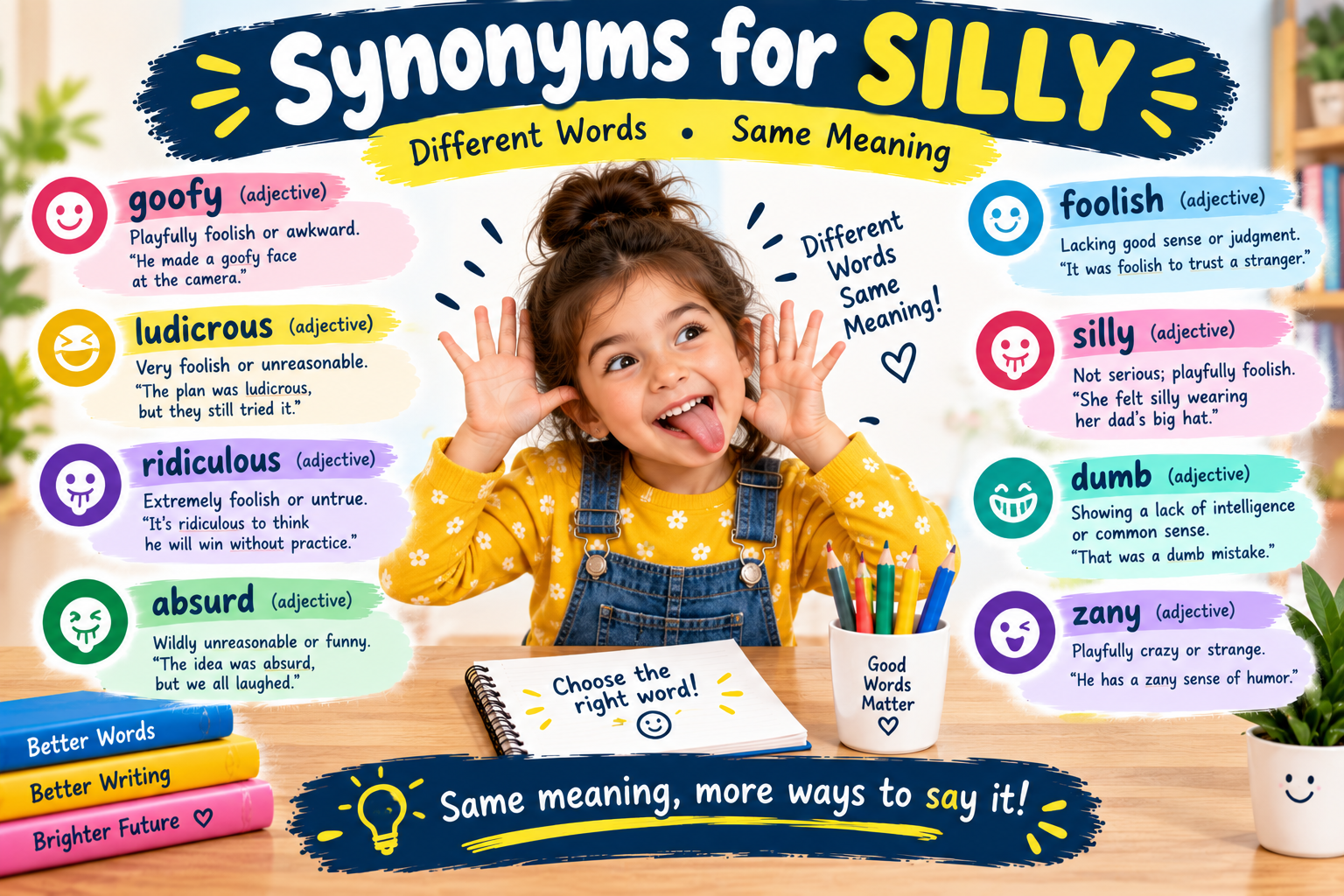
Synonyms for silly include foolish, goofy, ridiculous, absurd, childish, funny, daft, and idiotic. These words describe people, actions, or ideas that seem funny, unwise, strange, or lacking good sense.
Have you ever done something funny without thinking? Perhaps you told a joke that made everyone laugh or made a silly mistake while doing a simple task. The word silly is often used to describe such moments. It can refer to playful behavior, funny ideas, or actions that lack good judgment.
Learning synonyms for silly helps you express your thoughts in a more interesting way. For example, goofy describes someone who acts in a funny way, while foolish describes someone who makes poor choices. Ridiculous is useful when something seems unreasonable or hard to believe.
These words are helpful for students, English learners, teachers, bloggers, and content writers. In this guide, you will learn 30 synonyms for silly, their meanings, and examples. You will also explore their history, pronunciation, word forms, antonyms, and common uses.
Meaning of Silly
Definition
Silly (adjective): Showing poor judgment, lacking seriousness, or behaving in a funny or childish way.
The word can have a playful or negative meaning, depending on the situation.
Examples
- The children laughed at his silly jokes.
- It was silly to leave your umbrella at home on a rainy day.
Connotative Meaning
Connotation (the feeling or idea a word suggests beyond its basic meaning) helps explain how silly sounds in different situations.
- Positive tone: Playful, funny, cheerful, and harmless.
- Negative tone: Foolish, careless, childish, or lacking good judgment.
- Neutral tone: Not serious or sensible in a particular situation.
For example, calling a friend silly may sound friendly. Calling someone’s decision silly may suggest that the decision was unwise.
Etymology of Silly
The word silly has changed meaning over time.
- Old English (450–1100): The word developed from sǣlig, which meant happy, blessed, or fortunate.
- Middle English (1100–1500): The form sely was used with meanings such as innocent, harmless, or deserving sympathy. Later, it developed meanings related to weakness or foolishness.
- Modern English (1500–Present): Silly came to mean foolish, unreasonable, playful, or lacking good sense.
Today, the word can describe both harmless fun and poor judgment.
Pronunciation of Silly
- IPA: /ˈsɪli/
- Syllables: sil-ly (2 syllables)
- Part of speech: Adjective
The first syllable carries the main stress.
Affixation Pattern of Silly
- Root: Silly
- Prefix: No common prefix is used in the basic word.
- Suffix: The ending changes when related word forms are created.
Word Formations
- Silly (adjective): A silly idea.
- Silliness (noun): His silliness made everyone laugh.
- Sillier (comparative adjective): This joke is sillier than the last one.
- Silliest (superlative adjective): That was the silliest mistake.
- Sillily (adverb): He acted sillily during the game, although in a silly way is often more natural.
30 Synonyms of Silly With Meaning and Examples
1. Foolish (Adjective)
Meaning: Showing poor judgment or a lack of good sense.
Examples:
- It was foolish to ignore the warning.
- He made a foolish decision without thinking.
2. Goofy (Adjective)
Meaning: Funny or strange in a playful way.
Examples:
- My brother makes goofy faces in every photo.
- They laughed at his goofy dance.
3. Ridiculous (Adjective)
Meaning: So unreasonable or absurd that it seems hard to take seriously.
Examples:
- That is a ridiculous excuse.
- The price of the broken chair seemed ridiculous.
4. Absurd (Adjective)
Meaning: Completely unreasonable or illogical.
Examples:
- The story sounds absurd.
- It is absurd to expect everyone to agree.
5. Childish (Adjective)
Meaning: Behaving in an immature way.
Examples:
- Their childish argument lasted all afternoon.
- It was childish to blame everyone else.
6. Funny (Adjective)
Meaning: Causing laughter or amusement.
Examples:
- He told a funny story at dinner.
- The funny video made us laugh.
7. Daft (Adjective)
Meaning: Foolish or not sensible; common in British English.
Examples:
- That was a daft thing to say.
- He had a daft idea for the school play.
8. Idiotic (Adjective)
Meaning: Extremely foolish or lacking good judgment.
Examples:
- It was an idiotic mistake.
- He made an idiotic comment during the meeting.
9. Stupid (Adjective)
Meaning: Showing poor judgment or a lack of understanding; often insulting when used about a person.
Examples:
- It was stupid to leave the door unlocked.
- I made a stupid mistake on the test.
10. Absurdist (Adjective)
Meaning: Relating to humor or ideas that use strange or illogical situations.
Examples:
- The play used absurdist humor.
- She enjoys absurdist comedy.
11. Laughable (Adjective)
Meaning: So unreasonable or poor that it deserves to be laughed at.
Examples:
- His excuse was laughable.
- The proposal seemed laughable to the committee.
12. Nonsensical (Adjective)
Meaning: Having little or no meaning or logic.
Examples:
- The instructions were nonsensical.
- He gave a nonsensical answer to the question.
13. Zany (Adjective)
Meaning: Amusingly strange or unusual.
Examples:
- The comedian has a zany style.
- We enjoyed their zany performance.
14. Wacky (Adjective)
Meaning: Funny, unusual, or a little crazy in an amusing way.
Examples:
- She came up with a wacky plan.
- The show featured wacky characters.
15. Clownish (Adjective)
Meaning: Acting in a silly or exaggerated way to make people laugh.
Examples:
- His clownish behavior entertained the children.
- The actor used clownish movements on stage.
16. Impractical (Adjective)
Meaning: Not sensible or suitable for real use.
Examples:
- Buying a car without checking its condition was impractical.
- Her plan sounded exciting but impractical.
17. Unwise (Adjective)
Meaning: Not showing good judgment.
Examples:
- It was unwise to spend all his savings.
- Making promises without a plan is unwise.
18. Immature (Adjective)
Meaning: Not behaving in a grown-up or responsible way.
Examples:
- His immature reaction surprised everyone.
- It was immature to laugh at her mistake.
19. Absurdly (Adverb)
Meaning: In a way that is extremely unreasonable or illogical.
Examples:
- The ticket was absurdly expensive.
- He acted absurdly during the debate.
Usage note: Absurdly is an adverb, not a direct adjective replacement for silly.
20. Comical (Adjective)
Meaning: Funny in a way that makes people laugh.
Examples:
- His comical expression made us smile.
- The scene was both strange and comical.
21. Ludicrous (Adjective)
Meaning: So unreasonable or foolish that it seems laughable.
Examples:
- The claim was ludicrous.
- It is ludicrous to blame the weather for every problem.
22. Preposterous (Adjective)
Meaning: Completely unreasonable or contrary to common sense.
Examples:
- That is a preposterous suggestion.
- The rumor sounded preposterous.
23. Peculiar (Adjective)
Meaning: Strange or unusual.
Examples:
- He has a peculiar sense of humor.
- The machine made a peculiar noise.
24. Absurd-minded (Adjective)
Meaning: Inclined toward strange or illogical ideas.
Examples:
- The character is portrayed as absurd-minded.
- His absurd-minded approach made the story unusual.
Usage note: This is an uncommon expression. Absurd or eccentric will usually sound more natural.
25. Careless (Adjective)
Meaning: Not giving enough attention or thought to what you are doing.
Examples:
- It was careless to leave your phone on the bus.
- A careless mistake changed the result.
26. Thoughtless (Adjective)
Meaning: Acting without considering the effects on others.
Examples:
- His thoughtless remark hurt her feelings.
- It was thoughtless to cancel at the last minute.
27. Playful (Adjective)
Meaning: Full of fun and a desire to play.
Examples:
- The playful puppy chased the ball.
- She made a playful comment during lunch.
28. Whimsical (Adjective)
Meaning: Playfully unusual, imaginative, or fanciful.
Examples:
- The book has whimsical illustrations.
- He created a whimsical story about a talking cat.
29. Eccentric (Adjective)
Meaning: Unusual in behavior or style.
Examples:
- The eccentric artist wore colorful clothes.
- Her eccentric ideas made the project memorable.
30. Irresponsible (Adjective)
Meaning: Not acting with the care or sense of duty expected.
Examples:
- It was irresponsible to drive without enough sleep.
- His irresponsible behavior caused problems for the team.
Prototype Meaning
The prototype meaning of silly is something that seems funny, playful, or lacking good sense. People may imagine a child making funny faces, a friend telling a ridiculous joke, or someone making an avoidable mistake. The exact meaning depends on the situation. A silly joke can create happiness, while a silly decision can lead to trouble.
Prototype Categorization
The synonyms above fit into several groups:
- Foolish behavior: Foolish, stupid, idiotic, daft, unwise.
- Funny and playful behavior: Goofy, funny, zany, wacky, clownish, comical, playful.
- Unreasonable ideas: Ridiculous, absurd, nonsensical, laughable, ludicrous, preposterous.
- Immature or careless actions: Childish, immature, careless, thoughtless, irresponsible.
- Strange or unusual qualities: Peculiar, eccentric, whimsical, absurdist.
- Practical judgment: Impractical.
- Grammar-related alternatives: Absurdly is an adverb, so it fits sentences differently from the adjective silly.
These categories help writers choose words that match their intended meaning. Use goofy for playful humor, unwise for poor decisions, and ridiculous for ideas that seem unreasonable.
Antonyms of Silly
Antonyms are words with opposite meanings.
- Sensible (adjective): Showing good judgment.
Example: She made a sensible choice. - Wise (adjective): Showing knowledge and good judgment.
Example: It was wise to save money. - Serious (adjective): Not playful or joking.
Example: He became serious during the meeting. - Mature (adjective): Behaving in a responsible and grown-up way.
Example: She gave a mature response. - Rational (adjective): Based on reason and logic.
Example: We need a rational solution. - Practical (adjective): Suitable for real situations.
Example: This is a practical plan. - Thoughtful (adjective): Showing care and consideration.
Example: His thoughtful message made her happy.
Short Questions and Answers
What does silly mean?
Silly means funny, playful, unreasonable, or lacking good judgment, depending on the context.
When should silly be used?
Use silly for playful behavior, harmless mistakes, funny ideas, or actions that do not show good judgment.
Is silly positive or negative?
It can be both. Calling a joke silly may be friendly, while calling a decision silly may sound critical.
How is silly different from foolish?
Silly often describes playful or funny behavior. Foolish usually focuses on poor judgment or unwise actions.
Conclusion
Learning synonyms for silly helps you express ideas in a clearer and more engaging way. Words such as goofy, playful, and wacky can describe fun behavior, while foolish, unwise, and careless describe poor choices. Words like ridiculous and absurd help explain ideas that seem unreasonable.
Choosing the right synonym can improve your writing, make your speech more natural, and reduce repetition. It also helps you understand the tone of a sentence, so you can avoid sounding rude when you only mean to be playful.
Practice by learning a few words each day and using them in your own sentences. With regular practice, your vocabulary will grow, and you will feel more confident expressing yourself in English.

Emily Watson is an English language writer and vocabulary specialist dedicated to helping readers improve their communication skills. She writes clear, easy-to-understand guides on synonyms, word meanings, grammar, and word usage.