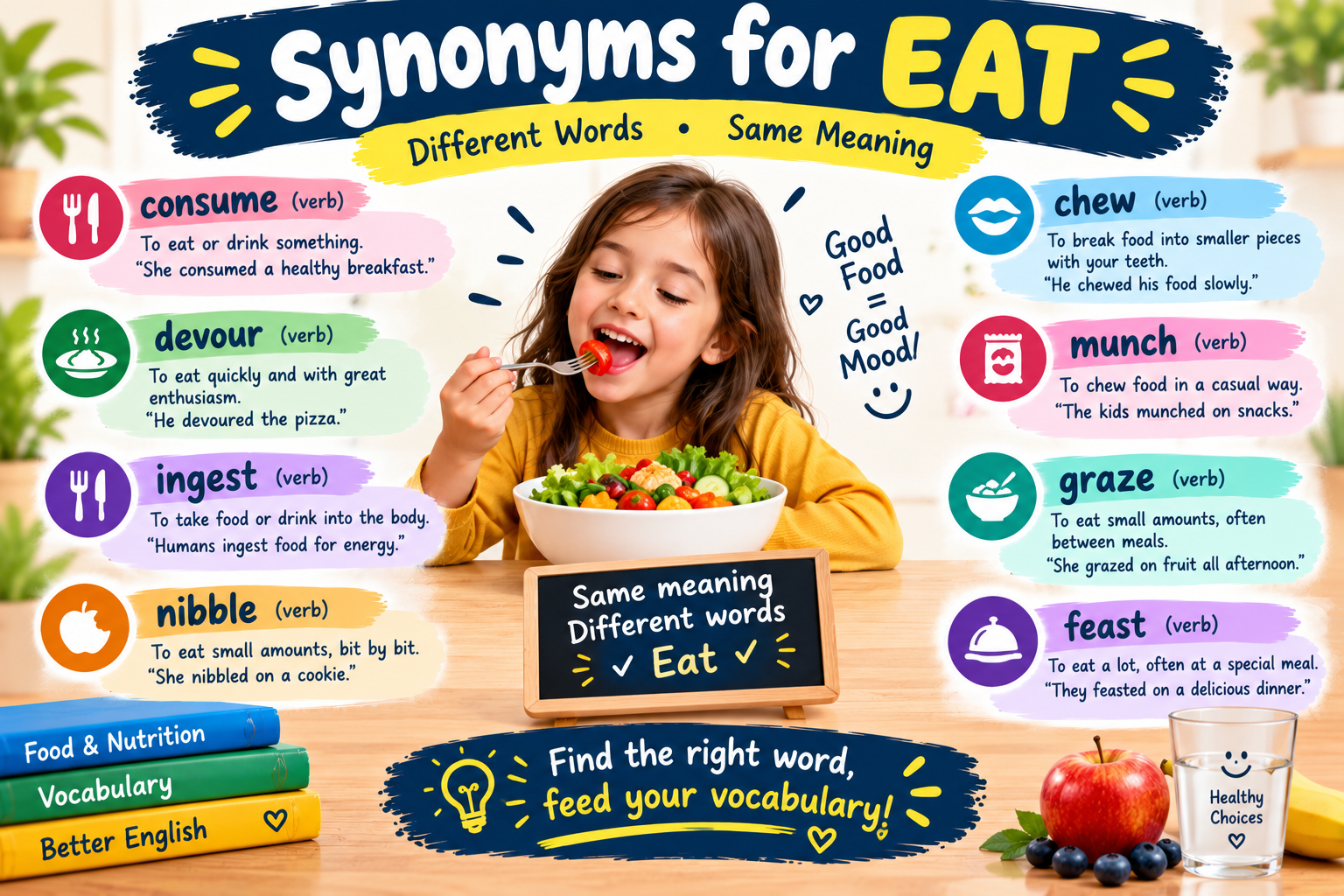
Eat is one of the most common English verbs. It means to take food into your mouth, chew it, and swallow it. But using eat again and again can make your writing sound plain. Learning synonyms for eat helps you describe food, meals, speed, manners, and even emotions more clearly.
Imagine writing this: “I ate breakfast, ate lunch, and ate dinner.” The meaning is correct, but the sentence feels repetitive. English gives you many better choices, depending on what you want to say.
You might consume a meal, devour a pizza, nibble on a snack, or taste a new dish. Each word gives the reader a slightly different picture.
As an English teacher, I often see learners use eat for every food-related situation. The word is perfectly correct, but choosing a more precise synonym can make everyday speech and writing much stronger.
This guide explains the meaning, pronunciation, history, grammar, and connotations of eat. You will also find 30 useful synonyms with simple meanings and natural examples.
Meaning of Eat
Definition
Eat (Verb): to put food into your mouth, chew it, and swallow it.
The word eat can also describe having a meal or consuming something for nourishment.
Examples
- I eat breakfast at seven every morning.
- She ate an apple after school.
Connotative Meaning
- Positive tone: enjoy or savor food.
- Negative tone: consume food greedily or carelessly.
- Neutral tone: consume food as part of normal life.
(Connotation: the feeling or idea associated with a word beyond its basic meaning.)
Etymology of Eat
Old English (450–1100)
Eat comes from the Old English verb etan, which meant “to eat” or “consume food.”
It is related to similar words in other Germanic languages. The basic idea has remained remarkably stable for centuries.
Middle English (1100–1500)
During Middle English, the spelling changed through different forms, including eten and eten/ete.
Pronunciation and spelling gradually moved toward the modern form eat.
Modern English (1500–Present)
Modern English uses eat as the basic verb for consuming food. It has also developed many expressions, such as eat up, eat out, eat away, and eat into.
Pronunciation of Eat
IPA: /iːt/
Syllables: 1
Pronunciation: sounds like “eet.”
Common forms include:
- Present: eat
- Past: ate
- Past participle: eaten
- Present participle: eating
Example:
- I eat rice every day.
- Yesterday, I ate rice.
- I have eaten already.
Affixation Pattern of Eat
Root
eat is the main root.
Prefix
There is no common prefix in the basic word eat.
Suffix
There is no suffix in the basic form.
Word Formations
- Eat — verb
- Eats — third-person singular verb
- Ate — past-tense verb
- Eaten — past participle
- Eating — present participle/gerund
Related compounds and phrasal verbs include:
- Eat up — finish eating something
- Eat out — have a meal at a restaurant
- Eat away — gradually destroy or reduce
- Eat into — gradually use or reduce something
30 Synonyms of Eat With Meaning & Examples
1. Consume (Verb)
Meaning: To eat, drink, or use something.
Examples:
- We should consume fresh vegetables every day.
- He consumed the entire meal.
2. Devour (Verb)
Meaning: To eat something quickly and eagerly.
Examples:
- The children devoured the pizza.
- She devoured her sandwich after the long trip.
3. Gobble (Verb)
Meaning: To eat very quickly and greedily.
Examples:
- He gobbled his lunch before class.
- The dog gobbled the food in seconds.
4. Munch (Verb)
Meaning: To eat something steadily, often with a noticeable chewing sound.
Examples:
- She munched on popcorn during the movie.
- He sat outside munching on an apple.
5. Nibble (Verb)
Meaning: To eat small amounts by taking tiny bites.
Examples:
- The rabbit nibbled on a carrot.
- She nibbled on some crackers.
6. Snack (Verb)
Meaning: To eat a small amount of food between meals.
Examples:
- I usually snack on fruit in the afternoon.
- He snacked while studying.
7. Chew (Verb)
Meaning: To bite and grind food with your teeth before swallowing it.
Examples:
- Chew your food slowly.
- She chewed the bread carefully.
8. Bite (Verb)
Meaning: To use your teeth to cut or take a piece of food.
Examples:
- He bit into the apple.
- She bit a piece of chocolate.
9. Taste (Verb)
Meaning: To eat or drink a small amount to discover its flavor.
Examples:
- Can I taste your dessert?
- The chef tasted the soup.
10. Savor (Verb)
Meaning: To eat or drink slowly and enjoy the flavor.
Examples:
- We savored every bite of the meal.
- She savored the rich chocolate cake.
11. Feed (Verb)
Meaning: To give food to yourself, another person, or an animal.
Examples:
- Please feed the baby.
- We fed the birds in the garden.
12. Dine (Verb)
Meaning: To eat a meal, especially in a formal or pleasant setting.
Examples:
- We dined at a beautiful restaurant.
- They dined together after the meeting.
13. Partake (Verb)
Meaning: To take part in eating or drinking something.
Examples:
- Guests were invited to partake in the meal.
- Everyone partook of the traditional food.
14. Feast (Verb)
Meaning: To eat a large or special meal.
Examples:
- The family feasted after the wedding.
- We feasted on traditional dishes.
15. Gorge (Verb)
Meaning: To eat a very large amount of food.
Examples:
- They gorged on sweets at the party.
- He gorged himself on fast food.
16. Devour (Verb)
Meaning: To consume something eagerly and completely.
Examples:
- She devoured the entire bowl of pasta.
- The hungry traveler devoured his dinner.
Note: “Devour” appears twice in this list conceptually, but for variety in vocabulary practice, you can replace the second use with wolf down.
16. Wolf Down (Phrasal Verb)
Meaning: To eat something very quickly.
Examples:
- He wolfed down his breakfast.
- I had to wolf down my lunch before work.
17. Swallow (Verb)
Meaning: To move food from your mouth down into your stomach.
Examples:
- Swallow the food before speaking.
- He swallowed the last bite.
18. Ingest (Verb)
Meaning: To take food, drink, or another substance into the body.
Examples:
- The body ingests nutrients through food.
- Avoid ingesting unknown substances.
19. Sup (Verb)
Meaning: To eat or drink, especially in an old-fashioned or literary style.
Examples:
- They supped together by the fire.
- The travelers supped before leaving.
20. Graze (Verb)
Meaning: To eat small amounts of food throughout a period of time.
Examples:
- I tend to graze during the afternoon.
- She grazed on fruit and nuts all day.
21. Pick At (Phrasal Verb)
Meaning: To eat only small amounts without showing much appetite.
Examples:
- He picked at his dinner.
- She picked at the salad during lunch.
22. Peck At (Phrasal Verb)
Meaning: To eat small pieces or amounts, often slowly.
Examples:
- The bird pecked at the seeds.
- He pecked at his food without much interest.
23. Chew On (Phrasal Verb)
Meaning: To slowly chew a piece of food.
Examples:
- He chewed on a piece of gum.
- She chewed on some dried fruit.
24. Nosh (Verb)
Meaning: To eat a small meal or snack, especially informally.
Examples:
- We nosh on snacks while watching movies.
- They were noshing at the café.
25. Chow Down (Phrasal Verb)
Meaning: To eat a meal, especially eagerly or informally.
Examples:
- Everyone chowed down after the game.
- We chowed down on burgers.
26. Tuck In (Phrasal Verb)
Meaning: To begin eating eagerly.
Examples:
- The food is ready, so tuck in!
- Everyone tucked in as soon as dinner arrived.
27. Partake of (Phrase)
Meaning: To eat or drink something, often in formal language.
Examples:
- Guests partook of the delicious meal.
- Visitors may partake of local dishes.
28. Have (Verb)
Meaning: To eat or drink something, especially when talking about meals.
Examples:
- I will have some soup.
- We had dinner at eight.
29. Take In (Phrasal Verb)
Meaning: To consume food or drink; it can also have other meanings.
Examples:
- The patient could not take in enough food.
- The body needs nutrients it can take in from food.
30. Feed On (Phrasal Verb)
Meaning: To eat a particular type of food regularly, especially when talking about animals.
Examples:
- Pandas feed on bamboo.
- Some birds feed on insects.
Prototype Meaning of Eat
The most typical meaning of eat is simple: to consume food through the mouth.
When people hear the word eat, they usually imagine a person having a meal, such as breakfast, lunch, or dinner.
However, the best synonym depends on the situation. Devour suggests speed and eagerness. Nibble suggests tiny bites. Savor focuses on enjoyment. Consume sounds more formal.
This difference is useful because synonyms are rarely perfect replacements.
Prototype Categorization of Eat Synonyms
Grouping synonyms by meaning makes them easier to remember and use correctly.
General Eating
- Eat
- Consume
- Have
- Ingest
These work well when simply describing food consumption.
Eating Quickly
- Devour
- Gobble
- Wolf down
- Chow down
These words suggest speed, hunger, or eagerness.
Eating Slowly or in Small Amounts
- Nibble
- Munch
- Graze
- Pick at
- Peck at
These describe smaller or slower eating habits.
Enjoying Food
- Savor
- Taste
- Dine
- Feast
These focus on enjoyment, quality, or the experience of eating.
Formal or Technical Eating
- Consume
- Ingest
- Partake
- Partake of
These are more suitable for formal, academic, medical, or professional contexts.
Informal Eating
- Nosh
- Chow down
- Tuck in
- Snack
These are common in casual conversation.
Learning these categories helps writers select the right synonym, rather than simply replacing one word with another.
Antonyms of Eat
There are several words and phrases that express the opposite or absence of eating.
1. Fast (Verb)
To avoid eating for a period of time.
- Muslims fast from dawn to sunset during Ramadan.
2. Abstain (Verb)
To deliberately avoid something, including food.
- The patient was told to abstain from food before the procedure.
3. Starve (Verb)
To suffer from a lack of food.
- The animals were left to starve.
4. Go Without Food (Phrase)
To live for a period without eating.
- He had to go without food for several hours.
5. Skip a Meal (Phrase)
To choose not to eat a planned meal.
- I skipped breakfast because I woke up late.
Short Questions and Answers
What does eat mean?
Eat means to take food into your mouth, chew it, and swallow it. It is the most common general verb for consuming food.
When should I use eat?
Use eat in normal conversations, school writing, emails, and everyday situations. It is simple, natural, and always widely understood.
Is eat a positive or negative word?
Eat is normally neutral. Its meaning can become positive or negative depending on the surrounding words and context.
What is a formal synonym for eat?
Consume and ingest are useful formal alternatives. Consume is common in general formal writing, while ingest is more technical.
What is a synonym for eating quickly?
Devour, gobble, and wolf down can describe eating quickly. They often suggest hunger, eagerness, or a lack of care.
What is a synonym for eating slowly?
Nibble, graze, and savor can describe slower eating. The exact choice depends on whether you mean small bites, repeated eating, or enjoyment.
What is the difference between eat and consume?
Eat is the normal everyday word. Consume sounds more formal and can refer to food, drinks, energy, resources, or other things.
Conclusion
Eat is a basic but powerful English verb. It works in almost every everyday situation involving food. However, learning its synonyms gives you more control over your writing and speaking.
Use consume for a formal tone, devour for eager eating, nibble for small bites, and savor when enjoyment matters. Words such as dine, feast, and partake can add a more formal or special tone.
The key is not to replace eat every time you see it. Instead, choose a synonym when it adds a more exact meaning.
For English learners, this is a great way to build vocabulary. Try learning three synonyms at a time and use each in your own sentences. With regular practice, your English will become more natural, precise, and expressive.

Emily Watson is an English language writer and vocabulary specialist dedicated to helping readers improve their communication skills. She writes clear, easy-to-understand guides on synonyms, word meanings, grammar, and word usage.