Cruel means causing pain, suffering, or fear without showing kindness or concern. Imagine a person laughing at someone who is already upset or hurting an animal for no reason. We would describe that behavior as cruel.
The word is common in everyday English because it helps us describe people, actions, words, and situations that cause unnecessary harm. However, using the same word many times can make your writing repetitive. Learning synonyms for cruel gives English learners and content writers more ways to express different levels and types of unkind behavior. Words such as harsh, brutal, heartless, vicious, merciless, and inhumane have related meanings but different shades of meaning. This article explains the meaning, grammar, history, pronunciation, word formation, and 32 useful synonyms for cruel, with clear examples and semantic categories.
Meaning of Cruel
Definition
Cruel (Adjective):
Cruel means deliberately causing pain, suffering, or distress without showing kindness or pity.
Examples
- It was cruel to make fun of someone who was already upset.
- The cruel treatment of the animals shocked everyone.
Connotative Meaning
Positive tone: Cruel is almost never positive because it describes harmful or unkind behavior.
Negative tone: Cruel strongly suggests a lack of kindness, sympathy, or mercy.
Neutral tone: In some factual descriptions, cruel can simply describe an action or behavior that causes unnecessary suffering.
(Connotation means the feeling or idea that a word suggests beyond its basic dictionary meaning.)
Etymology
The word cruel has roots in Latin and entered English through French.
- Old English (450–1100): There was no direct Old English form of modern cruel. Ideas of cruelty were expressed with native words related to harshness, violence, and evil behavior.
- Middle English (1100–1500): Cruel entered English through Old French, from cruel, which came from Latin crudelis, meaning “hard-hearted, ruthless, or cruel.”
- Modern English (1500–Present): Cruel became a common English adjective for describing people, actions, treatment, or situations that cause pain or suffering.
Pronunciation (IPA)
- IPA: /ˈkruːəl/
- Syllables: cru-el (2 syllables)
Affixation Pattern of Cruel
- Root: cruel
- Prefix: None
- Suffix: None in the basic word
- Related forms: cruelty, cruelly, cruelness
Word formations
- Cruel — adjective
- Cruelly — adverb
- Cruelty — noun
- Cruelties — plural noun
- Cruelness — noun
- Uncruel — adjective, uncommon
- Crueler — comparative adjective
- Cruelest — superlative adjective
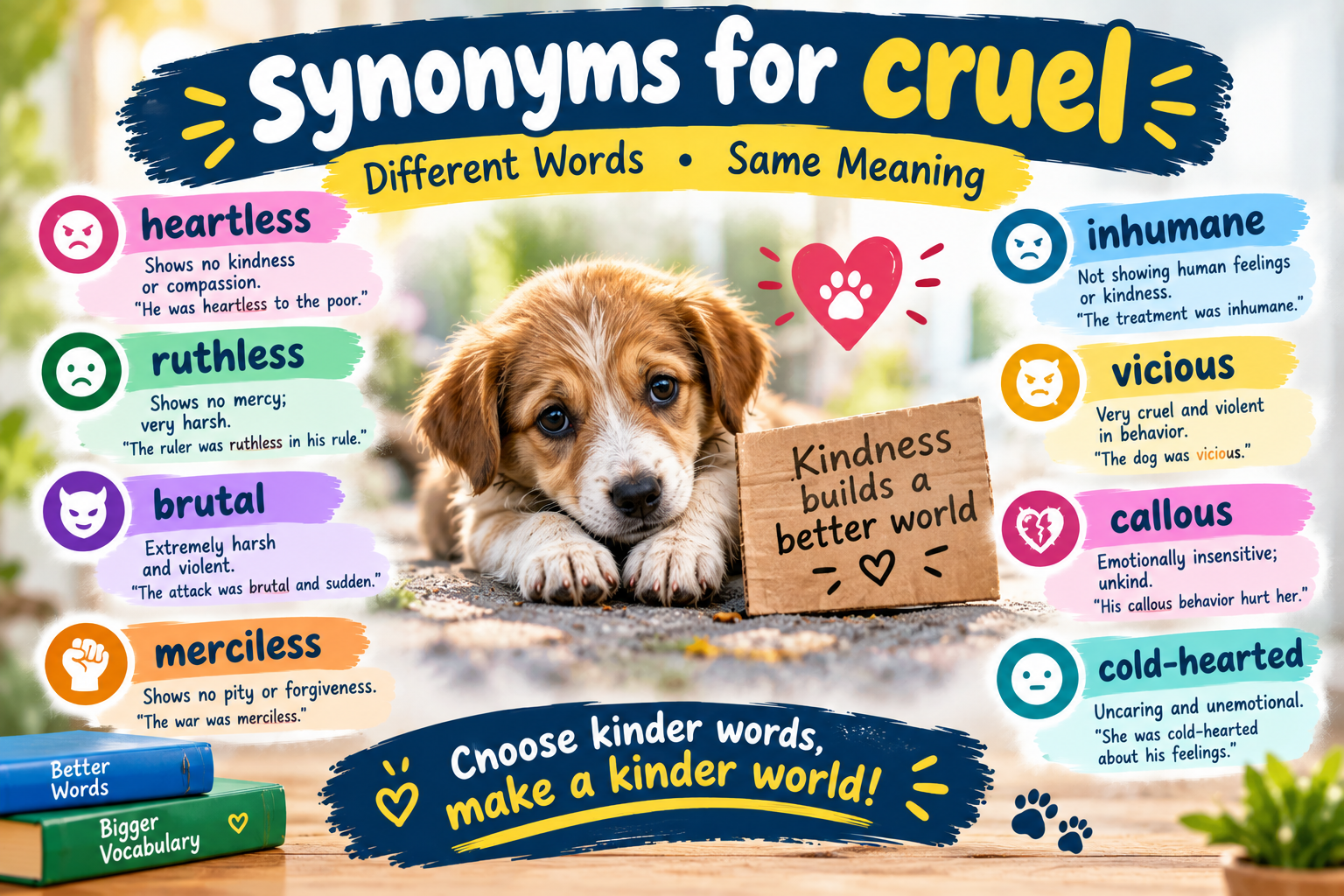
32 Synonyms of Cruel With Meaning & Examples
1. Harsh (Adjective)
Meaning: Harsh describes behavior or treatment that is severe and lacking kindness.
Examples:
- The teacher’s harsh words hurt the student’s feelings.
- The workers faced harsh conditions.
2. Brutal (Adjective)
Meaning: Brutal describes extremely violent, rough, or cruel behavior.
Examples:
- The soldiers witnessed a brutal attack.
- The criminal was known for his brutal actions.
3. Heartless (Adjective)
Meaning: Heartless means showing no sympathy or concern for others.
Examples:
- It was heartless to ignore her suffering.
- His heartless comment made everyone uncomfortable.
4. Merciless (Adjective)
Meaning: Merciless means showing no pity or forgiveness.
Examples:
- The merciless ruler punished his enemies.
- The storm was merciless.
5. Ruthless (Adjective)
Meaning: Ruthless means having no pity when trying to achieve a goal.
Examples:
- The ruthless leader removed anyone who opposed him.
- The company used ruthless tactics to defeat its rival.
6. Vicious (Adjective)
Meaning: Vicious describes violent, aggressive, or deliberately harmful behavior.
Examples:
- The dog gave a vicious growl.
- He launched a vicious attack on his opponent.
7. Inhumane (Adjective)
Meaning: Inhumane means lacking compassion for people or animals.
Examples:
- The prisoners suffered inhumane treatment.
- The organization protested against the inhumane conditions.
8. Barbaric (Adjective)
Meaning: Barbaric describes behavior that is extremely cruel, violent, or uncivilized.
Examples:
- The practice was considered barbaric.
- The attackers used barbaric methods.
9. Savage (Adjective)
Meaning: Savage can describe extremely violent, fierce, or cruel behavior.
Examples:
- The animal made a savage attack.
- The conflict led to savage fighting.
10. Violent (Adjective)
Meaning: Violent describes behavior that uses physical force or causes harm.
Examples:
- The protest became violent.
- He was arrested after a violent incident.
11. Pitiless (Adjective)
Meaning: Pitiless means showing no pity or compassion.
Examples:
- The pitiless enemy refused to surrender.
- The character was portrayed as pitiless.
12. Unmerciful (Adjective)
Meaning: Unmerciful means showing no mercy or kindness.
Examples:
- The soldiers faced an unmerciful attack.
- His unmerciful treatment shocked the community.
13. Callous (Adjective)
Meaning: Callous means emotionally insensitive to another person’s pain.
Examples:
- His callous response upset his friend.
- The manager seemed callous toward the workers’ concerns.
14. Cold-hearted (Adjective)
Meaning: Cold-hearted means lacking warmth, sympathy, or compassion.
Examples:
- The cold-hearted man refused to help.
- Her cold-hearted decision surprised everyone.
15. Unkind (Adjective)
Meaning: Unkind means not friendly, caring, or considerate.
Examples:
- That was an unkind thing to say.
- His unkind behavior hurt his classmates.
16. Mean (Adjective)
Meaning: Mean can describe behavior that is deliberately unpleasant or hurtful.
Examples:
- It was mean to laugh at her mistake.
- He made a mean comment about his friend.
17. Spiteful (Adjective)
Meaning: Spiteful means wanting to hurt or annoy someone because of anger or resentment.
Examples:
- She made a spiteful remark after the argument.
- His spiteful actions damaged the relationship.
18. Malicious (Adjective)
Meaning: Malicious means deliberately intending to cause harm.
Examples:
- The hacker sent a malicious message.
- His malicious rumor caused serious problems.
19. Ferocious (Adjective)
Meaning: Ferocious means extremely fierce, aggressive, or violent.
Examples:
- The lion looked ferocious.
- The team faced ferocious competition.
20. Oppressive (Adjective)
Meaning: Oppressive describes cruel or unfair control that causes suffering.
Examples:
- The people lived under an oppressive government.
- The workers protested against oppressive rules.
21. Tyrannical (Adjective)
Meaning: Tyrannical means using power in a cruel and unfair way.
Examples:
- The king became increasingly tyrannical.
- Citizens resisted the tyrannical regime.
22. Sadistic (Adjective)
Meaning: Sadistic describes taking pleasure in causing pain or suffering.
Examples:
- The villain had a sadistic personality.
- The story describes a sadistic criminal.
23. Inconsiderate (Adjective)
Meaning: Inconsiderate means failing to think about other people’s feelings or needs.
Examples:
- It was inconsiderate to interrupt her.
- His inconsiderate behavior annoyed everyone.
24. Unfeeling (Adjective)
Meaning: Unfeeling means showing little or no emotion or sympathy.
Examples:
- His unfeeling response made the situation worse.
- She thought the decision was unfeeling.
25. Remorseless (Adjective)
Meaning: Remorseless means showing no regret for harmful actions.
Examples:
- The remorseless criminal showed no regret.
- He remained remorseless after causing harm.
26. Savage-minded (Adjective)
Meaning: Savage-minded describes a person who thinks or behaves in a violent or cruel way.
Examples:
- The story portrays a savage-minded warrior.
- His savage-minded approach frightened others.
27. Severe (Adjective)
Meaning: Severe means extremely harsh, serious, or strict.
Examples:
- The judge gave him a severe punishment.
- The country faced severe conditions.
28. Hard-hearted (Adjective)
Meaning: Hard-hearted means having little sympathy or compassion.
Examples:
- The hard-hearted man refused to forgive him.
- Her hard-hearted attitude surprised her friends.
29. Uncompassionate (Adjective)
Meaning: Uncompassionate means lacking sympathy or concern for suffering.
Examples:
- The decision seemed uncompassionate.
- His uncompassionate response upset the family.
30. Vindictive (Adjective)
Meaning: Vindictive describes someone who wants to hurt another person because of anger or revenge.
Examples:
- His vindictive behavior caused more conflict.
- She made a vindictive decision after the argument.
31. Atrocious (Adjective)
Meaning: Atrocious describes something extremely bad, cruel, or shocking.
Examples:
- The prisoners suffered atrocious conditions.
- The attack was atrocious.
32. Relentless (Adjective)
Meaning: Relentless means continuing without stopping or showing mercy.
Examples:
- The enemy launched a relentless attack.
- The victims faced relentless pressure.
Prototype Meaning
The most typical meaning of cruel is deliberately causing pain or suffering without caring about the victim. When people hear the word, they may imagine someone hurting another person or animal, acting without sympathy, or enjoying another person’s suffering. The word can describe a person, action, comment, punishment, or situation. For example, a cruel person may lack compassion, while a cruel joke may hurt someone’s feelings. The central idea is a clear lack of kindness combined with harmful or hurtful behavior.
Prototype Categorization
The 32 synonyms can be grouped into semantic categories. These groups help writers choose a word that matches the exact kind of cruelty they want to describe.
- General unkindness: unkind, mean, inconsiderate, harsh. These are useful for everyday behavior, words, or treatment that hurts others.
- Lack of sympathy: heartless, callous, cold-hearted, unfeeling, hard-hearted, uncompassionate. These focus on emotional coldness and a lack of compassion.
- Violence and aggression: brutal, vicious, violent, savage, ferocious. These are stronger choices when physical violence or aggressive behavior is involved.
- Lack of mercy: merciless, pitiless, unmerciful, remorseless, relentless. These emphasize refusing to show pity or stop harmful behavior.
- Deliberate harm: malicious, spiteful, vindictive, sadistic. These suggest that the person intentionally wants to hurt, punish, or upset someone.
- Abuse of power: oppressive, tyrannical, severe. These work well when cruelty is connected to authority, rules, punishment, or control.
- Extreme cruelty: barbaric, inhumane, atrocious. These are strong words for shocking, unacceptable, or extremely cruel actions.
This categorization helps writers avoid using every synonym as if it had exactly the same meaning. Callous focuses on emotional insensitivity, while brutal focuses more on violence. Malicious highlights harmful intent, while merciless highlights a lack of pity.
Antonyms of Cruel
1. Kind (Adjective)
Showing care, sympathy, and concern for others.
2. Compassionate (Adjective)
Showing deep concern for someone who is suffering.
3. Gentle (Adjective)
Calm, careful, and unlikely to cause harm.
4. Caring (Adjective)
Showing concern and affection for others.
5. Merciful (Adjective)
Showing forgiveness and compassion instead of punishment.
6. Humane (Adjective)
Showing kindness and respect for people or animals.
7. Kind-hearted (Adjective)
Naturally caring, generous, and sympathetic.
8. Considerate (Adjective)
Thinking carefully about other people’s feelings and needs.
Short Questions and Answers
What does cruel mean?
Cruel means causing pain, suffering, or distress without showing kindness, sympathy, or mercy.
When should cruel be used?
Use cruel when describing behavior, treatment, words, or actions that deliberately or unnecessarily cause suffering or emotional pain.
Is cruel positive or negative?
Cruel is strongly negative. It describes a lack of kindness and often suggests unnecessary harm or suffering.
How is it different from similar words?
Cruel is a broad word for causing suffering or showing a lack of kindness. Brutal usually suggests extreme violence, callous focuses on a lack of feeling, ruthless suggests no pity while pursuing a goal, and malicious suggests an intention to cause harm.
Conclusion
Learning synonyms for cruel can make your English vocabulary stronger and more precise. Words such as harsh, brutal, heartless, ruthless, merciless, callous, malicious, and inhumane describe different forms and levels of cruelty. Choosing the right synonym helps you explain exactly what makes a person, action, or situation harmful. English learners can use these words to improve speaking and writing, while content writers can avoid repeating cruel in articles, stories, and reports. The key is to understand the small difference between each word before using it. Practice a few synonyms each day by creating your own sentences. This simple habit can expand your vocabulary, improve your communication, reduce repetition, and build greater confidence in English.

Olivia Wordsmith is a passionate vocabulary writer who loves exploring words, meanings, and their everyday use.
She creates clear, engaging content to help readers expand their vocabulary and communicate with confidence.