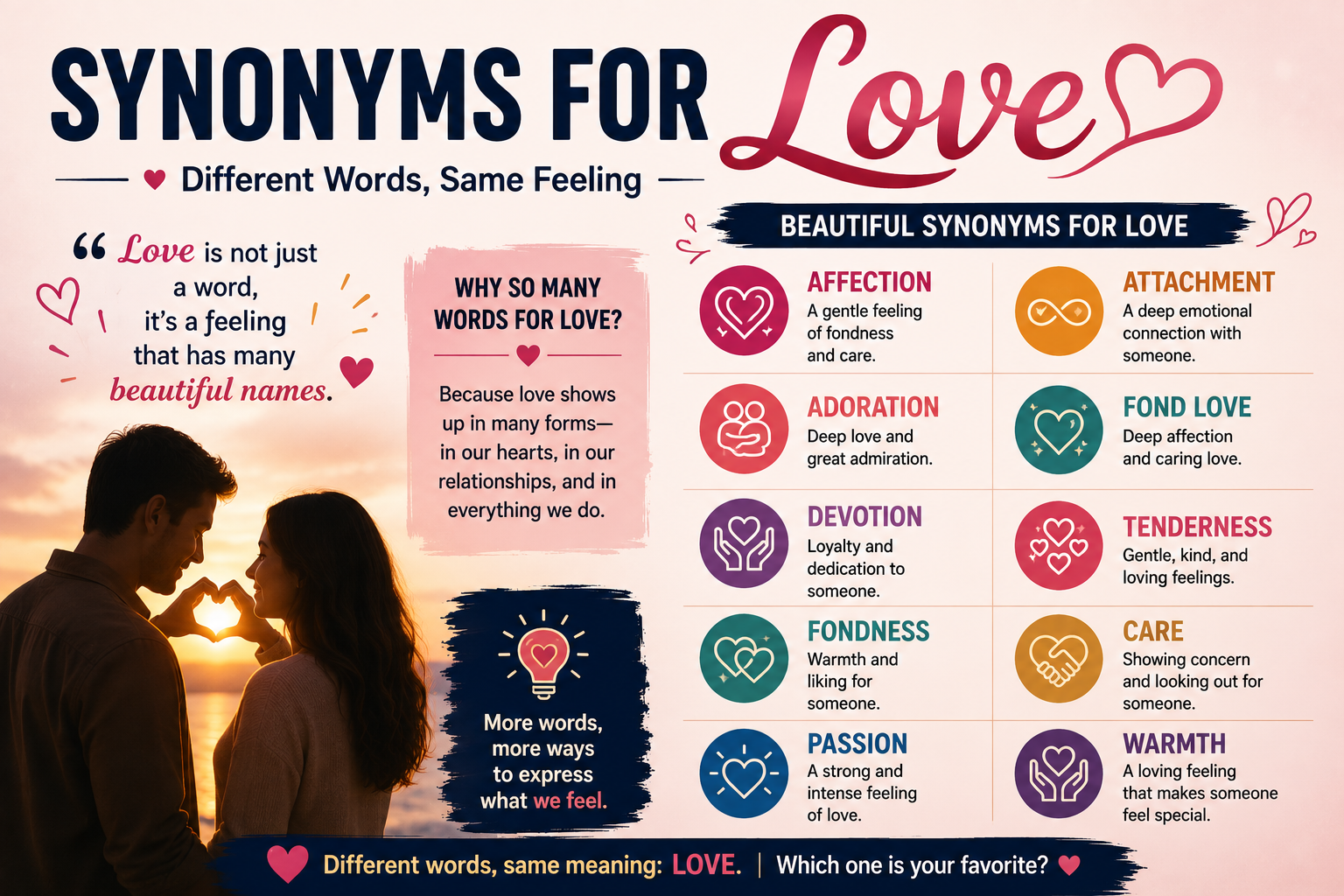
Love is one of the most common and powerful words in English. We use it when talking about family, friends, partners, hobbies, places, and even food. You might say, “I love my mother,” “I love this song,” or “I love chocolate.” Yet each sentence can express a different kind of feeling.
As an English teacher, I often notice that learners use love many times in the same paragraph. The meaning may be correct, but the writing can sound repetitive. Content writers face the same problem when they want to describe affection, care, passion, or deep emotional connection.
Learning synonyms gives you more ways to express the exact feeling you mean. Words such as adore, cherish, devotion, and affection are related to love, but each has its own shade of meaning. This guide explains 30 synonyms for love, with simple meanings and examples. You will also learn their history, pronunciation, word forms, semantic groups, and antonyms.
Meaning of love
Definition
Love (Noun/Verb): Love is a strong feeling of affection, care, attachment, or deep liking for someone or something. As a verb, it means to feel deep affection or strong enjoyment.
Examples
- I love spending time with my family.
- She loves her new job.
- Their love grew stronger over the years.
Connotative Meaning
(Connotation means the feeling or idea that a word suggests beyond its basic meaning.)
- Positive tone: Love usually suggests warmth, care, happiness, kindness, and connection.
- Negative tone: In some contexts, love can suggest obsession, dependence, or emotional pain.
- Neutral tone: It can simply describe a strong liking for an activity, object, place, or idea.
For example, “I love my children” shows deep affection, while “I love coffee” usually means strong enjoyment.
Etymology
The word love has very old Germanic roots.
- Old English (450–1100): Love came from Old English lufu, meaning affection, love, or friendliness. The related verb was lufian, meaning “to love.”
- Middle English (1100–1500): The word developed into forms such as love, while its meanings expanded to include affection, desire, friendship, and romantic attachment.
- Modern English (1500–Present): Love developed a wide range of meanings. It can describe romantic love, family affection, friendship, strong interest, enjoyment, and spiritual or moral devotion.
The word is related to similar forms in other Germanic languages, showing how deeply rooted the concept is in English vocabulary.
Pronunciation (IPA)
- IPA: /lʌv/
- Syllables: love — one syllable
The pronunciation is the same for the noun and verb.
Affixation Pattern of love
- Root: love
- Prefix: None
- Suffix: None in the basic form
- Word formations:
- love — noun/verb
- loved — verb/adjective
- loving — adjective/verb
- lover — noun
- lovely — adjective
- lovingly — adverb
- loveliness — noun
- loveless — adjective
- lovelessness — noun
- lovable — adjective
- lovability — noun
- beloved — adjective/noun
- unloving — adjective
30 Synonyms of love With Meaning & Examples
1. Affection (Noun)
Meaning: A warm feeling of care or liking for someone.
Examples:
- She has great affection for her grandmother.
- His affection for the dog was clear.
2. Adoration (Noun)
Meaning: A very strong feeling of love, respect, or admiration.
Examples:
- The child looked at his mother with adoration.
- Fans showed their adoration for the singer.
3. Devotion (Noun)
Meaning: Strong love and loyalty toward someone or something.
Examples:
- Her devotion to her family is remarkable.
- He showed great devotion to his work.
4. Fondness (Noun)
Meaning: A warm feeling of liking for someone or something.
Examples:
- I have a fondness for old books.
- She developed a fondness for her new neighbor.
5. Passion (Noun)
Meaning: A very strong feeling of love, excitement, or interest.
Examples:
- He has a passion for music.
- Their relationship was filled with passion.
6. Attachment (Noun)
Meaning: A strong emotional connection to someone or something.
Examples:
- The child formed a strong attachment to her teacher.
- He has a deep attachment to his hometown.
7. Adore (Verb)
Meaning: To love someone or something very much.
Examples:
- I adore my little sister.
- She adores classical music.
8. Cherish (Verb)
Meaning: To love and value someone or something deeply.
Examples:
- We cherish every moment with our parents.
- She cherished the memories of her childhood.
9. Treasure (Verb)
Meaning: To value someone or something very highly.
Examples:
- I treasure our friendship.
- He treasures the letters from his father.
10. Care (Verb)
Meaning: To feel concern, affection, or kindness toward someone.
Examples:
- I deeply care about my friends.
- She cares for her elderly father.
11. Devote (Verb)
Meaning: To give a lot of time, attention, or loyalty to someone or something.
Examples:
- He devotes his life to helping others.
- She devoted herself to her family.
12. Appreciate (Verb)
Meaning: To value someone or something and recognize its worth.
Examples:
- I really appreciate your kindness.
- She appreciates everything her parents do.
13. Desire (Noun)
Meaning: A strong wish or longing for someone or something.
Examples:
- He felt a strong desire to see her again.
- Her desire for success motivated her.
14. Liking (Noun)
Meaning: A feeling that someone or something is pleasant or enjoyable.
Examples:
- I have a strong liking for spicy food.
- His liking for the team grew over time.
15. Warmth (Noun)
Meaning: A friendly and caring feeling toward someone.
Examples:
- She welcomed us with great warmth.
- His warmth made everyone feel comfortable.
16. Kindness (Noun)
Meaning: Friendly and caring behavior toward others.
Examples:
- Her kindness touched my heart.
- Small acts of kindness can build strong relationships.
17. Friendship (Noun)
Meaning: A close and caring relationship between friends.
Examples:
- Their friendship lasted for many years.
- True friendship is built on trust.
18. Romance (Noun)
Meaning: A feeling or relationship involving romantic love.
Examples:
- Their romance began at college.
- The movie tells a beautiful romance.
19. Infatuation (Noun)
Meaning: A very strong but often short-lived feeling of attraction.
Examples:
- His infatuation faded after a few months.
- Teenage infatuation can feel very intense.
20. Devotedness (Noun)
Meaning: The quality of being deeply loyal and dedicated.
Examples:
- Her devotedness to her children was clear.
- His devotedness impressed everyone.
21. Loyalty (Noun)
Meaning: Strong support and faithfulness toward someone or something.
Examples:
- Her loyalty to her friends is admirable.
- The team values customer loyalty.
22. Sympathy (Noun)
Meaning: Feelings of care or concern for someone who is suffering.
Examples:
- She showed sympathy for the injured man.
- His words expressed deep sympathy.
23. Empathy (Noun)
Meaning: The ability to understand and share another person’s feelings.
Examples:
- Good leaders show empathy for their teams.
- Her empathy helped her comfort her friend.
24. Caring (Adjective/Noun)
Meaning: Showing concern, kindness, and affection.
Examples:
- She is a caring person.
- His caring nature made him a good teacher.
25. Tenderness (Noun)
Meaning: Gentle affection and care.
Examples:
- He spoke to the child with tenderness.
- The scene showed great tenderness.
26. Regard (Noun)
Meaning: Respect, care, or positive feelings toward someone.
Examples:
- I have great regard for my teacher.
- She holds him in high regard.
27. Esteem (Noun)
Meaning: Strong respect and admiration.
Examples:
- She is held in high esteem by her colleagues.
- His work earned the esteem of the community.
28. Yearning (Noun)
Meaning: A strong and emotional desire for someone or something.
Examples:
- He felt a deep yearning for home.
- She had a yearning to see her family.
29. Amity (Noun)
Meaning: A friendly and peaceful relationship.
Examples:
- The two groups lived together in amity.
- The agreement restored amity between the nations.
30. Endearment (Noun)
Meaning: A word, action, or expression that shows affection.
Examples:
- “Dear” can be a term of endearment.
- Her smile was a small endearment.
Prototype Meaning
The most typical meaning of love is a deep feeling of affection and care for another person. When people hear the word, they often imagine a close bond between family members, romantic partners, or close friends. However, love can also describe a strong liking for an activity, place, food, animal, or idea. The exact meaning comes from the context.
Prototype Categorization
The 30 synonyms can be grouped into useful semantic categories. This helps you choose a word that matches the exact type of love you want to describe.
- Deep affection:affection, adoration, devotion, fondness, tenderness
- These words work well when you want to show warmth and emotional closeness.
- Strong romantic feeling:passion, romance, desire, infatuation, yearning
- These are useful for romantic writing and emotional descriptions.
- Care and connection:care, attachment, warmth, kindness, caring
- These words fit family relationships, friendships, and supportive actions.
- Respect and admiration:appreciation, regard, esteem, loyalty
- These work well when love is connected with respect or gratitude.
- Loving actions:adore, cherish, treasure, devote
- These verbs help you describe what people do because they care deeply.
- Friendship and peaceful relationships:friendship, empathy, sympathy, amity
- These words describe social bonds, understanding, and goodwill.
- Affectionate expressions:endearment
- This is useful when discussing loving names, words, gestures, or expressions.
Choosing a synonym by meaning and context makes your writing more natural. You should not replace love with a synonym simply because the words look similar.
Antonyms of love
1. Hate (Noun/Verb)
Meaning: A very strong feeling of dislike or hostility.
2. Hatred (Noun)
Meaning: An intense feeling of hate.
3. Dislike (Noun/Verb)
Meaning: A feeling of not enjoying or liking someone or something.
4. Indifference (Noun)
Meaning: A lack of interest, concern, or feeling.
5. Hostility (Noun)
Meaning: Unfriendly or aggressive feelings toward someone.
6. Rejection (Noun)
Meaning: Refusal to accept or show affection toward someone or something.
7. Antipathy (Noun)
Meaning: A strong feeling of dislike toward someone or something.
Short Questions and Answers
What does love mean?
Love means a strong feeling of affection, care, attachment, or deep liking. It can describe romantic relationships, family bonds, friendships, or strong enjoyment.
When should love be used?
Use love when you want to express strong affection or enjoyment. It works in both everyday speech and formal writing, although more specific words may be better when you need precise meaning.
Is love positive or negative?
Love is usually positive. However, the word can appear in negative contexts when it describes obsession, loss, jealousy, or emotional pain.
How is love different from similar words?
The strength and type of feeling can differ. Fondness often means gentle liking, adoration suggests very strong admiration, passion suggests intense emotion, and devotion suggests lasting loyalty.
Is adore stronger than love?
Often, yes. Adore can express very strong love or admiration. However, the exact strength depends on the context.
Can love describe things other than people?
Yes. You can love food, music, books, sports, places, hobbies, and ideas. In these cases, it usually means strong enjoyment or liking.
What is the best synonym for love?
There is no single best synonym. Affection, adoration, devotion, fondness, passion, cherish, and care may work, but your choice should match the exact meaning.
Conclusion
Learning synonyms for love can make your English more expressive and natural. Instead of using love in every sentence, you can choose a word that shows the exact feeling. Affection suggests warmth, adoration shows strong admiration, devotion suggests loyalty, and passion expresses intense emotion.
These alternatives also help you avoid repetition in essays, stories, emails, and everyday conversations. They can make your writing more precise and help you express emotions with greater confidence.
Do not try to memorize all 30 words at once. Start with five or six. Use each one in your own sentence. Then add more as your vocabulary grows. Daily practice is one of the easiest ways to build stronger English skills.
Bookmark this guide and return to it whenever you need a better word for love.
SEO Meta Description
Synonyms for love: discover 30 powerful alternatives with meanings, examples, antonyms, word forms, and simple tips to improve your English vocabulary.
Love is one of the most common and powerful words in English. We use it when talking about family, friends, partners, hobbies, places, and even food. You might say, “I love my mother,” “I love this song,” or “I love chocolate.” Yet each sentence can express a different kind of feeling.
As an English teacher, I often notice that learners use love many times in the same paragraph. The meaning may be correct, but the writing can sound repetitive. Content writers face the same problem when they want to describe affection, care, passion, or deep emotional connection.
Learning synonyms gives you more ways to express the exact feeling you mean. Words such as adore, cherish, devotion, and affection are related to love, but each has its own shade of meaning. This guide explains 30 synonyms for love, with simple meanings and examples. You will also learn their history, pronunciation, word forms, semantic groups, and antonyms.
Meaning of love
Definition
Love (Noun/Verb): Love is a strong feeling of affection, care, attachment, or deep liking for someone or something. As a verb, it means to feel deep affection or strong enjoyment.
Examples
- I love spending time with my family.
- She loves her new job.
- Their love grew stronger over the years.
Connotative Meaning
(Connotation means the feeling or idea that a word suggests beyond its basic meaning.)
- Positive tone: Love usually suggests warmth, care, happiness, kindness, and connection.
- Negative tone: In some contexts, love can suggest obsession, dependence, or emotional pain.
- Neutral tone: It can simply describe a strong liking for an activity, object, place, or idea.
For example, “I love my children” shows deep affection, while “I love coffee” usually means strong enjoyment.
Etymology
The word love has very old Germanic roots.
- Old English (450–1100): Love came from Old English lufu, meaning affection, love, or friendliness. The related verb was lufian, meaning “to love.”
- Middle English (1100–1500): The word developed into forms such as love, while its meanings expanded to include affection, desire, friendship, and romantic attachment.
- Modern English (1500–Present): Love developed a wide range of meanings. It can describe romantic love, family affection, friendship, strong interest, enjoyment, and spiritual or moral devotion.
The word is related to similar forms in other Germanic languages, showing how deeply rooted the concept is in English vocabulary.
Pronunciation (IPA)
- IPA: /lʌv/
- Syllables: love — one syllable
The pronunciation is the same for the noun and verb.
Affixation Pattern of love
- Root: love
- Prefix: None
- Suffix: None in the basic form
- Word formations:
- love — noun/verb
- loved — verb/adjective
- loving — adjective/verb
- lover — noun
- lovely — adjective
- lovingly — adverb
- loveliness — noun
- loveless — adjective
- lovelessness — noun
- lovable — adjective
- lovability — noun
- beloved — adjective/noun
- unloving — adjective
30 Synonyms of love With Meaning & Examples
1. Affection (Noun)
Meaning: A warm feeling of care or liking for someone.
Examples:
- She has great affection for her grandmother.
- His affection for the dog was clear.
2. Adoration (Noun)
Meaning: A very strong feeling of love, respect, or admiration.
Examples:
- The child looked at his mother with adoration.
- Fans showed their adoration for the singer.
3. Devotion (Noun)
Meaning: Strong love and loyalty toward someone or something.
Examples:
- Her devotion to her family is remarkable.
- He showed great devotion to his work.
4. Fondness (Noun)
Meaning: A warm feeling of liking for someone or something.
Examples:
- I have a fondness for old books.
- She developed a fondness for her new neighbor.
5. Passion (Noun)
Meaning: A very strong feeling of love, excitement, or interest.
Examples:
- He has a passion for music.
- Their relationship was filled with passion.
6. Attachment (Noun)
Meaning: A strong emotional connection to someone or something.
Examples:
- The child formed a strong attachment to her teacher.
- He has a deep attachment to his hometown.
7. Adore (Verb)
Meaning: To love someone or something very much.
Examples:
- I adore my little sister.
- She adores classical music.
8. Cherish (Verb)
Meaning: To love and value someone or something deeply.
Examples:
- We cherish every moment with our parents.
- She cherished the memories of her childhood.
9. Treasure (Verb)
Meaning: To value someone or something very highly.
Examples:
- I treasure our friendship.
- He treasures the letters from his father.
10. Care (Verb)
Meaning: To feel concern, affection, or kindness toward someone.
Examples:
- I deeply care about my friends.
- She cares for her elderly father.
11. Devote (Verb)
Meaning: To give a lot of time, attention, or loyalty to someone or something.
Examples:
- He devotes his life to helping others.
- She devoted herself to her family.
12. Appreciate (Verb)
Meaning: To value someone or something and recognize its worth.
Examples:
- I really appreciate your kindness.
- She appreciates everything her parents do.
13. Desire (Noun)
Meaning: A strong wish or longing for someone or something.
Examples:
- He felt a strong desire to see her again.
- Her desire for success motivated her.
14. Liking (Noun)
Meaning: A feeling that someone or something is pleasant or enjoyable.
Examples:
- I have a strong liking for spicy food.
- His liking for the team grew over time.
15. Warmth (Noun)
Meaning: A friendly and caring feeling toward someone.
Examples:
- She welcomed us with great warmth.
- His warmth made everyone feel comfortable.
16. Kindness (Noun)
Meaning: Friendly and caring behavior toward others.
Examples:
- Her kindness touched my heart.
- Small acts of kindness can build strong relationships.
17. Friendship (Noun)
Meaning: A close and caring relationship between friends.
Examples:
- Their friendship lasted for many years.
- True friendship is built on trust.
18. Romance (Noun)
Meaning: A feeling or relationship involving romantic love.
Examples:
- Their romance began at college.
- The movie tells a beautiful romance.
19. Infatuation (Noun)
Meaning: A very strong but often short-lived feeling of attraction.
Examples:
- His infatuation faded after a few months.
- Teenage infatuation can feel very intense.
20. Devotedness (Noun)
Meaning: The quality of being deeply loyal and dedicated.
Examples:
- Her devotedness to her children was clear.
- His devotedness impressed everyone.
21. Loyalty (Noun)
Meaning: Strong support and faithfulness toward someone or something.
Examples:
- Her loyalty to her friends is admirable.
- The team values customer loyalty.
22. Sympathy (Noun)
Meaning: Feelings of care or concern for someone who is suffering.
Examples:
- She showed sympathy for the injured man.
- His words expressed deep sympathy.
23. Empathy (Noun)
Meaning: The ability to understand and share another person’s feelings.
Examples:
- Good leaders show empathy for their teams.
- Her empathy helped her comfort her friend.
24. Caring (Adjective/Noun)
Meaning: Showing concern, kindness, and affection.
Examples:
- She is a caring person.
- His caring nature made him a good teacher.
25. Tenderness (Noun)
Meaning: Gentle affection and care.
Examples:
- He spoke to the child with tenderness.
- The scene showed great tenderness.
26. Regard (Noun)
Meaning: Respect, care, or positive feelings toward someone.
Examples:
- I have great regard for my teacher.
- She holds him in high regard.
27. Esteem (Noun)
Meaning: Strong respect and admiration.
Examples:
- She is held in high esteem by her colleagues.
- His work earned the esteem of the community.
28. Yearning (Noun)
Meaning: A strong and emotional desire for someone or something.
Examples:
- He felt a deep yearning for home.
- She had a yearning to see her family.
29. Amity (Noun)
Meaning: A friendly and peaceful relationship.
Examples:
- The two groups lived together in amity.
- The agreement restored amity between the nations.
30. Endearment (Noun)
Meaning: A word, action, or expression that shows affection.
Examples:
- “Dear” can be a term of endearment.
- Her smile was a small endearment.
Prototype Meaning
The most typical meaning of love is a deep feeling of affection and care for another person. When people hear the word, they often imagine a close bond between family members, romantic partners, or close friends. However, love can also describe a strong liking for an activity, place, food, animal, or idea. The exact meaning comes from the context.
Prototype Categorization
The 30 synonyms can be grouped into useful semantic categories. This helps you choose a word that matches the exact type of love you want to describe.
- Deep affection:affection, adoration, devotion, fondness, tenderness
- These words work well when you want to show warmth and emotional closeness.
- Strong romantic feeling:passion, romance, desire, infatuation, yearning
- These are useful for romantic writing and emotional descriptions.
- Care and connection:care, attachment, warmth, kindness, caring
- These words fit family relationships, friendships, and supportive actions.
- Respect and admiration:appreciation, regard, esteem, loyalty
- These work well when love is connected with respect or gratitude.
- Loving actions:adore, cherish, treasure, devote
- These verbs help you describe what people do because they care deeply.
- Friendship and peaceful relationships:friendship, empathy, sympathy, amity
- These words describe social bonds, understanding, and goodwill.
- Affectionate expressions:endearment
- This is useful when discussing loving names, words, gestures, or expressions.
Choosing a synonym by meaning and context makes your writing more natural. You should not replace love with a synonym simply because the words look similar.
Antonyms of love
1. Hate (Noun/Verb)
Meaning: A very strong feeling of dislike or hostility.
2. Hatred (Noun)
Meaning: An intense feeling of hate.
3. Dislike (Noun/Verb)
Meaning: A feeling of not enjoying or liking someone or something.
4. Indifference (Noun)
Meaning: A lack of interest, concern, or feeling.
5. Hostility (Noun)
Meaning: Unfriendly or aggressive feelings toward someone.
6. Rejection (Noun)
Meaning: Refusal to accept or show affection toward someone or something.
7. Antipathy (Noun)
Meaning: A strong feeling of dislike toward someone or something.
Short Questions and Answers
What does love mean?
Love means a strong feeling of affection, care, attachment, or deep liking. It can describe romantic relationships, family bonds, friendships, or strong enjoyment.
When should love be used?
Use love when you want to express strong affection or enjoyment. It works in both everyday speech and formal writing, although more specific words may be better when you need precise meaning.
Is love positive or negative?
Love is usually positive. However, the word can appear in negative contexts when it describes obsession, loss, jealousy, or emotional pain.
How is love different from similar words?
The strength and type of feeling can differ. Fondness often means gentle liking, adoration suggests very strong admiration, passion suggests intense emotion, and devotion suggests lasting loyalty.
Is adore stronger than love?
Often, yes. Adore can express very strong love or admiration. However, the exact strength depends on the context.
Can love describe things other than people?
Yes. You can love food, music, books, sports, places, hobbies, and ideas. In these cases, it usually means strong enjoyment or liking.
What is the best synonym for love?
There is no single best synonym. Affection, adoration, devotion, fondness, passion, cherish, and care may work, but your choice should match the exact meaning.
Conclusion
Learning synonyms for love can make your English more expressive and natural. Instead of using love in every sentence, you can choose a word that shows the exact feeling. Affection suggests warmth, adoration shows strong admiration, devotion suggests loyalty, and passion expresses intense emotion.
These alternatives also help you avoid repetition in essays, stories, emails, and everyday conversations. They can make your writing more precise and help you express emotions with greater confidence.
Do not try to memorize all 30 words at once. Start with five or six. Use each one in your own sentence. Then add more as your vocabulary grows. Daily practice is one of the easiest ways to build stronger English skills.
Bookmark this guide and return to it whenever you need a better word for love.

Olivia Wordsmith is a passionate vocabulary writer who loves exploring words, meanings, and their everyday use.
She creates clear, engaging content to help readers expand their vocabulary and communicate with confidence.