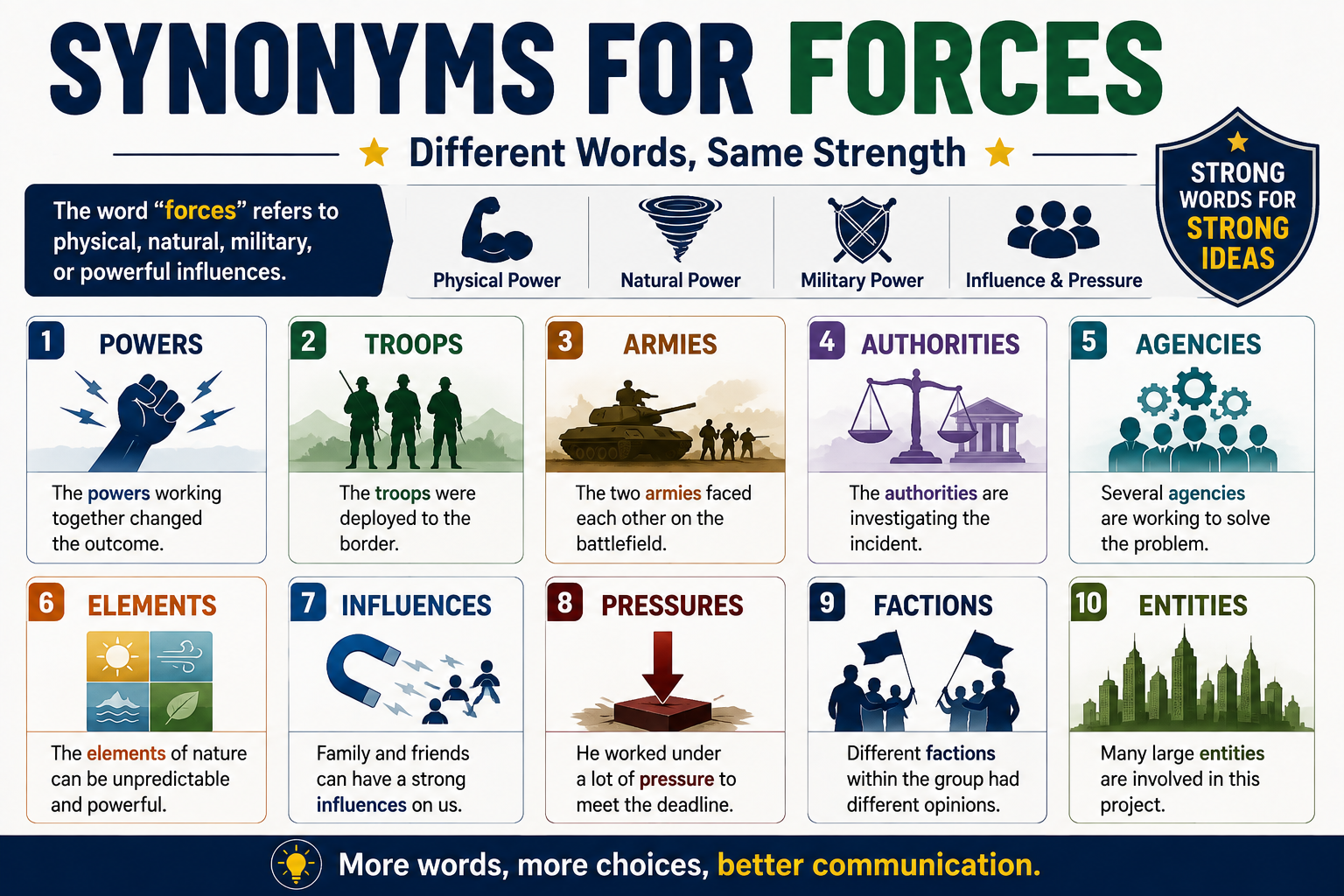
Forces is a useful word with several meanings. It can describe power, pressure, influence, or groups of people. For example, a strong wind forces a door open, while a police force works to protect people. The word can also describe something that makes a person do something against their wishes.
As an English teacher, I often see learners use forces again and again because it seems to fit many sentences. The problem is that its meaning changes with context. A word such as compels may work when someone is made to act, but it does not always replace forces when talking about physical power or military groups.
Learning synonyms helps you choose words that match your exact meaning. It also makes your writing clearer and less repetitive. In this guide, you will learn the meaning, history, pronunciation, word forms, and 30 synonyms for forces, with simple examples. You will also see how these words fit different semantic groups.
Meaning of forces
Definition
Forces (Noun/Verb): Forces is the plural form of force as a noun, and the third-person singular form of force as a verb.
As a noun, forces can mean powers that cause change, physical strength, or organized groups such as military forces.
As a verb, forces means makes someone do something, often against their wishes.
Examples
- Strong winds force trees to bend.
- The new rules force workers to change their routine.
- Several military forces gathered near the border.
Connotative Meaning
(Connotation means the feeling or idea that a word suggests beyond its basic meaning.)
- Positive tone: Forces can suggest strength, energy, protection, or determination.
- Negative tone: It can suggest pressure, control, or lack of choice.
- Neutral tone: In science, forces can simply mean physical influences that affect an object.
The tone depends on the sentence. Forces may sound helpful in “security forces protected the area” but negative in “the law forces people to pay.”
Etymology
The word force did not develop through the usual Old English → Middle English → Modern English path. It entered English later through French.
- Old English (450–1100): English mainly used native words such as miht for power or strength. The modern word force was not yet common in English.
- Middle English (1100–1500): Force entered English from Anglo-French and Old French force, meaning strength, power, or violence. The French word came from Latin fortia, related to fortis, meaning strong.
- Modern English (1500–Present): Force developed many meanings. It came to describe physical power, influence, compulsion, military groups, and scientific action.
The word now appears in everyday speech, science, law, politics, business, and military writing.
Pronunciation (IPA)
- IPA: /ˈfɔːrsɪz/ in many varieties of English
- Syllables: for-ces
The singular noun and base verb force are pronounced /fɔːrs/ in British English and commonly /fɔːrs/ in American English.
Affixation Pattern of forces
- Root: force
- Prefix: None
- Suffix: -s, marking either plural nouns or third-person singular verbs
- Word formations:
- force — noun/verb
- forces — plural noun/verb
- forced — verb/adjective
- forcing — verb/present participle
- forceful — adjective
- forcefully — adverb
- forcefulness — noun
- forcible — adjective
- forcibly — adverb
- enforce — verb
- enforcement — noun
- reinforce — verb
- reinforcement — noun
30 Synonyms of forces With Meaning & Examples
1. Compels (Verb)
Meaning: Makes someone do something, usually because they feel they have no choice.
Examples:
- The evidence compels us to act.
- His duty compels him to help.
2. Makes (Verb)
Meaning: Causes someone to do something.
Examples:
- The storm makes us stay indoors.
- The rule makes students wear uniforms.
3. Requires (Verb)
Meaning: Makes something necessary.
Examples:
- The job requires long hours.
- The form requires your signature.
4. Compels (Verb)
Meaning: Pushes a person strongly toward an action.
Examples:
- Her kindness compels me to trust her.
- The facts compel the team to reconsider.
5. Coerces (Verb)
Meaning: Makes someone act through threats or pressure.
Examples:
- The criminal coerces victims into giving money.
- Nobody should be coerced into signing a contract.
6. Pressures (Verb)
Meaning: Pushes someone to do something.
Examples:
- The manager pressures workers to finish early.
- Friends should not pressure you to agree.
7. Drives (Verb)
Meaning: Causes or strongly pushes someone or something toward an action.
Examples:
- Fear drives people to seek safety.
- Competition drives companies to improve.
8. Urges (Verb)
Meaning: Strongly encourages someone to do something.
Examples:
- The doctor urges him to rest.
- The coach urges the players to stay focused.
9. Persuades (Verb)
Meaning: Gets someone to do something by giving reasons or appealing to them.
Examples:
- She persuades her brother to join the trip.
- The speech persuades voters to support the plan.
10. Influences (Verb)
Meaning: Affects someone’s thoughts, choices, or actions.
Examples:
- Friends often influence our choices.
- Advertising influences buying habits.
11. Obliges (Verb)
Meaning: Requires someone to do something because of a duty or rule.
Examples:
- The contract obliges both sides to cooperate.
- The law obliges companies to report the data.
12. Constrains (Verb)
Meaning: Limits someone’s freedom or ability to act.
Examples:
- A small budget constrains the project.
- The rules constrain what we can do.
13. Compulses (Verb)
Meaning: Forces someone to act; this is a formal and less common alternative to compels.
Examples:
- The situation compulses the team to respond.
- The pressure compulses action.
Note: Compels is much more natural in standard English.
14. Enforces (Verb)
Meaning: Makes sure that a law, rule, or order is obeyed.
Examples:
- Police enforce the law.
- The school enforces its safety rules.
15. Imposes (Verb)
Meaning: Places a rule, duty, cost, or restriction on someone.
Examples:
- The government imposes new taxes.
- The rule imposes extra duties on staff.
16. Compounds (Noun)
Meaning: A substance made by joining two or more elements; in some contexts, this relates to forces acting together.
Examples:
- Several effects compound the problem.
- The forces compound when they act in the same direction.
Note: Compound is not a direct synonym for every use of forces.
17. Powers (Noun)
Meaning: Abilities or strengths that allow something to act or cause change.
Examples:
- Natural powers can shape the land.
- Political powers can influence public policy.
18. Energies (Noun)
Meaning: Forms of energy or active power.
Examples:
- The machine converts electrical energies into motion.
- Natural energies shape the environment.
19. Strengths (Noun)
Meaning: Physical or mental power.
Examples:
- The athlete used all his strengths to finish the race.
- Different strengths act on the structure.
20. Influences (Noun)
Meaning: Powers or effects that change people’s actions or situations.
Examples:
- Social influences can shape behavior.
- Several influences affected the decision.
21. Pressures (Noun)
Meaning: Physical or social forces that push or affect something.
Examples:
- Financial pressures can affect a family.
- The bridge must withstand strong pressures.
22. Impulses (Noun)
Meaning: Sudden pushes, urges, or driving influences.
Examples:
- Emotional impulses can affect decisions.
- The machine responds to electrical impulses.
23. Drivers (Noun)
Meaning: People, factors, or conditions that cause change.
Examples:
- Technology is one of the main drivers of change.
- High demand is a major driver of prices.
24. Agents (Noun)
Meaning: People or things that cause an action or change.
Examples:
- Water is an important agent of erosion.
- Several agents contributed to the change.
25. Causes (Noun)
Meaning: Things that make an event or change happen.
Examples:
- Scientists studied the causes of the damage.
- Poor planning was one of the main causes of failure.
26. Military (Noun)
Meaning: The armed forces of a country.
Examples:
- The military arrived after the disaster.
- The government increased its military presence.
27. Troops (Noun)
Meaning: Groups of soldiers.
Examples:
- Troops moved into the area.
- The country sent more troops to the region.
28. Armed forces (Noun)
Meaning: Organized military groups that defend a country.
Examples:
- The armed forces helped during the emergency.
- The armed forces conducted a rescue operation.
29. Authorities (Noun)
Meaning: People or organizations with official power.
Examples:
- The authorities closed the road.
- Local authorities issued a warning.
30. Might (Noun)
Meaning: Great power or strength.
Examples:
- The army displayed its might.
- The storm showed its natural might.
Prototype Meaning
The most typical meaning of forces depends on context. In everyday English, people often imagine power that makes something happen or pressure that makes someone act. In science, forces usually means pushes or pulls that can change an object’s motion. In social or political contexts, it may mean groups or powers that influence events. When you hear forces, think of power, pressure, influence, or organized strength.
Prototype Categorization
The 30 synonyms above can be grouped by meaning. This makes it easier to select the right word instead of replacing forces with a word that does not fully match the context.
- Compulsion and obligation:compels, requires, coerces, obliges, constrains, enforces, imposes
- Use these when someone has limited choice or must do something.
- Pressure and motivation:pressures, drives, urges, persuades, influences
- These words describe forces that affect decisions or behavior.
- Physical and natural power:powers, energies, strengths, pressures, impulses, might
- These work well when discussing physical, natural, or scientific effects.
- Causes and influences:influences, drivers, agents, causes
- These are useful for academic, business, and analytical writing.
- Military and official groups:military, troops, armed forces, authorities
- Use these when forces refers to organized groups with power or authority.
Choosing a synonym by semantic category helps you keep the original meaning while making your writing more precise.
Antonyms of forces
1. Releases (Verb)
Meaning: Allows someone or something to become free from control or pressure.
2. Frees (Verb)
Meaning: Removes control or restriction.
3. Allows (Verb)
Meaning: Gives permission or makes something possible.
4. Discourages (Verb)
Meaning: Makes someone less likely to act.
5. Weakens (Verb)
Meaning: Makes something less strong or powerful.
6. Powerlessness (Noun)
Meaning: A lack of power or ability to control events.
7. Freedom (Noun)
Meaning: The ability to act without being forced or controlled.
Short Questions and Answers
What does forces mean?
Forces can mean powers, pressures, causes, or organized groups. As a verb, it means makes someone do something, often without giving them a real choice.
When should forces be used?
Use forces when you mean strong physical power, pressure, influence, or organized groups. As a verb, use it when someone or something makes another person act.
Is forces positive or negative?
It can be either. Forces may sound positive when it means protection or strength, but it can sound negative when it means unwanted pressure or control.
How is forces different from similar words?
The best synonym depends on the meaning. Compels suggests strong pressure, influences suggests an effect on choices, requires suggests necessity, and troops refers specifically to soldiers.
Is forces formal or informal?
Forces works in both formal and informal English. It is common in academic, scientific, professional, news, and everyday writing.
Can forces describe people?
Yes. In phrases such as armed forces, security forces, and military forces, it describes organized groups of people.
Can forces be used in science?
Yes. In science, forces are pushes or pulls that can change an object’s motion. Words such as pressure, energy, and power may be related, but they do not always have the same scientific meaning.
Conclusion
Learning synonyms for forces gives you more control over your English. The word can describe physical power, pressure, influence, causes, or organized groups. That is why one synonym cannot replace it in every sentence.
Use compels, coerces, or obliges when someone is made to act. Choose influences, drives, or pressures when talking about effects on behavior. For physical ideas, words such as power, strength, and energy may fit better. When talking about soldiers, troops or armed forces is more precise.
Good vocabulary is not only about knowing many words. It is about knowing which word fits best. Practice these synonyms in your own sentences. Try replacing forces with a more exact word each time you write. With daily practice, your writing will become clearer, stronger, and more natural.
Keep this guide nearby and use these alternatives whenever you want to make your English more precise.

Sarah Linguist is a passionate language enthusiast who loves exploring words, meanings, and synonyms.
She creates clear, easy-to-understand content to help readers improve their vocabulary and English skills.
Through SynonymsGuide.com, Sarah makes finding the right words simple, useful, and enjoyable.