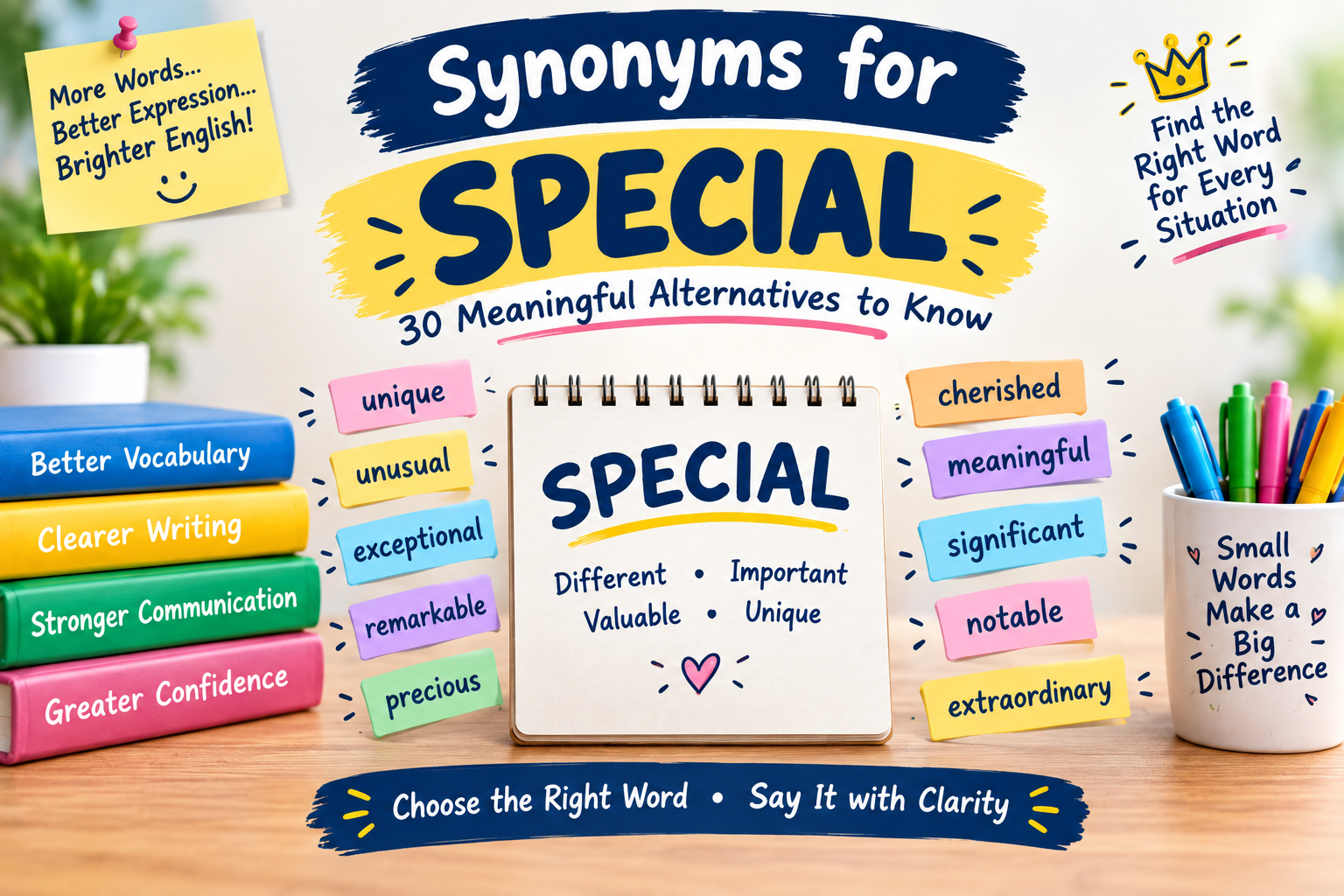
Special means different from the usual, important, or valued in a particular way.
Imagine a student receiving a handmade card from a friend on her birthday. The card feels special because it shows love and care. We also use this word for special events, special skills, special people, and special gifts. It is common in everyday English because it helps us describe things that stand out or have extra meaning. Learning synonyms for special helps English learners choose words that fit different situations. It also helps content writers make their articles more interesting and avoid repeating the same word. In this article, we will explore the meaning, examples, connotation, etymology, pronunciation, grammar, and word formations of special. We will also study 30 useful synonyms with meanings and examples. Finally, we will group these words into semantic categories and explain how to use them clearly.
Meaning of Special
Definition
Special (Adjective): Different from what is usual, or more important, valuable, or meaningful than ordinary things.
Special (Noun): A product, offer, event, or program provided for a particular purpose or for a limited time.
Examples
- Today is a special day because it is my birthday.
- She has a special talent for painting.
Connotative Meaning
- Positive tone: Special often suggests love, importance, beauty, value, or uniqueness.
- Negative tone: In some contexts, it can suggest unfair preference or treatment that excludes others.
- Neutral tone: It can simply mean designed for a particular purpose or different from the usual.
(Connotation: The feeling or idea that a word suggests in addition to its basic meaning.)
Etymology
The word special comes from Latin specialis, meaning “particular” or “of a particular kind.” It is related to Latin species, meaning “kind,” “appearance,” or “form.”
- Old English (450–1100): Special was not a common Old English word. English used native words such as sundor and swīþe to express ideas of being separate or notable.
- Middle English (1100–1500): Special entered English through Old French, from Latin specialis. It was used for something particular, distinct, or important.
- Modern English (1500–Present): The word developed its familiar meanings, including unusual, important, excellent, personal, and designed for a particular purpose.
Pronunciation (IPA)
- IPA: /ˈspeʃəl/
- Syllables: spe-cial
Affixation Pattern of Special
- Root: spec- — historically related to the Latin idea of seeing, appearance, or kind.
- Prefix: None in the modern English word.
- Suffix: -al — an adjective-forming suffix meaning “related to.”
- Word formations:
- special — adjective/noun
- specially — adverb
- specialness — noun
- specialist — noun
- specialize — verb
- specialized — adjective/verb
- specialization — noun
- specialty — noun
- specialization — noun
- unspecialized — adjective
- special-purpose — adjective
- special-case — noun/adjective
30 Synonyms of Special With Meaning & Examples
1. Unique (Adjective)
Meaning: One of a kind or unlike anything else.
Examples:
- Every person has a unique personality.
- The artist created a unique design.
2. Unusual (Adjective)
Meaning: Different from what is normal or expected.
Examples:
- We saw an unusual bird in the garden.
- She had an unusual idea for the project.
3. Exceptional (Adjective)
Meaning: Much better or different than usual.
Examples:
- He showed exceptional talent in music.
- The school gave her an award for exceptional work.
4. Extraordinary (Adjective)
Meaning: Very unusual, impressive, or remarkable.
Examples:
- She made extraordinary progress in English.
- The scientist made an extraordinary discovery.
5. Remarkable (Adjective)
Meaning: Worth noticing because it is unusual or impressive.
Examples:
- Her memory is remarkable.
- The team made a remarkable improvement.
6. Distinctive (Adjective)
Meaning: Having a quality that makes something easy to recognize.
Examples:
- The building has a distinctive shape.
- His distinctive voice is easy to remember.
7. Notable (Adjective)
Meaning: Important or worthy of attention.
Examples:
- The writer made a notable contribution to education.
- There was a notable change in the results.
8. Significant (Adjective)
Meaning: Important or meaningful.
Examples:
- This is a significant moment in her life.
- The project made significant progress.
9. Important (Adjective)
Meaning: Having great value, meaning, or influence.
Examples:
- Family is important to many people.
- She made an important decision.
10. Precious (Adjective)
Meaning: Very valuable or deeply loved.
Examples:
- The necklace is a precious family gift.
- Time with loved ones is precious.
11. Cherished (Adjective)
Meaning: Loved and valued deeply.
Examples:
- The photograph is a cherished memory.
- She keeps her grandmother’s letter as a cherished keepsake.
12. Beloved (Adjective)
Meaning: Loved very much by someone or many people.
Examples:
- The author was a beloved member of the community.
- They visited their beloved childhood home.
13. Dear (Adjective)
Meaning: Loved, valued, or important to someone.
Examples:
- My grandmother is very dear to me.
- She gave her friend a dear and thoughtful gift.
14. Meaningful (Adjective)
Meaning: Having a strong personal or emotional value.
Examples:
- He gave me a meaningful birthday present.
- The conversation was meaningful and helpful.
15. Memorable (Adjective)
Meaning: Easy to remember because it is important or enjoyable.
Examples:
- Our school trip was memorable.
- She gave a memorable speech.
16. Celebrated (Adjective)
Meaning: Famous or widely admired.
Examples:
- The celebrated author visited the school.
- The city is known for its celebrated festival.
17. Prestigious (Adjective)
Meaning: Respected and admired because of high status or quality.
Examples:
- He won a prestigious scholarship.
- She studied at a prestigious university.
18. Select (Adjective)
Meaning: Carefully chosen from a larger group.
Examples:
- Only select students joined the competition.
- The shop sells select handmade products.
19. Exclusive (Adjective)
Meaning: Limited to a particular person or group.
Examples:
- Members received exclusive access to the event.
- The hotel offers an exclusive dining area.
20. Particular (Adjective)
Meaning: Relating to one specific person, thing, or purpose.
Examples:
- This tool has a particular use.
- She has a particular interest in history.
21. Specific (Adjective)
Meaning: Clearly identified or related to one exact thing.
Examples:
- The teacher gave specific instructions.
- We need a specific answer to the question.
22. Customized (Adjective)
Meaning: Made or changed to suit a particular person or purpose.
Examples:
- The company created a customized learning plan.
- He ordered a customized notebook.
23. Tailored (Adjective)
Meaning: Designed to meet particular needs or preferences.
Examples:
- The course offers tailored lessons.
- She received tailored advice from her teacher.
24. Dedicated (Adjective)
Meaning: Intended for one particular purpose or use.
Examples:
- The school has a dedicated reading room.
- The team created a dedicated website for the project.
25. Extraordinary (Adjective)
Meaning: Far beyond what is ordinary or expected.
Examples:
- The athlete showed extraordinary courage.
- The view from the mountain was extraordinary.
26. Rare (Adjective)
Meaning: Not common or found only occasionally.
Examples:
- The museum has a rare painting.
- It is rare to see snow in this area.
27. Singular (Adjective)
Meaning: Very unusual, distinctive, or outstanding.
Examples:
- She has a singular talent for storytelling.
- His singular style made the artwork memorable.
28. Gifted (Adjective)
Meaning: Having a natural ability or talent.
Examples:
- The gifted student enjoys solving difficult problems.
- She is a gifted musician.
29. Wonderful (Adjective)
Meaning: Very good, enjoyable, or pleasing.
Examples:
- We had a wonderful evening together.
- She gave me a wonderful surprise.
30. Extraordinary (Adjective)
Meaning: Very unusual or far better than normal.
Examples:
- The team achieved extraordinary results.
- Her kindness made the day extraordinary.
Prototype Meaning
The most typical meaning of special is something that is different from the ordinary and has extra value or importance. When people hear this word, they may imagine a meaningful gift, a memorable occasion, a loved one, or a rare talent. The word can describe emotional value, unusual qualities, high importance, or a particular purpose. Its exact meaning depends on the context.
Prototype Categorization
The synonyms of special can be grouped into meaningful semantic categories:
- Uniqueness and difference: unique, unusual, distinctive, rare, singular. These words describe something that stands apart from the ordinary.
- Excellence and quality: exceptional, extraordinary, remarkable, notable, wonderful. These words suggest impressive or outstanding qualities.
- Emotional value: precious, cherished, beloved, dear, meaningful, memorable. These words describe things that are loved or important to someone’s feelings and memories.
- Importance and status: significant, important, celebrated, prestigious. These words are useful when something has high value, influence, or public respect.
- Specific purpose: particular, specific, dedicated, customized, tailored. These words describe something made or intended for a certain person, task, or need.
- Selection and limited access: select, exclusive. These words describe something carefully chosen or available to a limited group.
- Natural ability: gifted. This word is useful when special describes an impressive talent or skill.
This categorization helps writers choose the right word for each situation. For example, unique describes something one of a kind, while cherished describes something deeply loved. Customized is suitable for a product made for a particular person, whereas prestigious describes something widely respected.
Antonyms of Special
1. Ordinary (Adjective)
Not different, unusual, or remarkable.
2. Common (Adjective)
Found or happening often.
3. Normal (Adjective)
Usual or expected.
4. Typical (Adjective)
Having the usual qualities of a person or thing.
5. Regular (Adjective)
Usual, standard, or happening in the normal way.
6. Average (Adjective)
Ordinary in quality, size, or ability.
7. General (Adjective)
Relating to a whole group rather than one particular thing.
8. Unremarkable (Adjective)
Not unusual or worthy of special attention.
Short Questions and Answers
What does special mean?
Special means different from the ordinary, important, valuable, or intended for a particular purpose.
When should special be used?
Use special when describing something unusual, meaningful, important, excellent, or designed for a particular need.
Is special positive or negative?
Special is usually positive when it describes something loved, valuable, or impressive. However, its meaning depends on context. It can also refer to a specific purpose without expressing emotion.
How is special different from similar words?
Special is a broad word. Unique means one of a kind, rare means uncommon, important means valuable or meaningful, precious suggests deep emotional value, and specific refers to one clearly identified thing.
Conclusion
Learning synonyms for special helps English learners express ideas with greater detail and accuracy. Words such as unique, unusual, exceptional, remarkable, precious, cherished, meaningful, and significant share some meaning with special, but each has a different use. Understanding these differences helps speakers and writers choose words that fit their message. A richer vocabulary also makes writing more interesting and reduces repetition. Content writers can use these alternatives to describe people, events, products, skills, and experiences in a clearer way. English learners can practice by choosing one synonym each day and writing two simple sentences with it. Reading books, keeping a vocabulary notebook, and using new words in conversation can build confidence. With regular practice, your English vocabulary will become stronger and more expressive.

Emma Collins is an English language expert and vocabulary writer with a passion for making English easier to understand. She specializes in synonyms, word meanings, word choice, and clear writing tips.