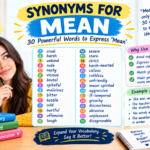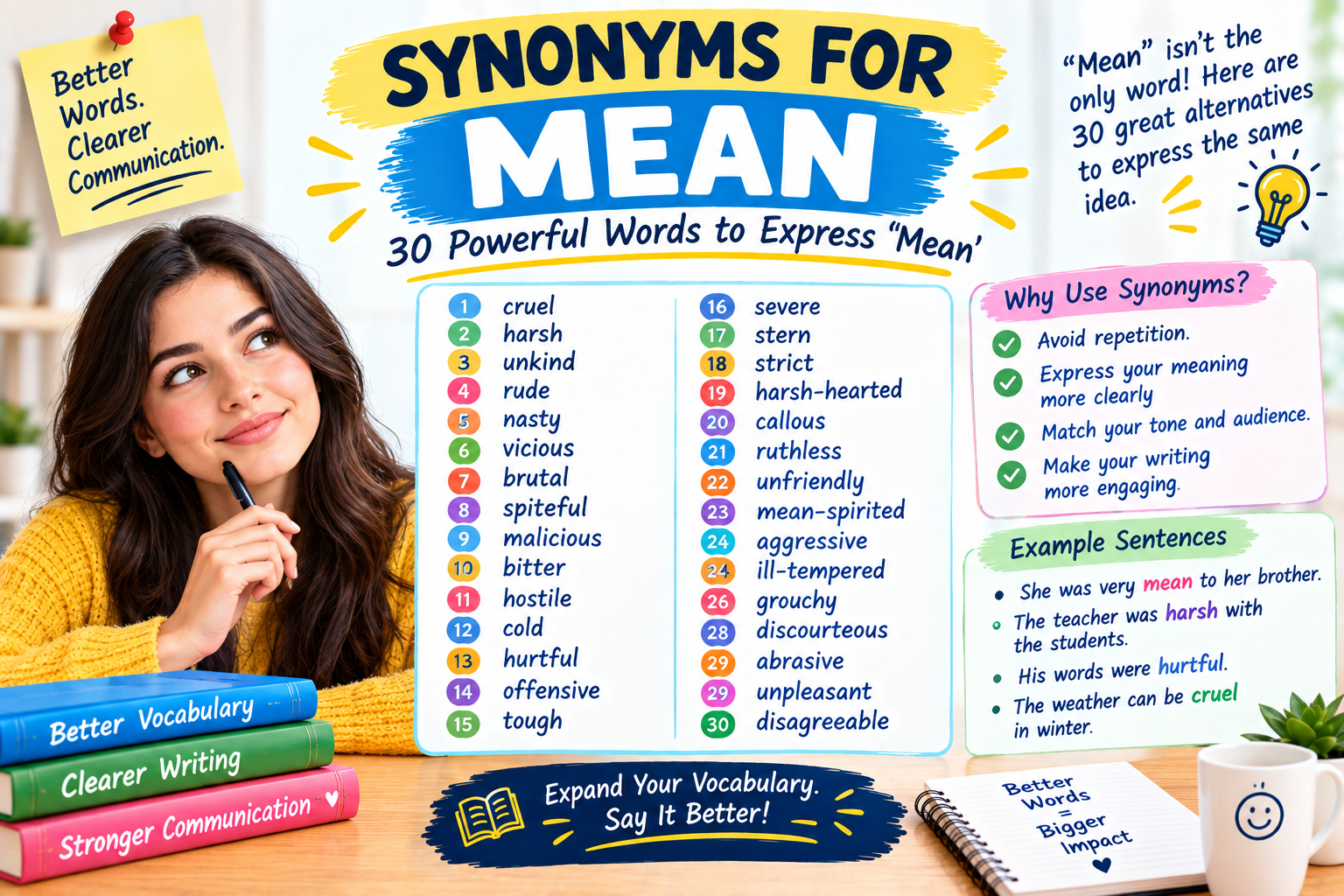
Synonyms for mean include unkind, cruel, nasty, signify, indicate, imply, intend, denote, average, ordinary, and stingy, depending on the meaning.
Mean is a common English word with several meanings. You might say, “She was mean to her brother,” when someone is unkind. You can also ask, “What does this word mean?” when you want to know its definition. In math, mean refers to an average, while in another context, it can describe someone who is unwilling to spend money.
Because mean has many uses, English learners can sometimes find it confusing. Learning its synonyms helps you choose a more exact word for each situation. For example, cruel is stronger than unkind, while signify is more formal than mean when discussing meaning. This guide explains the meaning, grammar, history, pronunciation, word forms, and synonyms of mean. It also explores its different semantic categories with clear examples.
Meaning of Mean
Definition
Mean (Verb/Adjective/Noun):
Mean can mean to signify something, intend something, behave unkindly, represent an average, or describe someone who is unwilling to give or spend.
Examples
- What does this sentence mean?
- He did not mean to hurt your feelings.
Connotative Meaning
Connotation means the feeling or idea that a word suggests beyond its basic dictionary meaning.
- Positive tone: Mean can have a neutral or positive sense when it means “intend” or “signify.”
- Negative tone: Mean often has a negative tone when it describes an unkind, cruel, or stingy person.
- Neutral tone: In mathematics, mean is neutral because it refers to an average value.
Etymology
The modern word mean comes from more than one historical source because its different meanings developed from different words.
- Old English (450–1100): The verb mean developed from Old English mænan, meaning “to mean, intend, signify, or tell of.”
- Middle English (1100–1500): Forms such as menen and meenen were used for intending, signifying, or expressing something.
- Modern English (1500–Present): Mean developed several distinct uses, including “intend,” “signify,” “unkind,” and the mathematical sense of “average.”
Pronunciation (IPA)
- IPA: /miːn/
- Syllables: mean
Affixation Pattern of Mean
- Root: mean
- Prefix: None
- Suffix: None in the basic word
- Word formations:
- mean — verb, adjective, noun
- meaning — noun/adjective
- meant — past tense and past participle of mean
- meaningful — adjective
- meaningfully — adverb
- meaningfulness — noun
- meaningless — adjective
- meaninglessly — adverb
- meaninglessness — noun
- meaner — comparative adjective
- meanest — superlative adjective
31 Synonyms of Mean With Meaning & Examples
1. Unkind (Adjective)
Meaning: Not caring about another person’s feelings or causing them hurt.
Examples:
- It was unkind to laugh at his mistake.
- Her unkind words upset her friend.
2. Cruel (Adjective)
Meaning: Deliberately causing pain or suffering to someone or something.
Examples:
- The bully was cruel to the younger students.
- It was cruel to treat the animal that way.
3. Nasty (Adjective)
Meaning: Very unpleasant, rude, or unkind.
Examples:
- He made a nasty comment about her work.
- The argument became nasty.
4. Harsh (Adjective)
Meaning: Unpleasantly severe, critical, or unkind.
Examples:
- The teacher’s words sounded harsh.
- Try not to be too harsh with yourself.
5. Rude (Adjective)
Meaning: Not showing good manners or respect.
Examples:
- It was rude to interrupt her.
- His rude behavior surprised everyone.
6. Spiteful (Adjective)
Meaning: Wanting to hurt or upset someone because of anger or resentment.
Examples:
- His spiteful remark caused an argument.
- She refused to make a spiteful comment.
7. Malicious (Adjective)
Meaning: Intending to cause harm or trouble.
Examples:
- The website contained a malicious message.
- He made a malicious accusation against his rival.
8. Unpleasant (Adjective)
Meaning: Not enjoyable, friendly, or pleasant.
Examples:
- The manager became unpleasant during the meeting.
- We had an unpleasant conversation.
9. Hostile (Adjective)
Meaning: Unfriendly or openly aggressive.
Examples:
- His hostile attitude made discussion difficult.
- The customer became hostile after the delay.
10. Insensitive (Adjective)
Meaning: Not showing enough care for another person’s feelings.
Examples:
- His joke was insensitive.
- That comment sounded insensitive to people who were affected.
11. Callous (Adjective)
Meaning: Showing little concern for the feelings or suffering of others.
Examples:
- His callous response shocked everyone.
- The decision seemed callous to the workers.
12. Wicked (Adjective)
Meaning: Very bad, evil, or morally wrong.
Examples:
- The story describes a wicked character.
- The villain had a wicked plan.
13. Stingy (Adjective)
Meaning: Unwilling to spend or give money.
Examples:
- He is too stingy to buy a new coat.
- Don’t be stingy with your time.
14. Miserly (Adjective)
Meaning: Extremely unwilling to spend or give money.
Examples:
- The miserly man refused to help.
- His miserly habits annoyed his family.
15. Cheap (Adjective)
Meaning: Unwilling to spend money or, in some contexts, lacking quality or value.
Examples:
- He is too cheap to pay for the service.
- That was a cheap trick.
16. Signify (Verb)
Meaning: To represent or communicate a particular meaning.
Examples:
- A red light can signify danger.
- The symbol signifies peace.
17. Indicate (Verb)
Meaning: To show or point to a particular meaning, fact, or condition.
Examples:
- The results indicate strong growth.
- Dark clouds indicate that rain may be coming.
18. Denote (Verb)
Meaning: To directly represent or stand for something.
Examples:
- The word denotes a specific action.
- This symbol denotes a warning.
19. Imply (Verb)
Meaning: To suggest an idea without saying it directly.
Examples:
- His silence seemed to imply agreement.
- Are you trying to imply that I was wrong?
20. Express (Verb)
Meaning: To communicate a thought, feeling, or idea.
Examples:
- These words express gratitude.
- She used a smile to express happiness.
21. Convey (Verb)
Meaning: To communicate or make an idea or feeling understood.
Examples:
- The painting conveys a sense of peace.
- His voice conveyed confidence.
22. Represent (Verb)
Meaning: To stand for or show something.
Examples:
- The dove represents peace.
- These figures represent the company’s sales.
23. Intend (Verb)
Meaning: To have a particular purpose or plan in your mind.
Examples:
- I did not intend to upset you.
- We intend to finish the project today.
24. Purpose (Noun)
Meaning: The reason why something is done or created.
Examples:
- What is the purpose of this tool?
- The purpose of the meeting is to plan the project.
25. Average (Noun)
Meaning: A number found by adding values together and dividing by the number of values.
Examples:
- The average of 10 and 20 is 15.
- Her test score was above the average.
26. Median (Noun)
Meaning: The middle value in an ordered set of numbers.
Examples:
- The median income increased this year.
- Find the median of these five numbers.
27. Ordinary (Adjective)
Meaning: Normal and not special or unusual.
Examples:
- He is an ordinary student with strong goals.
- It looked like an ordinary day.
28. Moderate (Adjective)
Meaning: Average in amount, size, strength, or degree.
Examples:
- The company experienced moderate growth.
- She has a moderate level of experience.
29. Average (Adjective)
Meaning: Typical rather than unusually good, bad, large, or small.
Examples:
- He is an average student.
- The movie received average reviews.
30. Mediocre (Adjective)
Meaning: Only average in quality and not very impressive.
Examples:
- The restaurant served mediocre food.
- His performance was mediocre.
31. Mean (Mathematical Average) (Noun)
Meaning: A mathematical average calculated by adding values and dividing the total by their number.
Examples:
- The mean of 4, 6, and 8 is 6.
- Calculate the mean before comparing the results.
Prototype Meaning
The most familiar meaning of mean depends on the context. In everyday conversation, many people first connect mean with being unkind or unpleasant. For example, calling someone “mean” usually suggests that the person has behaved badly toward another person. However, mean is also very common as a verb meaning “to signify” or “to intend,” as in “What does this mean?” or “I didn’t mean to hurt you.” In mathematics, mean has the specific meaning of an average.
Prototype Categorization
The 31 synonyms can be grouped into several semantic categories:
- Unkind behavior: unkind, cruel, nasty, harsh, rude, spiteful — these describe people, words, or actions that can hurt others.
- Strong negative behavior: malicious, hostile, callous, wicked, insensitive — these suggest harmful, aggressive, or uncaring behavior.
- Unwilling to spend: stingy, miserly, cheap — these describe a person who does not like giving or spending money.
- Meaning or significance: signify, indicate, denote, imply — these are useful when mean refers to what something communicates or suggests.
- Communication: express, convey, represent — these describe ways of communicating an idea, feeling, or message.
- Intention and purpose: intend, purpose — these relate to what someone plans or wants to achieve.
- Mathematical average: average, median, mean — these are used in mathematics and statistics, although they do not all have exactly the same mathematical meaning.
- Typical or average quality: ordinary, moderate, average, mediocre — these describe something that is normal or not especially outstanding.
This categorization helps writers select a synonym based on context. Cruel fits harmful behavior, signify fits formal discussions of meaning, and intend fits someone’s purpose or plan.
Antonyms of Mean
The correct antonym depends on which meaning of mean is being used.
- Kind (Adjective): Caring, friendly, and considerate toward others.
- Nice (Adjective): Pleasant and friendly.
- Generous (Adjective): Willing to give money, time, or help.
- Compassionate (Adjective): Showing concern for people who are suffering.
- Clear (Adjective): Easy to understand or interpret.
- Explain (Verb): To make an idea or meaning clear.
- Misunderstand (Verb): To understand something incorrectly.
- Specific (Adjective): Clearly defined rather than general or vague.
- Maximum (Noun/Adjective): The greatest possible amount or value, contrasted with a mathematical minimum rather than the mean itself.
Short Questions and Answers
What does mean mean?
Mean has several meanings. It can describe unkind behavior, express what something signifies, show someone’s intention, or refer to a mathematical average.
When should mean be used?
Use mean when you want to talk about meaning, intention, unkind behavior, or a mathematical average. Always consider the context.
Is mean positive or negative?
It depends on its use. Mean is negative when it describes unkind behavior. It is neutral when it means “signify,” “intend,” or “mathematical average.”
How is it different from similar words?
The synonym depends on the meaning. Unkind describes behavior, signify describes meaning, intend describes purpose, and average describes a mathematical value or typical level.
Conclusion
Learning the synonyms of mean can greatly improve your English vocabulary because this small word has many different uses. You can use unkind, cruel, rude, or harsh when describing negative behavior. For meaning or communication, words such as signify, indicate, imply, and convey are useful. When talking about intention, intend is often the better choice.
Understanding these differences helps you avoid repetition and choose words that express your exact idea. It also makes your writing clearer and your speech more natural. English learners can build confidence by studying a few synonyms each day and using them in real sentences. The more you practice context-based vocabulary, the easier it becomes to select the right word.
SEO Meta Description
Explore synonyms for mean with 31 simple alternatives, meanings, examples, antonyms, pronunciation, etymology, and useful context-based vocabulary.

Olivia Wordsmith is a passionate vocabulary writer who loves exploring words, meanings, and their everyday use.
She creates clear, engaging content to help readers expand their vocabulary and communicate with confidence.