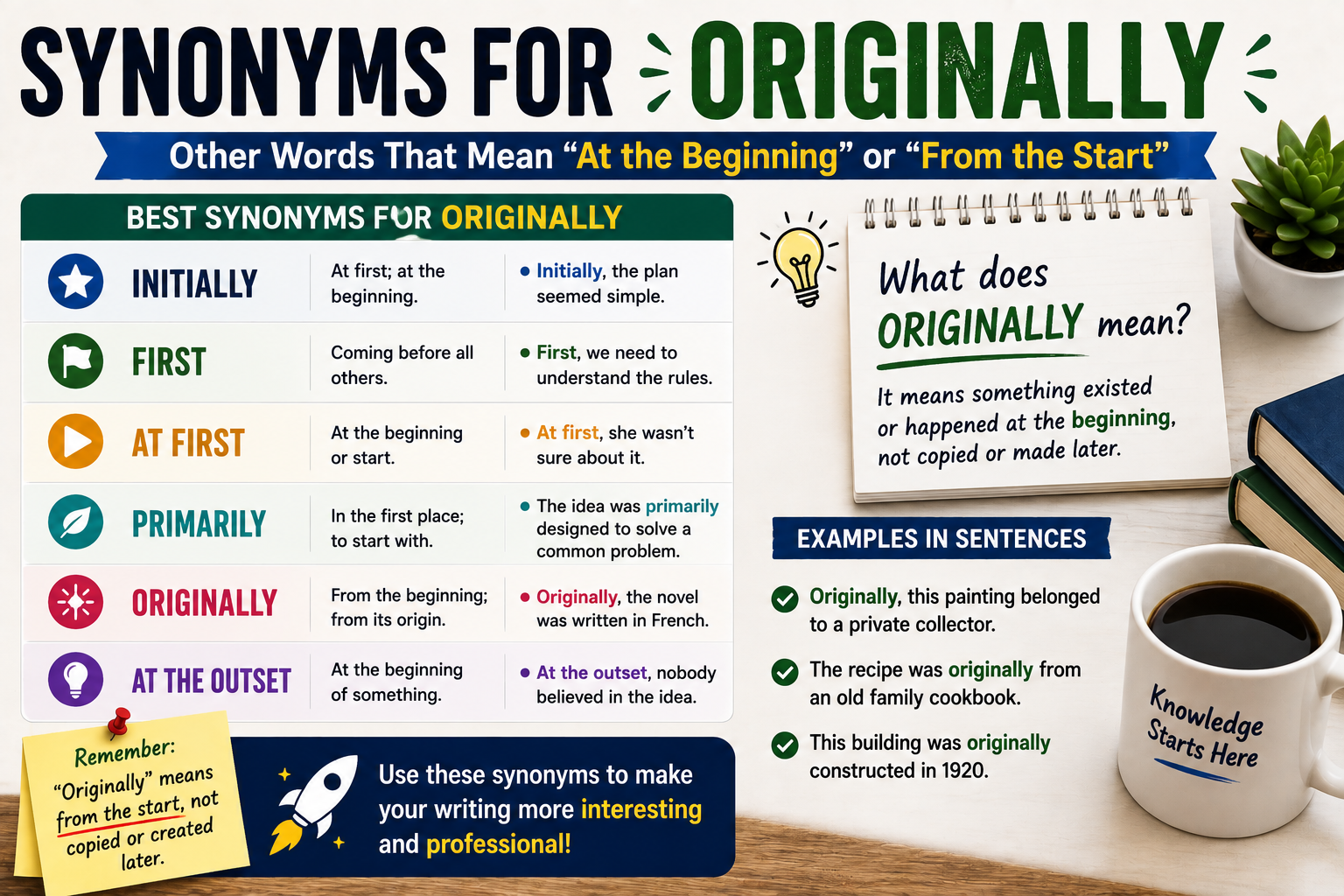
Use alternatives like initially, at first, formerly, in the beginning, and from the start to express something’s first or earliest state.
Originally means at first, from the beginning, or in its first form or place. Imagine a small café that originally opened as a family bakery. Years later, it becomes a popular restaurant, but its first purpose was different. You can say, “The building was originally a bakery.”
The word is common in everyday speech, academic writing, history, business, and storytelling. However, repeating originally too often can make writing sound dull. Learning synonyms for originally helps English learners and content writers express time, beginnings, and first purposes more clearly. Some alternatives focus on the beginning of an event, while others describe an earlier state or former purpose.
This guide explains the meaning, grammar, history, pronunciation, and 30 useful alternatives to originally, with simple examples and semantic categories to help you choose the right word.
Meaning of Originally
Definition
Originally (Adverb):
At first, from the beginning, or in the first form, place, or condition of something.
Examples
- The building was originally a small school.
- She originally planned to study medicine.
Connotative Meaning
Connotation: The feeling or idea a word suggests beyond its basic meaning.
- Positive tone: Can suggest authenticity, history, or a genuine beginning.
- Negative tone: May sometimes highlight that something has changed from its first state.
- Neutral tone: Simply describes what was true at the beginning or in the past.
Etymology
The word originally comes from original, which comes through Old French from Latin originalis, meaning “of the beginning” or “of the source.” The Latin word is related to origo, meaning “beginning,” “source,” or “origin.”
- Old English (450–1100): English did not have the modern word originally. Ideas about beginnings were expressed with native words such as those related to “first,” “beginning,” and “source.”
- Middle English (1100–1500): French and Latin greatly influenced English vocabulary. Words related to original entered English through French and developed meanings connected with beginnings and sources.
- Modern English (1500–Present): Original became established as an adjective and noun. The suffix -ly formed the adverb originally, meaning “in the beginning” or “in the first form.”
Pronunciation (IPA)
- IPA: /əˈrɪdʒənəli/
- Syllables: o-rig-i-nal-ly (5 syllables)
Affixation Pattern of Originally
- Root: origin
- Prefix: None in the modern English formation
- Suffix: -al + -ly
- Word formations:
- origin — noun: the beginning or source of something
- original — adjective: existing first or serving as the source
- originality — noun: the quality of being new or original
- originally — adverb: at first or in the beginning
- originate — verb: to begin or come from a source
- origination — noun: the act or process of beginning
30 Synonyms of Originally With Meaning & Examples
1. Initially (Adverb)
Meaning: At the beginning of a situation or process.
Examples:
- The project was initially planned for June.
- She initially rejected the offer.
2. At First (Adverbial Phrase)
Meaning: During the first part of a situation.
Examples:
- At first, I did not understand the idea.
- The job seemed difficult at first.
3. In the Beginning (Adverbial Phrase)
Meaning: At the earliest stage of something.
Examples:
- In the beginning, the company had only three employees.
- In the beginning, he found the new system confusing.
4. At the Start (Adverbial Phrase)
Meaning: At the point when something begins.
Examples:
- At the start, the team had very little information.
- We had different goals at the start.
5. First (Adverb)
Meaning: Before other events or actions.
Examples:
- She first worked as a teacher.
- The building was first used as a hospital.
6. Formerly (Adverb)
Meaning: In the past, especially when something has changed.
Examples:
- The building was formerly a train station.
- He was formerly the company’s director.
7. Previously (Adverb)
Meaning: Before the present time or before another event.
Examples:
- She had previously worked in London.
- The site was previously used as a warehouse.
8. Earlier (Adverb)
Meaning: At a time before the present or another stated time.
Examples:
- We had earlier discussed the problem.
- He had earlier planned to leave.
9. Inceptionally (Adverb)
Meaning: In relation to the beginning or inception of something.
Examples:
- The plan was different inceptionally from its final form.
- The project changed greatly after its early stages.
Note: This is rare and is not a natural replacement for originally in most everyday writing.
10. Historically (Adverb)
Meaning: In relation to the past or historical development of something.
Examples:
- The area has historically been an important trade center.
- The city was historically known for its markets.
11. Traditionally (Adverb)
Meaning: According to long-established customs or practices.
Examples:
- The dish was traditionally prepared by hand.
- The festival is traditionally held in spring.
12. Once (Adverb)
Meaning: At some time in the past.
Examples:
- The building was once a theater.
- She once lived in Spain.
13. Formerly Known As (Phrase)
Meaning: Used to describe an earlier name of a person, place, or organization.
Examples:
- The company was formerly known as GreenTech.
- The street was formerly known as King Road.
14. At the Outset (Adverbial Phrase)
Meaning: At the very beginning of something.
Examples:
- At the outset, the plan seemed simple.
- We identified the main problem at the outset.
15. From the Outset (Adverbial Phrase)
Meaning: From the very beginning.
Examples:
- She supported the project from the outset.
- The team knew the risks from the outset.
16. In Its Early Days (Adverbial Phrase)
Meaning: During the early period of something.
Examples:
- The company was small in its early days.
- The website had few visitors in its early days.
17. In Its Infancy (Adverbial Phrase)
Meaning: During the earliest stage of development.
Examples:
- The technology was still in its infancy.
- Online shopping was in its infancy at that time.
18. From the Beginning (Adverbial Phrase)
Meaning: Starting from the first point.
Examples:
- She was involved from the beginning.
- We knew about the problem from the beginning.
19. At the Beginning (Adverbial Phrase)
Meaning: At the first stage of an event or process.
Examples:
- At the beginning, the task seemed easy.
- At the beginning of the year, sales were low.
20. First of All (Adverbial Phrase)
Meaning: Before anything else.
Examples:
- First of all, we need to understand the problem.
- First of all, check that the information is correct.
21. In Origin (Adverbial Phrase)
Meaning: In terms of where something first came from.
Examples:
- The word is French in origin.
- The tradition is Asian in origin.
22. By Origin (Adverbial Phrase)
Meaning: According to the original source or background of something.
Examples:
- The family is Irish by origin.
- The plant is tropical by origin.
23. From Its Origin (Adverbial Phrase)
Meaning: Starting from the original source or beginning.
Examples:
- The custom has changed from its origin.
- The idea was different from its origin to its final version.
24. In Its Original Form (Adverbial Phrase)
Meaning: In the form something had when it first existed.
Examples:
- The building remains partly preserved in its original form.
- The recipe was much simpler in its original form.
25. As First Designed (Adverbial Phrase)
Meaning: In the way something was first planned or created.
Examples:
- The product was smaller as first designed.
- The system worked differently as first designed.
26. At Its Origin (Adverbial Phrase)
Meaning: At the point when something first began or developed.
Examples:
- The movement was small at its origin.
- The organization had different goals at its origin.
27. At Its Inception (Adverbial Phrase)
Meaning: At the time something was first created or started.
Examples:
- The company had five employees at its inception.
- The project was much smaller at its inception.
28. In Earlier Times (Adverbial Phrase)
Meaning: During a period in the past.
Examples:
- In earlier times, people traveled mainly by horse.
- The area was quieter in earlier times.
29. In Former Times (Adverbial Phrase)
Meaning: In a past period.
Examples:
- In former times, the building served as a school.
- In former times, the village was much smaller.
30. At the Very Beginning (Adverbial Phrase)
Meaning: At the earliest possible stage.
Examples:
- We identified the issue at the very beginning.
- She joined the organization at the very beginning.
Note: These alternatives are not all interchangeable in every sentence. Words such as initially, at first, formerly, and previously are often the closest replacements. Other phrases describe more specific ideas, such as origin, history, or an early stage.
Prototype Meaning
The most typical meaning of originally is “at first” or “in the beginning.” When people hear this word, they often imagine an earlier version, plan, purpose, location, or situation that later changed. For example, if a building was originally a school, people understand that it had a different purpose in the past.
Prototype Categorization
The 30 synonyms can be grouped into useful semantic categories:
- Beginning and first stage: initially, at first, in the beginning, at the start, first, at the outset, from the outset, from the beginning, at the beginning, at the very beginning. These are best when describing when something started.
- Past states: formerly, previously, earlier, once, in earlier times, in former times. These work well when something was true in the past but may not be true now.
- Origin and source: in origin, by origin, from its origin, at its origin. These focus on where something came from.
- Early development: in its early days, in its infancy, at its inception. These are useful when describing the first period of a project, company, idea, or movement.
- Original form or design: in its original form, as first designed. These focus on how something looked or worked when it was first created.
- Historical or traditional context: historically, traditionally. These are useful when discussing long-term patterns, customs, and historical facts.
- Sequence and priority: first of all. This is mainly used to show that one action or point comes before another.
This categorization helps writers choose a synonym based on the exact meaning they want. Initially emphasizes the first stage, formerly emphasizes a past state, and in origin emphasizes a source.
Antonyms of Originally
1. Subsequently (Adverb)
Meaning: After something else happened.
2. Eventually (Adverb)
Meaning: At a later time, especially after a process or period.
3. Finally (Adverb)
Meaning: At the end of a process or sequence.
4. Later (Adverb)
Meaning: At a time after the present or after another event.
5. Ultimately (Adverb)
Meaning: In the end or after everything has been considered.
6. Recently (Adverb)
Meaning: Not long ago.
Short Questions and Answers
What does synonyms for originally mean?
It refers to words and phrases that can replace originally when describing something that happened first, existed in an earlier form, or came from a particular source.
When should originally be used?
Use originally when you want to explain what was true at the beginning or what something was like before it changed.
Is originally positive or negative?
Originally is neutral. It does not have a strong positive or negative feeling. The surrounding sentence creates the tone.
How is originally different from similar words?
Originally is broad and can describe a first state, purpose, or plan. Initially focuses on the early stage, formerly emphasizes a past state, and previously means before a particular time or event.
Conclusion
Learning synonyms for originally can make your English more flexible and precise. Instead of repeating originally, you can choose a word or phrase that matches the exact idea. Initially works well for the first stage of a process, formerly describes an earlier state, and previously shows that something happened before another time or event.
Understanding these small differences can strengthen both speaking and writing. It also helps content writers create smoother articles and helps English learners express ideas with greater confidence. Remember that some alternatives are phrases rather than exact synonyms, so always consider the context before replacing originally.
Practice one new alternative each day. Write a few sentences, say them aloud, and compare the meanings. Regular vocabulary practice will help you avoid repetition, improve word choice, strengthen communication skills, and build lasting confidence in English.

Sophia Lexicon is a passionate language writer who explores words, meanings, and synonyms in simple, engaging ways.
Through her work, she helps readers build stronger vocabulary and communicate with confidence.