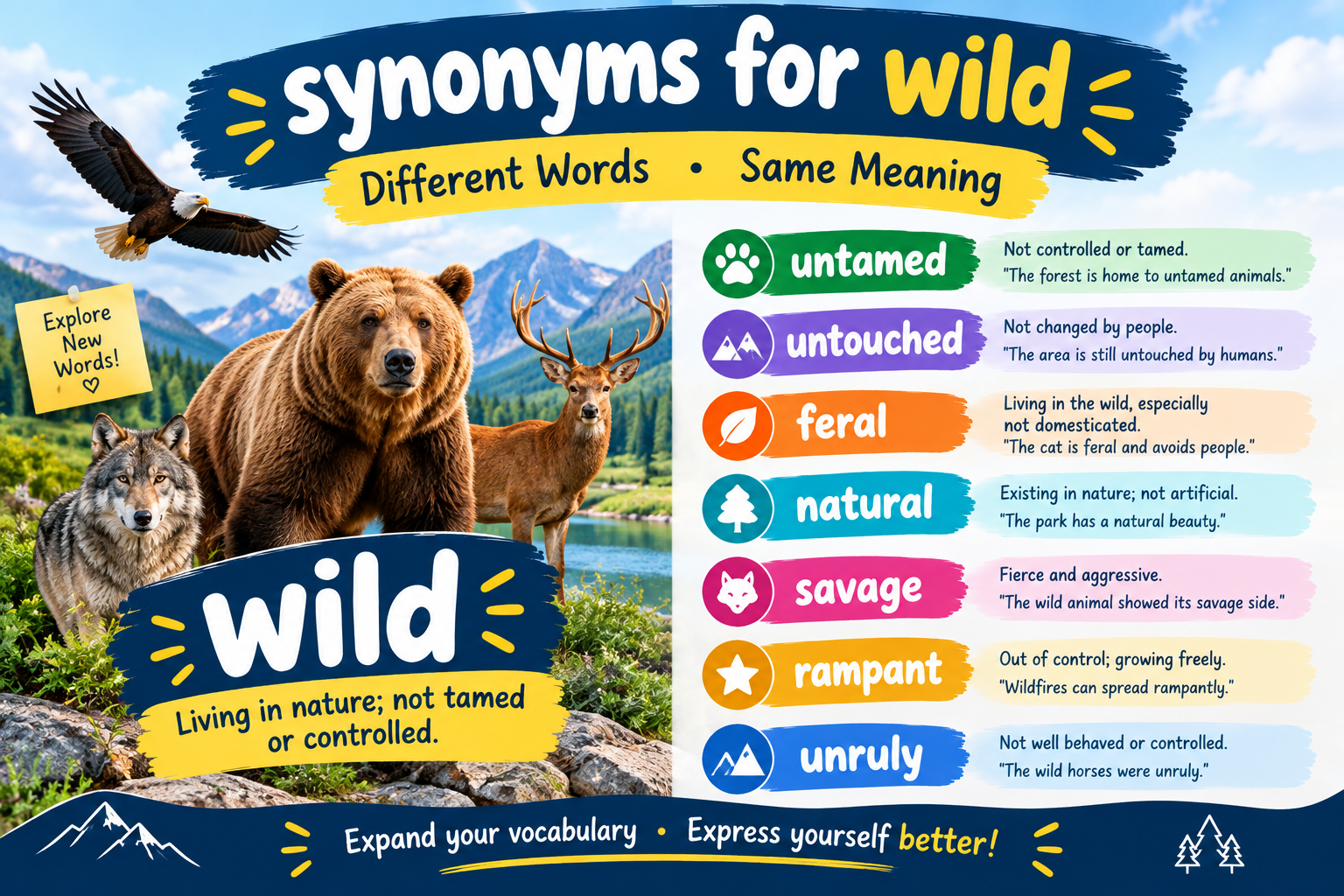
Wild means something that is not controlled, tame, calm, or usual. Imagine seeing a wild animal in a forest. It moves freely and follows its natural instincts instead of living under human control.
The word can also describe a wild party, wild weather, or a wild idea. Because it can describe many different situations, wild is a common and useful English word. However, using the same word again and again can make your writing feel dull. Learning synonyms for wild helps English learners, students, and content writers express ideas more clearly and accurately. Some alternatives describe nature, while others show excitement, disorder, freedom, or unusual behavior. In this guide, you will learn the meaning, history, pronunciation, grammar, and 30 useful synonyms for wild, along with examples and semantic categories to help you choose the right word.
Meaning of Wild
Definition
Wild (Adjective, Noun, Verb):
Wild means living or existing naturally without human control, or behaving in an uncontrolled, exciting, unusual, or disorderly way.
As a noun, the wild can mean a natural place where animals live freely. As a verb, wild is less common and usually appears in compounds or related forms.
Examples
- We saw a wild deer near the forest.
- The children became wild after eating too much candy.
Connotative Meaning
Connotation means the feelings or ideas that a word suggests beyond its basic meaning.
- Positive tone: Wild can suggest freedom, adventure, energy, and excitement.
- Negative tone: It can suggest disorder, danger, violence, or lack of control.
- Neutral tone: It can simply describe animals, plants, or places that exist naturally without human control.
Etymology
The word wild has a long history in English and is closely linked to nature and freedom.
- Old English (450–1100): Wild came from Old English wilde, meaning untamed, uncontrolled, or living in a natural state.
- Middle English (1100–1500): The word continued as forms such as wilde and was used for animals, land, and people who behaved without restraint.
- Modern English (1500–Present): Its meaning expanded. Today, wild can describe nature, behavior, emotions, events, ideas, weather, and experiences.
Pronunciation (IPA)
- IPA: /waɪld/
- Syllables: wild (1 syllable)
Affixation Pattern of Wild
- Root: wild
- Prefix: None in the basic word
- Suffix: None in the basic word
Word Formations
- wild — adjective/noun
- wilds — plural noun
- wildly — adverb
- wildness — noun
- wilder — comparative adjective
- wildest — superlative adjective
- wilderness — noun
- wildflower — noun
- wildlife — noun
- wildfire — noun
- wildland — noun
- wilding — noun/verb form in specific contexts
30 Synonyms of Wild With Meaning & Examples
1. Untamed (Adjective)
Meaning: Not controlled, trained, or changed by humans.
Examples:
- The park is home to several untamed animals.
- They explored an untamed part of the forest.
2. Uncontrolled (Adjective)
Meaning: Not controlled or kept within limits.
Examples:
- The fire quickly became uncontrolled.
- His anger seemed uncontrolled.
3. Feral (Adjective)
Meaning: Living in a wild state, especially after coming from domesticated animals.
Examples:
- A feral cat lives behind the building.
- The island has a population of feral goats.
4. Savage (Adjective)
Meaning: Extremely violent, fierce, or aggressive.
Examples:
- The animal gave a savage growl.
- The battle was unusually savage.
5. Fierce (Adjective)
Meaning: Very strong, powerful, or aggressive.
Examples:
- A fierce storm hit the coast.
- The two teams had a fierce competition.
6. Untamed (Adjective)
Meaning: Existing naturally without being trained or controlled.
Examples:
- The horses were beautiful but untamed.
- They traveled through an untamed region.
7. Unruly (Adjective)
Meaning: Difficult to control or manage.
Examples:
- The teacher struggled with an unruly class.
- The crowd became unruly after the announcement.
8. Disorderly (Adjective)
Meaning: Lacking order, organization, or control.
Examples:
- The room was left disorderly after the party.
- Police asked the disorderly crowd to move back.
9. Chaotic (Adjective)
Meaning: Completely confused, disorganized, or difficult to control.
Examples:
- The traffic was chaotic after the accident.
- The meeting became chaotic when everyone started talking.
10. Frenzied (Adjective)
Meaning: Extremely excited, active, or uncontrolled.
Examples:
- Fans made a frenzied rush toward the stage.
- The market was frenzied after the news.
11. Unrestrained (Adjective)
Meaning: Not limited, controlled, or held back.
Examples:
- She showed unrestrained excitement.
- His laughter was unrestrained.
12. Reckless (Adjective)
Meaning: Acting without thinking about danger or consequences.
Examples:
- His reckless driving worried everyone.
- They made a reckless decision.
13. Impulsive (Adjective)
Meaning: Acting suddenly without careful thought.
Examples:
- Buying the expensive phone was impulsive.
- She made an impulsive choice.
14. Crazy (Adjective)
Meaning: Very unusual, exciting, extreme, or difficult to believe in informal English.
Examples:
- We had a crazy night at the festival.
- That was a crazy idea, but it worked.
15. Unusual (Adjective)
Meaning: Different from what is normal or expected.
Examples:
- The artist has an unusual style.
- We experienced some unusual weather.
16. Strange (Adjective)
Meaning: Unusual or difficult to understand.
Examples:
- There was a strange sound outside.
- He had a strange dream last night.
17. Bizarre (Adjective)
Meaning: Very strange or unusual.
Examples:
- The movie had a bizarre ending.
- She told us a bizarre story.
18. Unpredictable (Adjective)
Meaning: Likely to change suddenly or behave in an unexpected way.
Examples:
- The weather is unpredictable this week.
- His unpredictable behavior surprised us.
19. Boisterous (Adjective)
Meaning: Very noisy, energetic, and cheerful.
Examples:
- The children were boisterous during the game.
- A boisterous crowd filled the stadium.
20. Rowdy (Adjective)
Meaning: Noisy, energetic, and sometimes difficult to control.
Examples:
- A rowdy group entered the restaurant.
- The fans became rowdy after the match.
21. Spirited (Adjective)
Meaning: Full of energy, enthusiasm, or confidence.
Examples:
- The students had a spirited discussion.
- She gave a spirited performance.
22. Lively (Adjective)
Meaning: Full of energy, activity, and excitement.
Examples:
- The market was lively in the evening.
- They enjoyed a lively conversation.
23. Energetic (Adjective)
Meaning: Having or showing a lot of energy.
Examples:
- The puppy is extremely energetic.
- She is an energetic speaker.
24. Free (Adjective)
Meaning: Not controlled, restricted, or limited.
Examples:
- The horses were running free across the field.
- He wanted to live free from strict rules.
25. Natural (Adjective)
Meaning: Existing in nature rather than being made or controlled by people.
Examples:
- The area has many natural habitats.
- They prefer natural landscapes.
26. Primitive (Adjective)
Meaning: Relating to an early or undeveloped state.
Examples:
- The explorers found a primitive shelter.
- The village used primitive tools.
27. Lawless (Adjective)
Meaning: Not controlled by laws or rules.
Examples:
- The region became almost lawless during the conflict.
- The story takes place in a lawless town.
28. Rampant (Adjective)
Meaning: Spreading or increasing quickly without enough control.
Examples:
- Rampant rumors caused confusion.
- The area suffered from rampant corruption.
29. Abandoned (Adjective)
Meaning: Left without care, control, or people.
Examples:
- They discovered an abandoned building in the woods.
- An abandoned garden had become overgrown.
30. Unbridled (Adjective)
Meaning: Not controlled or limited.
Examples:
- The team celebrated with unbridled joy.
- His unbridled enthusiasm inspired the group.
Prototype Meaning
The most typical meaning of wild is something that is untamed and free from human control. When people hear the word, they may imagine a wild animal such as a lion, wolf, or deer living in a forest. The word can also bring ideas of freedom, danger, excitement, energy, and unpredictability. Its exact meaning depends strongly on context.
Prototype Categorization
The 30 synonyms above can be grouped into semantic categories. This helps writers choose a word that matches the exact idea they want to express.
- Nature and lack of human control: untamed, feral, free, natural, primitive, abandoned. These words work well when discussing animals, land, habitats, or natural environments.
- Lack of control and disorder: uncontrolled, unruly, disorderly, chaotic, unrestrained, lawless. These are useful for situations involving poor organization or weak control.
- Violence and aggression: savage, fierce, reckless. These words are stronger and often suggest danger, aggression, or risky behavior.
- Excitement and energy: frenzied, boisterous, spirited, lively, energetic, rowdy. These are useful when describing people, crowds, celebrations, or active environments.
- Unusual behavior or ideas: crazy, unusual, strange, bizarre, unpredictable. These words describe things that differ from normal expectations.
- Fast growth or uncontrolled spread: rampant. This works especially well for problems, trends, rumors, or negative conditions that spread quickly.
- Strong emotion without restraint: unbridled. This is useful for intense feelings such as joy, enthusiasm, anger, or excitement.
Choosing a synonym from the correct category makes writing more precise. For example, lively sounds positive, while chaotic usually suggests confusion. Both can describe an active situation, but they create very different impressions.
Antonyms of Wild
Calm (Adjective)
Not excited, angry, noisy, or uncontrolled.
Tame (Adjective)
Trained or accustomed to living with people.
Controlled (Adjective)
Managed or kept within clear limits.
Orderly (Adjective)
Well organized and properly arranged.
Peaceful (Adjective)
Quiet, calm, and free from conflict.
Domestic (Adjective)
Kept or raised by people rather than living naturally in the wild.
Restrained (Adjective)
Controlled and prevented from becoming excessive.
Predictable (Adjective)
Likely to happen or behave in an expected way.
Civilized (Adjective)
Organized according to accepted social rules and customs.
Gentle (Adjective)
Kind, calm, and not aggressive.
Short Questions and Answers
What does wild mean?
Wild usually means not domesticated, controlled, or restricted. It can also describe something very exciting, unusual, energetic, or disorderly.
When should wild be used?
Use wild when describing untamed animals or natural places. It can also describe behavior, events, weather, ideas, emotions, or situations that are extreme or uncontrolled.
Is wild positive or negative?
Wild can be positive, negative, or neutral. A wild adventure may sound exciting, while wild behavior may suggest poor control. A wild animal can simply mean an animal living naturally.
How is wild different from similar words?
The best synonym depends on context. Untamed focuses on lack of human control, chaotic focuses on disorder, lively suggests positive energy, and fierce suggests strength or aggression.
Conclusion
Learning wild and its synonyms can make your English more precise, natural, and interesting. Instead of using wild for every situation, you can choose words such as untamed, chaotic, lively, fierce, unusual, unpredictable, or unrestrained based on your meaning. This helps you avoid repetition and express your thoughts with greater accuracy. For English learners, synonyms also build vocabulary and make speaking easier. For students and content writers, they can make descriptions clearer and more engaging. The key is to learn each synonym with its meaning and context rather than simply memorizing a word list. Practice a few new words every day, use them in your own sentences, and soon you will feel more confident using a wider range of English vocabulary.

Emma Collins is an English language expert and vocabulary writer with a passion for making English easier to understand. She specializes in synonyms, word meanings, word choice, and clear writing tips.