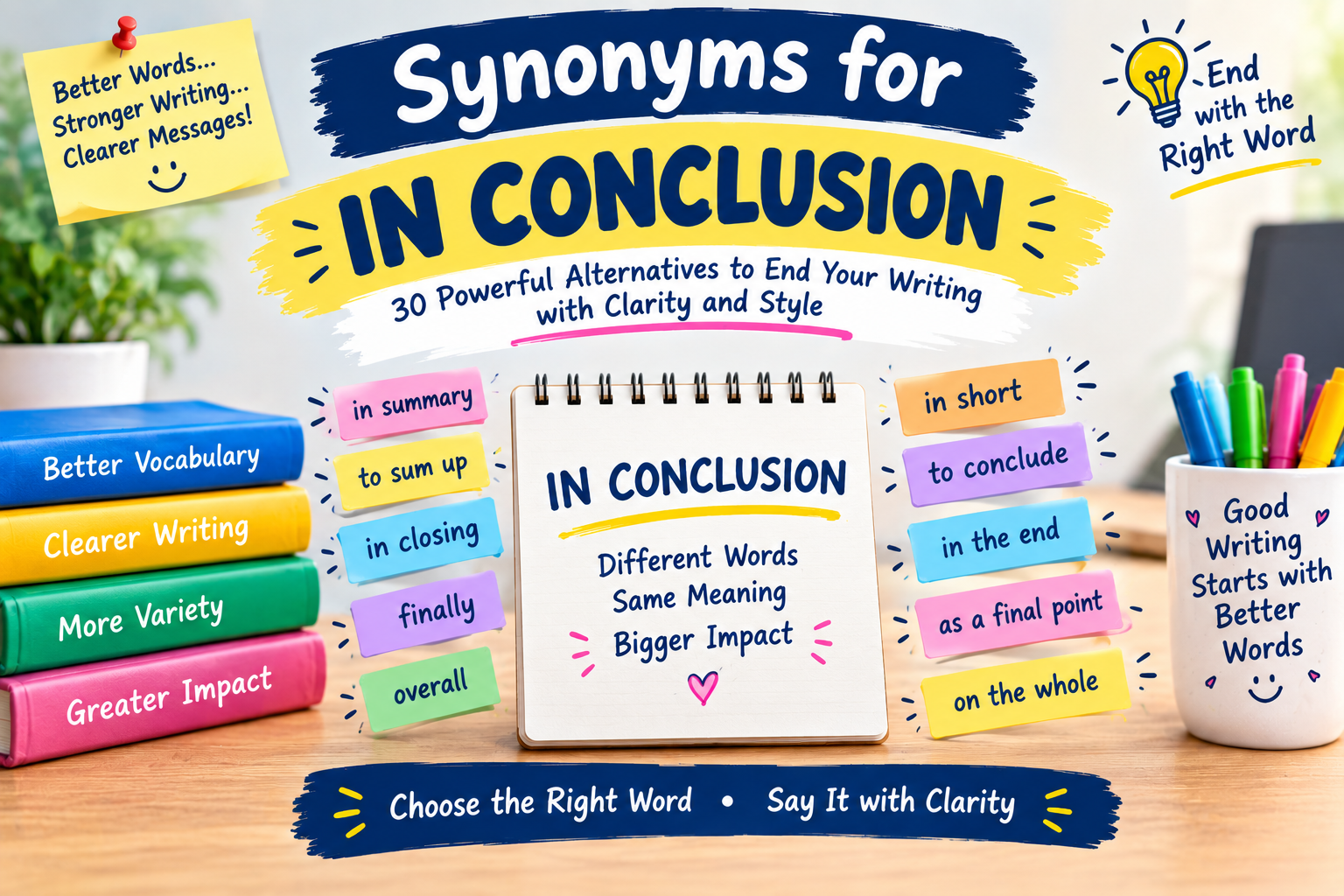
In conclusion is a phrase used to signal the final part of an essay, speech, article, or discussion. For example, after explaining the benefits of reading, a student may write, “In conclusion, reading every day can improve vocabulary and knowledge.”
The phrase is common because it clearly tells readers that the main discussion is ending. However, using the same phrase again and again can make writing sound repetitive. Learning synonyms and alternative phrases for in conclusion helps English learners and content writers make their writing smoother and more natural. Different alternatives also fit different situations. Some sound formal, while others are simple and conversational. In this article, we will explore the meaning, grammar, history, pronunciation, word formation, and 30 useful alternatives to in conclusion, with clear examples and semantic categories.
Meaning of in conclusion
Definition
In conclusion (Adverbial phrase):
A phrase used to introduce the final idea, summary, or judgment in a piece of writing or speech.
Examples
- In conclusion, regular exercise can support a healthy lifestyle.
- In conclusion, the evidence shows that careful planning is important.
Connotative Meaning
In conclusion usually has a clear and formal tone. It signals that the writer is bringing the main discussion to an end.
- Positive tone: It can sound clear, organized, and confident.
- Negative tone: It may sound repetitive or overly formal if used too often.
- Neutral tone: It simply marks the final part of an argument or discussion.
(Connotation means the feeling or idea that a word or phrase suggests beyond its basic meaning.)
Etymology
The phrase in conclusion is made from the preposition in and the noun conclusion. The word conclusion comes from Latin conclusio, meaning “a closing” or “an ending,” from concludere, meaning “to shut up, close, or finish.”
- Old English (450–1100): The exact phrase in conclusion was not an established Old English expression. Old English used other words and structures for ideas of ending and closing.
- Middle English (1100–1500): Words related to conclusion entered English through Anglo-French and Latin-influenced vocabulary. Conclusion developed as a word for an ending or final judgment.
- Modern English (1500–Present): In conclusion became a common formal phrase for introducing the final point or summary of writing and speech.
Pronunciation (IPA)
- IPA: /ɪn kənˈkluːʒən/
- Syllables: in con-clu-sion
Affixation Pattern of in conclusion
Because in conclusion is a phrase rather than a single word, its parts have different grammatical roles.
- Root: clud/clus — related to the idea of closing
- Prefix: con- in conclusion — historically connected with the idea of “together” or “completely”
- Suffix: -ion — forms a noun referring to an action, process, or result
- Word formations:
- conclude — verb
- conclusion — noun
- conclusive — adjective
- conclusively — adverb
- in conclusion — adverbial phrase
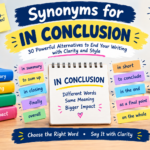
30 Synonyms of in conclusion With Meaning & Examples
1. In summary (Adverbial phrase)
Meaning: Used to give the main points of something briefly at the end.
Examples:
- In summary, the project was successful.
- In summary, students need more time to practice.
2. To sum up (Verb phrase)
Meaning: Used to give a short statement of the main ideas.
Examples:
- To sum up, the plan has many benefits.
- To sum up, good communication is essential.
3. In closing (Adverbial phrase)
Meaning: Used to introduce the final words of a speech, letter, or discussion.
Examples:
- In closing, I would like to thank everyone.
- In closing, the team should focus on its main goal.
4. To conclude (Verb phrase)
Meaning: Used to introduce the final point or judgment.
Examples:
- To conclude, the results support our idea.
- To conclude, careful preparation leads to better results.
5. Finally (Adverb)
Meaning: Used to introduce the last point or stage.
Examples:
- Finally, we should consider the cost.
- Finally, the report explains the main findings.
6. In short (Adverbial phrase)
Meaning: Used to give a brief statement of the main idea.
Examples:
- In short, the plan needs more work.
- In short, teamwork made the task easier.
7. In brief (Adverbial phrase)
Meaning: Used to express something in a short form.
Examples:
- In brief, the new system is faster.
- In brief, the study found positive results.
8. All in all (Adverbial phrase)
Meaning: Used to give an overall judgment after considering several points.
Examples:
- All in all, the trip was enjoyable.
- All in all, the project was a success.
9. Overall (Adverb)
Meaning: Used to describe the general result or view.
Examples:
- Overall, the results were encouraging.
- Overall, the new method worked well.
10. In the end (Adverbial phrase)
Meaning: Used to describe the final result after events or consideration.
Examples:
- In the end, we chose the simpler option.
- In the end, patience helped solve the problem.
11. Ultimately (Adverb)
Meaning: Used to refer to the final result or most important point.
Examples:
- Ultimately, success depends on consistent effort.
- Ultimately, the decision is yours.
12. On the whole (Adverbial phrase)
Meaning: Used to give a general opinion after considering everything.
Examples:
- On the whole, the plan worked well.
- On the whole, the results were positive.
13. To wrap up (Verb phrase)
Meaning: Used to introduce the final part of a discussion in a less formal way.
Examples:
- To wrap up, let’s review the main points.
- To wrap up, the project needs one final change.
14. Summing up (Participial phrase)
Meaning: Used to introduce a brief review of the main ideas.
Examples:
- Summing up, the evidence supports the proposal.
- Summing up, there are three main reasons for this change.
15. As a final point (Adverbial phrase)
Meaning: Used to introduce the last idea in a discussion.
Examples:
- As a final point, we should discuss safety.
- As a final point, remember to check your work.
16. As a final thought (Adverbial phrase)
Meaning: Used to introduce one last idea or reflection.
Examples:
- As a final thought, learning takes time.
- As a final thought, small changes can make a difference.
17. To finish (Verb phrase)
Meaning: Used to introduce the last part of a speech or discussion.
Examples:
- To finish, let’s review the main lesson.
- To finish, I want to thank the whole team.
18. In final analysis (Adverbial phrase)
Meaning: Used to introduce a final judgment after careful consideration.
Examples:
- In final analysis, the decision was reasonable.
- In final analysis, preparation was the key factor.
19. In the final analysis (Adverbial phrase)
Meaning: Used to state the final result after examining the facts.
Examples:
- In the final analysis, the benefits outweigh the costs.
- In the final analysis, the evidence is convincing.
20. By way of conclusion (Adverbial phrase)
Meaning: Used to introduce a concluding statement in formal writing or speech.
Examples:
- By way of conclusion, the study offers several useful lessons.
- By way of conclusion, we can identify three major points.
21. As a conclusion (Adverbial phrase)
Meaning: Used to introduce a statement that brings a discussion to an end.
Examples:
- As a conclusion, the report highlights the need for change.
- As a conclusion, we can say that practice is important.
22. In summation (Adverbial phrase)
Meaning: Used to introduce a formal summary of the main points.
Examples:
- In summation, the evidence supports the argument.
- In summation, the research provides useful information.
23. In essence (Adverbial phrase)
Meaning: Used to state the basic or most important idea.
Examples:
- In essence, the problem is about communication.
- In essence, the two plans have the same goal.
24. In a nutshell (Adverbial phrase)
Meaning: Used to give the main idea in very few words.
Examples:
- In a nutshell, the project needs more time.
- In a nutshell, practice improves performance.
25. To put it briefly (Verb phrase)
Meaning: Used to introduce a short version of the main point.
Examples:
- To put it briefly, the plan is practical.
- To put it briefly, the results were successful.
26. Briefly (Adverb)
Meaning: Used to introduce a short statement or summary.
Examples:
- Briefly, the study found three major problems.
- Briefly, the plan aims to improve education.
27. In a final summary (Adverbial phrase)
Meaning: Used to introduce the main points in a final summary.
Examples:
- In a final summary, the report shows clear progress.
- In a final summary, the evidence supports the original claim.
28. Taken together (Adverbial phrase)
Meaning: Used to consider several facts or ideas as one whole.
Examples:
- Taken together, these results show steady growth.
- Taken together, the findings provide useful evidence.
29. On balance (Adverbial phrase)
Meaning: Used to give a final opinion after considering both positive and negative points.
Examples:
- On balance, the advantages are greater than the disadvantages.
- On balance, the decision seems reasonable.
30. With this in mind (Adverbial phrase)
Meaning: Used to give a final point while considering the information already discussed.
Examples:
- With this in mind, we should improve the current system.
- With this in mind, the team decided to change its approach.
Prototype Meaning
The most typical meaning of in conclusion is “to give the final point or summary.” When people hear this phrase, they usually imagine the closing part of an essay, report, speech, or argument. It tells the reader or listener that the main discussion is ending and that a final idea or judgment is about to follow.
Prototype Categorization
The 30 alternatives can be grouped by their main meaning and level of formality:
- Formal conclusion phrases: in conclusion, to conclude, in closing, by way of conclusion, in summation, in final analysis, and in the final analysis. These work well in academic and professional writing.
- Summary phrases: in summary, to sum up, in short, in brief, summing up, briefly, and in a final summary. These focus on reviewing the main points.
- General overview phrases: overall, all in all, on the whole, on balance, and taken together. These give a broad view of the information.
- Final-stage phrases: finally, in the end, ultimately, to finish, and as a final point. These highlight the last stage or final idea.
- Informal or conversational phrases: to wrap up, in a nutshell, and to put it briefly. These are useful in everyday speech and less formal writing.
- Final reflection phrases: as a final thought, in essence, and with this in mind. These introduce a final reflection or important idea.
This categorization helps writers choose a phrase that matches the purpose, audience, and tone of their writing instead of repeating in conclusion.
Antonyms of in conclusion
There is no single exact antonym for the phrase in conclusion, because it is an expression used to introduce an ending. However, phrases that introduce the beginning or continuation of an idea can work as contextual opposites.
1. To begin (Verb phrase)
Meaning: Used to introduce the first point or opening idea.
2. At the beginning (Adverbial phrase)
Meaning: Used to refer to the starting point.
3. First of all (Adverbial phrase)
Meaning: Used to introduce the first point.
4. To start with (Verb phrase)
Meaning: Used to introduce the first part of a discussion.
5. At the outset (Adverbial phrase)
Meaning: Used to refer to the very beginning of something.
Short Questions and Answers
What does in conclusion mean?
In conclusion means that the writer or speaker is giving a final point, summary, or judgment.
When should in conclusion be used?
Use in conclusion when you are about to finish an essay, report, speech, argument, or discussion and want to introduce the final idea.
Is in conclusion positive or negative?
In conclusion is neutral. It does not have a positive or negative meaning by itself. The tone depends on the information that follows it.
How is it different from similar words?
In conclusion directly signals an ending. In summary focuses more on reviewing the main points, while overall gives a general view. Finally often introduces the last point rather than a complete conclusion.
Conclusion
Learning in conclusion and its alternatives can make English writing clearer and more flexible. Phrases such as in summary, to sum up, in closing, overall, finally, ultimately, and on the whole can help writers avoid repetition. However, these expressions are not always interchangeable. Some are formal, some are conversational, and others focus on a summary, final point, or overall judgment. Knowing these small differences helps English learners choose the right phrase for each situation. Strong vocabulary also makes essays, reports, speeches, and everyday communication easier to understand. Practice using one or two new alternatives each day. Over time, this simple habit can improve vocabulary, strengthen writing and speaking skills, reduce repetition, and build confidence in English.

Sarah Linguist is a passionate language enthusiast who loves exploring words, meanings, and synonyms.
She creates clear, easy-to-understand content to help readers improve their vocabulary and English skills.
Through SynonymsGuide.com, Sarah makes finding the right words simple, useful, and enjoyable.