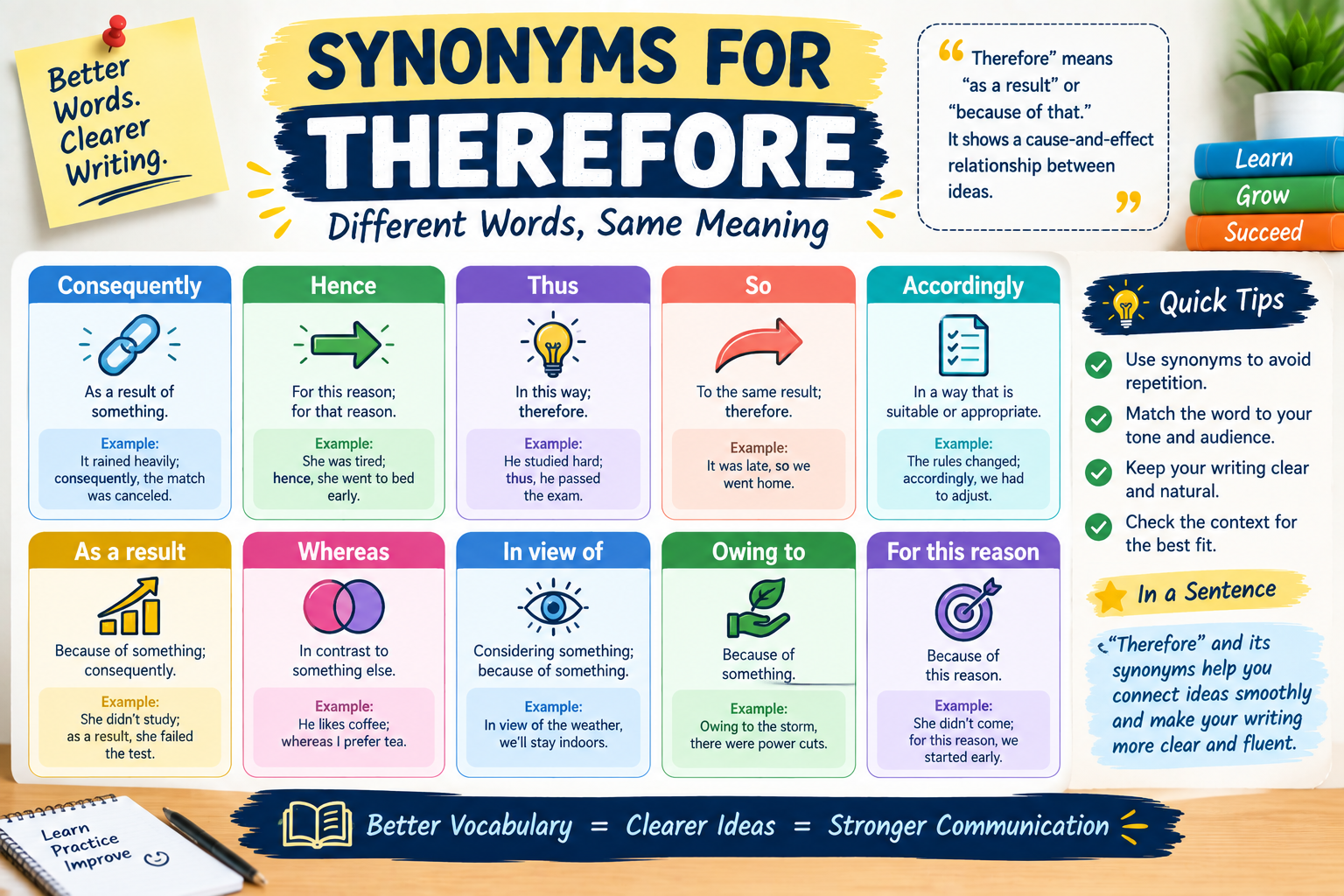
Common synonyms for therefore include thus, hence, consequently, accordingly, so, as a result, for this reason, and because of this. The best choice depends on the sentence and level of formality.
Therefore means “for that reason” or “as a result.” Imagine that you forgot to charge your phone before leaving home. Your battery is now dead. Therefore, you cannot call anyone. The word clearly connects the first fact with the result.
Therefore is common in formal writing, school essays, reports, business documents, and academic work. English learners and content writers often need synonyms for therefore because using the same linking word too often can make writing feel repetitive.
Learning alternatives helps you show cause and effect in different ways. In this guide, you will learn the meaning, grammar, history, pronunciation, and word forms of therefore. You will also learn 25 useful synonyms with simple examples and semantic categories.
Meaning of Therefore
Definition
Therefore (Adverb): Used to show that something happens or is true because of a previous fact or situation.
Examples
- The store was closed; therefore, we went home.
- She studied hard and therefore passed the exam.
Connotative Meaning
(Connotation: the feeling or idea that a word suggests beyond its basic meaning.)
- Positive tone: Therefore can make an idea sound clear, logical, and well organized.
- Negative tone: It may sound stiff or overly formal in casual conversation.
- Neutral tone: It simply shows a logical result or conclusion.
Etymology
The word therefore comes from old English word-building patterns.
- Old English (450–1100): Old English used related forms such as þȳ for and other expressions meaning “for that” or “because of that.”
- Middle English (1100–1500): Forms such as therefore developed from there + fore, with the sense of “for that” or “because of that.”
- Modern English (1500–Present): Therefore became a standard adverb used to introduce a result, conclusion, or logical consequence.
The word is a combination of there and the older form fore, meaning “for that reason” in this compound.
Pronunciation (IPA)
- IPA: /ˈðer.fɔːr/
- Syllables: there-fore
Affixation Pattern of Therefore
- Root: there + fore
- Prefix: None
- Suffix: None
- Word type: Compound adverb
Word Formations
- therefore — adverb
- there — adverb/pronoun
- fore — adverb/adjective/noun/preposition
- therein — adverb
- thereof — adverb
- thereby — adverb
- therewith — adverb
- thereafter — adverb
- thereupon — adverb
- thereinbefore — adverb, formal/legal
Unlike words formed with common prefixes or suffixes, therefore is mainly a compound word.
25 Synonyms of Therefore With Meaning & Examples
1. Thus (Adverb)
Meaning: As a result or in this way.
Examples:
- The road was blocked; thus, we took another route.
- He missed the bus and thus arrived late.
2. Hence (Adverb)
Meaning: For this reason or as a result.
Examples:
- The weather was bad; hence, the flight was delayed.
- She was tired; hence, she went to bed early.
3. Consequently (Adverb)
Meaning: As a result of something that happened before.
Examples:
- He broke the rules and consequently lost his position.
- The price increased; consequently, fewer people bought the product.
4. Accordingly (Adverb)
Meaning: In a way that is suitable because of a particular situation.
Examples:
- The weather changed, so we planned accordingly.
- The instructions were updated, and the team acted accordingly.
5. So (Conjunction/Adverb)
Meaning: For that reason or as a result.
Examples:
- It was raining, so we stayed inside.
- She was hungry, so she made a sandwich.
6. As a Result (Phrase)
Meaning: Because of something that happened before.
Examples:
- The road flooded. As a result, traffic stopped.
- He practiced every day. As a result, his skills improved.
7. For This Reason (Phrase)
Meaning: Because of the reason just mentioned.
Examples:
- The machine is unsafe. For this reason, it should not be used.
- She needed more time. For this reason, we delayed the meeting.
8. Because of This (Phrase)
Meaning: As a result of the situation just described.
Examples:
- He missed the train. Because of this, he arrived late.
- The store closed early. Because of this, we changed our plans.
9. As a Consequence (Phrase)
Meaning: As a result of a particular action or event.
Examples:
- She ignored the warning. As a consequence, the problem became worse.
- The company lost money and as a consequence reduced its costs.
10. For That Reason (Phrase)
Meaning: Because of the reason already given.
Examples:
- The road is dangerous. For that reason, drivers should slow down.
- He was sick. For that reason, he stayed home.
11. Thereby (Adverb)
Meaning: By that action or as a result of that action.
Examples:
- She saved money, thereby reducing her debt.
- The company changed its process, thereby improving efficiency.
12. Ergo (Adverb)
Meaning: Therefore or for that reason.
Examples:
- The evidence was weak; ergo, the case failed.
- He thinks carefully; ergo, he makes fewer mistakes.
Usage note: Ergo is less common and often sounds formal, humorous, or philosophical.
13. In Consequence (Phrase)
Meaning: As a result of something.
Examples:
- The rules were ignored and, in consequence, problems followed.
- The company lost customers in consequence of the poor service.
14. Subsequently (Adverb)
Meaning: After something happened, especially as part of a sequence.
Examples:
- The team reviewed the plan and subsequently changed it.
- He completed the course and subsequently found a new job.
Usage note: Subsequently usually means “afterward,” so it is not a direct synonym for therefore in every sentence.
15. As Such (Phrase)
Meaning: Because of the nature or condition just mentioned.
Examples:
- The road is private and, as such, cannot be used by the public.
- She is the manager and, as such, makes the final decision.
16. In That Case (Phrase)
Meaning: Because of the situation just described.
Examples:
- The shop is closed. In that case, we can return tomorrow.
- You are busy? In that case, I will call later.
17. On That Account (Phrase)
Meaning: For that reason.
Examples:
- The evidence was incomplete. On that account, the decision was delayed.
- He was inexperienced, but we did not reject him on that account.
18. Wherefore (Adverb)
Meaning: For what reason or for that reason, depending on context.
Examples:
- The contract was broken, wherefore the agreement ended.
- He wondered wherefore the rule existed.
Usage note: Wherefore is very old-fashioned and is rare in modern everyday English.
19. Thusly (Adverb)
Meaning: In this way or as a result.
Examples:
- The facts were explained thusly.
- The decision was made thusly after a long discussion.
Usage note: Thusly is uncommon and is often avoided in careful formal writing. Thus is usually better.
20. So Then (Phrase)
Meaning: Therefore or because of what was just said.
Examples:
- You have finished your work, so then you can leave.
- The plan failed, so then we tried another method.
21. For That Cause (Phrase)
Meaning: Because of that particular cause or reason.
Examples:
- The bridge was damaged. For that cause, it was closed.
- The service was unreliable, and customers complained for that cause.
Usage note: This phrase is uncommon in modern English. For that reason is much more natural.
22. As a Consequence of That (Phrase)
Meaning: Because that event or action caused a particular result.
Examples:
- The company changed its policy. As a consequence of that, costs increased.
- He ignored the advice. As a consequence of that, he made the same mistake.
23. In View of This (Phrase)
Meaning: Because of the information or situation just mentioned.
Examples:
- The evidence was unclear. In view of this, the case was reviewed.
- Sales were falling. In view of this, the company changed its strategy.
24. With This in Mind (Phrase)
Meaning: Considering the fact or situation just mentioned.
Examples:
- The budget is small. With this in mind, we chose a simple design.
- Time is limited. With this in mind, the team focused on the main task.
25. For Which Reason (Phrase)
Meaning: Because of the reason that was just stated.
Examples:
- The road was unsafe, for which reason it was closed.
- He had no experience, for which reason he needed extra training.
Prototype Meaning
The most typical meaning of therefore is “as a result” or “for that reason.” When people hear therefore, they usually imagine a clear connection between two ideas. One fact happens first, and therefore a result follows. It is especially common in logical, formal, and academic writing.
Prototype Categorization
The 25 alternatives can be grouped by how they connect ideas. This helps writers choose a word that fits the sentence instead of using therefore repeatedly.
- Direct result: thus, hence, consequently, as a result — clear choices when one event directly causes another.
- Reason or cause: for this reason, for that reason, because of this, on that account — useful when focusing on why something happens.
- Formal and academic: thereby, ergo, in consequence, in view of this — suitable for formal reports and structured writing.
- Conditional response: so, in that case, as such, with this in mind — useful when the next action depends on the situation.
- Time or sequence: subsequently — shows what happens later, rather than directly meaning “therefore.”
- Rare or old-fashioned forms: wherefore, thusly — uncommon in modern everyday English and should be used carefully.
This grouping makes your writing more precise. It also helps you match the synonym to the tone and meaning you need.
Antonyms of Therefore
There is no perfect one-word antonym for therefore because it is a linking adverb. However, these expressions can introduce contrast or a different relationship between ideas:
- However (Adverb): Shows contrast between two ideas.
- Nevertheless (Adverb): Shows that something remains true despite a previous point.
- Instead (Adverb): Shows an alternative result or choice.
- Conversely (Adverb): Shows an opposite or reversed relationship.
- Otherwise (Adverb): Shows what would happen under a different condition.
Short Questions and Answers
What does therefore mean?
Therefore means “for that reason” or “as a result.” It connects an earlier fact with a conclusion or result.
When should therefore be used?
Use therefore when you want to clearly show that one idea leads to another. It is especially useful in formal and academic writing.
Is therefore positive or negative?
Therefore is neutral. It does not express a positive or negative feeling by itself. The surrounding sentence gives it the meaning and tone.
How is it different from similar words?
Therefore, thus, hence, and consequently can all show a result. Therefore is common and clear, while hence and thus can sound more formal. So is usually more natural in casual speech.
Conclusion
Learning therefore and its synonyms can improve your English vocabulary and make your writing more flexible. Words such as thus, hence, consequently, accordingly, and as a result help you connect ideas without repeating the same expression.
These alternatives are useful in essays, reports, emails, business writing, and everyday communication. Each one has a slightly different tone or use, so choosing the right word can make your message clearer.
Practice using a few synonyms each day. Write short sentences and compare how each word changes the tone. With regular practice, you will avoid repetition, strengthen your speaking and writing, and build greater confidence in English.

Sarah Linguist is a passionate language enthusiast who loves exploring words, meanings, and synonyms.
She creates clear, easy-to-understand content to help readers improve their vocabulary and English skills.
Through SynonymsGuide.com, Sarah makes finding the right words simple, useful, and enjoyable.