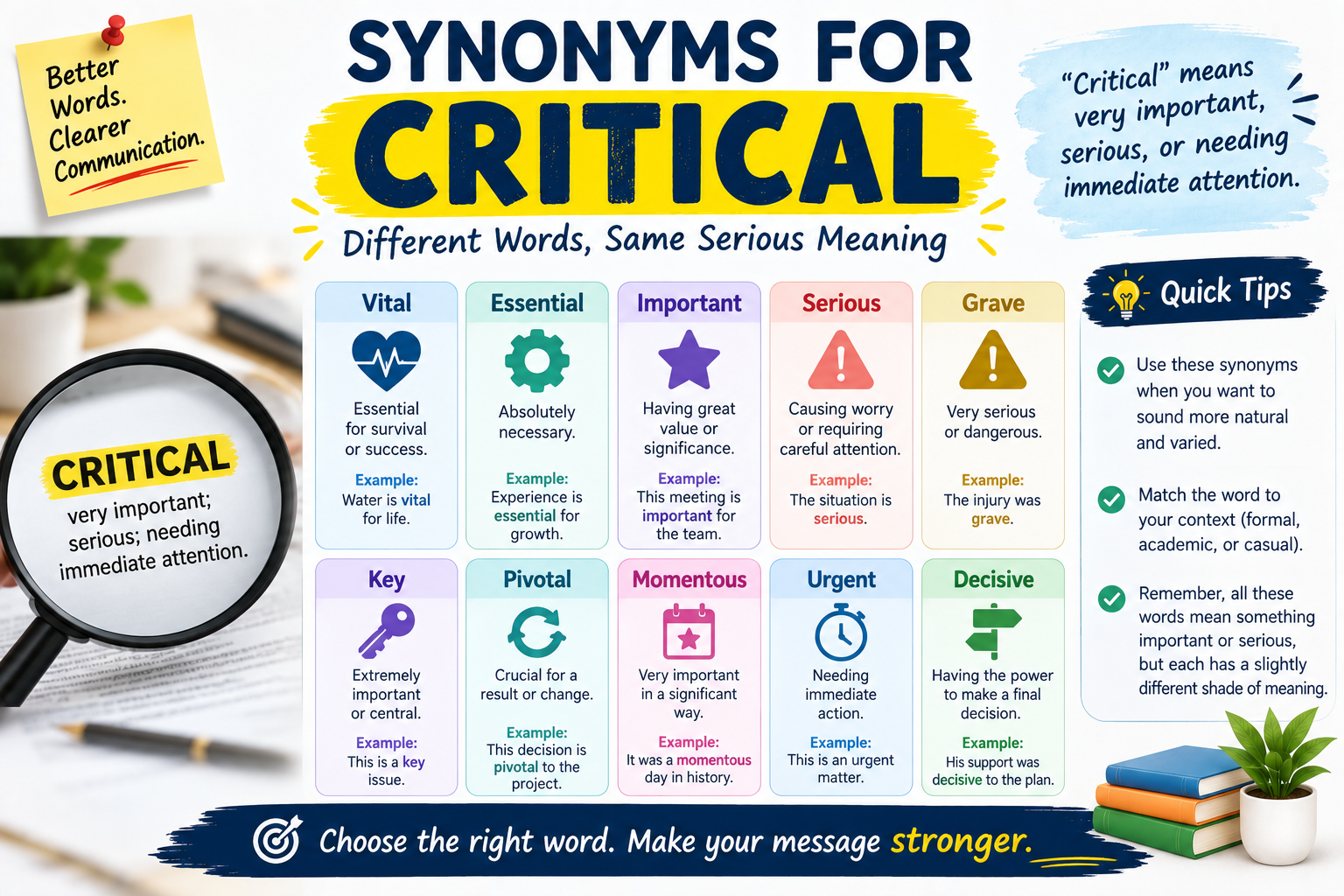
Critical can mean very important, very serious, or focused on finding and judging problems. For example, imagine your doctor says that quick treatment is critical. This means the treatment is extremely important.
A teacher may also ask you to use critical thinking when studying a difficult topic. Here, the word means careful and logical judgment. Critical is common in school, business, medicine, science, news, and daily conversation. Because it has several meanings, choosing the right synonym can sometimes be confusing. Learning synonyms helps English learners build a stronger vocabulary and helps content writers make their sentences more precise. In this guide, you will learn the meaning, examples, grammar, history, pronunciation, word forms, and 23 useful synonyms of critical. You will also learn how to group these synonyms by meaning and choose the best word for each situation.
Meaning of Critical
Definition
Critical (Adjective):
Critical means extremely important, very serious, or involving careful judgment and evaluation.
Examples
- Clean water is critical for human health.
- The manager gave a critical review of the new plan.
Connotative Meaning
Connotation means the feeling or idea that a word suggests beyond its basic meaning.
- Positive tone: Critical can have a positive tone when it means important, necessary, or thoughtful, as in critical thinking.
- Negative tone: It can have a negative tone when it means finding faults, being harsh, or describing a dangerous situation.
- Neutral tone: It can be neutral when it means carefully examining or evaluating something.
The meaning of critical depends heavily on context. For example, critical thinking is usually positive, while critical comments can sound negative.
Etymology
Critical comes from the Greek word kritikos, meaning “able to judge” or “skilled in judging.” It entered English through Latin and French.
- Old English (450–1100): The modern word critical was not used in Old English. English speakers used native words related to judging, deciding, examining, and finding fault.
- Middle English (1100–1500): Greek and Latin learning influenced English through French and scholarly writing. Words related to critic and criticism gradually entered English.
- Modern English (1500–Present): Critical developed several meanings, including “judging carefully,” “finding faults,” “extremely important,” and “very serious.”
The deeper Greek root is krinein, meaning “to judge,” “decide,” or “separate.” This root is also connected with words such as critic, criticism, and criterion.
Pronunciation (IPA)
- IPA: /ˈkrɪtɪkəl/
- Syllables: crit-i-cal
The main stress falls on the first syllable.
Affixation Pattern of Critical
- Root: crit-, historically linked to Greek krinein, meaning “to judge” or “decide”
- Prefix: None in the modern word critical
- Suffix: -ical, which forms an adjective
Word Formations
- Critic — noun
- Critics — noun
- Critique — noun/verb
- Criticize — verb
- Criticized — verb
- Criticizing — verb
- Criticism — noun
- Critical — adjective
- Critically — adverb
- Criticality — noun
- Uncritical — adjective
- Uncritically — adverb
- Criticizer — noun
These words belong to the same historical word family, although not every form is created directly from critical.
23 Synonyms of Critical With Meaning & Examples
1. Crucial (Adjective)
Meaning: Crucial means extremely important to the success or result of something.
Examples:
- Good communication is crucial to a successful team.
- Her decision was crucial to the project’s success.
2. Essential (Adjective)
Meaning: Essential means absolutely necessary.
Examples:
- Fresh water is essential for life.
- Good planning is essential for this project.
3. Vital (Adjective)
Meaning: Vital means extremely important or necessary.
Examples:
- Exercise is vital for good health.
- Trust is vital in a strong friendship.
4. Important (Adjective)
Meaning: Important means having great value, influence, or meaning.
Examples:
- Education is important for personal growth.
- This is an important decision.
5. Significant (Adjective)
Meaning: Significant means important enough to have a noticeable effect.
Examples:
- The study found a significant increase in sales.
- She made a significant contribution to the project.
6. Urgent (Adjective)
Meaning: Urgent means needing immediate attention or action.
Examples:
- The hospital received an urgent request for help.
- We have an urgent problem to solve.
7. Imperative (Adjective)
Meaning: Imperative means absolutely necessary or extremely important.
Examples:
- It is imperative that we protect the environment.
- Quick action is imperative in an emergency.
8. Fundamental (Adjective)
Meaning: Fundamental means basic and necessary to something.
Examples:
- Trust is fundamental to a healthy relationship.
- These are fundamental principles of science.
9. Pivotal (Adjective)
Meaning: Pivotal means extremely important because it can change the direction of a situation.
Examples:
- She played a pivotal role in the project.
- The meeting was a pivotal moment for the company.
10. Decisive (Adjective)
Meaning: Decisive means having a strong effect on the final result.
Examples:
- His goal was decisive in the final match.
- Her vote was decisive in the final decision.
11. Momentous (Adjective)
Meaning: Momentous means very important because it may have major future effects.
Examples:
- The country faced a momentous decision.
- It was a momentous day for the organization.
12. Serious (Adjective)
Meaning: Serious means important, dangerous, or requiring careful attention.
Examples:
- The company has a serious financial problem.
- The accident caused serious injuries.
13. Grave (Adjective)
Meaning: Grave means extremely serious and often connected with danger or concern.
Examples:
- The leaders discussed the grave situation.
- The mistake could have grave consequences.
14. Dire (Adjective)
Meaning: Dire describes a situation that is extremely serious or desperate.
Examples:
- The region is facing a dire shortage of food.
- The team was in dire need of assistance.
15. Severe (Adjective)
Meaning: Severe means very serious, intense, or harmful.
Examples:
- The storm caused severe damage.
- The patient suffered severe pain.
16. Discerning (Adjective)
Meaning: Discerning means able to judge quality or differences clearly and wisely.
Examples:
- She is a discerning reader.
- A discerning buyer checks the product carefully.
17. Analytical (Adjective)
Meaning: Analytical means using careful thought and logical examination.
Examples:
- He has an analytical approach to problems.
- The report gives an analytical review of the data.
18. Evaluative (Adjective)
Meaning: Evaluative means focused on judging the value, quality, or performance of something.
Examples:
- The teacher wrote an evaluative report.
- We need an evaluative study of the new system.
19. Judgmental (Adjective)
Meaning: Judgmental describes someone who is too quick to form negative opinions about others.
Examples:
- Try not to be judgmental about other people’s choices.
- His judgmental comments upset his friend.
20. Fault-finding (Adjective)
Meaning: Fault-finding describes a habit of looking for mistakes or weaknesses.
Examples:
- His fault-finding attitude hurt the team.
- Constant fault-finding can lower employee morale.
21. Disapproving (Adjective)
Meaning: Disapproving means showing that you think something is wrong or unacceptable.
Examples:
- She gave him a disapproving look.
- His disapproving tone ended the discussion.
22. Exacting (Adjective)
Meaning: Exacting describes someone who demands very high standards.
Examples:
- The editor has exacting standards.
- The job requires an exacting level of accuracy.
23. Scrutinizing (Adjective)
Meaning: Scrutinizing means examining something very carefully and closely.
Examples:
- The committee is scrutinizing the proposal.
- Investors are scrutinizing the company’s financial results.
Usage note: These synonyms do not all replace critical in every sentence. Crucial, essential, and vital are best when critical means “extremely important.” Urgent focuses on immediate action, while severe, grave, and dire focus on seriousness. Analytical, discerning, evaluative, and scrutinizing relate to careful examination. Judgmental, fault-finding, and disapproving usually carry a negative meaning.
Prototype Meaning
The most typical meaning of critical is extremely important or requiring serious attention. When people hear this meaning, they may imagine a key decision, a serious problem, an emergency, or an important part of a plan. Another common meaning involves careful judgment, as in critical analysis or critical thinking. The surrounding words usually tell you which meaning is intended.
Prototype Categorization
The 23 synonyms can be placed into semantic groups based on their main meaning. This helps writers select a word that matches the exact idea they want to express.
- Extreme importance: crucial, essential, vital, important, significant
These words describe something that matters greatly. - Urgency and necessity: urgent, imperative
These words suggest that immediate action is needed or something must be done. - Major influence: fundamental, pivotal, decisive, momentous
These words describe something that strongly affects a result, decision, or future. - Seriousness and danger: serious, grave, dire, severe
These words are useful for problems, risks, conditions, and harmful situations. - Careful analysis and judgment: discerning, analytical, evaluative, scrutinizing
These words focus on examining or judging something carefully. - Negative criticism: judgmental, fault-finding, disapproving, exacting
These words describe criticism, high demands, or negative judgments.
This categorization helps you avoid repeating critical. It also lets you choose a synonym that gives your sentence the exact meaning and tone you need.
Antonyms of Critical
- Unimportant (Adjective): Not having much importance or value.
- Minor (Adjective): Small in importance, effect, or seriousness.
- Insignificant (Adjective): Not important or meaningful.
- Trivial (Adjective): Too small or unimportant to deserve serious attention.
- Unnecessary (Adjective): Not needed for a particular purpose.
- Safe (Adjective): Not dangerous or likely to cause harm.
- Accepting (Adjective): Willing to accept something without strong criticism.
- Uncritical (Adjective): Not carefully examining or questioning something.
Short Questions and Answers
What does critical mean?
Critical can mean extremely important, very serious, or related to careful judgment and evaluation.
When should critical be used?
Use critical when something is extremely important, serious, urgent, or connected with careful evaluation. The context determines the exact meaning.
Is critical positive or negative?
Critical can be positive, negative, or neutral. Critical thinking is usually positive, while critical comments can be negative. Critical condition describes a serious medical situation.
How is it different from similar words?
The best synonym depends on the context. Crucial means extremely important, urgent means needing immediate action, severe means very serious, and analytical means based on careful examination.
Is critical the same as crucial?
They can have the same meaning when both describe something extremely important. However, critical has several other meanings, while crucial mainly focuses on importance.
Does critical always mean negative?
No. Critical does not always have a negative meaning. For example, critical thinking means careful and logical thinking and is generally viewed as a useful skill.
Conclusion
Learning critical and its synonyms can make your English clearer and more flexible. Words such as crucial, essential, and vital are useful when something is extremely important. Urgent works when quick action is needed, while severe, grave, and dire describe serious situations. When you mean careful examination, words such as analytical, discerning, and scrutinizing are better choices. Understanding these differences helps you write stronger essays, reports, articles, emails, and everyday messages. It also prevents unnecessary repetition and makes your vocabulary more precise. English learners can build confidence by learning a few synonyms each day and using them in their own sentences. Regular practice will help you recognize the right word faster and communicate your ideas with greater accuracy.

Emily Watson is an English language writer and vocabulary specialist dedicated to helping readers improve their communication skills. She writes clear, easy-to-understand guides on synonyms, word meanings, grammar, and word usage.