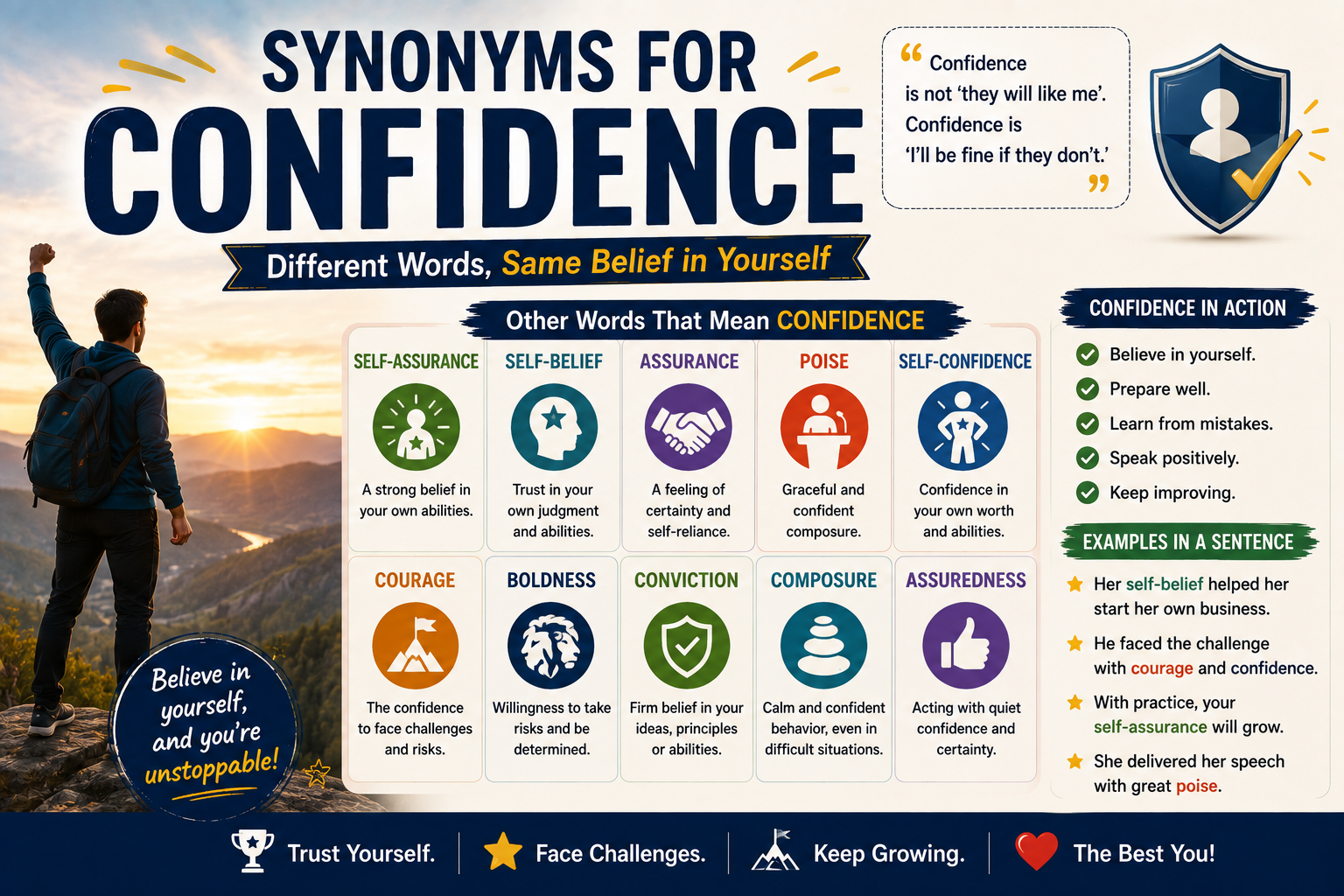
Confidence means believing in yourself, your skills, or your ability to handle something. Imagine you have to give a speech in front of your class. At first, your hands feel nervous. Then you take a deep breath and begin speaking clearly. That feeling of trust in yourself is confidence.
We use this word often when we talk about success, personal growth, work, school, and social life. However, using the same word many times can make your writing repetitive. Learning synonyms gives you more ways to describe self-belief, courage, certainty, and assurance. This is useful for English learners, students, and content writers. In this guide, you will learn the meaning, examples, grammar, history, pronunciation, and word forms of confidence. You will also discover 20 useful synonyms and learn how they fit into different semantic categories.
Meaning of confidence
Definition
Confidence (Noun): A strong belief in yourself, your abilities, or the success of something.
Confidence can describe self-belief or trust in something.
Examples
- She spoke with great confidence during the interview.
- His confidence grew after he passed the exam.
Connotative Meaning
Connotation means the feeling or idea that a word suggests beyond its basic meaning.
- Positive tone: Confidence suggests self-belief, courage, strength, and competence.
- Negative tone: Too much confidence can suggest arrogance or overconfidence.
- Neutral tone: Confidence can simply mean trust or certainty about something.
Etymology
The word confidence comes from Latin through French.
- Old English (450–1100): The modern word confidence was not part of Old English vocabulary. Its Latin roots developed outside Old English.
- Middle English (1100–1500): Confidence entered English through Anglo-French and Old French forms related to Latin confidentia, meaning trust or firm belief.
- Modern English (1500–Present): Confidence developed its modern meanings of self-assurance, trust, certainty, and belief in someone’s ability.
The word ultimately comes from Latin confidere, meaning “to trust fully” or “to have firm faith.”
Pronunciation (IPA)
- IPA: /ˈkɒnfɪdəns/ in British English; /ˈkɑːnfɪdəns/ in American English
- Syllables: con-fi-dence — three syllables
Affixation Pattern of confidence
- Root: fid / confid- — related to the Latin idea of trust or faith
- Prefix: con- — from Latin, meaning “with” or “together”
- Suffix: -ence — forms nouns describing a state, quality, or condition
Word formations
- confidence — noun
- confident — adjective
- confidently — adverb
- confidential — adjective, meaning private or secret
- confidentiality — noun, meaning the state of keeping information private
- confide — verb, meaning to share something private with someone you trust
Note: These words are historically related, but they do not all have the same meaning as confidence.
20 Synonyms of confidence With Meaning & Examples
1. Self-assurance (Noun)
Meaning: A strong belief in your own abilities and decisions.
Examples:
- Her self-assurance impressed the interview panel.
- He answered the questions with self-assurance.
2. Self-belief (Noun)
Meaning: The belief that you can succeed or do something well.
Examples:
- Self-belief helped her reach her goal.
- You need self-belief when facing challenges.
3. Assurance (Noun)
Meaning: A feeling of certainty or confidence about something.
Examples:
- He spoke with assurance during the meeting.
- Her calm voice gave me assurance.
4. Certainty (Noun)
Meaning: A strong belief that something is true or will happen.
Examples:
- She answered with complete certainty.
- There was no certainty that the plan would work.
5. Conviction (Noun)
Meaning: A strong belief that something is true or right.
Examples:
- He spoke with conviction about his ideas.
- She defended her position with conviction.
6. Poise (Noun)
Meaning: Calm and controlled behavior, especially in a difficult situation.
Examples:
- She handled the interview with poise.
- His poise helped him stay calm on stage.
7. Composure (Noun)
Meaning: The ability to remain calm and in control.
Examples:
- She kept her composure during the argument.
- His composure surprised everyone.
8. Courage (Noun)
Meaning: The ability to face fear or difficulty without giving up.
Examples:
- It took courage to speak in front of the crowd.
- Her courage inspired her team.
9. Boldness (Noun)
Meaning: A willingness to act or speak without fear.
Examples:
- His boldness helped him take the opportunity.
- She showed boldness during the presentation.
10. Nerve (Noun)
Meaning: Courage and confidence in a difficult or risky situation.
Examples:
- She had the nerve to challenge the decision.
- It takes nerve to perform before a large audience.
11. Fearlessness (Noun)
Meaning: A lack of fear when facing danger or difficulty.
Examples:
- His fearlessness made him a strong leader.
- Her fearlessness helped her overcome the challenge.
12. Self-esteem (Noun)
Meaning: The value and respect that a person has for themselves.
Examples:
- Exercise can improve self-esteem.
- Positive feedback helped build her self-esteem.
13. Self-respect (Noun)
Meaning: A feeling of respect for your own worth and abilities.
Examples:
- He showed strong self-respect.
- Good boundaries can protect your self-respect.
14. Trust (Noun)
Meaning: A firm belief that someone or something is reliable.
Examples:
- She has complete trust in her team.
- His experience gave us trust in his judgment.
15. Faith (Noun)
Meaning: Strong belief or trust in someone or something.
Examples:
- She has faith in her abilities.
- His faith in the team remained strong.
16. Optimism (Noun)
Meaning: The belief that good things are likely to happen.
Examples:
- Her optimism gave the team hope.
- He approached the challenge with optimism.
17. Empowerment (Noun)
Meaning: A feeling of having the power and ability to control your life or choices.
Examples:
- Education can bring a sense of empowerment.
- The training gave workers greater empowerment.
18. Security (Noun)
Meaning: A feeling of safety, stability, or freedom from doubt.
Examples:
- The job gave him financial security.
- Her preparation gave her a sense of security.
19. Assertiveness (Noun)
Meaning: The ability to express your needs and opinions clearly and firmly.
Examples:
- Assertiveness helped her communicate her needs.
- Good assertiveness can improve workplace communication.
20. Bravery (Noun)
Meaning: The quality of facing fear, danger, or difficulty with courage.
Examples:
- Her bravery helped her face the challenge.
- Everyone admired his bravery.
Usage note: These synonyms are related to confidence, but they are not always exact replacements. Self-assurance and self-belief are very close. Courage and bravery focus more on facing fear. Certainty focuses on being sure, while poise focuses on calm behavior.
Prototype Meaning
The most typical meaning of confidence is belief in yourself and your ability to succeed. When people hear this word, they often imagine someone who stands tall, speaks clearly, makes decisions, and does not easily doubt themselves. Confidence does not mean knowing everything. It means trusting that you can handle a situation and learn when things become difficult.
Prototype Categorization
The synonyms can be grouped into useful semantic categories:
- Strong self-belief:self-assurance, self-belief, self-esteem, self-respect
- These words focus on how you view yourself and your abilities.
- Certainty and trust:assurance, certainty, conviction, trust, faith
- These words work well when confidence means being sure about a person, idea, or result.
- Calm confidence:poise, composure, security
- These terms describe a calm and controlled state.
- Courage and fearlessness:courage, boldness, nerve, fearlessness, bravery
- These words fit situations where confidence helps someone face fear or risk.
- Positive mental strength:optimism, empowerment
- These words connect confidence with hope, strength, and personal control.
- Strong communication:assertiveness
- This word is useful when confidence appears in the way someone expresses opinions, needs, or boundaries.
This categorization helps writers select a word that matches the exact meaning and tone they want.
Antonyms of confidence
- Insecurity (Noun): A lack of confidence or certainty about yourself.
- Self-doubt (Noun): A lack of belief in your own abilities or decisions.
- Uncertainty (Noun): A state of not being sure about something.
- Timidity (Noun): A lack of courage or confidence when facing people or situations.
- Fear (Noun): An emotional response that can make someone feel unable to act confidently.
- Diffidence (Noun): A lack of self-confidence, often shown through hesitation.
Short Questions and Answers
What does confidence mean?
Confidence means having a strong belief in yourself, your abilities, or the success of something.
When should confidence be used?
Use confidence when you want to describe self-belief, trust, certainty, or assurance. It works in both everyday and formal English.
Is confidence positive or negative?
Confidence is usually positive. However, excessive confidence can become arrogance or overconfidence.
How is it different from similar words?
Confidence is a broad word for belief in yourself or something. Courage focuses on facing fear, certainty focuses on being sure, and poise focuses on calm behavior.
Conclusion
Learning synonyms for confidence can make your English stronger and more precise. The word confidence is useful, but related words can show different shades of meaning. Self-assurance highlights belief in yourself, while certainty shows that you feel sure. Courage and bravery focus on facing fear, while poise describes calm control.
Using these words can improve both your writing and speaking. They also help you avoid repeating the same word in essays, articles, emails, and conversations. The best synonym depends on your exact meaning and situation.
Try learning two or three new words each day. Write your own sentences with them. With regular practice, your vocabulary will grow, your writing will become more natural, and your English confidence will become stronger.

Olivia Wordsmith is a passionate vocabulary writer who loves exploring words, meanings, and their everyday use.
She creates clear, engaging content to help readers expand their vocabulary and communicate with confidence.