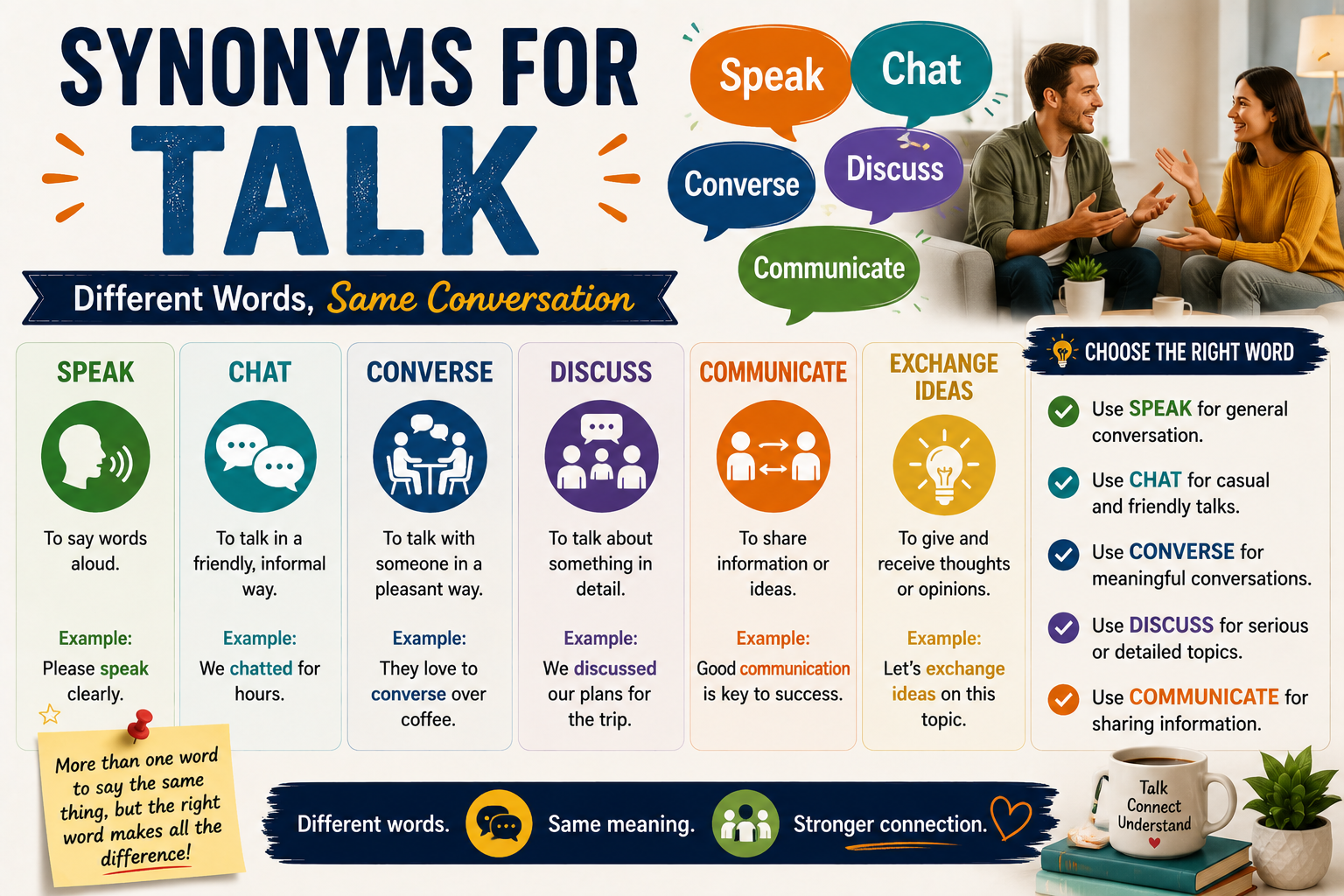
Talk means to speak or communicate with someone. Depending on the situation, useful synonyms include speak, chat, discuss, converse, communicate, mention, explain, and address.
Talk is one of the first English words many learners use. You might say, “Can I talk to you?” when you need help, or “We talked about the new project” at work. The word is simple, but using it again and again can make your writing sound flat.
As an English teacher, I often see learners use talk for almost every type of communication. That is not always wrong, but a more exact word can make your meaning clearer. Chat sounds friendly. Discuss sounds more formal. Argue shows disagreement. Whisper tells us how someone spoke.
Learning synonyms helps you choose the right word for the right setting. It also improves your vocabulary and makes your writing more natural. In this guide, you will learn the meaning, history, pronunciation, word forms, and 40 useful synonyms for talk, with simple examples. You will also learn which alternatives work best in formal, casual, and professional English.
Meaning of Talk
Definition
Talk (verb/noun): To speak with someone or express ideas, thoughts, or feelings using words.
As a verb, talk means to speak or communicate.
We need to talk about the problem.
As a noun, talk can mean a conversation or a speech.
We had a long talk after dinner.
Examples
- I want to talk to my teacher about the assignment.
- They talk every evening on the phone.
Connotative Meaning
Connotation means the feeling or idea a word suggests beyond its basic meaning.
- Positive tone: Talk can suggest friendly communication, openness, or connection.
- Negative tone: In some contexts, it can suggest too much or meaningless speech, as in “empty talk.”
- Neutral tone: It can simply mean speaking or having a conversation.
Etymology
The word talk has a long history in English.
- Old English (450–1100): Talk is related to Middle English forms such as talken. Its exact early origin is uncertain, but it developed within the Germanic language family.
- Middle English (1100–1500): Forms such as talken became common and meant to speak, converse, or communicate.
- Modern English (1500–Present): Talk developed into a very common word for speaking, conversation, discussion, and informal communication.
Today, talk is one of the most flexible communication words in English.
Pronunciation (IPA)
- IPA: /tɔːk/ in many British varieties; /tɑːk/ in many American varieties
- Syllables: talk — one syllable
Affixation Pattern of Talk
- Root: talk
- Prefix: None
- Suffix: None in the basic word
Word formations
- talk — verb/noun
- talked — verb, past tense
- talking — verb, present participle/gerund
- talker — noun, a person who talks
- talkative — adjective, speaking a lot
- talkativeness — noun, the quality of talking a lot
- talking-point — noun, a subject that attracts discussion
40 Synonyms of Talk With Meaning & Examples
1. Speak (Verb)
Meaning: To use your voice to express words or ideas.
Examples:
- Please speak clearly.
- She spoke about her experience.
2. Converse (Verb)
Meaning: To have a conversation with someone.
Examples:
- We conversed about our plans.
- They often converse after work.
3. Chat (Verb)
Meaning: To talk in a relaxed and friendly way.
Examples:
- We chatted over coffee.
- I like to chat with my friends.
4. Discuss (Verb)
Meaning: To talk about a subject in detail.
Examples:
- We need to discuss the problem.
- They discussed the new plan.
5. Communicate (Verb)
Meaning: To share information, thoughts, or feelings.
Examples:
- Good leaders communicate clearly.
- We need to communicate with our customers.
6. Say (Verb)
Meaning: To express something in words.
Examples:
- What did she say?
- He said that he was tired.
7. Tell (Verb)
Meaning: To give information to someone through speech.
Examples:
- Please tell me the truth.
- She told us about her trip.
8. Mention (Verb)
Meaning: To refer to something briefly.
Examples:
- He mentioned your name.
- She mentioned the meeting.
9. Explain (Verb)
Meaning: To make an idea or situation easier to understand.
Examples:
- Can you explain the problem?
- The teacher explained the lesson.
10. Address (Verb)
Meaning: To speak about a particular issue or concern.
Examples:
- The manager addressed the complaint.
- We must address this issue quickly.
11. Debate (Verb)
Meaning: To discuss different opinions, often formally.
Examples:
- The students debated the topic.
- They debated whether the plan would work.
12. Argue (Verb)
Meaning: To speak angrily because you disagree with someone.
Examples:
- The two friends argued about money.
- They often argue over small things.
13. Confer (Verb)
Meaning: To talk with someone in order to make a decision.
Examples:
- The lawyers conferred before the meeting.
- We need to confer with the manager.
14. Consult (Verb)
Meaning: To talk to someone for advice or information.
Examples:
- She consulted her doctor.
- We should consult an expert.
15. Remark (Verb)
Meaning: To make a short spoken comment.
Examples:
- He remarked on the weather.
- She remarked that the room was cold.
16. State (Verb)
Meaning: To express something clearly and directly.
Examples:
- The report states the main facts.
- He stated his opinion clearly.
17. Declare (Verb)
Meaning: To announce something clearly and firmly.
Examples:
- The leader declared his support.
- She declared that she was ready.
18. Announce (Verb)
Meaning: To give information publicly or officially.
Examples:
- The company announced the results.
- They announced the winner.
19. Express (Verb)
Meaning: To show or communicate a thought or feeling.
Examples:
- She expressed her concerns.
- He expressed his gratitude.
20. Voice (Verb)
Meaning: To express an opinion or concern openly.
Examples:
- Workers voiced their concerns.
- She voiced her disagreement.
21. Relate (Verb)
Meaning: To tell or describe something, especially an experience.
Examples:
- He related the story to us.
- She related what had happened.
22. Narrate (Verb)
Meaning: To tell a story or describe events.
Examples:
- The guide narrated the history of the building.
- She narrated the events clearly.
23. Recount (Verb)
Meaning: To tell someone about events in detail.
Examples:
- He recounted his journey.
- She recounted the events of the day.
24. Report (Verb)
Meaning: To give information about something that happened.
Examples:
- The witness reported what she saw.
- He reported the incident to the police.
25. Inform (Verb)
Meaning: To give someone useful information.
Examples:
- Please inform me of any changes.
- The manager informed the staff about the update.
26. Communicate (Verb)
Meaning: To exchange information or ideas with another person.
Examples:
- Teams must communicate effectively.
- We communicated by email.
27. Dialogue (Verb)
Meaning: To communicate through an exchange of ideas or opinions.
Examples:
- The groups dialogued about the issue.
- Leaders should dialogue with local residents.
28. Confer (Verb)
Meaning: To discuss something privately with another person.
Examples:
- The directors conferred before voting.
- She conferred with her colleagues.
29. Converse (Noun)
Meaning: A conversation or exchange of words.
Examples:
- Their converse was brief.
- The formal converse continued for an hour.
30. Conversation (Noun)
Meaning: An informal exchange of ideas or words.
Examples:
- We had a long conversation.
- Our conversation lasted all evening.
31. Discussion (Noun)
Meaning: A detailed talk about a particular subject.
Examples:
- The discussion lasted an hour.
- We had a useful discussion about the project.
32. Dialogue (Noun)
Meaning: A conversation between two or more people.
Examples:
- The movie has realistic dialogue.
- Open dialogue can solve problems.
33. Communication (Noun)
Meaning: The act of sharing information or ideas.
Examples:
- Clear communication prevents mistakes.
- Good communication is vital at work.
34. Speech (Noun)
Meaning: A spoken message given to an audience.
Examples:
- She gave a powerful speech.
- His speech lasted ten minutes.
35. Address (Noun)
Meaning: A formal speech given to an audience.
Examples:
- The president gave an address.
- Her address focused on education.
36. Conversation (Noun)
Meaning: An exchange of spoken ideas between people.
Examples:
- Their conversation was friendly.
- I enjoyed our conversation.
37. Consultation (Noun)
Meaning: A meeting or discussion held to get advice or make a decision.
Examples:
- The doctor arranged a consultation.
- The company held a consultation with employees.
38. Debate (Noun)
Meaning: A formal discussion in which people present different views.
Examples:
- The students held a debate.
- The political debate lasted two hours.
39. Chat (Noun)
Meaning: A short, informal conversation.
Examples:
- We had a quick chat.
- Let’s have a chat after lunch.
40. Discussion (Noun)
Meaning: An organized talk about a subject or problem.
Examples:
- The team had a discussion about costs.
- Our discussion helped us find a solution.
Note: Some words above are close synonyms rather than exact replacements. For example, argue, whisper, and debate add specific meanings that the general word talk does not always carry.
Prototype Meaning
The most typical meaning of talk is to speak with another person about something. When people hear talk, they usually imagine a normal conversation between two people. It can happen face to face, on the phone, or online. The word is broad, so context tells us whether the conversation is friendly, serious, formal, or emotional.
Prototype Categorization
The 40 alternatives can be grouped by their main meaning:
- General speaking: speak, say, tell, communicate, converse
- Friendly or informal talk: chat, converse, chat as a noun
- Detailed discussion: discuss, discussion, consultation, confer
- Formal communication: address, state, declare, announce, speech
- Sharing thoughts or feelings: express, voice, communicate
- Storytelling: narrate, recount, relate
- Giving information: inform, report, tell
- Disagreement: argue, debate
- Conversation as a noun: conversation, dialogue, discussion, chat
This grouping helps you choose a word based on purpose, tone, and context, instead of replacing talk with a random synonym.
Antonyms of Talk
Silence (Noun)
Meaning: A state in which no one is speaking.
Listen (Verb)
Meaning: To pay attention to sounds or what someone is saying.
Mute (Verb)
Meaning: To make someone or something silent.
Suppress (Verb)
Meaning: To prevent something from being expressed or communicated.
Withhold (Verb)
Meaning: To keep information or words from someone.
Short Questions and Answers
What does talk mean?
Talk means to speak or communicate with someone. It can also mean a conversation or speech.
When should talk be used?
Use talk for general speaking and everyday conversations. It works well in both casual and many neutral situations.
Is talk positive or negative?
Talk is usually neutral. Its tone depends on context, such as friendly talk, angry talk, or empty talk.
How is it different from similar words?
Talk is broad. Chat is more casual, discuss suggests a focused subject, debate suggests opposing views, and argue usually suggests conflict.
Conclusion
Learning synonyms for talk gives you more control over your English. The basic word talk is useful, but it cannot express every type of communication with the same level of detail. Words such as chat, discuss, converse, explain, debate, argue, announce, express, narrate, and communicate each add a different shade of meaning.
Your choice should match the situation. Use chat with friends, discuss for a focused topic, confer in professional settings, and debate when people present different views. This makes your writing clearer and your speech more natural.
Try learning a few new alternatives each week. Use them in your own sentences. With regular practice, you can avoid repetition, build stronger vocabulary, and speak with greater confidence.

Emma Collins is an English language expert and vocabulary writer with a passion for making English easier to understand. She specializes in synonyms, word meanings, word choice, and clear writing tips.