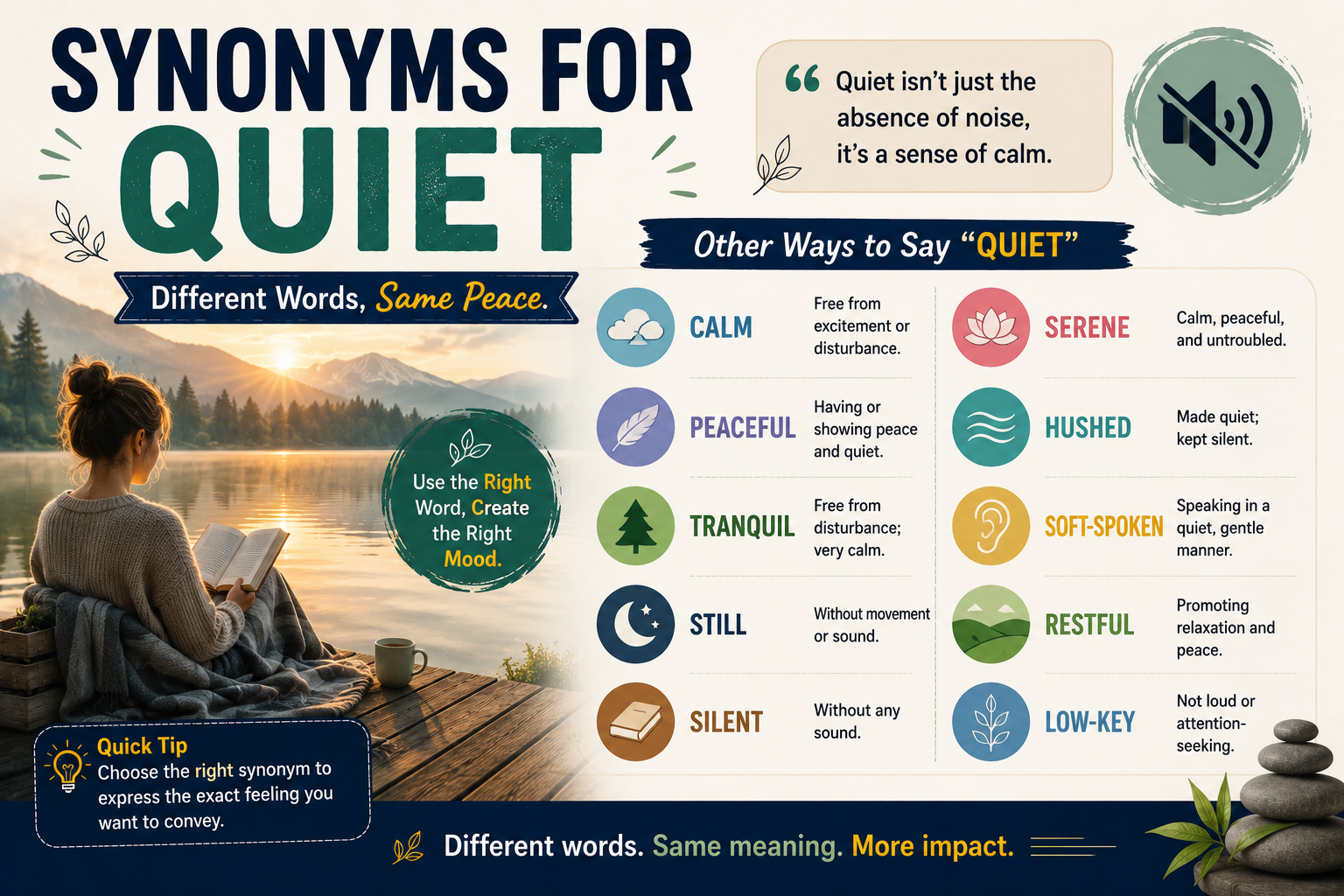
Synonyms for quiet include silent, peaceful, calm, still, hushed, tranquil, serene, noiseless, and mute. The best synonym depends on whether you mean low noise, a calm person, or a peaceful place.
Quiet is a simple word, but it can describe many different things. Imagine walking into a library after spending an hour in a busy street. The sudden quiet feels almost surprising. There is little or no noise, and your mind feels calmer.
We use quiet to talk about sound, people, places, moods, and situations. That is why finding the right synonym can sometimes be hard. Silent may mean no sound at all, while peaceful often describes a calm and pleasant feeling.
Learning synonyms helps you avoid repeating the same word. It also helps you choose a word that fits your exact meaning. This guide explains the meaning, history, pronunciation, grammar, and 30 useful synonyms for quiet. You will also see simple examples and semantic groups to help you choose the right word.
Meaning of quiet
Definition
Quiet (Adjective, Noun, Verb):
Quiet means making little or no noise, or having a calm and peaceful nature.
As an adjective, it can describe a person, place, sound, or situation.
- The classroom was quiet during the exam.
- She is a quiet person who enjoys reading.
As a noun, quiet means a state with little or no noise.
- I enjoy the quiet of the countryside.
As a verb, quiet means to make someone or something less noisy or less active.
- The teacher asked the students to quiet down.
Connotative Meaning
Connotation means the feeling or idea that a word suggests beyond its basic meaning.
- Positive tone: peaceful, relaxing, calm, soothing
- Negative tone: silent, withdrawn, or unresponsive can sometimes suggest loneliness or lack of communication.
- Neutral tone: quiet, still, and noiseless can simply describe a lack of sound or movement.
The meaning often depends on the situation.
Etymology of quiet
The word quiet comes from Latin quietus, meaning “at rest” or “free from disturbance.” It entered English through Old French and Middle English.
Old English (450–1100)
Quiet was not a common native Old English word. English speakers mainly used native words such as still and soft to express related ideas.
Middle English (1100–1500)
The word entered English through Anglo-French and Middle English forms related to Old French quiet, from Latin quietus. Its meaning was linked to rest, calm, and freedom from disturbance.
Modern English (1500–Present)
Over time, quiet developed several uses. Today, it can describe low sound, peaceful conditions, calm behavior, or a lack of activity.
Pronunciation (IPA)
- IPA: /ˈkwaɪ.ət/
- Syllables: qui-et
- Stress: The first syllable is stressed.
The word is usually pronounced KWY-uht, not as one long syllable.
Affixation Pattern of quiet
- Root: quiet
- Prefix: None
- Suffix: None in the basic word
- Origin: Latin quietus → Old French → Middle English → Modern English
Word formations
- quiet — adjective, noun, verb
- quietly — adverb
- quietness — noun
- quieten — verb
- quieted — past-tense verb
- quieting — present participle/gerund
- quieter — comparative adjective
- quietest — superlative adjective
30 Synonyms of quiet With Meaning & Examples
1. Silent (Adjective)
Meaning: Having no sound or making no noise.
Examples:
- The room became silent after the announcement.
- Please remain silent during the test.
2. Still (Adjective)
Meaning: Having little or no movement or noise.
Examples:
- The lake was still at sunrise.
- Everyone stood still during the ceremony.
3. Calm (Adjective)
Meaning: Peaceful and free from excitement, anger, or worry.
Examples:
- She remained calm during the interview.
- The sea was calm in the morning.
4. Peaceful (Adjective)
Meaning: Quiet and free from trouble or disturbance.
Examples:
- We spent a peaceful evening at home.
- The village is small and peaceful.
5. Tranquil (Adjective)
Meaning: Very calm, quiet, and relaxing.
Examples:
- The garden was tranquil in the early morning.
- They stayed beside a tranquil lake.
6. Serene (Adjective)
Meaning: Calm, peaceful, and free from stress.
Examples:
- Her face looked serene.
- The mountain view was serene and beautiful.
7. Hushed (Adjective)
Meaning: Very quiet, especially because people are speaking softly.
Examples:
- The crowd became hushed before the performance.
- They spoke in hushed voices.
8. Noiseless (Adjective)
Meaning: Making no noise.
Examples:
- The machine operates almost noiselessly.
- He made a noiseless exit.
9. Soundless (Adjective)
Meaning: Without any sound.
Examples:
- The bird flew through the air in a soundless motion.
- The room was completely soundless.
10. Muted (Adjective)
Meaning: Made softer or less loud.
Examples:
- We heard muted voices from the next room.
- The television remained muted during the meeting.
11. Soft (Adjective)
Meaning: Making little noise or having a low volume.
Examples:
- She spoke in a soft voice.
- We heard soft music in the background.
12. Low (Adjective)
Meaning: Not loud in volume.
Examples:
- Keep your voice low in the library.
- The radio was playing at a low volume.
13. Restful (Adjective)
Meaning: Helping you relax or rest.
Examples:
- The cabin provided a restful environment.
- I had a restful afternoon at home.
14. Relaxing (Adjective)
Meaning: Helping you feel less tense or worried.
Examples:
- The quiet beach was very relaxing.
- We had a relaxing weekend.
15. Soothing (Adjective)
Meaning: Having a calming or comforting effect.
Examples:
- Her soothing voice helped the child sleep.
- The sound of rain was soothing.
16. Untroubled (Adjective)
Meaning: Free from worry, problems, or disturbance.
Examples:
- They enjoyed an untroubled afternoon.
- His childhood seemed untroubled.
17. Undisturbed (Adjective)
Meaning: Not interrupted, disturbed, or changed.
Examples:
- The forest remained undisturbed.
- She wanted a few minutes of undisturbed work.
18. Secluded (Adjective)
Meaning: Away from other people and places.
Examples:
- They found a secluded spot near the lake.
- The hotel is in a secluded area.
19. Retiring (Adjective)
Meaning: Shy and likely to avoid attention or social activity.
Examples:
- He is a retiring young man.
- Her retiring nature made her avoid large parties.
20. Reserved (Adjective)
Meaning: Not openly showing feelings or speaking much.
Examples:
- The new student was quiet and reserved.
- He is polite but reserved with strangers.
21. Introverted (Adjective)
Meaning: More comfortable with private activities than large social groups.
Examples:
- She is introverted and enjoys reading alone.
- His introverted nature does not mean he dislikes people.
22. Taciturn (Adjective)
Meaning: Usually speaking very little.
Examples:
- The taciturn man answered with one word.
- His taciturn nature made him hard to read.
23. Peaceable (Adjective)
Meaning: Calm and not likely to cause conflict.
Examples:
- The group reached a peaceable agreement.
- He is known as a peaceable person.
24. Sedate (Adjective)
Meaning: Calm, quiet, and not very active.
Examples:
- The event had a sedate atmosphere.
- They enjoyed a sedate dinner at home.
25. Placid (Adjective)
Meaning: Calm and not easily upset.
Examples:
- The dog has a placid nature.
- We watched the placid water from the shore.
26. Composed (Adjective)
Meaning: Calm and in control of your feelings.
Examples:
- She stayed composed during the difficult meeting.
- He looked composed despite the pressure.
27. Unruffled (Adjective)
Meaning: Calm and not upset by problems.
Examples:
- She remained unruffled by the criticism.
- His unruffled manner impressed the team.
28. Subdued (Adjective)
Meaning: Quiet, gentle, or less energetic than usual.
Examples:
- The party had a subdued mood.
- His voice was subdued after the news.
29. Calmness (Noun)
Meaning: A peaceful state without stress or excitement.
Examples:
- Her calmness helped the team.
- I admire his calmness under pressure.
30. Quietness (Noun)
Meaning: The state of being quiet.
Examples:
- I enjoy the quietness of the countryside.
- The quietness of the room helped me focus.
Note: Not every word above is interchangeable with quiet in every sentence. Words such as silent focus on sound, while reserved describes personality and tranquil describes a peaceful atmosphere.
Prototype Meaning
The most typical meaning of quiet is having little or no noise. When people hear the word, they often imagine a calm room, an empty street, a peaceful library, or someone speaking in a low voice. The word can also describe a person’s behavior or a peaceful state of mind.
Prototype Categorization
The 30 synonyms can be grouped by their closest meaning:
- No sound: silent, noiseless, soundless, hushed
These are best when you want to stress the absence of sound. - Low sound: soft, low, muted, subdued
Use these when there is some sound, but it is not loud. - Peace and relaxation: calm, peaceful, tranquil, serene, restful, relaxing, soothing, placid
These words focus on a pleasant and calming atmosphere. - Stillness or lack of disturbance: still, undisturbed, untroubled
These work well when nothing is moving, changing, or causing trouble. - Quiet personality: reserved, retiring, introverted, taciturn
These describe people who speak less or prefer limited social interaction. - Calm behavior: composed, unruffled, sedate, peaceable
These suggest control, calmness, or a lack of conflict.
This grouping helps you avoid choosing a synonym that sounds unnatural. For example, silent is better for a room with no sound, while reserved is better for a person who does not speak much.
Antonyms of quiet
1. Loud (Adjective)
Meaning: Making a lot of noise.
2. Noisy (Adjective)
Meaning: Full of loud or unwanted sounds.
3. Boisterous (Adjective)
Meaning: Very noisy, energetic, and lively.
4. Talkative (Adjective)
Meaning: Speaking often and a lot.
5. Chatty (Adjective)
Meaning: Enjoying talking to other people.
6. Disturbed (Adjective)
Meaning: Interrupted or affected by noise, activity, or trouble.
7. Restless (Adjective)
Meaning: Unable to stay calm or still.
Short Questions and Answers
What does quiet mean?
Quiet usually means making little or no noise. It can also describe someone who speaks little or a situation that feels calm and peaceful.
When should quiet be used?
Use quiet when you want a simple, general word for low noise or calm behavior. It works well in both everyday and formal English.
Is quiet positive or negative?
Quiet is usually neutral or positive. A quiet place may feel peaceful, but a quiet person may seem shy or distant depending on the context.
How is quiet different from similar words?
Quiet is a broad word. Silent means no sound, calm focuses on emotions or activity, peaceful suggests a pleasant atmosphere, and reserved usually describes a person’s behavior.
Is silent a synonym for quiet?
Yes, in many situations. However, silent is stronger because it usually suggests a complete lack of sound.
Can quiet describe a person?
Yes. A quiet person usually does not speak much. However, it does not always mean the person is shy or introverted.
What is the noun form of quiet?
The noun is quietness. Another common noun is quiet, as in “I enjoy the quiet.”
Conclusion
Learning quiet and its synonyms can make your English more precise and natural. The word quiet has several uses, so the best alternative depends on what you want to say. Use silent when there is no sound, calm for emotions or behavior, and peaceful or tranquil for a relaxing setting. Words such as reserved, taciturn, and introverted are better when describing a person’s social behavior.
Knowing these differences helps you avoid repetition and choose stronger words in essays, emails, stories, and everyday speech. It also builds your vocabulary and gives you more confidence as an English learner. Try learning two or three synonyms each day and use them in your own sentences. Practice them often, and your English will become clearer and more flexible.

Emily Watson is an English language writer and vocabulary specialist dedicated to helping readers improve their communication skills. She writes clear, easy-to-understand guides on synonyms, word meanings, grammar, and word usage.