Explore the best synonyms for “chuckle,” including giggle, snicker, chortle, and more, with clear meanings and examples.
Meaning of Chuckle
Definition
Chuckle (Verb/Noun):
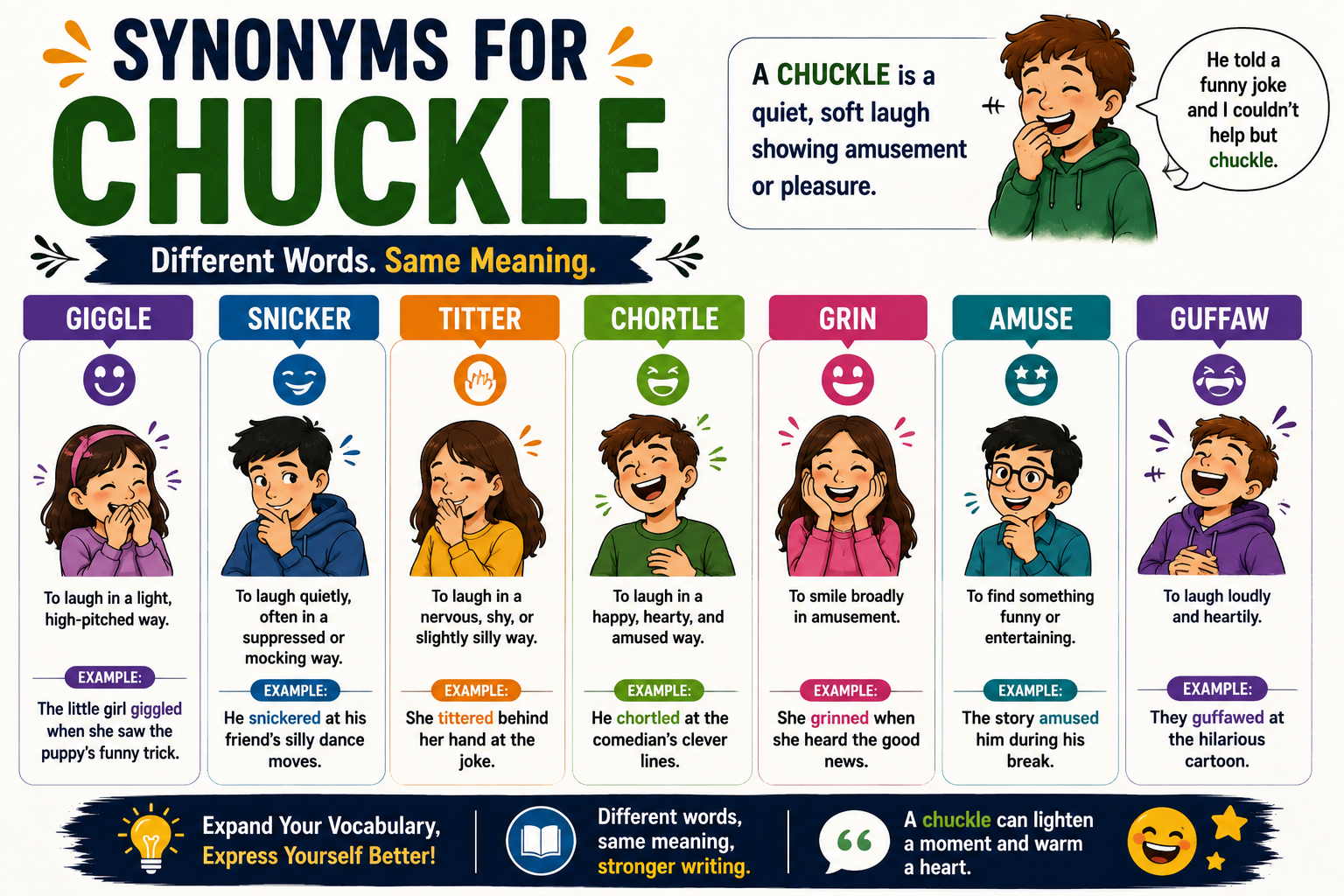
To chuckle means to laugh quietly or softly, often because something is funny, amusing, or pleasing. As a noun, a chuckle is a quiet, gentle laugh.
Examples
- She chuckled when she heard the funny story.
- His joke made everyone chuckle.
- I could hear a quiet chuckle from the back of the room.
Connotative Meaning
Connotation means the feeling or idea that a word suggests beyond its basic meaning.
- Positive tone: A warm, friendly, or amused feeling.
- Negative tone: It can sometimes suggest that someone is laughing at another person.
- Neutral tone: A simple, quiet laugh caused by mild amusement.
Etymology
The word chuckle has an interesting history. Its exact origin is not fully certain, but it developed in English as a word for a soft or quiet laugh.
- Old English (450–1100): There is no direct modern form of chuckle in Old English.
- Middle English (1100–1500): Related forms developed as English gained more words for different kinds of laughter.
- Modern English (1500–Present): Chuckle became established as a word for a quiet, low laugh. It is now common in everyday English.
Unlike laugh, which covers many types of laughter, chuckle usually suggests a softer and more controlled laugh.
Pronunciation (IPA)
- IPA: /ˈtʃʌk.əl/
- Syllables: chuck-le
- Stress: First syllable
Affixation Pattern of Chuckle
- Root: chuckle
- Prefix: None
- Suffix: The -le ending is part of the word form rather than a productive English suffix in this case.
Word formations
- Chuckle — verb/noun
- Chuckled — verb, past tense
- Chuckling — verb, present participle
- Chuckles — verb/noun, third-person singular or plural noun
- Chuckler — noun, a person who chuckles
30 Synonyms of Chuckle With Meaning & Examples
Note: These words are not all exact replacements for chuckle. Some describe a similar type of laughter, while others describe a stronger, louder, or more specific reaction.
1. Giggle (Verb/Noun)
Meaning: To laugh lightly, often in a high or playful way.
Examples:
- The children giggled at the silly joke.
- Her giggle filled the quiet room.
2. Laugh (Verb/Noun)
Meaning: To make sounds that show amusement or happiness.
Examples:
- We laughed at his funny story.
- Her laugh was warm and friendly.
3. Snicker (Verb/Noun)
Meaning: To laugh quietly, often in a rude or secretive way.
Examples:
- The students snickered during the lesson.
- He gave a quiet snicker.
4. Titter (Verb/Noun)
Meaning: To laugh quietly in a nervous or silly way.
Examples:
- She tittered when everyone looked at her.
- A nervous titter came from the audience.
5. Chortle (Verb/Noun)
Meaning: To laugh with pleasure or amusement.
Examples:
- Grandpa chortled at the clever joke.
- He gave a happy chortle.
6. Gigglefit (Noun)
Meaning: A period when someone cannot stop giggling.
Examples:
- The girls had a gigglefit during the movie.
- I had a gigglefit after hearing the strange story.
7. Snort (Verb/Noun)
Meaning: To make a sudden sound through the nose while laughing.
Examples:
- She snorted with laughter.
- His laugh ended in a loud snort.
8. Smile (Verb/Noun)
Meaning: To show happiness or amusement with your face.
Examples:
- She smiled at the funny comment.
- His smile showed that he enjoyed the joke.
9. Grin (Verb/Noun)
Meaning: To smile widely because you are happy or amused.
Examples:
- He grinned at his friend’s joke.
- She had a huge grin on her face.
10. Beam (Verb/Noun)
Meaning: To smile very happily.
Examples:
- The winner beamed with joy.
- He was beaming after hearing the good news.
11. Amuse (Verb)
Meaning: To make someone feel entertained or pleased.
Examples:
- The comedian amused the audience.
- Her story amused everyone at dinner.
12. Merriment (Noun)
Meaning: Fun, happiness, and laughter.
Examples:
- The party was filled with merriment.
- Their merriment could be heard outside.
13. Mirth (Noun)
Meaning: Great amusement or happiness shown through laughter.
Examples:
- The joke caused much mirth.
- His face showed mirth after the funny remark.
14. Guffaw (Verb/Noun)
Meaning: To laugh loudly and deeply.
Examples:
- He guffawed at the joke.
- A loud guffaw came from the next room.
15. Roar (Verb/Noun)
Meaning: To laugh very loudly.
Examples:
- The audience roared with laughter.
- A roar of laughter came from the crowd.
16. Cackle (Verb/Noun)
Meaning: To laugh in a loud, sharp, or unpleasant way.
Examples:
- The villain cackled after his plan worked.
- We heard her strange cackle.
17. Howl (Verb/Noun)
Meaning: To laugh very loudly and for a long time.
Examples:
- We howled with laughter at the video.
- His story made us howl.
18. Snigger (Verb/Noun)
Meaning: To laugh quietly in a rude or disrespectful way.
Examples:
- The boys sniggered at the mistake.
- I heard a snigger behind me.
19. Tittering (Noun/Adjective)
Meaning: Quiet, nervous, or silly laughter.
Examples:
- The room was full of tittering.
- Her tittering made the situation awkward.
20. Laughter (Noun)
Meaning: The sound or act of laughing.
Examples:
- Their laughter echoed through the house.
- We could hear laughter from outside.
21. Amusement (Noun)
Meaning: A feeling of enjoyment caused by something funny or entertaining.
Examples:
- She watched the scene with amusement.
- His face showed amusement.
22. Delight (Noun/Verb)
Meaning: A strong feeling of pleasure or happiness.
Examples:
- The children laughed with delight.
- The funny story delighted the audience.
23. Enjoyment (Noun)
Meaning: The feeling of getting pleasure from something.
Examples:
- We watched the show with great enjoyment.
- His enjoyment was clear from his smile.
24. Light laugh (Noun)
Meaning: A soft and gentle laugh.
Examples:
- She gave a light laugh at the comment.
- His light laugh made everyone feel relaxed.
25. Soft laugh (Noun)
Meaning: A quiet laugh that is not loud or strong.
Examples:
- He gave a soft laugh.
- Her soft laugh showed that she understood the joke.
26. Quiet laugh (Noun)
Meaning: A laugh that is controlled and not loud.
Examples:
- She gave a quiet laugh during the meeting.
- His quiet laugh showed mild amusement.
27. Amused laugh (Noun)
Meaning: A laugh that shows that something is funny or entertaining.
Examples:
- He gave an amused laugh.
- Her amused laugh followed the clever comment.
28. Smirk (Verb/Noun)
Meaning: To smile in a way that can suggest confidence, pride, or disrespect.
Examples:
- He smirked after winning the argument.
- She gave a small smirk.
29. Snickerle (Noun)
Meaning: A rare or playful word related to a small, suppressed laugh.
Examples:
- He let out a little snickerle at the joke.
- Her snickerle was barely noticeable.
30. Chuckling laugh (Noun)
Meaning: A quiet, warm laugh that shows mild amusement.
Examples:
- His chuckling laugh made the story more enjoyable.
- I heard her chuckling laugh from the other room.
Prototype Meaning
The most typical meaning of chuckle is a quiet, gentle laugh. When people hear the word, they often imagine someone smiling and making a low, soft laughing sound after hearing something amusing. A chuckle is usually less powerful than a guffaw or roar of laughter. It can also feel warmer and more relaxed than a snicker.
Prototype Categorization
The 30 alternatives above can be grouped by the type and strength of laughter.
- Quiet and gentle laughter: chuckle, light laugh, soft laugh, quiet laugh, amused laugh
- Playful laughter: giggle, gigglefit, titter
- Secretive or rude laughter: snicker, snigger, smirk
- Loud laughter: guffaw, roar, howl, cackle
- Positive feelings: mirth, merriment, delight, enjoyment, amusement
- Facial expressions: smile, grin, beam
- General laughter terms: laugh, laughter
- Physical laughter sounds: snort
This grouping helps you choose the right word. Use giggle for light, playful laughter. Choose guffaw for loud laughter. Use snicker when the laughter feels rude or secretive. For a warm and quiet laugh, chuckle is often the best choice.
Antonyms of Chuckle
There is no single perfect antonym for chuckle. However, these words can express the opposite emotional or physical response.
1. Cry (Verb)
Meaning: To produce tears because of sadness, pain, or strong emotion.
2. Weep (Verb)
Meaning: To cry, often with strong sadness.
3. Sob (Verb/Noun)
Meaning: To cry with short, uneven breaths.
4. Frown (Verb/Noun)
Meaning: To show unhappiness or concern with your face.
5. Scowl (Verb/Noun)
Meaning: To look angry or displeased.
6. Sigh (Verb/Noun)
Meaning: To breathe out deeply, often because of sadness, tiredness, or worry.
Short Questions and Answers
What does chuckle mean?
Chuckle means to laugh quietly and gently. It often shows mild amusement or pleasure.
When should chuckle be used?
Use chuckle when someone gives a small, quiet laugh. It works well for funny comments, amusing stories, and pleasant situations.
Is chuckle positive or negative?
It is usually positive or neutral. However, the meaning can change if someone chuckles at another person’s mistake or problem.
How is chuckle different from similar words?
A chuckle is usually quiet and controlled. A giggle can sound playful, while a guffaw is much louder. A snicker often has a rude or secretive feeling.
Is chuckle a noun or a verb?
It can be both. You can say, “She began to chuckle,” or “I heard a chuckle.”
What is the strongest synonym for chuckle?
There is no single strongest synonym. Guffaw, roar, and howl describe much louder laughter than a chuckle.
Can I use chuckle in formal writing?
Yes. Chuckle is a standard English word. It can be used in formal writing when describing a person’s reaction, although words such as laugh may be more common in academic writing.
Conclusion
Learning synonyms for chuckle helps you describe laughter with more detail. The word chuckle usually means a quiet and gentle laugh. However, English has many words for different types of laughter.
You can use giggle for playful laughter, snicker for quiet and sometimes rude laughter, and guffaw for a loud laugh. Words such as smile, grin, amusement, and mirth can also describe related feelings or actions.
The best synonym depends on the sound, strength, emotion, and situation. Choosing the right word makes your writing clearer and more natural. It also helps you avoid repeating the same word.
Practice these words in short sentences each day. Soon, you will know exactly which one fits your meaning. Bookmark this guide and use it whenever you need a better word for chuckle.

Emma Collins is an English language expert and vocabulary writer with a passion for making English easier to understand. She specializes in synonyms, word meanings, word choice, and clear writing tips.