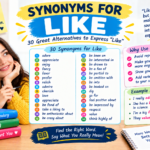
Like is a common English word that can show enjoyment, preference, similarity, or affection. For example, you might say, “I like this book” when you enjoy reading it. You may also say, “She looks like her mother” when two people look similar. Because like has so many uses, it appears in everyday speech, emails, stories, and online writing.
Learning synonyms for like helps you avoid repeating the same word. It also helps you express your ideas more clearly. English learners can use different words to show stronger feelings, simple preferences, similarity, or admiration. Writers can also choose words that fit the exact meaning and tone they want.
This guide explains the meaning, grammar, history, pronunciation, word formation, synonyms, semantic groups, and antonyms of like with simple examples.
Meaning of Like
Definition
Like (Verb): To enjoy, prefer, or have a positive feeling toward someone or something.
Like (Preposition/Conjunction): Used to show that someone or something is similar to another person or thing.
Like (Noun): An act of showing approval or enjoyment, especially on social media.
Examples
- I like listening to music after work.
- She likes her new teacher.
- Your jacket looks like mine.
- He runs like a professional athlete.
Connotative Meaning
Connotation is the feeling or idea that a word suggests beyond its basic meaning.
- Positive tone: Like can express enjoyment, affection, approval, or admiration.
- Negative tone: The word itself is usually neutral, but the context can show dislike or criticism.
- Neutral tone: Like can simply describe similarity, as in “He looks like his father.”
Etymology
Old English (450–1100)
The verb like is connected to Old English gelīcian, meaning “to please” or “to be pleasing.” The word is related to gelīc, meaning “similar” or “like.”
Middle English (1100–1500)
During Middle English, forms such as liken and liken were used for meanings connected with pleasing, enjoying, and being similar. The word continued to develop several related uses.
Modern English (1500–Present)
In Modern English, like became one of the most flexible words in the language. It can work as a verb, noun, adjective, preposition, conjunction, and informal discourse marker. Its common meanings include enjoying something, showing preference, and comparing two things.
Pronunciation (IPA)
- IPA: /laɪk/
- Syllables: like
Affixation Pattern of Like
- Root: like
- Prefix: None in the basic word.
- Suffix: None in the basic word.
- Word formations:
- likes — verb/noun
- liked — verb/adjective
- liking — noun/verb form
- likely — adjective/adverb
- likeness — noun
- likable / likeable — adjective
- dislike — verb/noun
- disliked — verb/adjective
- disliking — noun/verb form
- unlike — adjective/preposition
- likewise — adverb
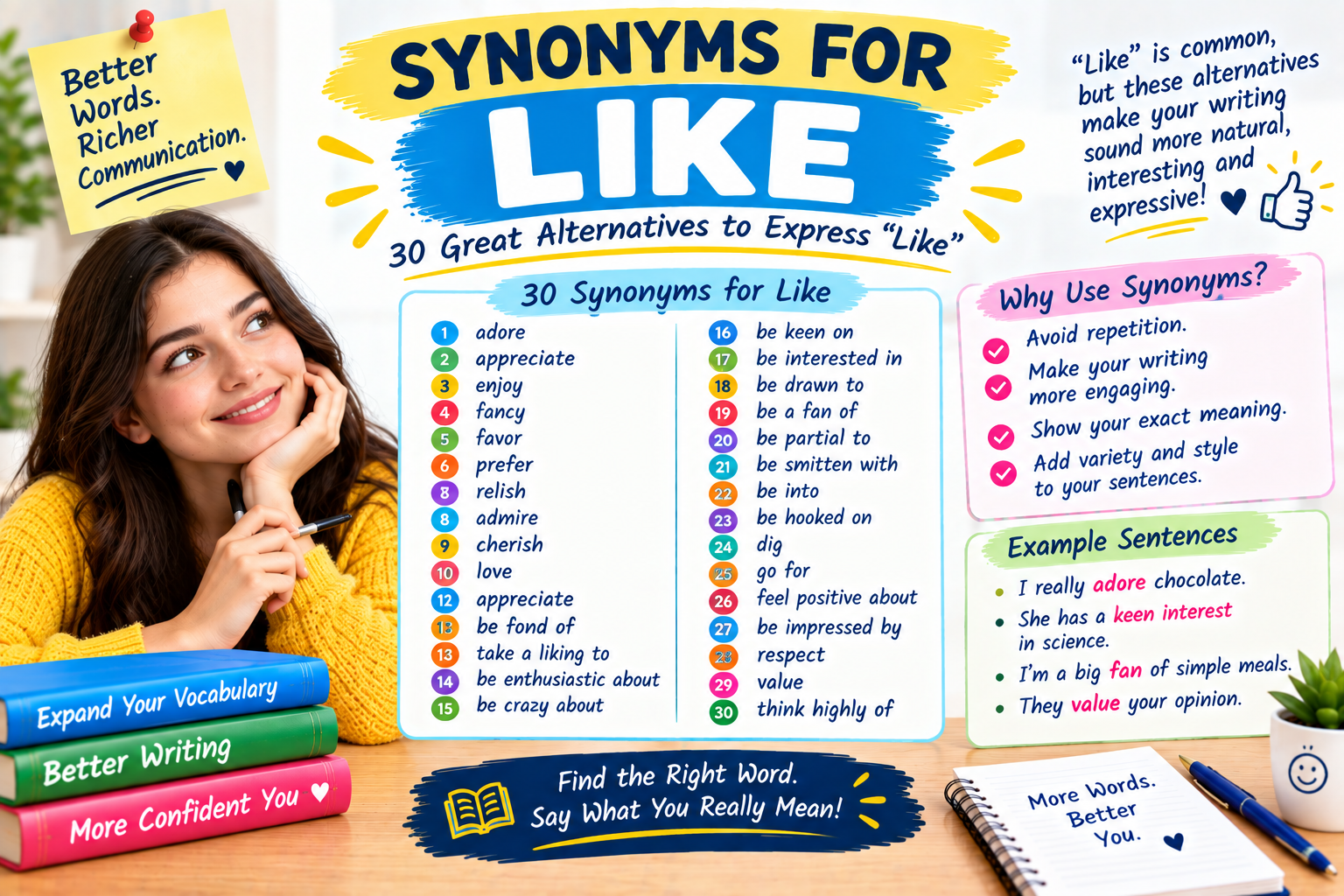
25 Synonyms of Like With Meaning & Examples
Because like has several meanings, not every synonym works in every sentence. The following alternatives are grouped by their closest meaning.
1. Enjoy (Verb)
Meaning: To get pleasure or satisfaction from something.
Examples:
- I enjoy reading mystery novels.
- She enjoys spending time with her family.
2. Love (Verb)
Meaning: To have a very strong feeling of affection or enjoyment.
Examples:
- I love this song.
- They love visiting the beach.
3. Prefer (Verb)
Meaning: To choose or favor one thing more than another.
Examples:
- I prefer tea to coffee.
- She prefers working in the morning.
4. Admire (Verb)
Meaning: To respect or appreciate someone or something greatly.
Examples:
- I admire her dedication.
- Many students admire their teacher.
5. Appreciate (Verb)
Meaning: To recognize the value or good qualities of something or someone.
Examples:
- I appreciate your help.
- She appreciates good music.
6. Favor (Verb)
Meaning: To prefer or support one person or thing.
Examples:
- He favors simple designs.
- She favors the second option.
7. Fancy (Verb)
Meaning: To want, enjoy, or feel attracted to something or someone.
Examples:
- Do you fancy a cup of tea?
- He fancies Italian food tonight.
8. Relish (Verb)
Meaning: To enjoy something greatly.
Examples:
- She relished the chance to travel.
- He relishes difficult challenges.
9. Adore (Verb)
Meaning: To love or like someone or something very much.
Examples:
- She adores her little dog.
- I adore this beautiful garden.
10. Cherish (Verb)
Meaning: To value someone or something deeply and lovingly.
Examples:
- I cherish our friendship.
- She cherishes her childhood memories.
11. Appreciate (Verb)
Meaning: To enjoy or understand the value of something.
Examples:
- He appreciates classical music.
- We appreciate the beauty of nature.
12. Support (Verb)
Meaning: To approve of or stand behind a person, idea, or cause.
Examples:
- I support your decision.
- Many people support the new project.
13. Approve (Verb)
Meaning: To consider something acceptable or good.
Examples:
- I approve of your plan.
- Her parents approved of her choice.
14. Relate to (Verb)
Meaning: To understand or identify with someone’s experience or feelings.
Examples:
- I can relate to your experience.
- Many students relate to the character.
15. Favorable Toward (Adjective Phrase)
Meaning: Showing approval or a positive attitude toward someone or something.
Examples:
- The manager was favorable toward the proposal.
- The audience was favorable toward the new design.
16. Resemble (Verb)
Meaning: To look or seem similar to someone or something.
Examples:
- You resemble your father.
- The building resembles a small castle.
17. Resembling (Adjective)
Meaning: Looking or appearing similar to someone or something.
Examples:
- She wore a dress resembling a traditional gown.
- The plant has leaves resembling small feathers.
18. Similar to (Adjective Phrase)
Meaning: Having qualities or features that are almost the same as something else.
Examples:
- This design is similar to the old one.
- Your answer is similar to mine.
19. Alike (Adjective/Adverb)
Meaning: Similar in appearance, nature, or qualities.
Examples:
- The two brothers look alike.
- The houses are alike in many ways.
20. Comparable (Adjective)
Meaning: Similar enough to be compared with another person or thing.
Examples:
- The two products are comparable in quality.
- Her performance is comparable to that of an expert.
21. Kindred (Adjective)
Meaning: Similar in character, nature, or interests.
Examples:
- We have kindred interests.
- She met people with kindred ideas.
22. Such As (Phrase)
Meaning: Used to introduce examples that are similar to something mentioned.
Examples:
- I enjoy outdoor activities such as hiking.
- Fruits such as apples and oranges are popular.
23. Seem (Verb)
Meaning: To appear to be a certain way.
Examples:
- You seem like a kind person.
- The task seems like a good opportunity.
24. Respective (Adjective)
Meaning: Relating separately to the people or things already mentioned.
Examples:
- The students returned to their respective classrooms.
- They went to their respective homes.
25. Liken (Verb)
Meaning: To compare one person or thing with another because of a similarity.
Examples:
- The writer likened the city to a sleeping giant.
- She likened his voice to a soft melody.
Prototype Meaning
The most common meaning of like is to enjoy, prefer, or feel positively about someone or something. When people hear “I like it,” they usually understand that the speaker has a favorable feeling toward the thing being discussed. For example, “I like this movie” means the speaker enjoys or approves of the movie.
However, like is also commonly used to show similarity. In “She looks like her sister,” it does not mean that she enjoys her sister. It means that the two people look similar.
Prototype Categorization
The synonyms for like can be grouped according to meaning:
- Enjoyment and pleasure: enjoy, relish, adore, fancy — useful when you want to show that something gives you pleasure.
- Strong affection: love, adore, cherish — useful for powerful feelings toward people, activities, or things.
- Preference and approval: prefer, favor, approve, appreciate, support — useful when choosing or showing approval.
- Similarity: resemble, alike, similar to, comparable, kindred, liken — useful when comparing people or things.
- Connection and understanding: relate to, seem — useful when talking about shared experiences or appearances.
- Examples and comparison: such as — useful when giving examples of things in the same general group.
This grouping helps writers choose a synonym based on the exact meaning they want instead of replacing like with a word that does not fit the sentence.
Antonyms of Like
- Dislike (Verb): To have a negative feeling toward someone or something.
- Hate (Verb): To strongly dislike someone or something.
- Detest (Verb): To dislike something very strongly.
- Reject (Verb): To refuse to accept or approve of something.
- Avoid (Verb): To stay away from someone or something.
- Differ (Verb): To be different rather than similar.
- Unlike (Preposition/Adjective): Not similar to someone or something.
- Dissimilar (Adjective): Not alike or similar.
Short Questions and Answers
What does like mean?
Like can mean to enjoy or prefer something. It can also mean that two people or things are similar.
When should like be used?
Use like when you want to show enjoyment, preference, affection, or similarity. The sentence context tells you which meaning applies.
Is like positive or negative?
Like is usually positive when it means enjoyment or approval. When it means similarity, it is generally neutral.
How is like different from similar words?
The difference depends on the meaning. Enjoy focuses on pleasure, prefer focuses on choice, love shows stronger affection, and resemble describes similarity.
Conclusion
Learning synonyms for like can make your English more flexible and natural. Instead of using the same word again and again, you can choose enjoy for pleasure, prefer for choice, love for strong affection, or resemble for similarity. This makes your writing clearer and helps you express your exact meaning.
For English learners, these alternatives are also useful for speaking, essays, emails, stories, and everyday conversations. Content writers can use them to avoid repetition and create more engaging sentences. Start by learning a few words at a time and use them in your own sentences. With regular practice, your vocabulary will grow, your writing will become stronger, and you will feel more confident using English.

Sarah Linguist is a passionate language enthusiast who loves exploring words, meanings, and synonyms.
She creates clear, easy-to-understand content to help readers improve their vocabulary and English skills.
Through SynonymsGuide.com, Sarah makes finding the right words simple, useful, and enjoyable.