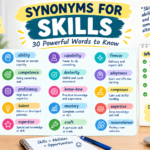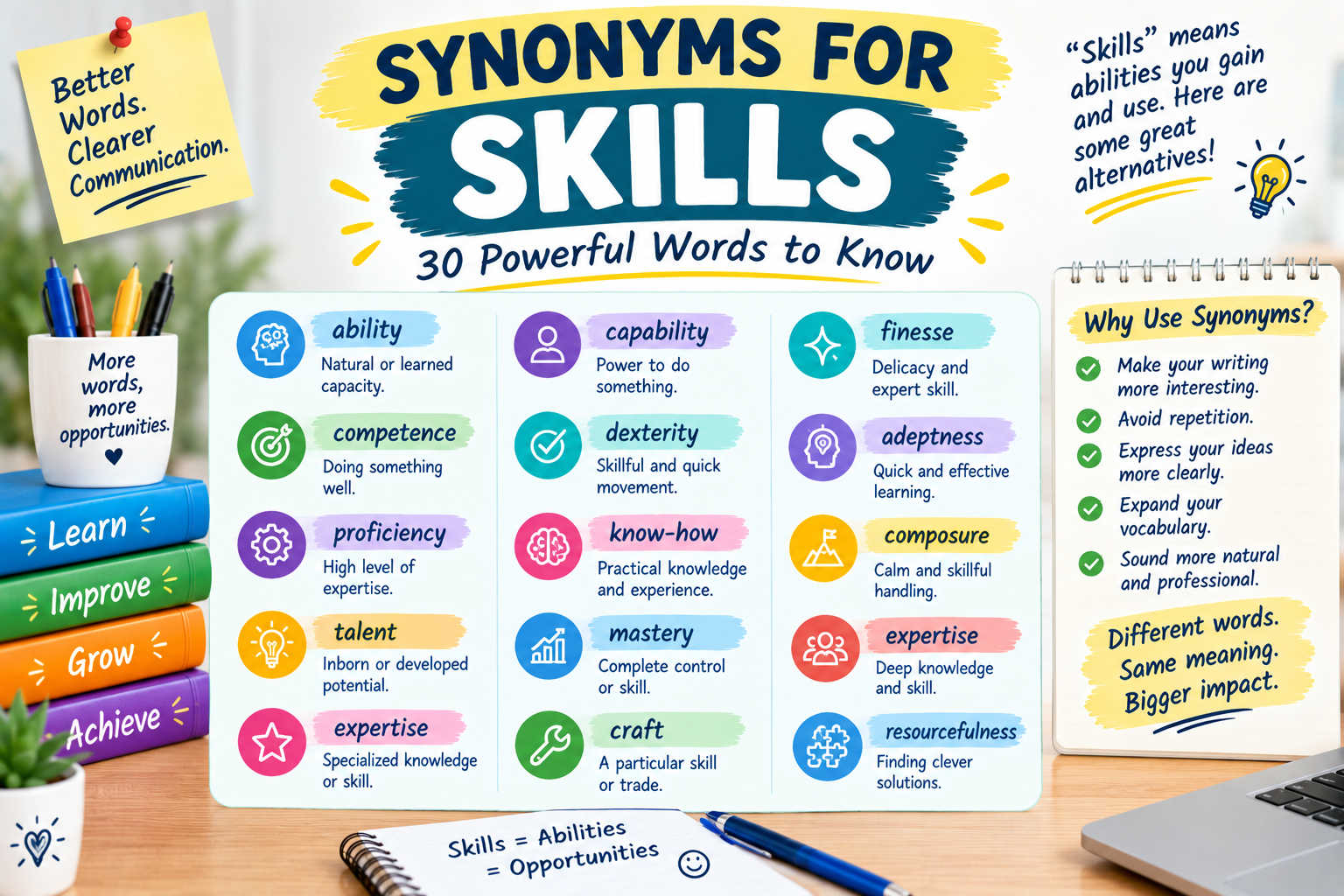
Synonyms for skills include abilities, talents, capabilities, expertise, competencies, strengths, proficiencies, aptitudes, techniques, knowledge, and qualifications. The best synonym depends on the type of skill and the context.
Skills are the abilities you develop that help you do something well. For example, a student may have strong writing skills, while a worker may have excellent communication or computer skills. The word is common in school, work, business, sports, and everyday life. However, using skills too often can make your writing repetitive. Learning synonyms helps you choose more precise words and describe abilities in a stronger way. This is useful for English learners, students, job seekers, teachers, and content writers. In this guide, you will learn the meaning of skills, its grammar, history, pronunciation, and word formation. You will also explore 26 useful synonyms with simple meanings and examples. Semantic categories, antonyms, and common questions will help you understand which word works best in each situation.
Meaning of Skills
Definition
Skills (Noun): Skills are abilities or learned techniques that help a person perform a task well.
A skill can be learned through education, training, practice, or experience.
Examples
- She has excellent skills in communication and teamwork.
- Learning new skills can help you find better career opportunities.
Connotative Meaning
- Positive tone: Skills often suggest ability, competence, talent, and personal growth.
- Negative tone: The word can sometimes suggest a lack of ability when used in phrases such as “poor skills.”
- Neutral tone: Skills can simply describe abilities needed to perform a task.
(Connotation: the feeling or association that a word suggests beyond its basic meaning.)
Etymology
- Old English (450–1100): The word skill has roots in Old Norse rather than native Old English. The Old Norse word skil was linked to knowledge, distinction, or discernment.
- Middle English (1100–1500): Middle English used forms such as skil and skille. The word developed meanings connected with knowledge, understanding, and the ability to do something.
- Modern English (1500–Present): Skill gradually became strongly associated with learned ability, practical knowledge, and competence. The plural form skills is now widely used for abilities in work, education, crafts, sports, and daily life.
Pronunciation (IPA)
- IPA: /skɪlz/
- Syllables: skills
Affixation Pattern of Skills
- Root: skill
- Prefix: None
- Suffix: None in the basic noun
Word formations:
- skill — noun
- skills — plural noun
- skilled — adjective
- skilling — noun/verb form
- skillfully — adverb
- skillful — adjective
- skillfulness — noun
- unskilled — adjective
- skilled worker — noun phrase
- skill-based — adjective
- skillset — noun
The plural skills is formed by adding the inflectional suffix -s to skill. Words such as skillful and unskilled use derivational elements to create new forms.
26 Synonyms of Skills With Meaning & Examples
1. Abilities (Noun)
Meaning: Abilities are the things a person can do well.
Examples:
- She has strong abilities in mathematics.
- His communication abilities impressed the manager.
2. Talents (Noun)
Meaning: Talents are natural abilities that help someone perform something very well.
Examples:
- She has several artistic talents.
- His musical talents became clear at a young age.
3. Capabilities (Noun)
Meaning: Capabilities are the abilities or power needed to do something.
Examples:
- The job requires strong technical capabilities.
- The new software has advanced analytical capabilities.
4. Expertise (Noun)
Meaning: Expertise is high-level knowledge or skill in a particular area.
Examples:
- She has expertise in digital marketing.
- His technical expertise helped solve the problem.
5. Competencies (Noun)
Meaning: Competencies are the skills and knowledge needed to perform a task effectively.
Examples:
- The course develops important professional competencies.
- Employers look for strong leadership competencies.
6. Proficiencies (Noun)
Meaning: Proficiencies are abilities that show a person can do something well.
Examples:
- The position requires computer proficiencies.
- She listed her language proficiencies on her résumé.
7. Strengths (Noun)
Meaning: Strengths are areas where a person performs particularly well.
Examples:
- Communication is one of her greatest strengths.
- His creative strengths helped the team.
8. Aptitudes (Noun)
Meaning: Aptitudes are natural abilities or potential for learning a particular skill.
Examples:
- He has an aptitude for learning languages.
- Her mathematical aptitude was clear from an early age.
9. Know-How (Noun)
Meaning: Know-how is practical knowledge of how to do something.
Examples:
- He has the technical know-how to repair the machine.
- Practical know-how is valuable in this job.
10. Mastery (Noun)
Meaning: Mastery is a very high level of skill or knowledge.
Examples:
- She has achieved mastery of the piano.
- His mastery of the language is impressive.
11. Proficiency (Noun)
Meaning: Proficiency is the ability to do something well because of training or practice.
Examples:
- The job requires proficiency in English.
- Her proficiency with computers helped her succeed.
12. Competence (Noun)
Meaning: Competence is the ability to do something successfully and effectively.
Examples:
- His competence made him a reliable employee.
- The training improved her professional competence.
13. Techniques (Noun)
Meaning: Techniques are specific methods used to perform a task.
Examples:
- The course teaches useful writing techniques.
- The artist uses traditional painting techniques.
14. Methods (Noun)
Meaning: Methods are particular ways of doing something.
Examples:
- Good teaching methods can improve learning.
- The coach introduced new training methods.
15. Qualifications (Noun)
Meaning: Qualifications are skills, education, or experience that make someone suitable for a job or role.
Examples:
- She has the right qualifications for the position.
- His professional qualifications impressed the employer.
16. Credentials (Noun)
Meaning: Credentials are qualifications or achievements that show a person’s ability or experience.
Examples:
- Her academic credentials are excellent.
- He has strong professional credentials.
17. Acumen (Noun)
Meaning: Acumen is the ability to make good judgments in a particular area.
Examples:
- She has excellent business acumen.
- His financial acumen helped the company grow.
18. Finesse (Noun)
Meaning: Finesse is great skill and careful control when doing something.
Examples:
- She handled the difficult customer with finesse.
- The player completed the move with great finesse.
19. Dexterity (Noun)
Meaning: Dexterity is skill and control in using your hands or body.
Examples:
- The job requires excellent manual dexterity.
- The surgeon showed remarkable dexterity.
20. Facility (Noun)
Meaning: Facility is natural ease or ability in doing something.
Examples:
- She has a facility for learning languages.
- His facility with numbers made the task easy.
21. Gift (Noun)
Meaning: A gift is a natural ability to do something especially well.
Examples:
- She has a gift for storytelling.
- His gift for music was obvious.
22. Knack (Noun)
Meaning: A knack is a special natural ability to do something easily.
Examples:
- She has a knack for explaining difficult ideas.
- He has a knack for fixing old computers.
23. Prowess (Noun)
Meaning: Prowess is great skill or ability in a particular activity.
Examples:
- The athlete is known for his physical prowess.
- Her programming prowess earned her a promotion.
24. Craftsmanship (Noun)
Meaning: Craftsmanship is skill and care shown when making or creating something.
Examples:
- The furniture shows excellent craftsmanship.
- The watch is admired for its fine craftsmanship.
25. Aptitude (Noun)
Meaning: Aptitude is a natural ability to learn or do something.
Examples:
- He has an aptitude for science.
- Her aptitude for languages helped her learn quickly.
26. Knowledges (Noun)
Meaning: Knowledge means information and understanding gained through learning or experience.
Examples:
- Her technical knowledge helped the team.
- Practical knowledge is useful in many careers.
Usage note: Some words above are closer synonyms than others. Abilities, capabilities, and competencies are broad alternatives. Expertise, proficiency, and mastery suggest advanced skill. Talents, aptitudes, gifts, and knacks often suggest natural ability. Techniques and methods refer to ways of doing something rather than ability itself.
Prototype Meaning
The most typical meaning of skills is the learned ability to do something well. When people hear the word, they often imagine abilities used at school, work, or in daily life, such as communication, writing, cooking, driving, computer use, or teamwork. Skills usually become stronger through practice, training, education, and experience.
Prototype Categorization
Grouping synonyms by meaning helps writers choose a word that fits the exact context.
- General abilities: abilities, capabilities, competencies — useful when talking about what someone can do.
- Advanced professional ability: expertise, proficiency, competence, mastery — useful for jobs, careers, and specialist knowledge.
- Natural ability: talents, aptitudes, gifts, knack, facility — useful when ability seems natural or develops easily.
- Practical knowledge: know-how, knowledge, acumen — useful for real-world understanding and professional judgment.
- Specific ways of working: techniques, methods — useful when discussing how a task is performed.
- Professional qualifications: qualifications, credentials — useful for education, training, and job applications.
- Specialized physical skill: dexterity, finesse, prowess — useful for sports, crafts, performance, and controlled physical actions.
- Creative or practical workmanship: craftsmanship — useful for making, building, art, and skilled manual work.
This grouping helps writers avoid using a synonym that sounds unnatural or changes the original meaning.
Antonyms of Skills
There is no single perfect antonym for skills, but these words can express the opposite idea in different contexts:
- Inability (Noun): Lack of ability to do something.
- Incompetence (Noun): Lack of the ability needed to perform a task properly.
- Ineptness (Noun): Lack of skill or effectiveness.
- Inexperience (Noun): Lack of practical experience or training.
- Unskilled (Adjective): Having little or no special training or ability.
- Ignorance (Noun): Lack of knowledge or understanding.
- Weakness (Noun): An area where someone has less ability.
- Helplessness (Noun): A state of being unable to act or solve a problem effectively.
Short Questions and Answers
What does skills mean?
Skills are learned or natural abilities that help someone perform a task successfully.
When should skills be used?
Use skills when talking generally about abilities gained through learning, training, practice, or experience.
Is skills positive or negative?
Skills is usually positive or neutral. It becomes negative only when the context describes poor, weak, or missing skills.
How is it different from similar words?
Skills is a broad term. Talent often suggests natural ability, expertise suggests advanced knowledge, competence suggests effective performance, and technique means a specific way of doing something.
What is the best synonym for skills on a résumé?
Competencies, proficiencies, expertise, qualifications, and capabilities can work well on a résumé, depending on the context.
What is the difference between skills and abilities?
Skills often suggest abilities developed through learning and practice, while abilities is a broader word that can include both natural and learned abilities.
What is the difference between skills and talents?
A skill can be developed through practice and training. A talent usually refers to a natural ability or special aptitude.
What is a strong synonym for skills?
Expertise, proficiency, competencies, and capabilities are strong alternatives when the context is professional or academic.
Conclusion
Learning synonyms for skills can make your English more precise and interesting. Words such as abilities, competencies, and capabilities work well for general writing. Expertise, proficiency, and mastery are better when you want to show a high level of ability. Words like talent, aptitude, and gift focus more on natural ability. Choosing the right synonym can strengthen your essays, job applications, reports, conversations, and professional writing. It also helps you avoid repeating the word skills too often. Try learning two or three alternatives each day and write your own examples with them. With regular practice, these words will become easier to use. A stronger vocabulary can help you communicate your abilities with greater clarity and confidence.
Olivia Wordsmith is a passionate vocabulary writer who loves exploring words, meanings, and their everyday use.
She creates clear, engaging content to help readers expand their vocabulary and communicate with confidence.