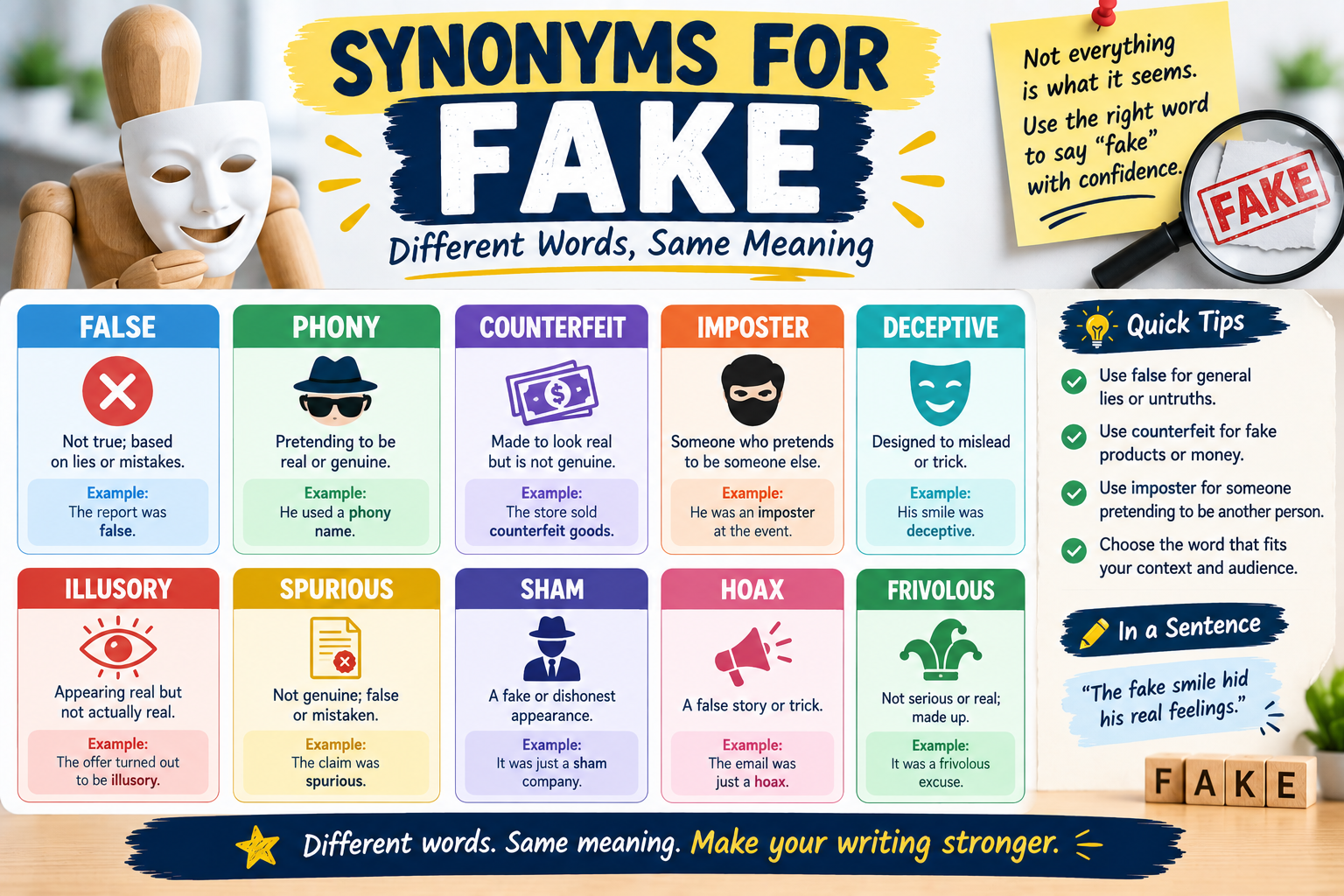
Fake means something that is not real, genuine, or honest. Imagine buying a designer bag online and later finding out that it is not made by the real brand. You might call it a fake bag.
The word is common in daily English because people often need to describe false products, made-up stories, false identities, or people who are not sincere. Learning synonyms for fake can help you choose a more exact word for each situation. English learners can use words such as false, artificial, counterfeit, bogus, phony, fraudulent, and imitation to make their writing clearer. Content writers can also use these alternatives to avoid repeating the same word. This guide explains the meaning, examples, grammar, history, pronunciation, word forms, synonyms, and semantic categories of fake in simple English.
Meaning of fake
Definition
Fake (adjective, noun, verb): Something fake is not real, genuine, or true, often because it is made to look or seem real.
As a verb, fake means to pretend or make something appear different from what it really is.
Examples
- The website was selling fake designer watches.
- He gave a fake name when he checked into the hotel.
Connotative Meaning
- Positive tone: Usually none, although fake can sometimes describe something made for fun, such as fake snow in a film.
- Negative tone: It often suggests dishonesty, deception, poor quality, or a lack of trust.
- Neutral tone: It can simply describe something artificial or not genuine when no judgment is intended.
(Connotation: the feeling or idea that a word suggests beyond its basic meaning.)
Etymology
The exact early history of fake is uncertain. The modern word appeared much later than many common English words.
- Old English (450–1100): Fake was not part of Old English. English used other words for false or deceptive things, including words related to false and feigned.
- Middle English (1100–1500): The modern word fake was still not established in common English. Words such as false, counterfeit, and feigned were used to express similar ideas.
- Modern English (1500–Present): Fake emerged in English slang in the 18th century. It developed meanings connected with pretending, deceiving, and making something appear genuine when it was not. Today, it is a very common word for false or imitation things.
The origin of the verb fake is uncertain, but its modern meanings are strongly linked with ideas of pretending and deception.
Pronunciation (IPA)
- IPA: /feɪk/
- Syllables: fake
Affixation Pattern of fake
- Root: fake
- Prefix: None
- Suffix: None in the base word
- Word formations:
- fake — adjective/noun/verb
- fakes — noun/verb
- faked — verb/adjective
- faking — verb/noun
- faker — noun
- fakeable — adjective
- fakery — noun
- fake-out — noun
- fake news — noun phrase
- fake-looking — adjective
The base word fake can change form through normal English inflection. Some compounds and derivatives add further meaning.
20 Synonyms of fake With Meaning & Examples
1. False (Adjective)
Meaning: Something false is not true or correct.
Examples:
- The story was based on false information.
- He gave the police a false name.
2. Artificial (Adjective)
Meaning: Something artificial is made by people rather than being natural.
Examples:
- The room had artificial flowers.
- The drink contains artificial flavors.
3. Counterfeit (Adjective/Noun)
Meaning: A counterfeit item is illegally made to look like a real product.
Examples:
- The police found counterfeit money.
- She unknowingly bought a counterfeit watch.
4. Bogus (Adjective)
Meaning: Something bogus is false, fake, or not genuine.
Examples:
- The website made a bogus offer.
- He received a bogus email asking for money.
5. Phony (Adjective/Noun)
Meaning: Something phony is not genuine or sincere.
Examples:
- The salesman made a phony promise.
- Everyone knew his friendly smile was phony.
6. Fraudulent (Adjective)
Meaning: Something fraudulent is dishonest and intended to deceive people.
Examples:
- The company was accused of making fraudulent claims.
- She reported a fraudulent transaction.
7. Imitation (Adjective/Noun)
Meaning: An imitation is made to look like a real or original thing.
Examples:
- She bought an imitation leather jacket.
- The painting was an imitation of a famous work.
8. Forged (Adjective)
Meaning: Something forged has been illegally copied or created to look genuine.
Examples:
- The bank discovered a forged signature.
- He was arrested for using a forged document.
9. Fabricated (Adjective)
Meaning: Something fabricated is invented or made up rather than being true.
Examples:
- The newspaper published a fabricated story.
- His excuse was completely fabricated.
10. Spurious (Adjective)
Meaning: Something spurious appears to be real or correct but is actually false.
Examples:
- The report made several spurious claims.
- The study was based on spurious evidence.
11. Deceptive (Adjective)
Meaning: Something deceptive is designed to make people believe something that is not true.
Examples:
- The advertisement was deceptive.
- The product description was deceptive.
12. Pretended (Adjective)
Meaning: Something pretended is acted or claimed rather than genuine.
Examples:
- He showed pretended interest in the discussion.
- Her pretended surprise was easy to notice.
13. Feigned (Adjective)
Meaning: Something feigned is deliberately shown or expressed without being genuine.
Examples:
- He gave a feigned smile.
- She showed feigned concern for the problem.
14. Simulated (Adjective)
Meaning: Something simulated is made to copy a real situation or experience.
Examples:
- The pilots practiced in a simulated flight.
- The game uses a simulated environment.
15. Imitative (Adjective)
Meaning: Something imitative copies the style or appearance of another thing.
Examples:
- The artist created an imitative design.
- His work was highly imitative of older styles.
16. Unreal (Adjective)
Meaning: Something unreal does not exist in reality or does not seem real.
Examples:
- The scene looked unreal.
- The dream felt completely unreal.
17. Misleading (Adjective)
Meaning: Something misleading gives the wrong idea or impression.
Examples:
- The headline was misleading.
- The advertisement contained misleading information.
18. Sham (Adjective/Noun)
Meaning: A sham is something presented as real or genuine when it is not.
Examples:
- The company was accused of running a sham business.
- Their agreement was just a sham.
19. Pseudo (Adjective/Combining Form)
Meaning: Pseudo- means something that appears to be real or genuine but is not.
Examples:
- He follows a pseudo-scientific theory.
- The website promotes pseudo-medical advice.
20. Dishonest (Adjective)
Meaning: Someone or something dishonest is not truthful or sincere.
Examples:
- The seller was dishonest about the product.
- He gave a dishonest answer.
Prototype Meaning
The most typical meaning of fake is “not real or genuine.” When people hear the word, they often imagine an imitation product, false document, fake identity, or made-up story. The key idea is that something looks or seems real but is not what it claims to be. The word can describe objects, information, behavior, emotions, and even people.
Prototype Categorization
The 20 synonyms can be grouped into meaningful semantic categories:
- False information: false, fabricated, spurious, misleading — useful for claims, stories, reports, and information that is not true.
- Fake products: counterfeit, imitation, artificial, imitative — useful for objects that copy or replace genuine products.
- Dishonesty and deception: fraudulent, deceptive, bogus, dishonest — useful when someone tries to mislead another person.
- Pretended feelings or behavior: phony, pretended, feigned, sham — useful for actions, emotions, relationships, or behavior that are not sincere.
- Copies or controlled versions: simulated, pseudo, unreal — useful when something resembles reality but is not fully real.
This grouping helps writers choose a word based on the exact meaning they want. For example, counterfeit is better for illegal copies of branded products, while fabricated is better for invented information.
Antonyms of fake
- Real (Adjective): Existing or actually true.
- Genuine (Adjective): Truly what something claims to be.
- Authentic (Adjective): Original and not copied.
- True (Adjective): Correct or based on fact.
- Original (Adjective/Noun): The first or real version of something.
- Legitimate (Adjective): Genuine, lawful, or acceptable.
- Sincere (Adjective): Honest and genuine in feelings or behavior.
- Honest (Adjective): Truthful and not deceptive.
Short Questions and Answers
What does fake mean?
Fake means something that is not real, genuine, or true, or something made to appear real when it is not.
When should fake be used?
Use fake when you want a simple, common word for something that is not genuine. It can describe products, stories, identities, emotions, or behavior.
Is fake positive or negative?
Fake usually has a negative tone because it often suggests deception or dishonesty. However, it can be neutral when describing artificial objects or things created for entertainment.
How is it different from similar words?
The best synonym depends on the context. Counterfeit usually refers to illegally copied products or money. False often describes information. Phony can describe people or behavior that are not sincere. Fraudulent suggests deliberate dishonesty for gain.
Conclusion
Learning fake and its synonyms can make your English stronger and more precise. Instead of using fake for every situation, you can choose a word that gives your sentence a clearer meaning. Use counterfeit for illegal copies, fabricated for made-up information, phony for insincere behavior, and fraudulent for dishonest actions. Words such as false, artificial, imitation, deceptive, and misleading are also useful in different contexts. Knowing these differences helps you avoid repetition and communicate your ideas clearly. It also improves your writing and speaking skills. Try adding one new synonym to your vocabulary each day. Write your own examples and use the words in real conversations. With regular practice, you can build confidence and express yourself more naturally in English.

Emma Collins is an English language expert and vocabulary writer with a passion for making English easier to understand. She specializes in synonyms, word meanings, word choice, and clear writing tips.