In addition means adding another fact, idea, or point to what was already said. Imagine you are writing about your favorite restaurant. You say the food is tasty.
In addition, the service is friendly and the prices are fair. This phrase is common in essays, emails, reports, articles, and everyday English. Still, using in addition too often can make your writing sound repetitive. Learning synonyms helps you express the same idea in different and natural ways. This is especially useful for English learners, students, and content writers who want clear and varied writing. In this guide, you will learn the meaning, grammar, history, pronunciation, and word formation of in addition. You will also discover 20 useful alternatives, their meanings, examples, and semantic categories so you can choose the right phrase for each situation.
Meaning of in addition
Definition
In addition (Adverbial Phrase): Used to introduce another fact, idea, person, or thing that is added to what was already mentioned.
It has a similar meaning to also, besides, and as well.
Examples
- The hotel has clean rooms. In addition, it offers free breakfast.
- She is a talented writer. In addition, she is an excellent editor.
Connotative Meaning
Connotation means the feeling or idea that a word or phrase suggests beyond its basic meaning.
- Positive tone: In addition can make writing sound organized, complete, and informative.
- Negative tone: It usually has no negative meaning, but repeated use can make writing sound formal or repetitive.
- Neutral tone: It simply adds another point or piece of information.
Etymology
The phrase in addition is made from two words with Latin roots that entered English through French and Latin-based vocabulary.
- Old English (450–1100): The modern phrase in addition was not used in Old English. Old English had native words and phrases for adding or increasing something.
- Middle English (1100–1500): Latin-based vocabulary became more common in English after the Norman Conquest. Addition came through Old French from Latin additio, meaning “an adding” or “something added.”
- Modern English (1500–Present): In addition developed as a common phrase meaning “also” or “as an extra point.” It became especially useful in formal and written English.
The word addition comes from Latin additio, from addere, meaning “to add.”
Pronunciation (IPA)
- IPA: /ɪn əˈdɪʃən/
- Syllables: in ad-di-tion
The phrase is normally spoken smoothly, with the main stress falling on the middle part of addition.
Affixation Pattern of in addition
- Root: add — meaning to put something together or increase something
- Prefix: in- in addition is not a productive English prefix here. The in in in addition is a separate preposition.
- Suffix: -ition — part of the historical formation of addition and related nouns
- Word formations:
- add — verb
- adds — verb
- added — verb/adjective
- adding — verb/noun
- addition — noun
- additional — adjective
- additionally — adverb
- additive — adjective/noun
- addendum — noun
- in addition — adverbial phrase
20 Synonyms of in addition With Meaning & Examples
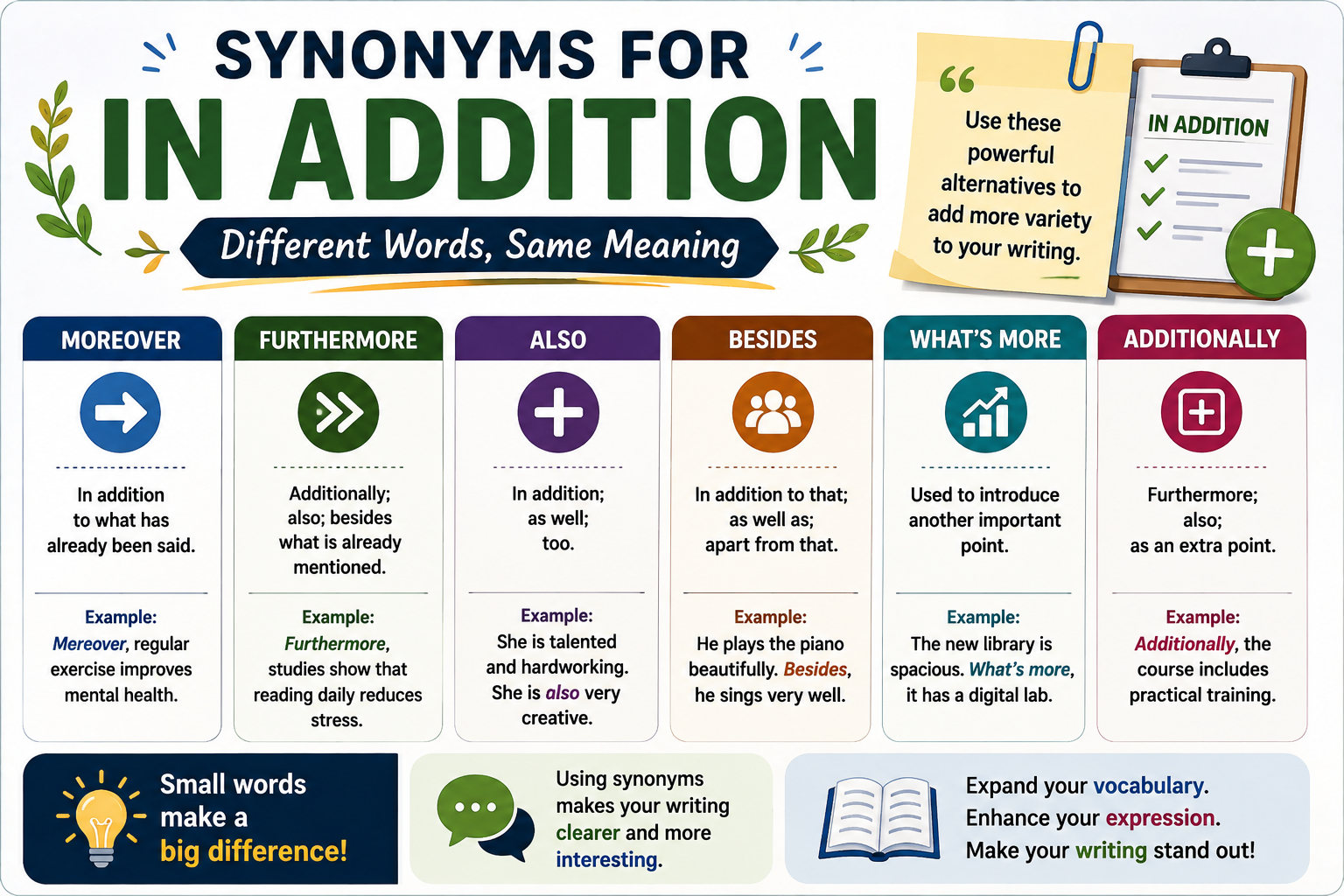
1. Also (Adverb)
Meaning: Used to add another fact or idea.
Examples:
- She speaks English and also speaks Spanish.
- The course is useful and also affordable.
2. Additionally (Adverb)
Meaning: Used to introduce extra information or another point.
Examples:
- The hotel is cheap. Additionally, it is near the airport.
- Additionally, students receive free study materials.
3. Besides (Adverb)
Meaning: Used to add another reason, fact, or point.
Examples:
- I do not want to go. Besides, I am tired.
- Besides being smart, she is very kind.
4. Furthermore (Adverb)
Meaning: Used to add another supporting point, especially in formal writing.
Examples:
- The plan is expensive. Furthermore, it may take months.
- Furthermore, the study supports our main argument.
5. Moreover (Adverb)
Meaning: Used to add important information that strengthens a previous point.
Examples:
- The car is reliable. Moreover, it uses very little fuel.
- Moreover, the product is easy to use.
6. As well (Adverb)
Meaning: Used to mean “also” or “too.”
Examples:
- She plays tennis as well.
- You should bring a notebook as well.
7. Too (Adverb)
Meaning: Used to show that another person or thing shares the same quality or action.
Examples:
- I enjoyed the movie too.
- He wants to join the trip too.
8. In addition to (Prepositional Phrase)
Meaning: Used before a noun or gerund to show that something extra is included.
Examples:
- In addition to English, she studies French.
- In addition to working, he attends college.
9. Along with (Preposition)
Meaning: Used to show that something is included with another thing.
Examples:
- She brought her laptop along with her books.
- Along with the report, we sent the photographs.
10. As well as (Conjunction/Preposition)
Meaning: Used to add one person or thing to another.
Examples:
- She teaches English as well as mathematics.
- He bought a jacket as well as new shoes.
11. Plus (Preposition/Conjunction)
Meaning: Used informally to add another fact, reason, or item.
Examples:
- The apartment is large, plus it has a balcony.
- We need chairs, plus a large table.
12. What is more (Adverbial Phrase)
Meaning: Used to introduce another point that adds strength to an argument.
Examples:
- The plan is simple. What is more, it is inexpensive.
- She finished early. What is more, her work was excellent.
13. On top of that (Adverbial Phrase)
Meaning: Used to add another fact, often one that makes a situation stronger.
Examples:
- The car is old. On top of that, it needs repairs.
- He missed the bus, and on top of that, it started raining.
14. Over and above (Prepositional Phrase)
Meaning: Used to describe something that is added beyond what is already included.
Examples:
- The company offered benefits over and above the basic salary.
- Over and above his regular duties, he helped train new staff.
15. Beyond that (Adverbial Phrase)
Meaning: Used to introduce something further or additional.
Examples:
- The plan saves money. Beyond that, it saves time.
- Beyond that, we need to consider the long-term effects.
16. Further (Adverb)
Meaning: Used to introduce an additional point or step.
Examples:
- Further, the report shows a rise in sales.
- We need to investigate the matter further.
17. Another point is (Phrase)
Meaning: Used to introduce one more idea or reason.
Examples:
- Another point is that the plan costs less.
- Another point is that students need more practice.
18. Not to mention (Phrase)
Meaning: Used to add another important thing that has not yet been discussed.
Examples:
- The house is beautiful, not to mention spacious.
- The trip was expensive, not to mention tiring.
19. Coupled with (Preposition/Phrase)
Meaning: Used to show that one thing is added to another to create a combined effect.
Examples:
- Good planning, coupled with hard work, led to success.
- Experience, coupled with training, makes him a strong candidate.
20. In the same vein (Adverbial Phrase)
Meaning: Used to introduce another idea that is closely related to the previous one.
Examples:
- The first plan focuses on cost. In the same vein, the second focuses on saving time.
- She discussed healthy food. In the same vein, she talked about daily exercise.
Usage note: These alternatives are not perfect replacements in every sentence. Also, additionally, and as well are close to the basic meaning. Moreover and furthermore are more formal. Plus is informal, while in addition to is normally followed by a noun or gerund.
Prototype Meaning
The most typical meaning of in addition is “also” or “as another point.” When people hear this phrase, they usually imagine someone giving extra information after making an earlier statement. For example, a student may say that a course is useful and then add that it is affordable. The phrase helps connect the two ideas clearly.
Prototype Categorization
The 20 alternatives can be grouped into meaningful semantic categories:
- Simple addition:also, as well, too, additionally
- These are useful when you simply want to add another fact.
- Formal addition:furthermore, moreover, further, what is more
- These choices work well in essays, reports, academic writing, and formal arguments.
- Informal addition:besides, plus, on top of that
- These sound more natural in casual conversations and friendly writing.
- Including another thing:in addition to, along with, as well as
- These phrases are useful when adding a person, object, activity, or idea directly to a sentence.
- Extra or stronger information:over and above, beyond that, not to mention
- These phrases emphasize that something more is being added.
- Related ideas:coupled with, in the same vein, another point is
- These expressions connect an additional idea with the point already being discussed.
This categorization helps writers choose a synonym based on tone, grammar, and purpose. It also prevents repetitive use of in addition.
Antonyms of in addition
There is no perfect one-word antonym for in addition, because the phrase expresses the idea of adding information. However, these words and phrases can express an opposite idea:
- Instead (Adverb): Used to show a replacement rather than an addition.
- Rather (Adverb): Used to show an alternative or preference.
- Excluding (Preposition): Used to show that something is left out.
- Without (Preposition): Used to show that something is absent.
- Only (Adverb): Used to limit something to one thing or group.
- Alone (Adverb/Adjective): Used to show that something exists or happens by itself.
Short Questions and Answers
What does in addition mean?
In addition means also, as well, or as another point. It is used to add information to an earlier statement.
When should in addition be used?
Use in addition when you want to introduce another fact, reason, idea, or item. It is especially common in formal and written English.
Is in addition positive or negative?
In addition is neutral. It does not show a positive or negative feeling by itself. The surrounding sentence gives it the tone.
How is it different from similar words?
In addition is a general phrase for adding information. Moreover and furthermore sound more formal, while plus and besides are often more conversational.
Conclusion
Learning synonyms for in addition gives you more ways to connect ideas in English. Instead of repeating the same phrase, you can choose words such as also, additionally, moreover, besides, or furthermore. Each option has a slightly different tone or grammatical use.
These alternatives can improve your vocabulary and make your writing smoother. They are useful in essays, reports, emails, articles, and everyday conversations. Knowing the difference between formal and informal choices also helps you communicate with greater accuracy.
Try learning two or three alternatives each day. Write simple sentences with them and use them in your own writing. With regular practice, you will avoid repetition, express ideas more clearly, and build greater confidence in English.

Sarah Linguist is a passionate language enthusiast who loves exploring words, meanings, and synonyms.
She creates clear, easy-to-understand content to help readers improve their vocabulary and English skills.
Through SynonymsGuide.com, Sarah makes finding the right words simple, useful, and enjoyable.