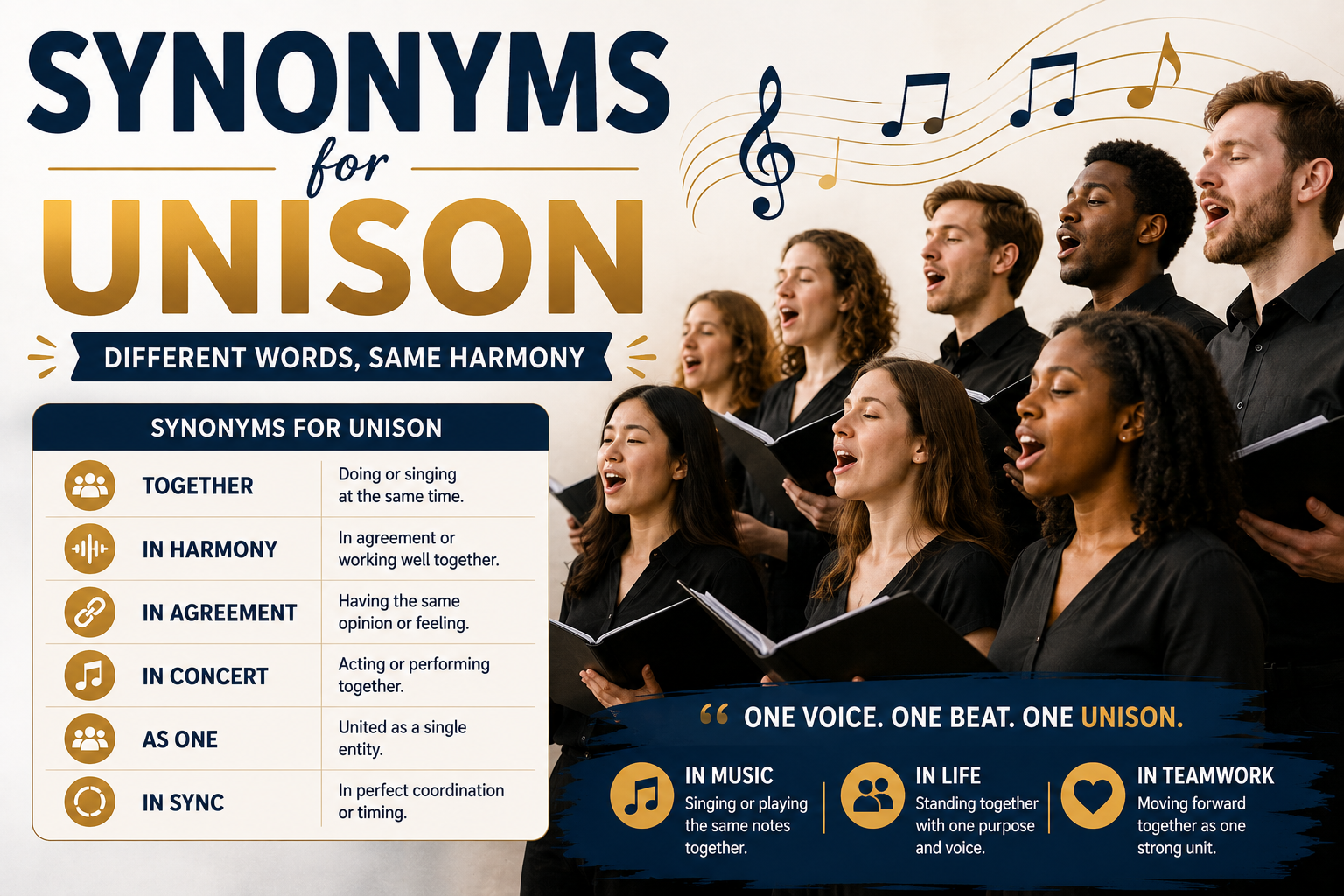
Unison means doing something together at the same time or in perfect agreement.
Imagine a choir singing the same note at exactly the same moment. Their voices blend into one sound. That is unison. The word is common in music, teamwork, speech, and descriptions of people acting together. You may also see it in phrases such as “in unison” and “move in unison.” Learning synonyms for unison helps you avoid repeating the same word and choose a term that fits your exact meaning. Some alternatives focus on togetherness, while others highlight agreement, harmony, unity, or coordination. This guide explains the meaning of unison and gives 30 useful synonyms with simple examples. You will also learn its history, pronunciation, word formation, connotations, semantic groups, and antonyms.
Meaning of Unison
Definition
Unison (Noun): The state of doing, saying, or producing something together at the same time or in agreement.
In music, unison means two or more voices or instruments performing the same note or melody at the same pitch.
Examples
- The audience shouted in unison.
- The singers performed the final note in unison.
Connotative Meaning
Connotation: The feeling or idea that a word suggests beyond its basic meaning.
- Positive tone: Unison can suggest unity, teamwork, harmony, and cooperation.
- Negative tone: It may sometimes suggest complete conformity when individual opinions are lost.
- Neutral tone: It can simply describe people or things acting at the same time.
Etymology
The word unison comes from Latin and entered English through French.
- Old English (450–1100): Unison was not a common Old English word. English speakers used native expressions to describe people acting or sounding together.
- Middle English (1100–1500): The word entered English through Old French, influenced by Latin unisonus.
- Modern English (1500–Present): Unison developed its modern meanings in music and general English. The Latin word combines uni-, meaning “one,” with sonus, meaning “sound.”
So, the basic idea behind unison is “one sound.”
Pronunciation (IPA)
- IPA: /ˈjuː.nɪ.sən/
- Syllables: u-ni-son — 3 syllables
The stress falls on the first syllable: U-ni-son.
Affixation Pattern of Unison
- Root: son — related to Latin sonus, meaning “sound”
- Prefix: uni- — meaning “one” or “single”
- Suffix: -son — part of the Latin-derived word rather than a productive English suffix
Word formations
- unison — noun
- unisons — plural noun
- unisonal — adjective
- unisonous — adjective
- unisonally — adverb, rare
- unisonance — noun, rare
The most common modern form is unison.
30 Synonyms of Unison With Meaning & Examples
1. Unity (Noun)
Meaning: The state of being joined together as one.
Examples:
- The team showed great unity.
- Their unity helped them succeed.
2. Harmony (Noun)
Meaning: A pleasing state of agreement or cooperation.
Examples:
- The group worked together in harmony.
- Their voices blended in perfect harmony.
3. Agreement (Noun)
Meaning: A state in which people share the same opinion or decision.
Examples:
- The members reached agreement.
- They acted in complete agreement.
4. Accord (Noun)
Meaning: Agreement or harmony between people or groups.
Examples:
- The two nations reached an accord.
- The workers acted in accord with the plan.
5. Solidarity (Noun)
Meaning: Unity among people who share a common purpose or interest.
Examples:
- The workers showed solidarity.
- The community stood together in solidarity.
6. Togetherness (Noun)
Meaning: The feeling of being close and united with others.
Examples:
- Music created a sense of togetherness.
- The event brought a feeling of togetherness.
7. Cooperation (Noun)
Meaning: The act of working together toward a shared goal.
Examples:
- The project required close cooperation.
- Their cooperation solved the problem.
8. Collaboration (Noun)
Meaning: The act of working with others to achieve something.
Examples:
- The song was a collaboration between two artists.
- Their collaboration produced excellent results.
9. Coordination (Noun)
Meaning: The act of making different actions work well together.
Examples:
- The dancers showed perfect coordination.
- Good coordination helped the team finish quickly.
10. Synchrony (Noun)
Meaning: The state of happening at the same time.
Examples:
- The dancers moved in perfect synchrony.
- Their movements were perfectly timed and in synchrony.
11. Synchronization (Noun)
Meaning: The process of making actions or events happen together.
Examples:
- The machines require careful synchronization.
- The dancers practiced their synchronization.
12. Simultaneity (Noun)
Meaning: The state of two or more things happening at the same time.
Examples:
- The simultaneity of the events surprised everyone.
- The lights changed with perfect simultaneity.
13. Concord (Noun)
Meaning: Agreement or harmony between people or things.
Examples:
- The members worked in concord.
- The agreement restored concord between the groups.
14. Conformity (Noun)
Meaning: The act of behaving or thinking in the same way as others.
Examples:
- The group showed strong conformity.
- Social pressure can encourage conformity.
15. Consistency (Noun)
Meaning: The state of remaining the same or behaving in a steady way.
Examples:
- The team performed with great consistency.
- Musical consistency improved the performance.
16. Cohesion (Noun)
Meaning: The quality of forming a united and connected group.
Examples:
- Team cohesion improved after the training.
- The group showed strong cohesion.
17. Unanimity (Noun)
Meaning: Complete agreement among all members of a group.
Examples:
- The decision was approved with unanimity.
- The committee reached unanimity.
18. Concert (Noun)
Meaning: Agreement or harmony, especially between people or actions.
Examples:
- The teams acted in concert.
- The groups worked in concert to solve the issue.
19. Union (Noun)
Meaning: The state of being joined or combined.
Examples:
- The union of the groups created a stronger organization.
- Their union brought the teams together.
20. Oneness (Noun)
Meaning: The state of being united as one.
Examples:
- The ceremony created a feeling of oneness.
- The dancers moved with a strong sense of oneness.
21. Accordance (Noun)
Meaning: Agreement with a rule, plan, or idea.
Examples:
- The team acted in accordance with the instructions.
- The work was completed in accordance with the plan.
22. Teamwork (Noun)
Meaning: The combined effort of people working toward the same goal.
Examples:
- Their success came from excellent teamwork.
- Good teamwork helped them finish the project.
23. Partnership (Noun)
Meaning: A relationship in which people or groups work together.
Examples:
- Their partnership produced a successful campaign.
- The two companies formed a strong partnership.
24. Alignment (Noun)
Meaning: A state of agreement or shared direction.
Examples:
- The teams are in alignment about the new plan.
- Their goals are in close alignment.
25. Cohesiveness (Noun)
Meaning: The quality of being closely united as a whole.
Examples:
- The team’s cohesiveness was clear.
- Good communication improved group cohesiveness.
26. Unification (Noun)
Meaning: The process of bringing separate things together as one.
Examples:
- The unification of the groups took years.
- The project encouraged unification among the teams.
27. Symmetry (Noun)
Meaning: A balanced similarity between parts.
Examples:
- The dancers created visual symmetry.
- The design has perfect symmetry.
28. Teaming (Noun)
Meaning: The act of joining with others to work toward a goal.
Examples:
- Teaming with experts improved the project.
- Their teaming effort produced a better result.
29. Synchronism (Noun)
Meaning: The occurrence of events at the same time.
Examples:
- The performance depended on perfect synchronism.
- The machines operate in synchronism.
30. Concordance (Noun)
Meaning: Agreement, harmony, or correspondence between things.
Examples:
- There was strong concordance between the two reports.
- The researchers found concordance in their results.
Prototype Meaning
The most typical meaning of unison is people or things acting or sounding together at exactly the same time. When you hear the word, you may imagine a choir singing one note, dancers making the same movement, or a crowd shouting the same words together. The central idea is timing plus unity. While unity focuses more on being joined, unison often emphasizes doing something together and at the same moment.
Prototype Categorization
The 30 synonyms of unison fall into several useful semantic groups. Knowing these groups helps you select a word that matches your exact meaning.
- Agreement and shared opinion:agreement, accord, concord, unanimity, concordance
- Use these when people share the same view or decision.
- Unanimity is strongest when everyone agrees.
- Unity and togetherness:unity, togetherness, solidarity, oneness, union
- These focus on people being connected as one group.
- Solidarity often suggests support for a shared cause.
- Working together:cooperation, collaboration, teamwork, partnership, teaming
- These words are useful for groups working toward a goal.
- Collaboration is common in professional and creative settings.
- Timing and movement:synchrony, synchronization, simultaneity, synchronism
- These are closest to the timing sense of unison.
- Use them when actions happen at the same time.
- Harmony and balance:harmony, cohesion, cohesiveness, symmetry
- These describe parts that fit or work well together.
- Harmony is especially useful for music and relationships.
- Alignment and conformity:alignment, conformity, consistency, accordance
- These suggest that actions, ideas, or behaviors match.
- Conformity can have a negative sense because it may suggest pressure to behave like others.
Antonyms of Unison
Discord (Noun)
Meaning: A lack of agreement or harmony.
- The debate ended in discord.
Disagreement (Noun)
Meaning: A situation in which people do not share the same opinion.
- The proposal caused disagreement among the members.
Dissonance (Noun)
Meaning: A lack of harmony, especially in music or ideas.
- The song created a feeling of dissonance.
Conflict (Noun)
Meaning: A serious disagreement or clash.
- The two groups were involved in conflict.
Division (Noun)
Meaning: The state of being separated into different groups.
- The issue caused division in the community.
Disunity (Noun)
Meaning: A lack of unity among people or groups.
- Disunity weakened the organization.
Isolation (Noun)
Meaning: The state of being separate from others.
- Social isolation can make people feel lonely.
Short Questions and Answers
What does unison mean?
Unison means doing or saying something together at the same time. In music, it means performing the same note or melody at the same pitch.
When should unison be used?
Use unison when you want to emphasize that people or things act, move, speak, or sound together. The phrase “in unison” is especially common.
Is unison positive or negative?
Unison is usually neutral or positive. It often suggests harmony, teamwork, and unity, although it can sometimes suggest too much conformity.
How is unison different from similar words?
Unison focuses strongly on simultaneous action or sound. Unity focuses on being joined, while harmony focuses on agreement or pleasing combination.
Conclusion
Learning synonyms for unison can make your English more accurate and expressive. Words such as unity, harmony, agreement, coordination, synchrony, solidarity, cooperation, and unanimity share parts of its meaning, but each has its own use. For actions happening at the same time, synchrony or synchronization may be more precise. For shared opinions, agreement or unanimity may work better. For teamwork, cooperation or collaboration is often the best choice.
Knowing these differences helps you avoid repetition and choose stronger words in both writing and speech. Practice these synonyms in short sentences each day. Soon, you will be able to express ideas about unity, agreement, timing, and teamwork with greater confidence.

Emma Collins is an English language expert and vocabulary writer with a passion for making English easier to understand. She specializes in synonyms, word meanings, word choice, and clear writing tips.