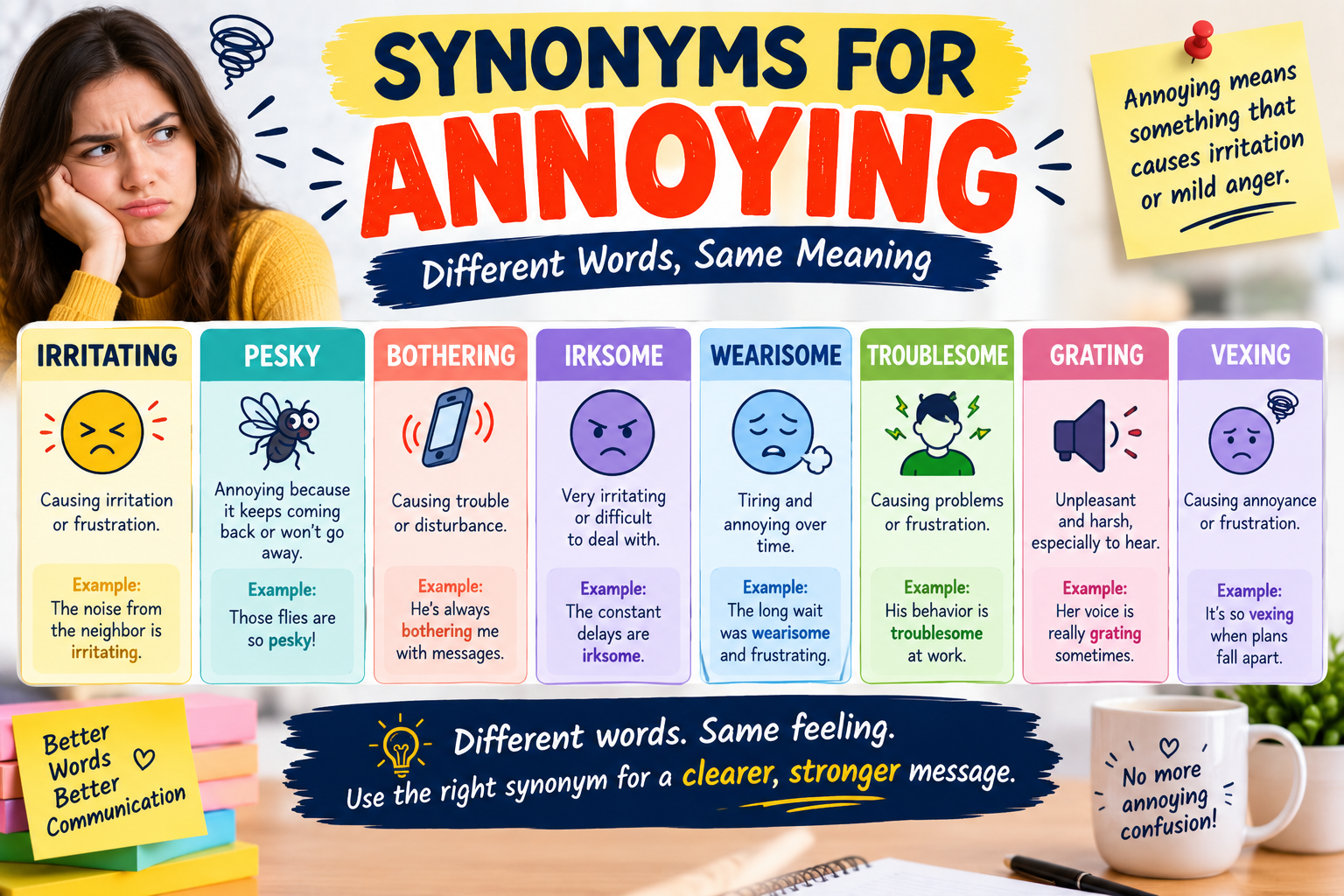
Annoying means causing irritation, frustration, or mild anger. For example, imagine trying to study while someone keeps making loud noises. You may say, “That noise is annoying.”
The word is common in everyday English because people often need to describe things, actions, sounds, or people that bother them. However, “annonying” is not the correct spelling. The correct spelling is “annoying.” Learning synonyms for annoying helps English learners choose more exact words for different situations. A person, sound, habit, or problem may be irritating, bothersome, frustrating, troublesome, or aggravating, depending on the context. Content writers can also use these alternatives to avoid repetition. This guide explains the meaning, grammar, history, pronunciation, word formation, synonyms, and semantic categories of annonying (annoying) with simple examples.
Meaning of annonying
Definition
Annonying / Annoying (Adjective): Something annoying causes irritation, frustration, or discomfort.
Correct spelling: annoying
Incorrect spelling: annonying
The word comes from the verb annoy, meaning to bother or irritate someone.
Examples
- The loud music was annoying me.
- It is annoying when my phone keeps losing its signal.
Connotative Meaning
- Positive tone: Annoying usually has no positive meaning, although people may use it playfully.
- Negative tone: It usually shows irritation, frustration, or dislike.
- Neutral tone: It can simply describe something that causes minor trouble without strong anger.
(Connotation: the feeling or idea that a word suggests beyond its basic meaning.)
Etymology
The word annoying comes from the verb annoy, which entered English through French and ultimately has Latin roots.
- Old English (450–1100): The modern word annoy was not used in Old English. English had native words for troubling, harming, or disturbing someone.
- Middle English (1100–1500): Annoy entered English from Anglo-French and Old French forms related to anoier and anuier. The word originally carried the sense of causing trouble, distress, or discomfort.
- Modern English (1500–Present): Annoy developed its modern meaning of irritating or bothering someone. The adjective annoying means “causing annoyance.”
The word is related to French ennuyer, meaning “to bore” or “to weary.”
Pronunciation (IPA)
- IPA: /əˈnɔɪɪŋ/
- Syllables: an-noy-ing
Affixation Pattern of annonying
The correct base word is annoy, not annony.
- Root: annoy
- Prefix: None
- Suffix: -ing — forms the present participle and gerund.
- Word formations:
- annoy — verb
- annoys — verb
- annoyed — verb/adjective
- annoying — adjective/verb
- annoyingly — adverb
- annoyance — noun
- annoyances — noun
- annoyer — noun
The spelling changes slightly when -ing is added: annoy + ing = annoying. There is no extra “n” before the -ing ending.
25 Synonyms of annonying With Meaning & Examples
1. Irritating (Adjective)
Meaning: Something irritating causes mild anger or discomfort.
Examples:
- The constant noise was irritating.
- His repeated questions became irritating.
2. Bothering (Adjective/Verb)
Meaning: Something bothering you causes worry, discomfort, or irritation.
Examples:
- The bright light is bothering me.
- Her constant calls were bothering him.
3. Bothersome (Adjective)
Meaning: Something bothersome causes trouble or irritation.
Examples:
- The small delay was bothersome.
- These insects can be very bothersome.
4. Irrksome (Adjective)
Meaning: Something irksome is annoying because it continues to cause irritation.
Examples:
- The repeated error was irksome.
- Waiting for hours was irksome.
5. Aggravating (Adjective)
Meaning: Something aggravating makes you feel more annoyed or frustrated.
Examples:
- The slow internet was aggravating.
- It was aggravating to repeat the same task.
6. Frustrating (Adjective)
Meaning: Something frustrating makes it hard to achieve what you want.
Examples:
- The broken printer was frustrating.
- Learning the new system was frustrating at first.
7. Troublesome (Adjective)
Meaning: Something troublesome causes problems or difficulty.
Examples:
- The old machine is troublesome.
- We had a troublesome problem with the software.
8. Irritative (Adjective)
Meaning: Something irritative causes irritation or discomfort.
Examples:
- The chemical can have an irritative effect.
- The doctor warned about its irritative properties.
9. Exasperating (Adjective)
Meaning: Something exasperating makes you very frustrated or annoyed.
Examples:
- The repeated delays were exasperating.
- His refusal to listen was exasperating.
10. Provoking (Adjective)
Meaning: Something provoking causes a strong reaction, often anger or irritation.
Examples:
- His comments were provoking.
- The unfair decision was provoking.
11. Pestering (Adjective/Verb)
Meaning: Something pestering repeatedly bothers or asks someone for attention.
Examples:
- The pestering child kept asking questions.
- Stop pestering me while I work.
12. Obnoxious (Adjective)
Meaning: Someone or something obnoxious is very unpleasant or offensive.
Examples:
- The man was loud and obnoxious.
- His obnoxious behavior upset everyone.
13. Tiresome (Adjective)
Meaning: Something tiresome becomes boring or annoying because it takes too long or happens too often.
Examples:
- The long meeting was tiresome.
- Repeating the same instructions is tiresome.
14. Wearisome (Adjective)
Meaning: Something wearisome makes you feel tired or bored.
Examples:
- The long journey was wearisome.
- The endless paperwork became wearisome.
15. Tedious (Adjective)
Meaning: Something tedious is boring and tiring because it is repetitive.
Examples:
- The data entry work was tedious.
- Cleaning the entire building was tedious.
16. Nuisance (Noun)
Meaning: A nuisance is a person, thing, or situation that causes trouble or annoyance.
Examples:
- The broken alarm was a nuisance.
- That noise is a real nuisance.
17. Inconvenient (Adjective)
Meaning: Something inconvenient causes difficulty or trouble.
Examples:
- The new schedule is inconvenient.
- The sudden change was inconvenient for everyone.
18. Disruptive (Adjective)
Meaning: Something disruptive interrupts normal activity or prevents people from working peacefully.
Examples:
- The loud students were disruptive.
- The construction work was disruptive.
19. Intrusive (Adjective)
Meaning: Something intrusive interferes with your privacy, space, or activities.
Examples:
- The questions felt intrusive.
- Constant advertisements can be intrusive.
20. Unpleasant (Adjective)
Meaning: Something unpleasant is not enjoyable and may cause discomfort.
Examples:
- The smell was unpleasant.
- We had an unpleasant experience at the restaurant.
21. Disturbing (Adjective)
Meaning: Something disturbing causes discomfort, worry, or upset feelings.
Examples:
- The loud sound was disturbing my sleep.
- The news was deeply disturbing.
22. Pesky (Adjective)
Meaning: Something pesky is slightly annoying and hard to get rid of.
Examples:
- A pesky fly kept landing on my food.
- We had a pesky computer problem.
23. Vexing (Adjective)
Meaning: Something vexing is difficult and annoying.
Examples:
- The missing file was a vexing problem.
- This error is particularly vexing.
24. Galling (Adjective)
Meaning: Something galling is very irritating, especially because it feels unfair or insulting.
Examples:
- Losing after working so hard was galling.
- His unfair criticism was galling.
25. Exasperatingly Difficult (Phrase)
Meaning: Something exasperatingly difficult causes strong frustration because it is hard to solve or complete.
Examples:
- The software was exasperatingly difficult to use.
- Finding the missing document became exasperatingly difficult.
Usage note: These words are not exact replacements in every sentence. Irritating and bothersome are close everyday synonyms. Frustrating focuses on difficulty, while obnoxious describes behavior that is especially unpleasant. Tedious focuses more on boredom and repetition.
Prototype Meaning
The most typical meaning of annoying is something that makes you feel irritated or bothered. When people hear this word, they often imagine a repeated noise, an unwanted interruption, a difficult problem, or behavior that gets on their nerves. The feeling is usually stronger than simple dislike but weaker than serious anger.
Prototype Categorization
The 25 synonyms can be grouped into useful semantic categories:
- General irritation: irritating, bothersome, irksome, aggravating, pesky — useful for common things that bother you.
- Frustration: frustrating, exasperating, vexing, galling — better when something causes strong frustration or anger.
- Boredom and tiredness: tiresome, wearisome, tedious — useful when something is annoying because it is repetitive or tiring.
- Unpleasant behavior: obnoxious, provoking, pestering — useful for people or actions that strongly bother others.
- Interruption and trouble: troublesome, disruptive, inconvenient, nuisance — useful for problems that create difficulty or interfere with normal activities.
- Privacy or discomfort: intrusive, unpleasant, disturbing — useful when something interferes with your space or causes discomfort.
- Specialized use: irritative — more suitable for technical or medical contexts than everyday conversation.
This categorization helps writers choose the right word instead of using annoying for every situation. The best synonym depends on the reason something causes irritation.
Antonyms of annonying
- Pleasant (Adjective): Enjoyable and comfortable.
- Enjoyable (Adjective): Giving pleasure or happiness.
- Delightful (Adjective): Very pleasant and enjoyable.
- Calming (Adjective): Making someone feel relaxed and peaceful.
- Soothing (Adjective): Helping reduce stress or discomfort.
- Helpful (Adjective): Providing useful support.
- Convenient (Adjective): Easy and useful for a particular situation.
- Peaceful (Adjective): Quiet, calm, and free from disturbance.
Short Questions and Answers
What does annonying mean?
“Annonying” is a misspelling. The correct spelling is “annoying,” which means causing irritation, frustration, or discomfort.
When should annoying be used?
Use annoying when something or someone makes you feel bothered or irritated. It is a common and natural word in everyday English.
Is annoying positive or negative?
Annoying usually has a negative meaning because it describes something that causes irritation. The strength of the feeling depends on the situation.
How is it different from similar words?
Annoying is a general word. Irritating is very close in meaning. Frustrating focuses on difficulty, tedious focuses on boredom, and obnoxious suggests behavior that is especially unpleasant.
Conclusion
Learning annoying and its synonyms can make your English more precise and natural. Remember that annonying is a common spelling mistake, while annoying is the correct form. Once you know the correct spelling, you can expand your vocabulary with words such as irritating, bothersome, frustrating, aggravating, tedious, disruptive, and obnoxious. Each word gives a slightly different meaning or level of irritation. Using the right synonym helps you avoid repetition and describe situations more clearly. It also strengthens your writing and speaking skills. English learners can practice by choosing one synonym each day and writing a sentence with it. Regular practice makes new words easier to remember. Over time, a stronger vocabulary can help you communicate your feelings and ideas with greater confidence.

Olivia Wordsmith is a passionate vocabulary writer who loves exploring words, meanings, and their everyday use.
She creates clear, engaging content to help readers expand their vocabulary and communicate with confidence.